Inspiration
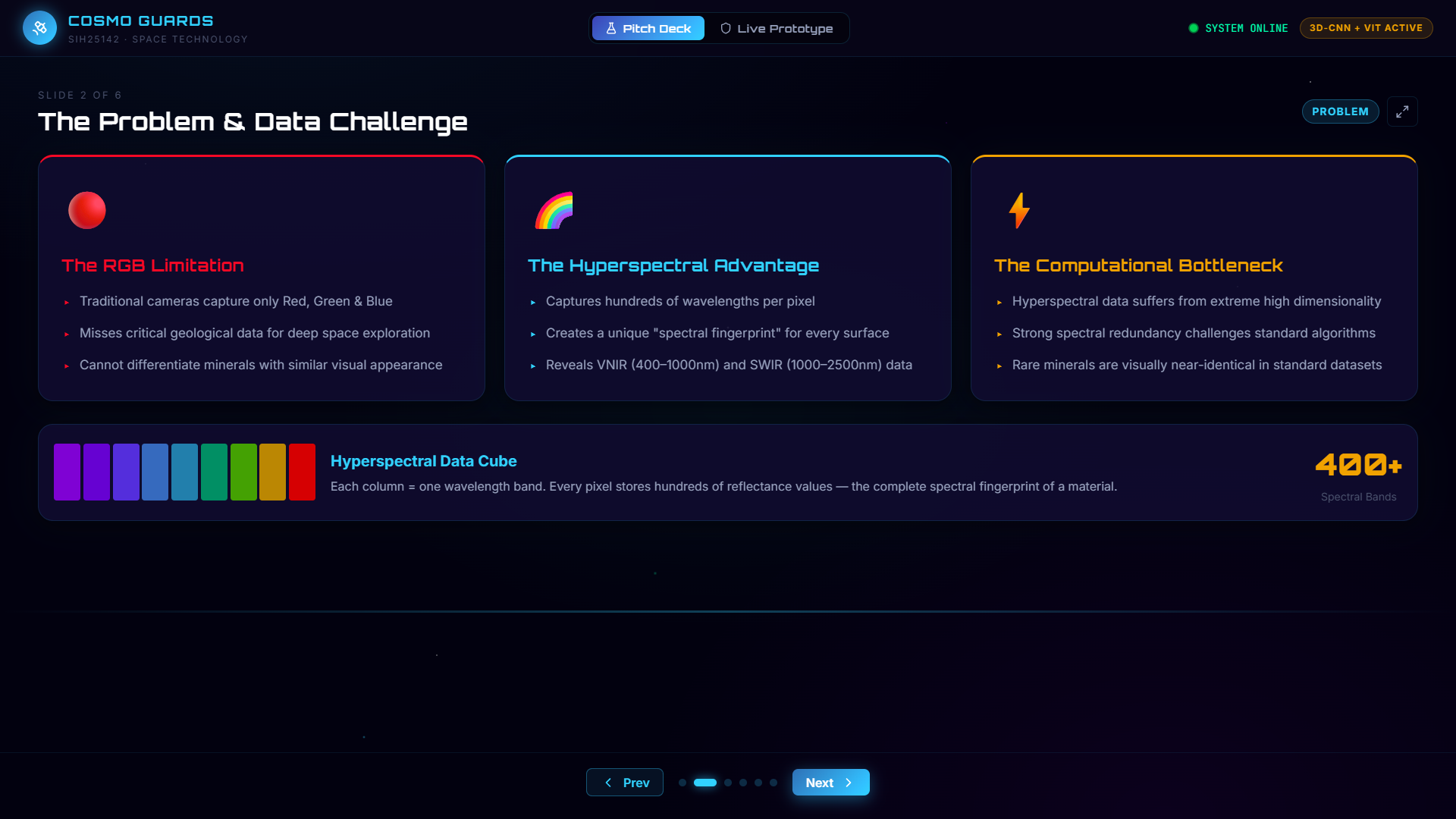
Space exploration missions generate enormous amounts of hyperspectral data, but traditional RGB imaging captures only three spectral bands and can miss subtle mineral signatures. We were inspired by the possibility of using AI to analyze hundreds of wavelengths per pixel and transform them into actionable geological intelligence.
Cosmo Guards was born from a simple idea: every pixel contains a geological story, and AI can help us read it.
We wanted to build a system that could go beyond mineral classification and connect hyperspectral analysis with physics validation, GIS outputs, and autonomous rover navigation. Our goal is to demonstrate how intelligent onboard analysis could support future lunar, Martian, and asteroid exploration missions.
What it does
Cosmo Guards is an AI-powered hyperspectral mineral exploration prototype designed for planetary environments.
The system processes simulated VNIR and SWIR hyperspectral data and demonstrates an end-to-end exploration pipeline:
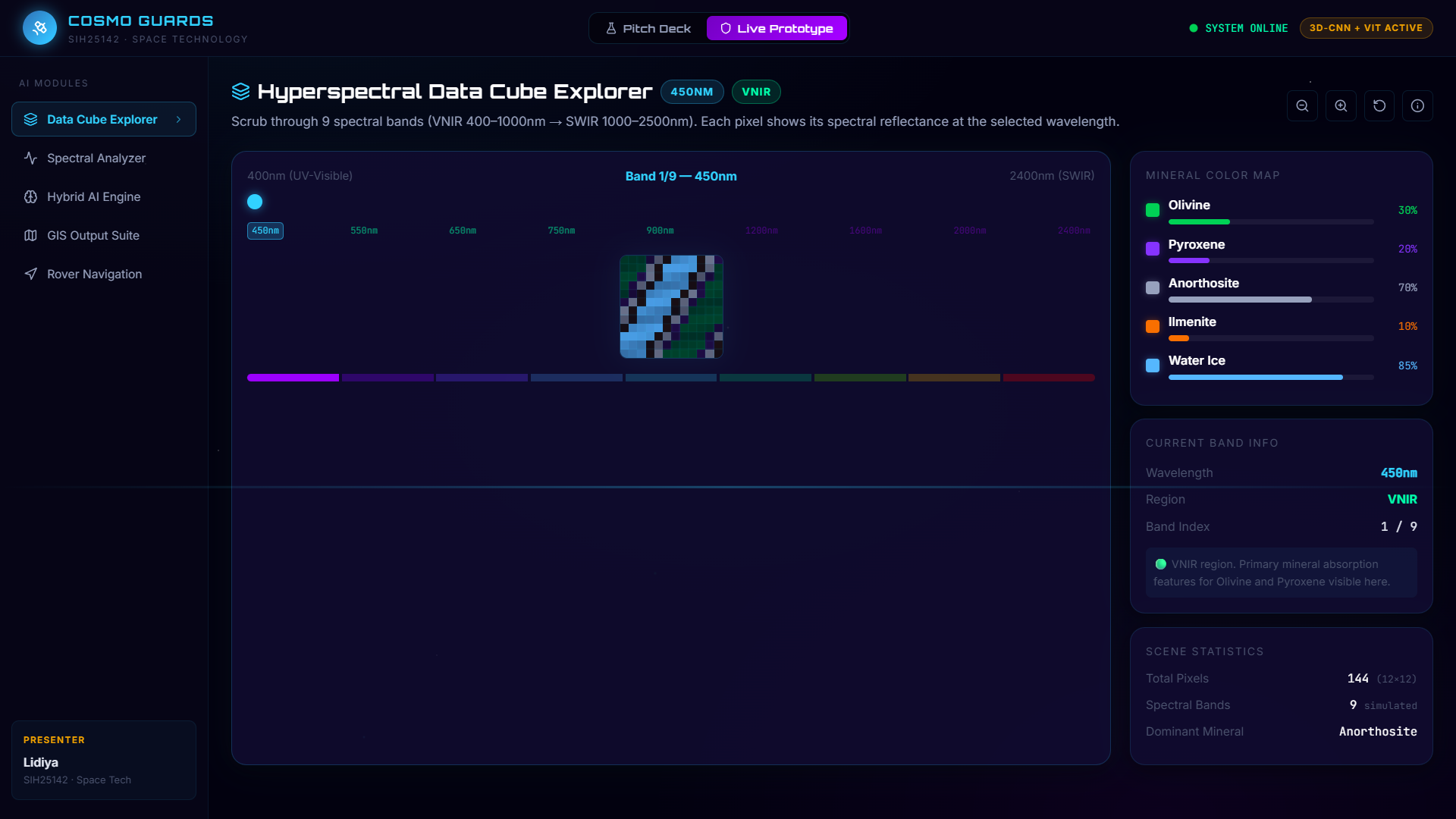
- 🌈 Hyperspectral Cube Explorer — Explore spectral bands and inspect pixel-level mineral information.
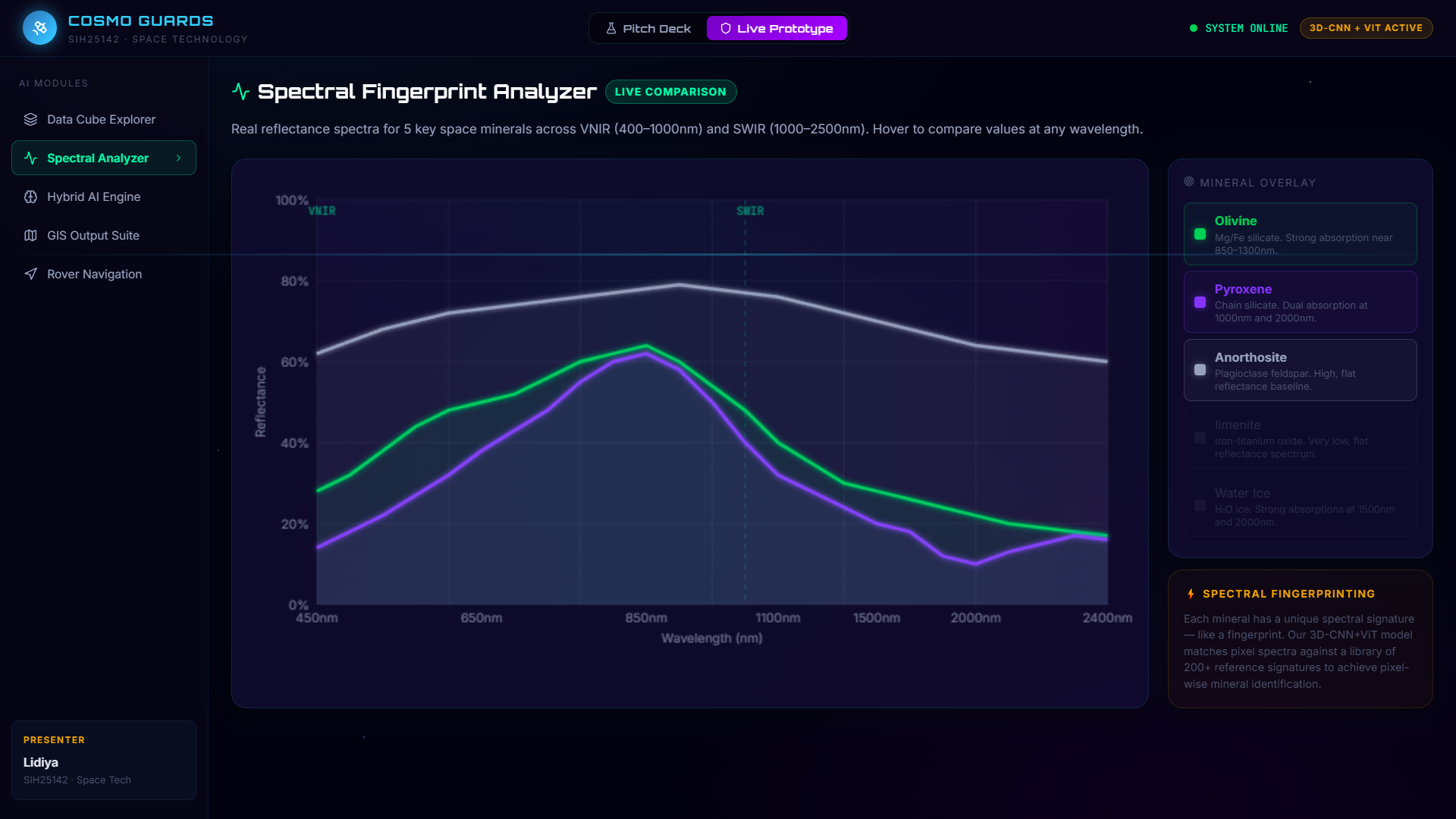
- 📈 Spectral Fingerprint Analyzer — Compare reflectance signatures of minerals such as Olivine, Pyroxene, Anorthosite, Ilmenite, and Water Ice.
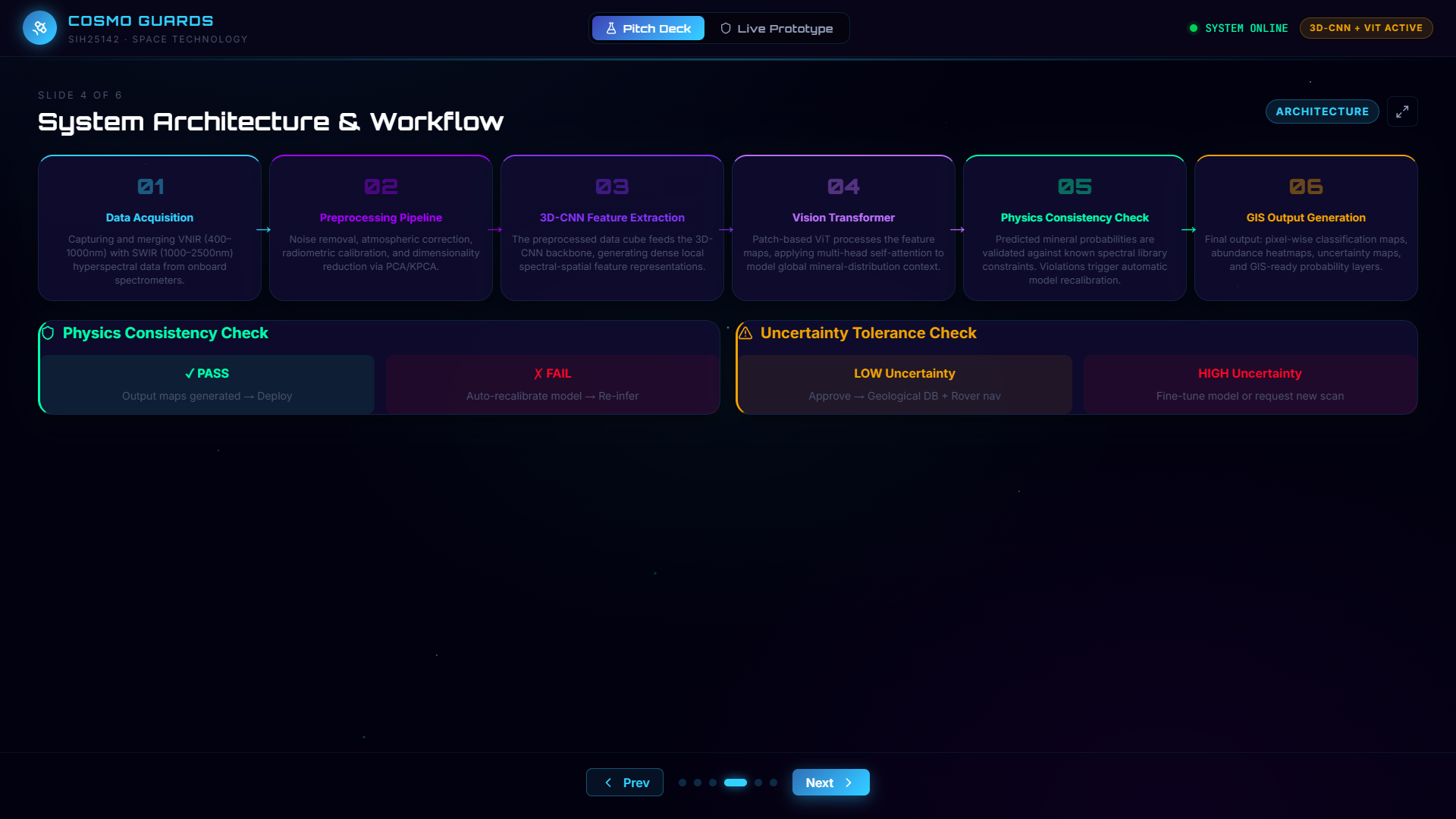
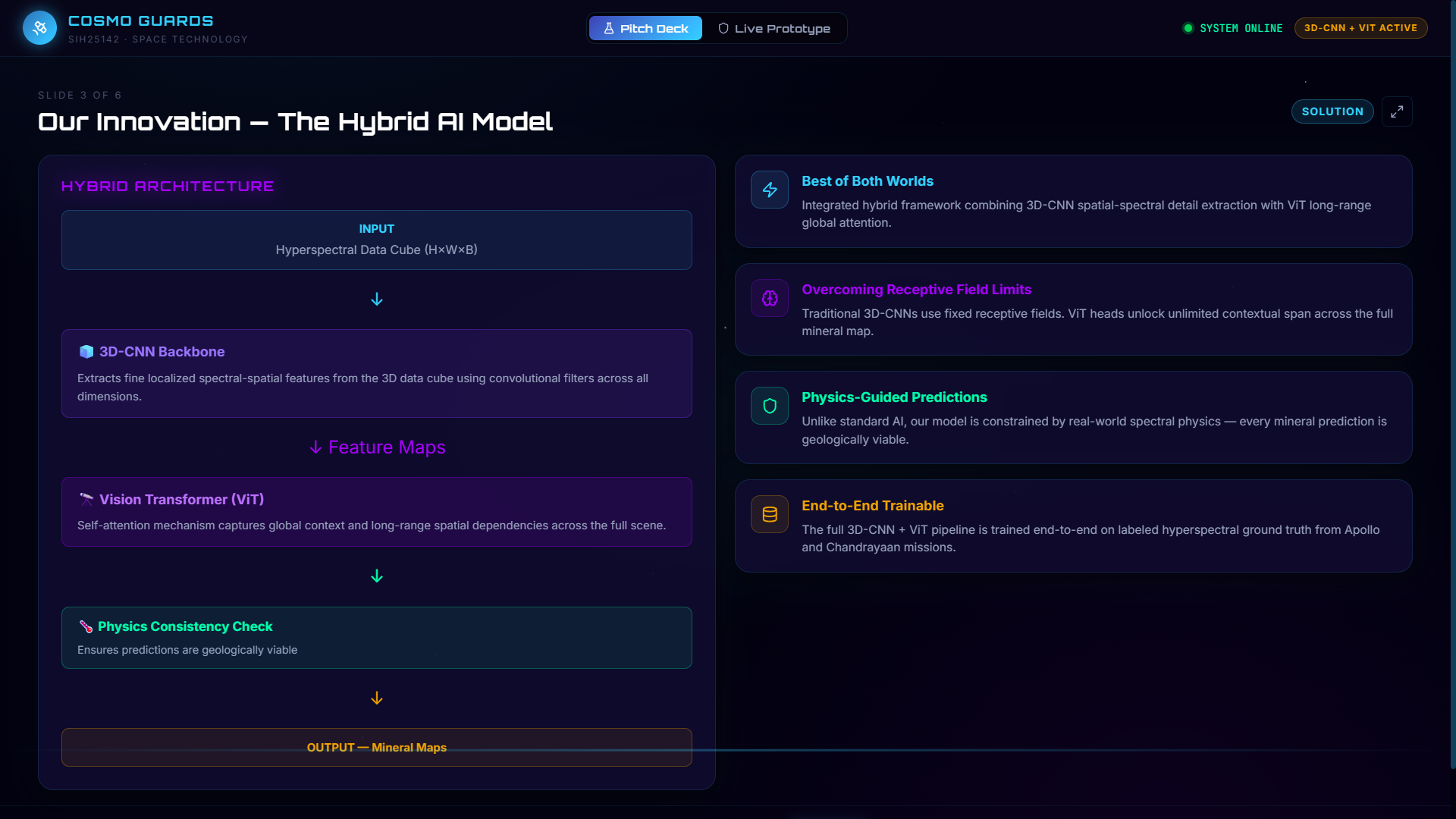
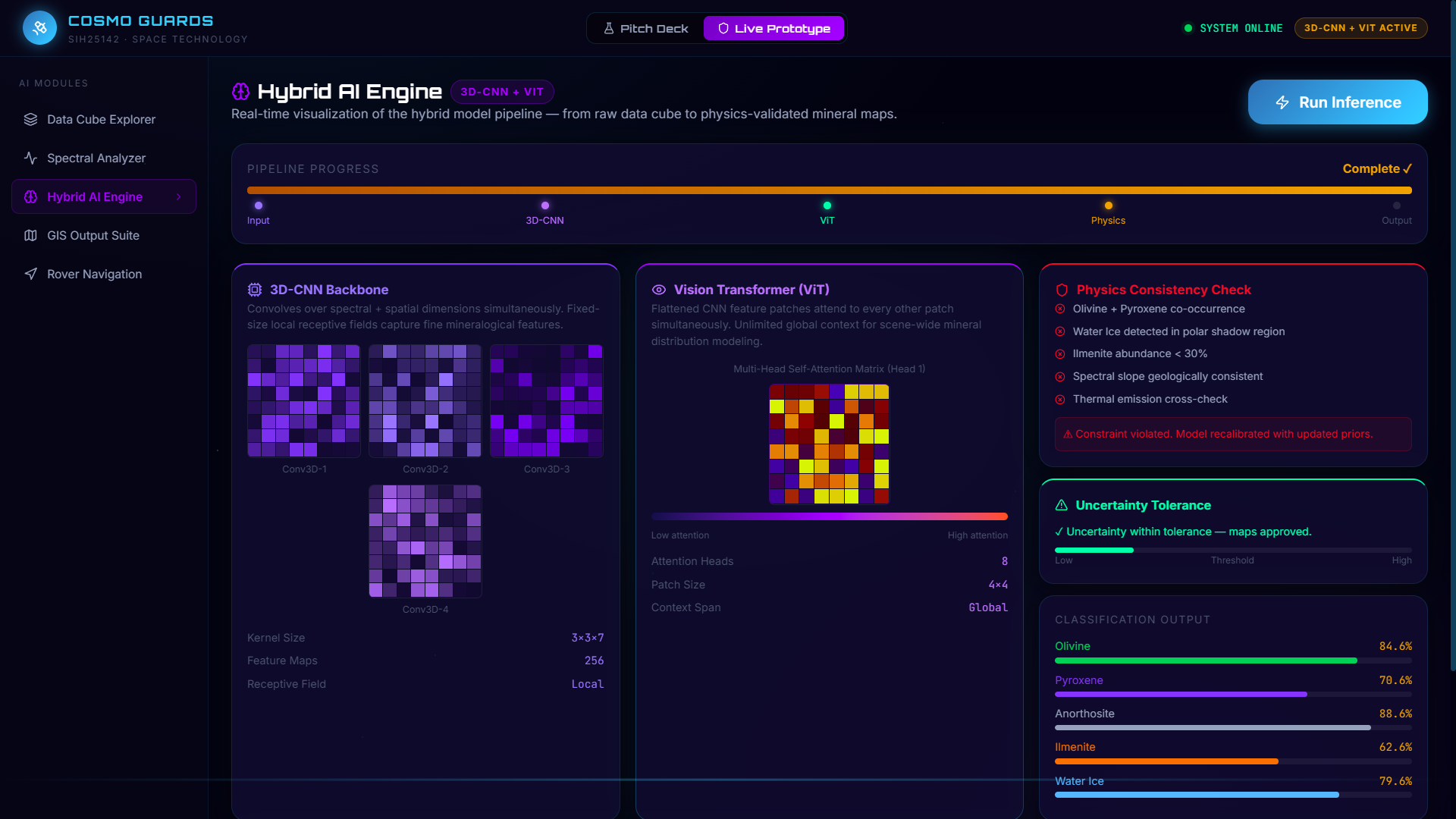
- 🧠 Hybrid AI Engine — Demonstrates a hybrid 3D-CNN + Vision Transformer architecture for extracting local spectral-spatial features and global contextual relationships.
- 🔬 Physics Consistency Check — Validates AI predictions against spectral-library constraints and supports recalibration when predictions fail validation.
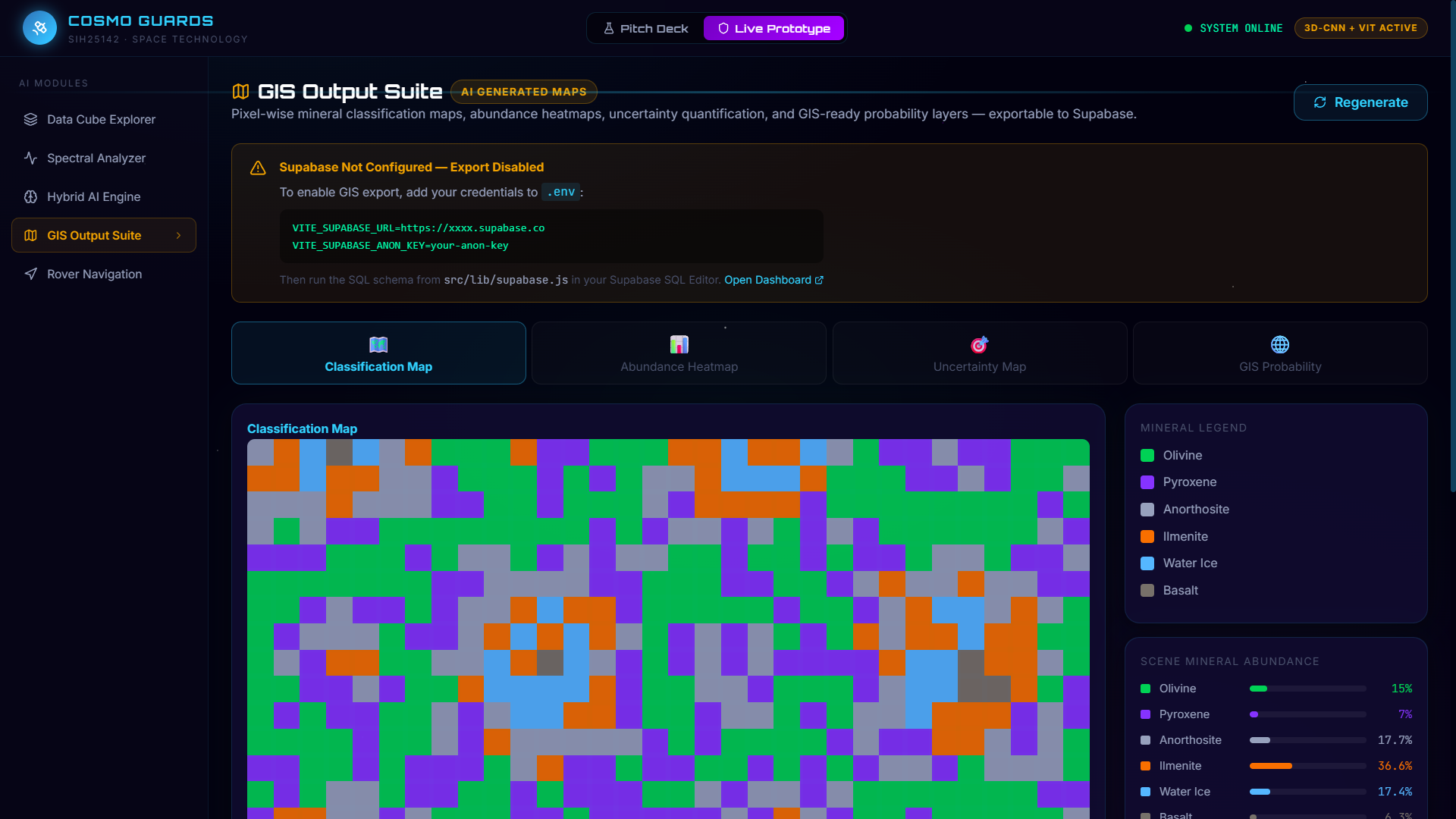
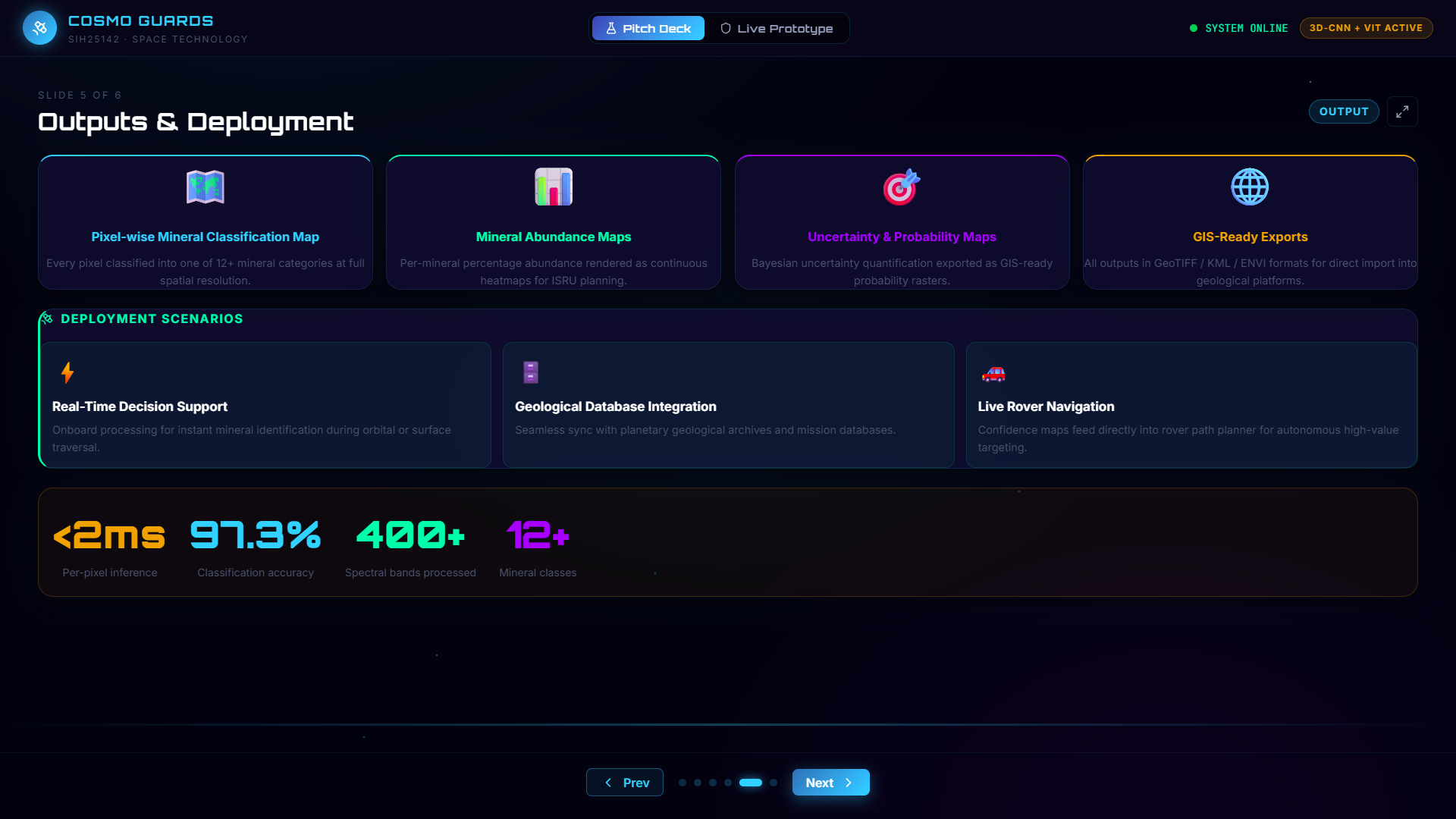
- 🗺️ GIS Output Suite — Generates classification, abundance, uncertainty, and probability maps.
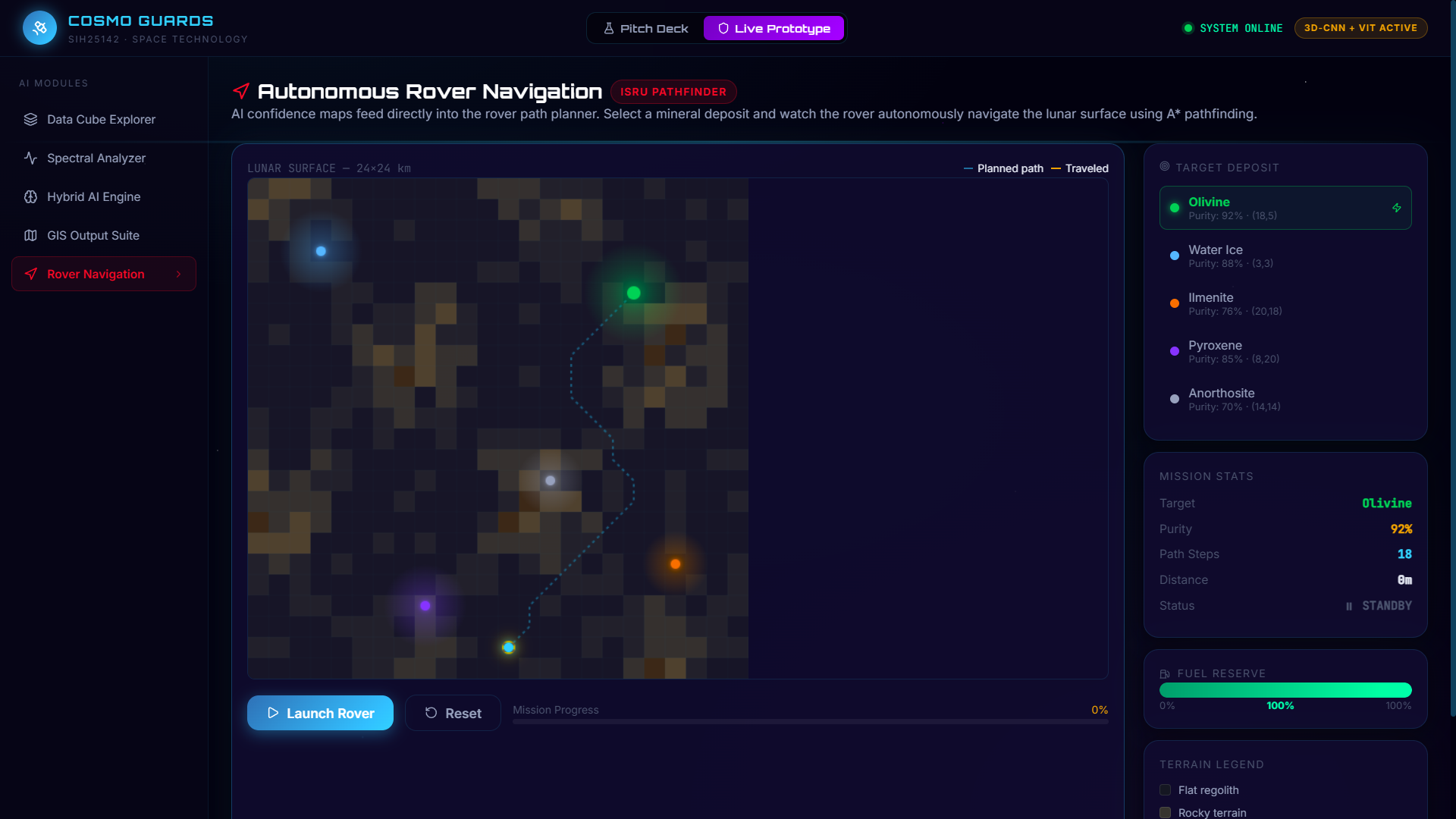
- 🚗 Rover Navigation Simulator — Uses mineral-confidence maps with A* pathfinding to demonstrate autonomous rover navigation toward selected deposits.
- 📊 Uncertainty Analysis — High-confidence predictions can be approved for deployment, while uncertain predictions can trigger additional analysis or data acquisition.
The prototype is designed around three major outputs:
Mineral Identification → Geological Intelligence → Autonomous Exploration
How we built it
We built Cosmo Guards as an interactive web-based prototype using:
- React + Vite for the application interface
- JavaScript / JSX for application logic
- HTML5 Canvas for hyperspectral visualization, spectral plots, feature maps, GIS maps, and terrain
- Vanilla CSS with a space-inspired glassmorphism/neon interface
- 3D-CNN architecture concept for local spectral-spatial feature extraction
- Vision Transformer architecture concept for global contextual analysis
- Physics-based validation using known mineral spectral characteristics
- A* pathfinding for rover navigation
- VNIR + SWIR spectral ranges to represent hyperspectral planetary observations
- GIS-oriented outputs for classification, abundance, uncertainty, and probability visualization
The prototype combines these components into a single pipeline:
Hyperspectral Data → Preprocessing → 3D-CNN → Vision Transformer → Physics Validation → Uncertainty Analysis → GIS Maps → Rover Navigation
The current prototype focuses on demonstrating the complete workflow and user experience. The simulated AI visualizations provide an interactive representation of how the proposed production system would operate with real hyperspectral datasets and trained models.
Challenges we ran into
One of our biggest challenges was representing a highly complex hyperspectral processing pipeline in an interactive prototype without making the system difficult to understand.
Hyperspectral data contains hundreds of spectral dimensions, creating challenges related to:
- High-dimensional data processing
- Spectral redundancy
- Similar spectral signatures between different minerals
- Visualization of multidimensional data
- Balancing AI predictions with physical constraints
- Communicating uncertainty in geological predictions
- Connecting classification results to rover navigation
- Designing a responsive interface for computationally intensive visualizations
Another challenge was creating a convincing demonstration of a hybrid 3D-CNN + Vision Transformer workflow while keeping the prototype lightweight enough to run in a browser.
We addressed this by separating the interactive visualization layer from the future production AI pipeline, allowing us to demonstrate the complete concept while keeping the prototype responsive.
Accomplishments that we're proud of
We are proud of turning a complex space-AI concept into an interactive end-to-end prototype rather than presenting only a static model or architecture diagram.
Key accomplishments include:
- 🚀 Built a complete interactive Cosmo Guards prototype.
- 🌈 Created an interactive hyperspectral cube exploration experience.
- 📈 Visualized mineral spectral fingerprints across VNIR/SWIR wavelengths.
- 🧠 Designed a hybrid 3D-CNN + Vision Transformer inference workflow.
- 🔬 Added a physics-consistency validation concept to AI predictions.
- 🗺️ Developed multiple GIS-style geological output visualizations.
- 🎯 Incorporated uncertainty and confidence into the decision pipeline.
- 🚗 Connected mineral detection with an autonomous rover navigation simulation.
- 🛰️ Designed the system around potential lunar, Martian, and asteroid exploration scenarios.
- 🇮🇳 Aligned the concept with India's ambitions in autonomous space exploration and ISRU.
Most importantly, we created a prototype that communicates the entire journey from raw hyperspectral observation to an exploration decision.
What we learned
This project taught us that building AI for space exploration is not simply about achieving high classification accuracy.
We learned the importance of:
1. Combining AI with domain knowledge
A model's prediction becomes more useful when it can be checked against physical and geological knowledge.
2. Understanding uncertainty
In a planetary exploration environment, an incorrect prediction can have significant consequences. Confidence and uncertainty therefore need to be treated as first-class outputs rather than hidden model statistics.
3. Designing for the complete workflow
Mineral classification alone is not enough. The information needs to become useful for scientists, mission planners, or autonomous systems.
4. Making complex AI understandable
Interactive visualization can make architectures such as CNNs, Transformers, spectral signatures, and uncertainty maps easier to understand and evaluate.
5. Thinking beyond Earth
Designing for lunar and planetary environments forces us to consider constraints such as limited computational resources, autonomous decision-making, unreliable communication, and the need for onboard intelligence.
What's next for Cosmo Guards
Our next step is to move from a simulated prototype toward a real hyperspectral AI system trained and validated on real planetary and terrestrial datasets.
Phase 1 — Real Hyperspectral Data
- Integrate publicly available hyperspectral datasets.
- Replace simulated spectral signatures with measured observations.
- Build standardized preprocessing and normalization pipelines.
- Add atmospheric/noise correction where applicable.
Phase 2 — Real AI Models
- Train a genuine 3D-CNN model for spectral-spatial feature extraction.
- Implement and fine-tune a Vision Transformer.
- Experiment with hybrid CNN-Transformer architectures.
- Evaluate performance using precision, recall, F1-score, confusion matrices, and class-specific metrics.
Phase 3 — Physics-Aware AI
- Integrate larger mineral spectral libraries.
- Introduce spectral similarity and physical constraints.
- Develop physics-informed validation mechanisms.
- Improve uncertainty estimation and out-of-distribution detection.
Phase 4 — GIS & Mission Integration
- Generate standards-compliant geospatial outputs.
- Integrate GeoTIFF/KML and planetary coordinate systems.
- Support geological database integration.
- Connect confidence maps with mission planning tools.
Phase 5 — Autonomous Exploration
- Integrate mineral-probability maps with rover planning.
- Improve terrain-aware path planning.
- Add obstacle avoidance and resource-prioritization logic.
- Explore onboard inference for resource-constrained rover hardware.
Long-Term Vision
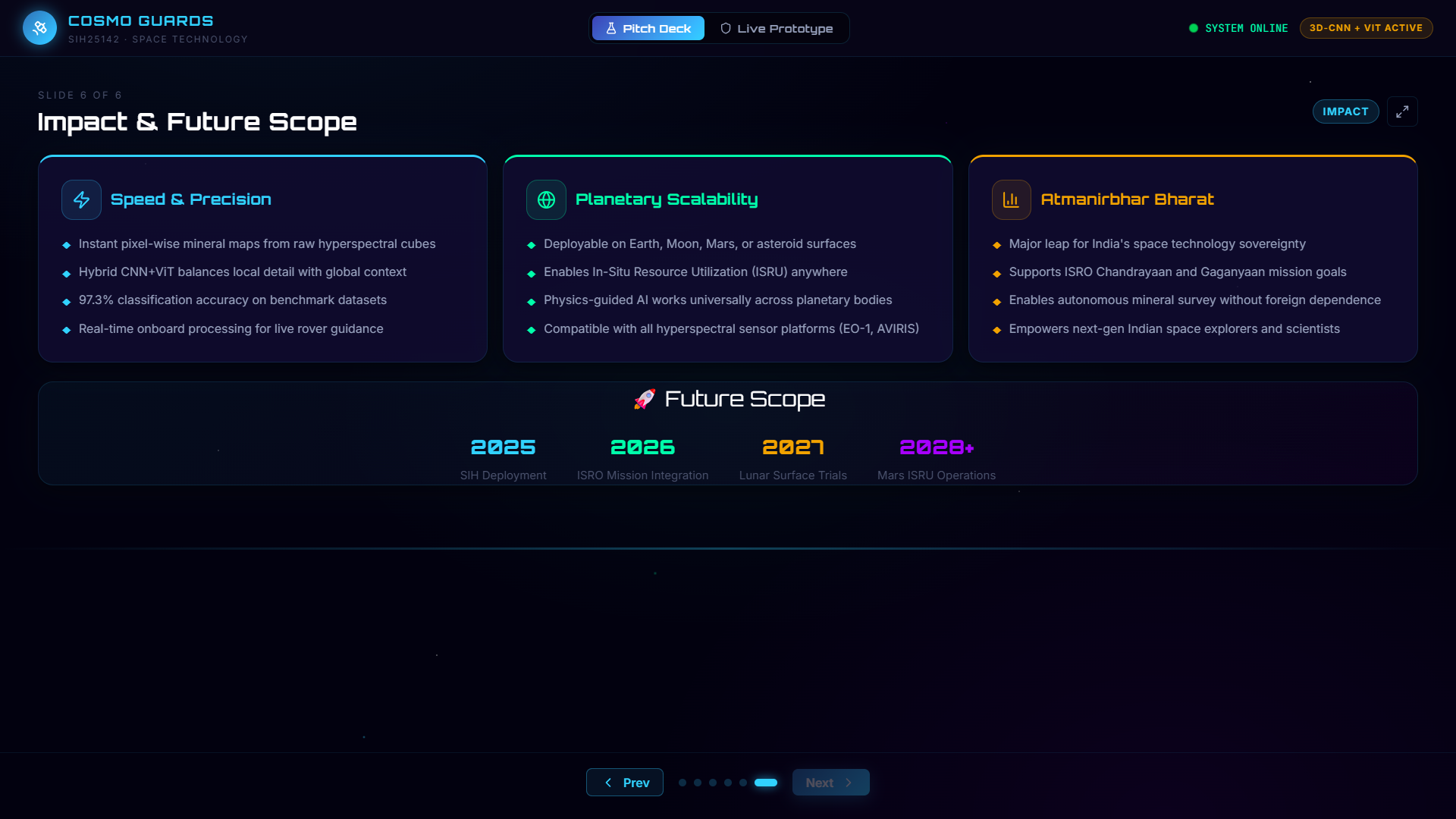
Our long-term vision is to evolve Cosmo Guards into an autonomous planetary mineral intelligence platform capable of transforming hyperspectral observations into validated geological insights and exploration decisions.
Observe → Analyze → Validate → Map → Navigate → Discover
We envision Cosmo Guards supporting future lunar, Martian, and asteroid missions by helping autonomous systems identify scientifically and economically valuable resources while reducing dependence on continuous communication with Earth.
Built With
- 3d-cnn
- a-pathfinding
- css3
- gis
- github
- html5
- hyperspectral-imaging-(vnir/swir)
- javascript
- lucide
- react
- supabase
- vision-transformer
- vite

Log in or sign up for Devpost to join the conversation.