🚀 Inspiration
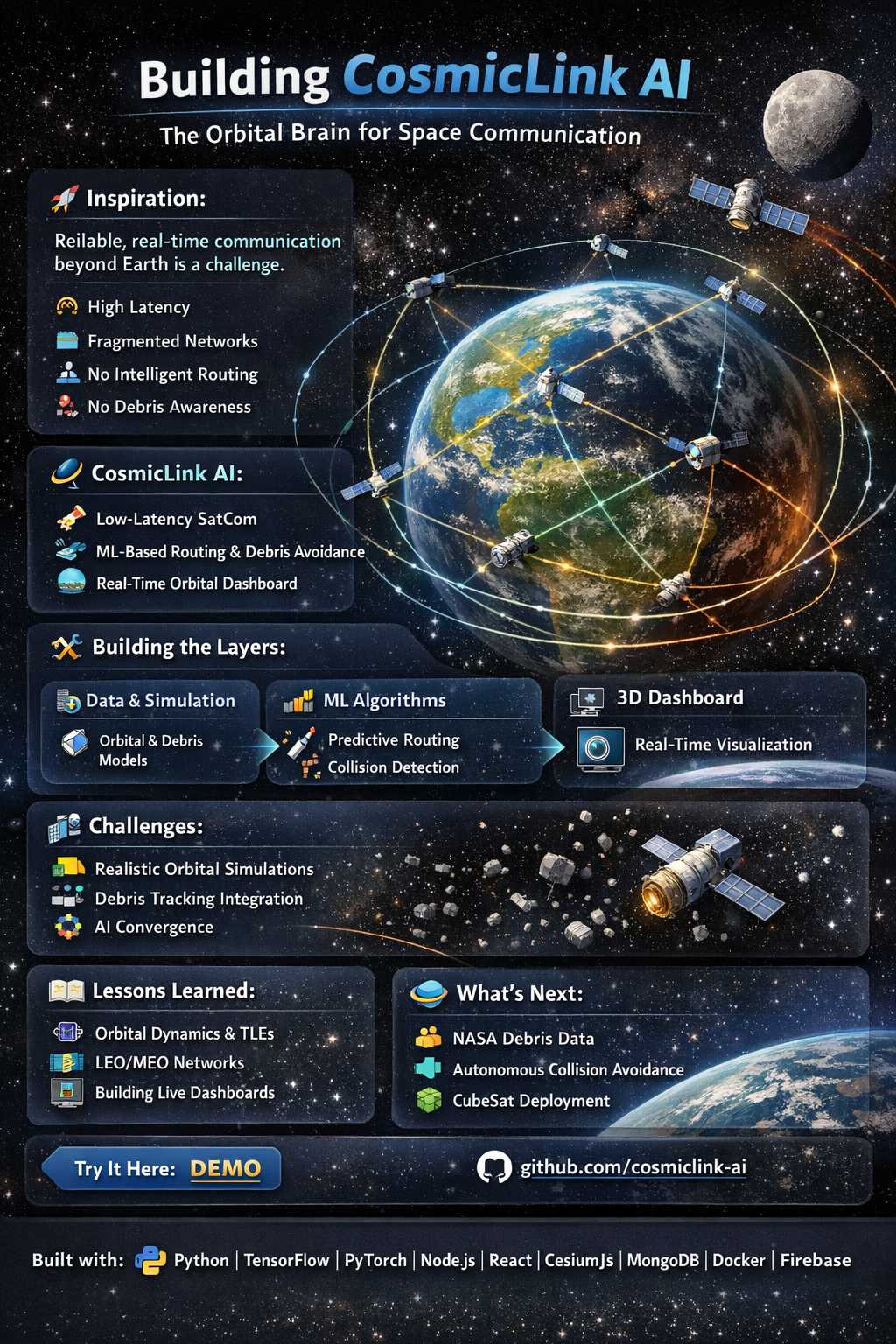
As satellite constellations grow and humanity prepares for lunar bases and deep-space exploration, one challenge becomes critical: How do we maintain reliable, real-time communication beyond Earth?
Current satellite networks face:
High latency
Fragmented communication layers
Lack of intelligent routing
No built-in debris awareness
We wanted to build a system that doesn’t just connect satellites, but also thinks, predicts, and adapts — like an orbital brain. That idea became CosmicLink AI.
🌌 What CosmicLink AI Does
CosmicLink AI is an AI-driven orbital communication platform that:
Enables low-latency communication between satellites
Uses ML to predict path loss, signal strength, and optimal routing
Monitors space debris and suggests safe transmission paths
Provides a real-time orbital dashboard for mission control
It acts as a smart communication layer for space, connecting spacecraft, stations, and future exploration missions.
🛠️ How We Built It
We structured the project in three major layers:
- Data + Simulation Layer
Satellite orbits simulated using Two-Line Element (TLE) data
Debris trajectory simulation
Communication scenarios generated for LEO/MEO/GEO
- AI Intelligence Layer
We used ML models for:
Predicting signal loss
Optimizing satellite-to-satellite relay routes
Detecting collision risk zones
Suggesting best communication paths
Frameworks: Python, TensorFlow/PyTorch, Scikit-learn
- Visualization + System Layer
Real-time 3D orbital map using Three.js / CesiumJS
Backend using Node.js + Express
API system to relay prediction outputs
Dashboard built with React
🧩 Challenges We Faced
Simulating realistic orbital mechanics was harder than expected
Integrating debris tracking with communication routing
Ensuring the AI model converged with limited training data
Designing a dashboard that works in real-time
Running computationally heavy predictions within hackathon time limits
📚 What We Learned
Deep understanding of orbital dynamics and TLE data
How communication works in LEO/MEO/GEO constellations
Building predictive ML models for non-traditional datasets
Optimizing real-time dashboards
Working efficiently as a team under a time crunch
🌠 What’s Next
Expanding the model with NASA and Space-Track real debris datasets
Adding autonomous collision-avoidance commands
Building a deployable version for CubeSat teams
Integrating quantum-safe communication
Built With
- cesiumjs
- docker
- express.js
- firebase
- javascript
- mongodb
- node.js
- numpy
- pandas
- python
- pytorch
- react.js
- rest-apis
- scikit-learn
- space-tle-data
- tensorflow
- three.js
- typescript

Log in or sign up for Devpost to join the conversation.