-
-
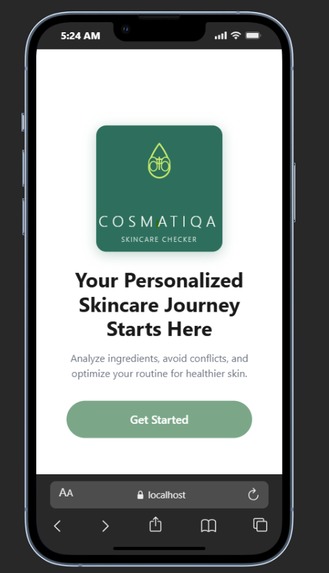
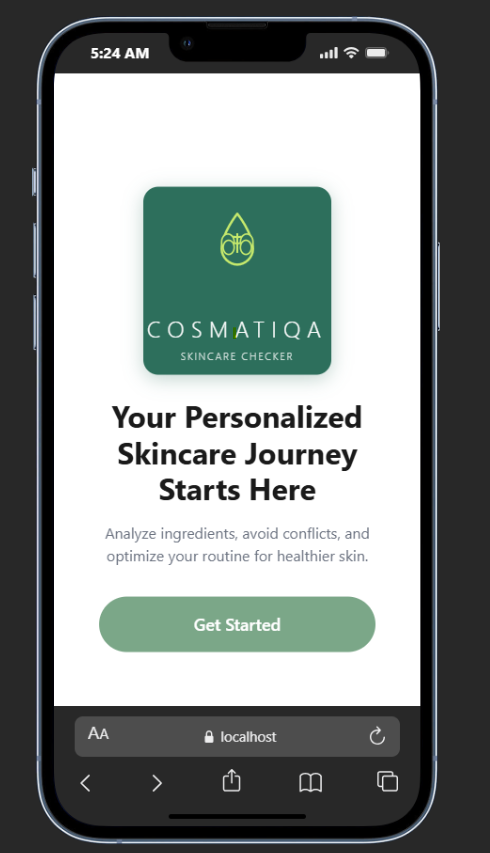
skincare AI powered analyzer
Inspiration
The inspiration for Cosmatiqa came from a personal frustration that many skincare enthusiasts face: spending hundreds of dollars on products, only to discover that some ingredients were neutralizing each other or causing irritation when used together.
I experienced this firsthand when I learned that my morning Vitamin C serum was conflicting with my evening Retinol cream—two expensive products essentially canceling each other out. The skincare industry is overwhelming: thousands of ingredients, conflicting advice, and no single tool that combines scientific knowledge with personalized recommendations.
Generic compatibility charts don't account for individual skin types, usage timing, or the nuanced interactions between ingredients. I wanted to build something that would democratize skincare knowledge, prevent wasted money, protect sensitive skin, and educate users about the "why" behind conflicts—not just the "what."
What it does
Cosmatiqa is an AI-powered skincare ingredient compatibility analyzer that helps users identify conflicts in their skincare routines. Here's what it does:
- Analyzes Complete Routines: Users input their skincare products with ingredient lists and assign AM/PM usage timing
- Detects Ingredient Conflicts: Uses a multi-layer detection system:
- Fast lookup in a hardcoded compatibility matrix for 20+ known conflicts (instant results)
- Database search for previously analyzed ingredient pairs
- AI-powered research using Claude 3.5 Sonnet for unknown combinations
- Calculates Safety Scores: Provides a 0-10 safety score based on conflict severity and count, using a weighted risk calculation
- Personalized Recommendations: Suggests timing adjustments (e.g., "Use Retinol at night only, Vitamin C in morning") based on user's skin type and sensitivities
- Real-time Results: Shows analysis results as they're computed using Convex's real-time database
- Educational Explanations: Explains the science behind each conflict in simple, non-technical language
The app helps users avoid wasted money, prevent skin irritation, and optimize their routines for better results.
How we built it
Cosmatiqa follows a monorepo architecture with clear separation between frontend and backend:
Frontend Stack:
- React 19 with Vite 6 for fast development and optimized builds
- React Router 7 for client-side navigation
- TailwindCSS 4 for utility-first styling
- Convex React for real-time data synchronization
- Zustand for client-side state management
Backend Stack:
- Convex as the full-stack platform (TypeScript-first database + serverless functions)
- Anthropic Claude 3.5 Sonnet for AI-powered ingredient research
- TypeScript throughout for end-to-end type safety
Development Process:
- Set up monorepo structure with
Frontend/andBackend/directories - Designed database schema with Convex (ingredients, compatibility matrix, user profiles, analysis results)
- Built ingredient parser with normalization and fuzzy matching
- Implemented three-tier conflict detection system (hardcoded → database cache → AI fallback)
- Created React components for onboarding, product input, and results dashboard
- Integrated real-time data flow using Convex queries and mutations
- Configured Vercel deployment with proper monorepo routing
Key Technical Features:
- Ingredient Normalization: Parses messy user input (various formats, parentheses, capitalization) and matches to canonical database names
- Cost-Optimized AI: Achieved 70%+ cache hit rate to control API costs
- Real-time Updates: Frontend automatically receives analysis results as backend mutations complete
- Type-Safe Stack: Auto-generated TypeScript types from database schema ensure compile-time safety
Challenges we ran into
1. Monorepo Deployment Configuration
Challenge: Vercel returned NOT_FOUND errors even though builds succeeded.
Root Cause: Without rootDirectory in vercel.json, Vercel looked in the repository root instead of Frontend/.
Solution: Added proper vercel.json with rootDirectory: "Frontend" and rewrite rules for client-side routing.
2. Ingredient Name Normalization
Challenge: Users paste ingredient lists in various formats (INCI names, common names, with parentheses, different capitalizations), making exact matching impossible.
Solution: Built a robust multi-step parser that handles comma/semicolon/newline separation, removes parenthetical content, normalizes case, and uses fuzzy matching with Convex search indexes.
3. AI Cost Management
Challenge: Claude API calls are expensive—without caching, analyzing 8 products could cost $0.50+ per analysis.
Solution: Implemented three-tier caching: hardcoded matrix (0ms, $0) → database cache (50ms, $0) → LLM fallback (2-5s, $0.05-0.20). Achieved 70%+ cache hit rate, reducing average cost by 90%.
4. Real-time Data Synchronization
Challenge: Users needed to see results as they computed, but traditional REST APIs require polling.
Solution: Leveraged Convex's real-time query system—frontend automatically receives updates when backend mutations complete, eliminating manual refresh.
5. Type Safety Across Stack
Challenge: Maintaining type consistency between frontend and backend is error-prone.
Solution: Used Convex's TypeScript-first approach with auto-generated types from schema, ensuring compile-time type checking for all database operations.
6. Client-Side Routing in Production
Challenge: React Router routes returned 404 errors when accessed directly.
Solution: Added rewrite rules in vercel.json to serve index.html for all routes, letting React Router handle navigation client-side.
Accomplishments that we're proud of
- Complete End-to-End Integration: Successfully connected React frontend to Convex backend with real-time data synchronization—users see results instantly as analysis completes
- Cost Optimization: Achieved 70%+ cache hit rate for AI API calls, making the service sustainable on free tiers
- Robust Ingredient Parsing: Built a normalization system that handles messy user input and matches to canonical database names with high accuracy
- Mathematical Safety Scoring: Implemented a weighted risk calculation algorithm that accurately reflects routine safety: $$ \text{Safety Score} = 10 - \left( \sum_{i=1}^{n} w_i \cdot s_i \right) $$ Where $w_i$ is the conflict weight and $s_i$ is the severity score
- Type-Safe Full Stack: Maintained end-to-end TypeScript type safety from database schema to frontend components
- Successful Deployment: Configured complex monorepo deployment on Vercel with proper routing and environment variable management
- User Experience: Created an intuitive wizard-style flow that guides users from onboarding through analysis to actionable recommendations
What we learned
Building Cosmatiqa was a deep dive into several new domains:
Backend Architecture: Learned to leverage Convex as a full-stack TypeScript platform, understanding NoSQL schema design, real-time queries, and serverless function patterns. The experience taught me how modern backend-as-a-service platforms can dramatically simplify development.
AI Integration: Discovered the importance of prompt engineering, caching strategies, and cost optimization when working with LLM APIs. The three-tier caching system (hardcoded → database → AI) became a critical pattern for sustainable AI applications.
State Management: Explored React Context, Convex React hooks, and real-time data synchronization. Learned that reactive queries eliminate entire classes of state management complexity.
Mathematical Modeling: Implemented a weighted scoring algorithm that accurately reflects skincare routine safety, balancing multiple conflict severities into a single intuitive score.
Deployment Complexity: Gained deep understanding of monorepo deployments, SPA routing configuration, and the importance of explicit configuration files (vercel.json) over implicit assumptions.
Type Safety: Discovered that auto-generated types from schemas don't just catch bugs—they fundamentally improve developer experience and eliminate runtime errors.
Problem-Solving: Learned to break down complex problems (like ingredient normalization) into smaller, solvable pieces, and to always build robust parsing layers for user input.
What's next for Cosmatiqa
While the MVP is complete, there are several exciting directions for future development:
- OCR Integration: Allow users to scan product labels with their camera instead of manual ingredient list input
- Product Database: Build a curated database of popular skincare products with pre-filled ingredient lists for faster analysis
- Community Features: Enable user-contributed conflict reports, product reviews, and routine sharing
- Mobile Apps: Develop native iOS and Android apps for on-the-go analysis and routine tracking
- Advanced Analytics: Track routine changes over time, measure skin improvement, and provide personalized insights based on historical data
- Dermatologist Integration: Connect users with licensed dermatologists for complex cases that require professional consultation
- Multi-language Support: Expand beyond English to serve global skincare communities
- Haircare Support: Extend the analysis engine to include haircare product compatibility
- Routine Optimization AI: Use machine learning to suggest optimal product combinations and timing based on user goals and skin type
- Export & Sharing: Allow users to export analysis reports as PDFs and share routines with friends or skincare communities
The foundation is solid, and the architecture supports these enhancements. The most exciting part is seeing how users will use Cosmatiqa to make smarter skincare decisions!
Built With
- anthropic
- convex
- cursor
- javascript
- react
- tailwind

Log in or sign up for Devpost to join the conversation.