Inspiration
After a disaster like a hurricane or earthquake, phone and internet networks often go down. Rubble and damaged buildings also block radio signals. Most drones need a connection to do their smart work, so they stop being useful exactly when they're needed most. We wanted a rescue drone that doesn't need any connection at all. It finds people and keeps a record of where they are, all on its own.
What it does
Corvidia is a rescue drone that searches for people using a camera and an onboard computer.
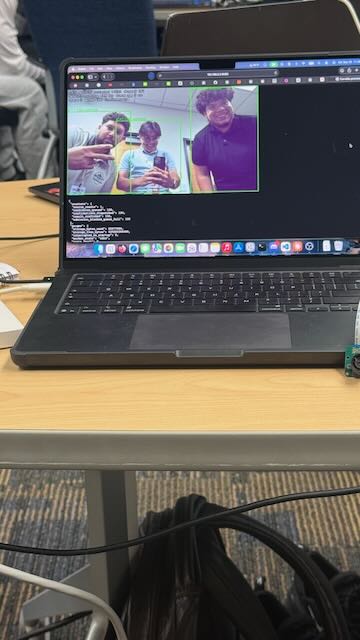
- It spots people in the camera feed.
- It double-checks each sighting with a second AI model, so posters, statues, or shadows don't fool it.
- It estimates how far away each person is.
- It saves a photo and a record of every person it finds, so rescuers can review them later.
It does all of this without internet or radio. That's what we mean by "radio silent."
How we built it
We bought most of our parts the day before the hackathon and made runs to Micro Center during the event for the rest.
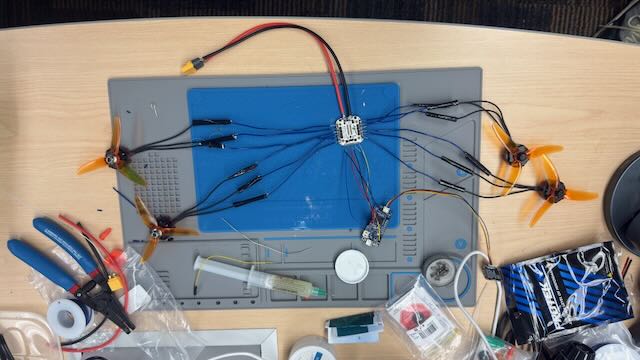
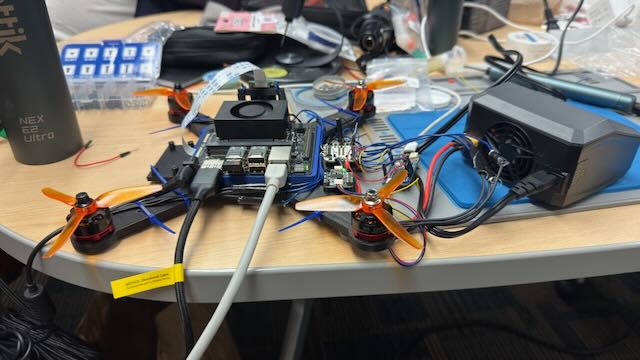
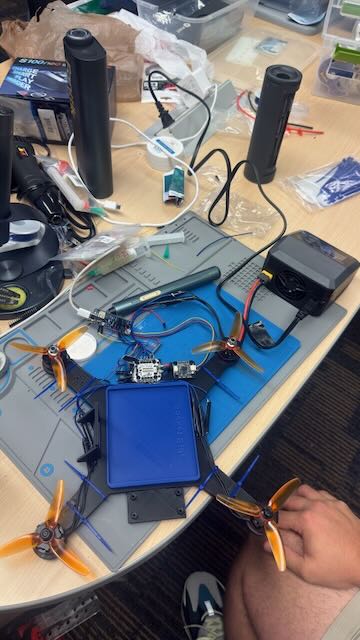
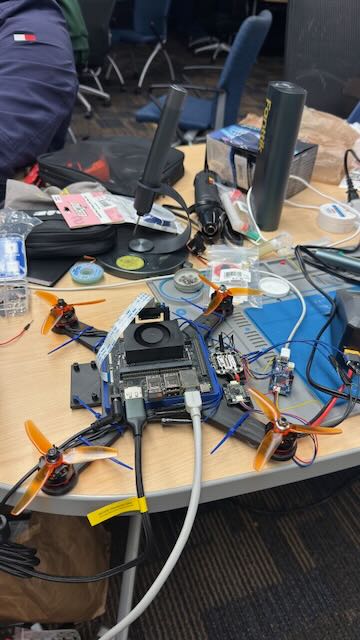
- The body: We designed our own drone frame and 3D printed it.
- The flight controller: An Adafruit Feather STM32F405 running our own firmware, with a BNO085 motion sensor.
- The brain: An NVIDIA Jetson Orin Nano Super (8 GB) with an Arducam 12.3MP IMX477 camera.
- The software: Three AI models working together, all running on the drone:
- YOLO11n watches the camera feed in real time and spots people.
- NVIDIA Cosmos Reason 2 (2B), a vision-language model, checks each detection to confirm it's a real person.
- Depth Anything V2 estimates how far away each person is from a single camera.
Challenges we ran into
- Designing the software architecture: Getting three different AI models to work together was the hardest part. We had to decide which model runs when, how they pass results to each other, and how to keep the pipeline fast enough to run on the drone. All of it had to fit in 8 GB of memory.
- Soldering problems: Our soldering iron wasn't getting hot enough, so wiring the drone took much longer than planned.
- Missing parts: We kept finding out we were missing components and had to drive to the store and back while the clock was running.
- Lots of bugs: We fixed issues in both the frame and the code to get everything working together.
Accomplishments that we're proud of
- We built a whole drone in 36 hours.
- We used off-the-shelf parts wherever we could, so Corvidia is cheap and easy to repair or rebuild.
- We fit a full AI system onto a small computer that works with no internet.
- In our tests, it correctly found 120 out of 121 people.
What we learned
- Get expert input early. At the NVIDIA seminar, we talked with NVIDIA engineers about our design. Nikhil V, an NVIDIA Solutions Architect, suggested Cosmos Reason 2 (2B) as our verification model. It's a vision-language model small enough to run on the Jetson next to YOLO, and it can reason about whether a detection is really a person. That shaped our whole architecture.
- Don't run your biggest model on every frame. YOLO11n is fast, so it watches continuously. Cosmos Reason is slower, so it only runs when YOLO flags someone. That split is what made three models practical on one small computer.
- Wording matters. How we phrased the question to Cosmos Reason made a big difference in how reliably it rejected posters, statues, and shadows.
- Test with recorded video before the live camera. Bugs are much easier to find that way.
- Buy parts early and bring backup tools.
What's next for Corvidia
- Get it flying on its own, following search patterns.
- Add camera-based positioning so rescuers know exactly where each person was found, even indoors where GPS doesn't work.
- Add a heat-sensing camera to find people at night or under debris.
- Add a way to send an alert only when someone is found, staying radio silent the rest of the time.


Log in or sign up for Devpost to join the conversation.