Inspiration
Satellite imagery can help researchers understand changing coastlines, ports and environments, but finding suitable spacecraft and turning a question into an observation request takes specialist knowledge. We built Coruscant to make that journey easier to understand and inspect.
What it does
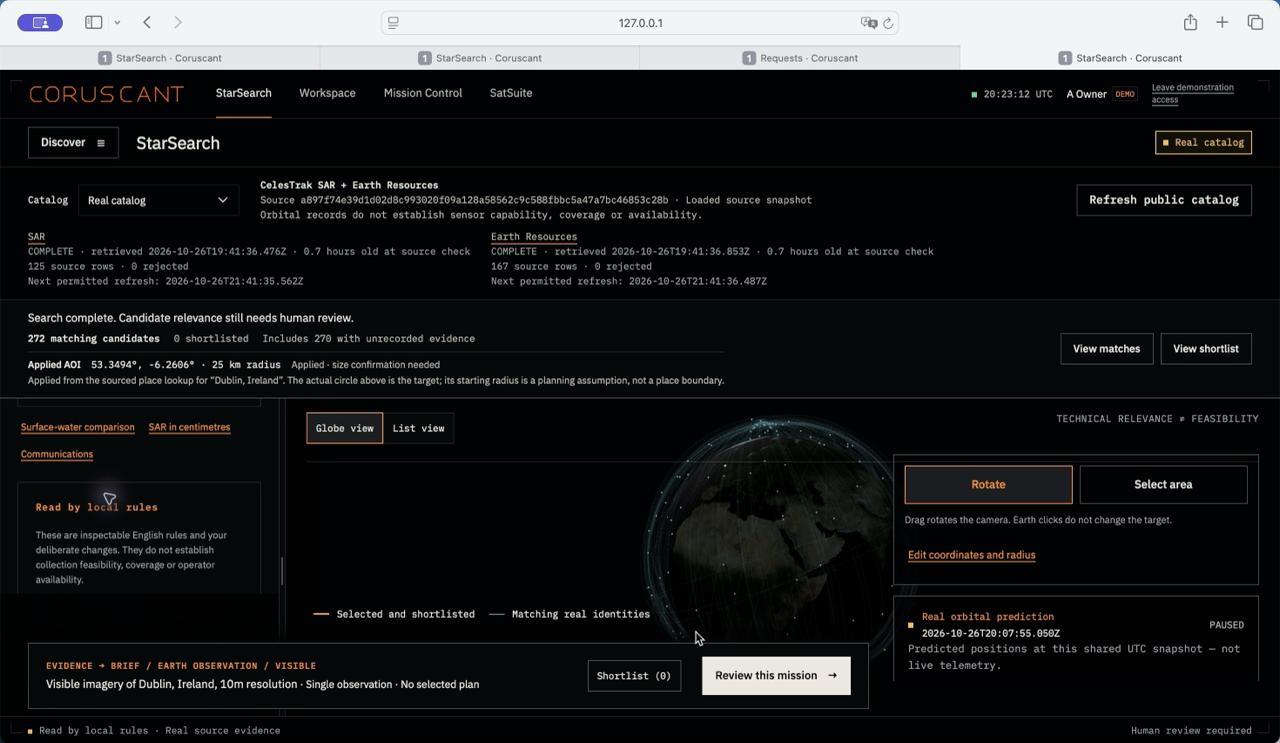
Coruscant connects three workspaces: StarSearch for discovery and technical planning, Mission Control for request history, and SatSuite for inspecting results.
A user can describe a need such as “Visible imagery of Dublin, Ireland, 10m resolution.” StarSearch extracts editable requirements, searches real CelesTrak satellite records and displays predicted orbital positions. The user can explicitly look up a place, choose its location, adjust a circular target and confirm its size.
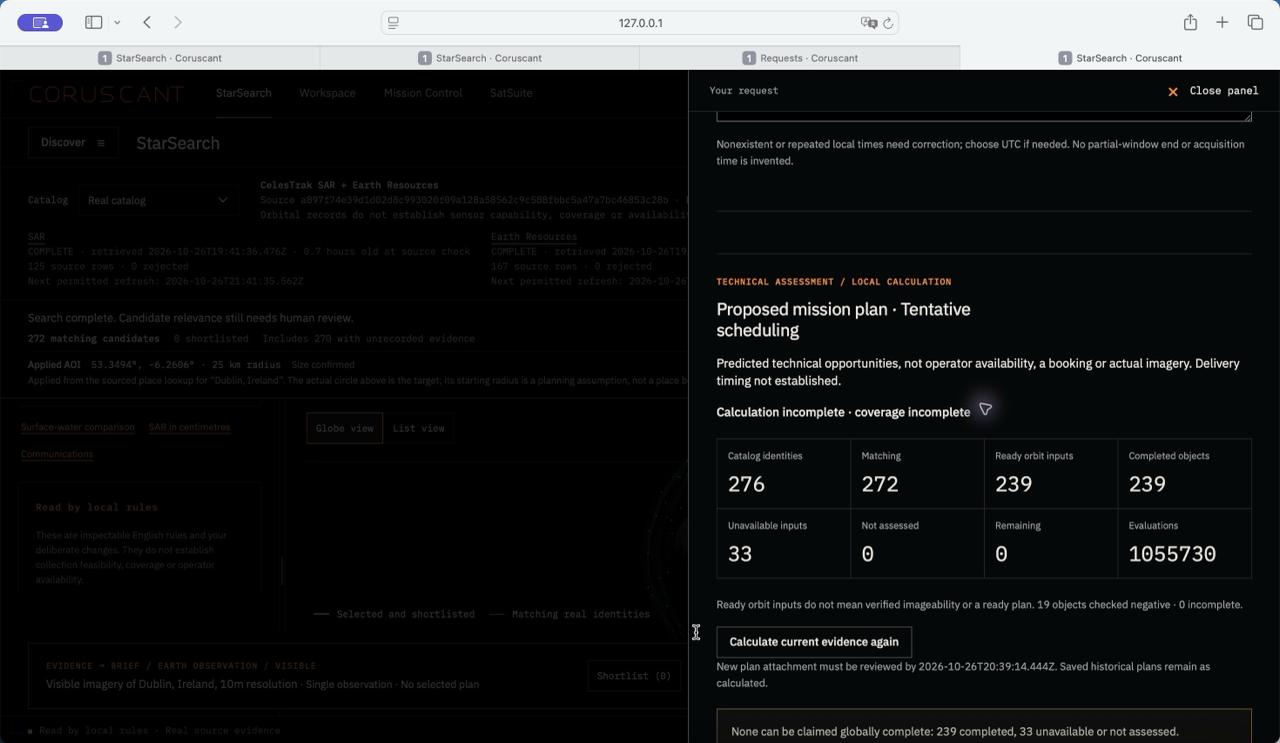
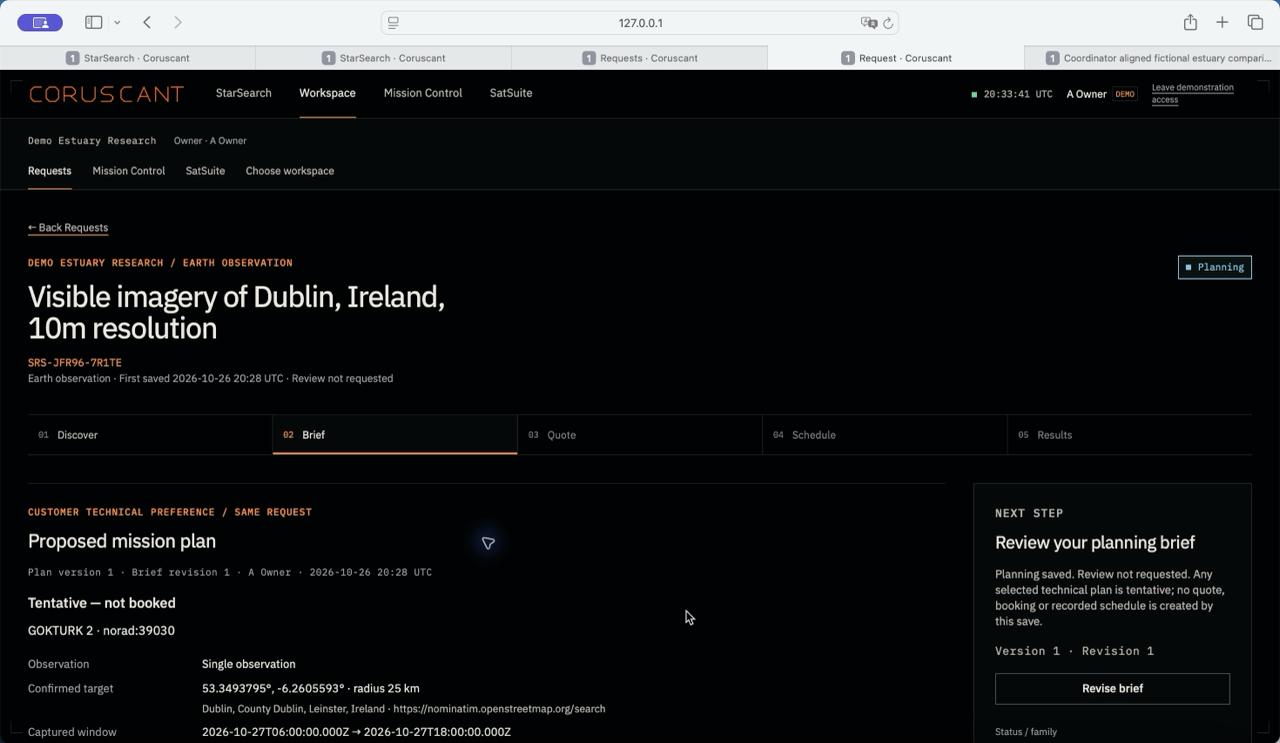
A future planning window triggers bounded local orbital calculations. Options expose their checks, source evidence and unresolved requirements. The user can select an option and save its exact evidence and plan version to a persistent Planning request.
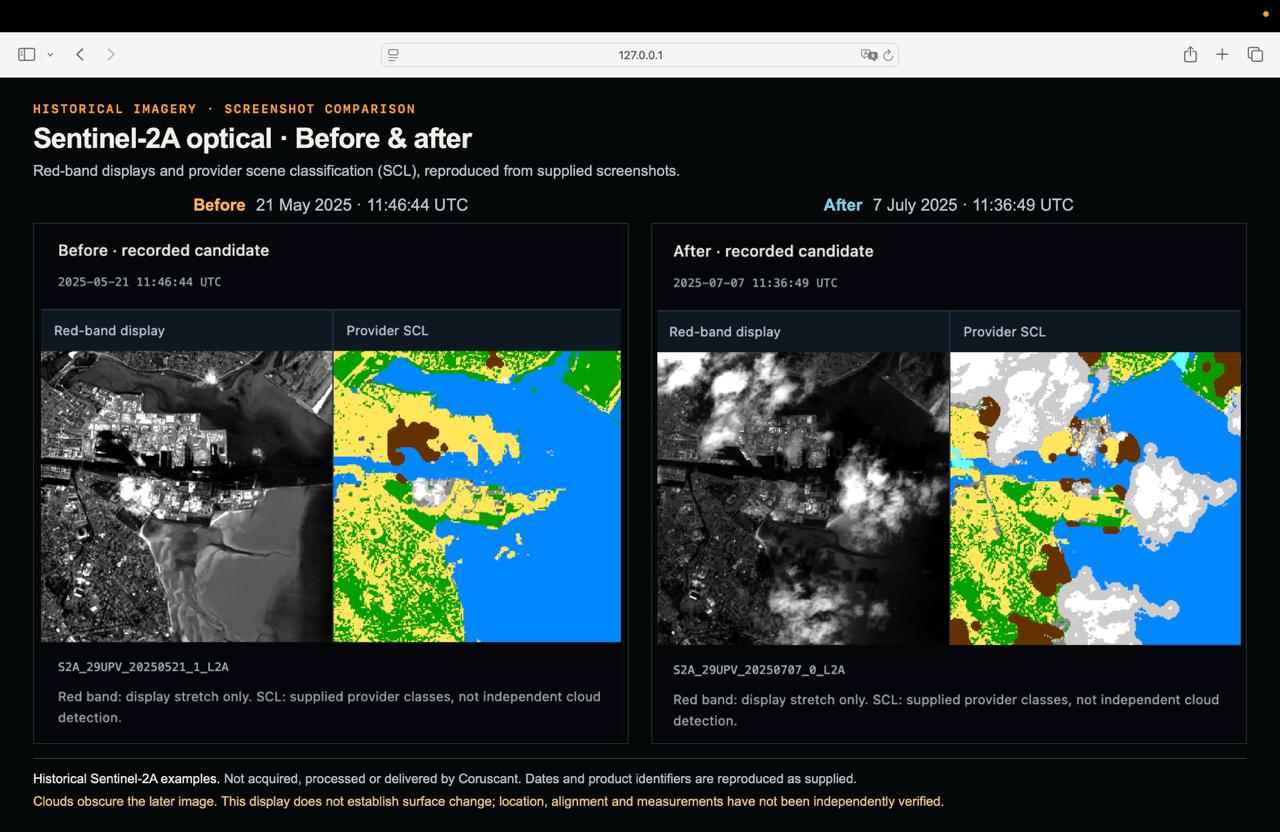
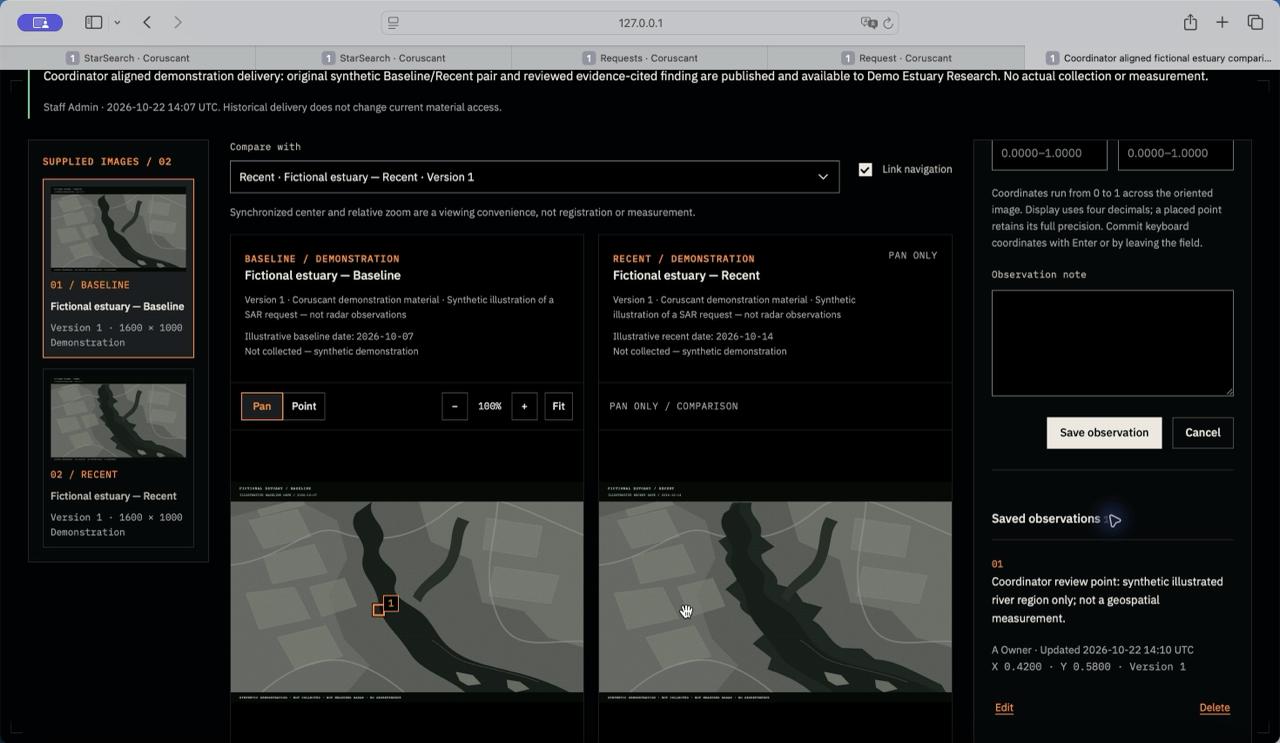
A separate customer/staff workflow connects review, quotation, acceptance, scheduling and delivery. Our fulfillment demonstration uses clearly labeled synthetic SAR imagery. In SatSuite, users can compare image versions, inspect an evidence-cited finding and save a point observation linked to its image version.
How we built it
We used TypeScript, React and Vite for the interface; Three.js for the globe; satellite.js for orbital propagation; and Node.js, Fastify and SQLite for the server and durable records. CelesTrak supplies orbital records, while explicit Nominatim searches provide place candidates. Plain-language requirements use inspectable local rules. We used AI-assisted development with incremental implementation, hands-on checkpoints and regression testing.
Challenges and what we learned
The hardest part was keeping a convincing interface tied to trustworthy evidence. We replaced the initial fictional discovery catalog with sourced satellite records, corrected place-to-coordinate handoff and role recovery, and handled stale orbital inputs and incomplete calculations explicitly. Missing capability information remains unknown, and tentative plans retain those uncertainties.
We learned that source freshness, permissions and saved evidence versions are central product features. A useful mission-planning tool needs to explain what was checked and preserve the exact basis of a decision. The completed build has recorded verification from 276 project checks and 228 browser tests, including persistence and restart checks.
What's next
We want to expand verified sensor evidence, improve the planning experience and explore authorized provider integrations. Coruscant is currently a local prototype: its predictions and saved plans do not book spacecraft or acquire imagery.
Built With
- celestrak
- fastify
- node.js
- nominatim
- playwright
- react
- satellite.js
- sqlite
- three.js
- typescript
- vite

Log in or sign up for Devpost to join the conversation.