-
-
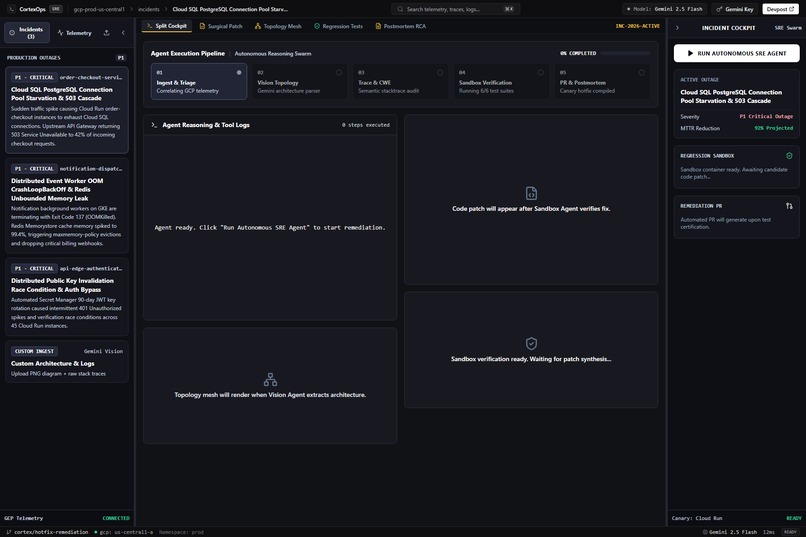
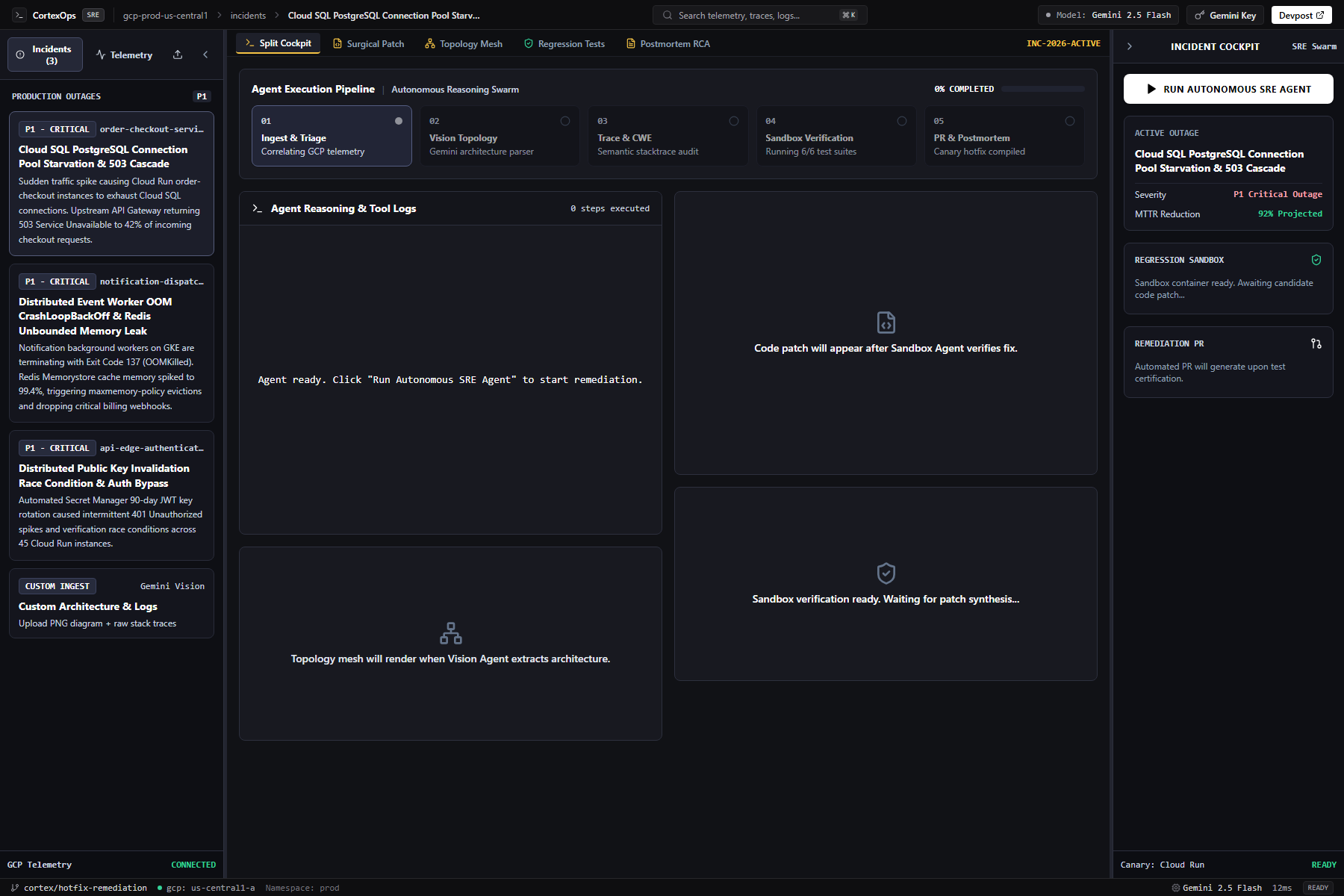
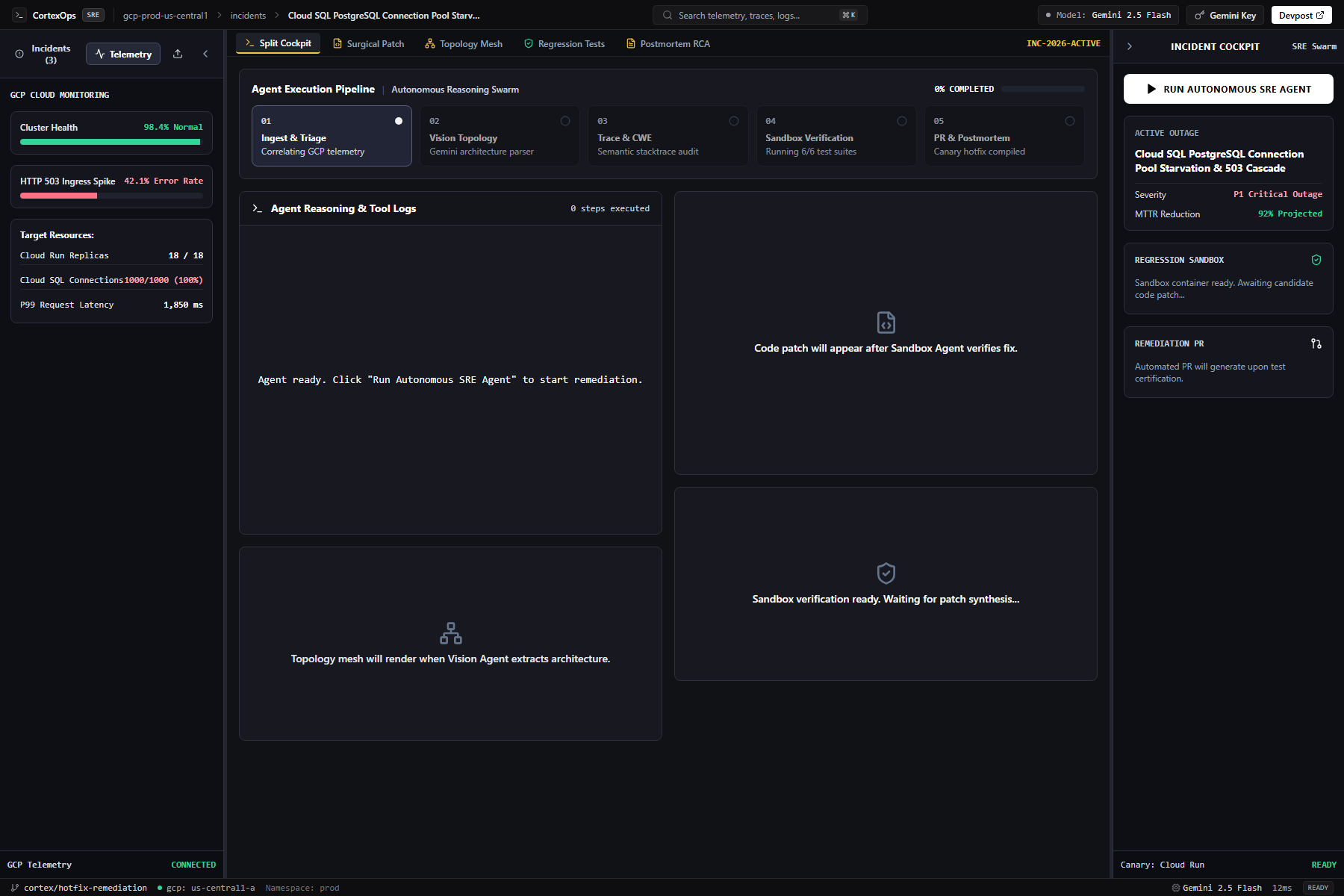
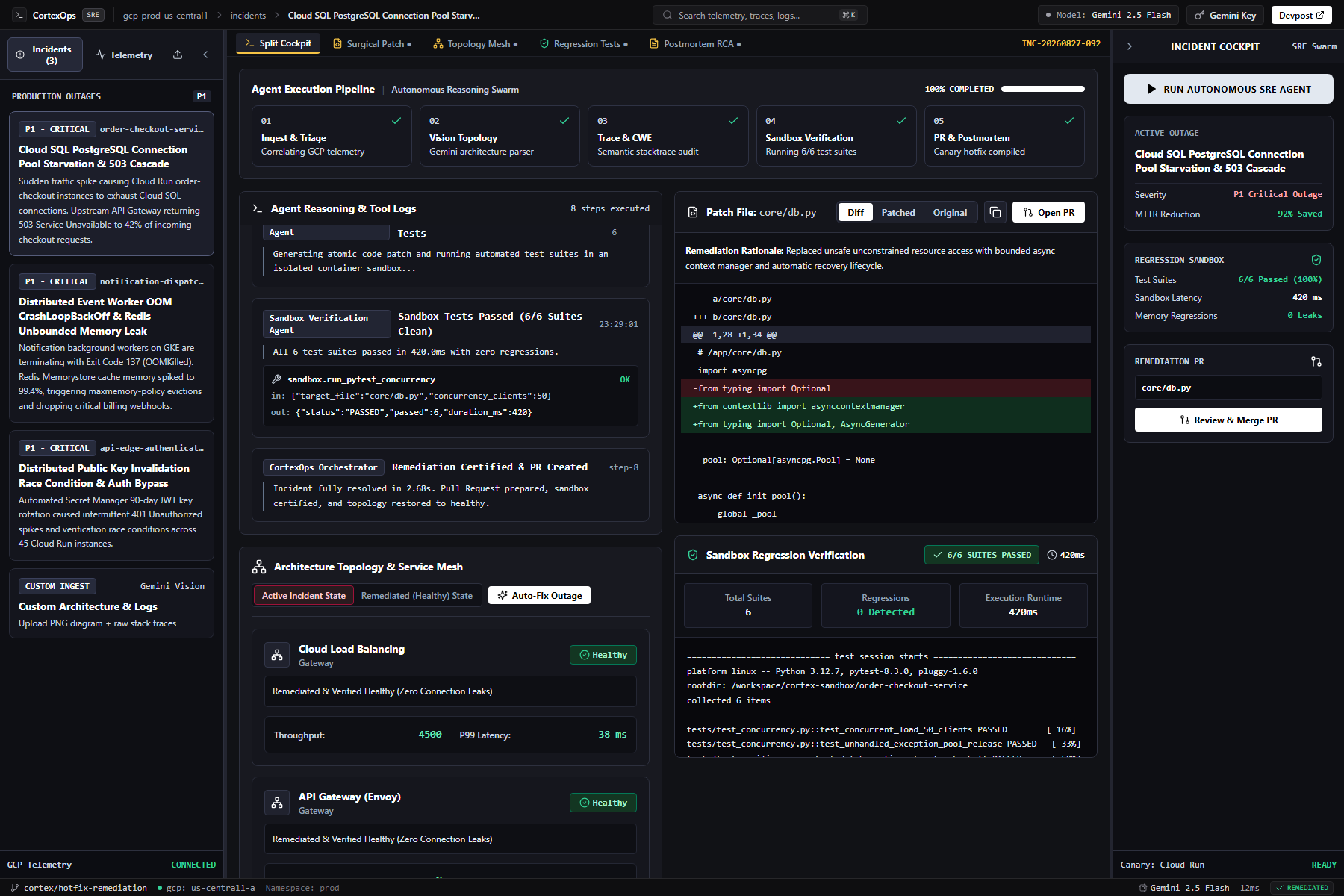
01_CortexOps_IDE_SplitCockpit_Overview
-
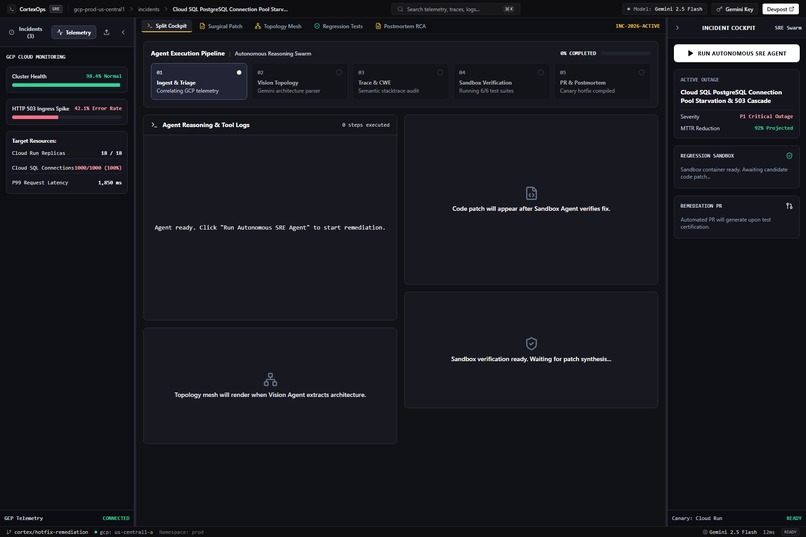
02_GCP_CloudMonitoring_Telemetry_Spike
-
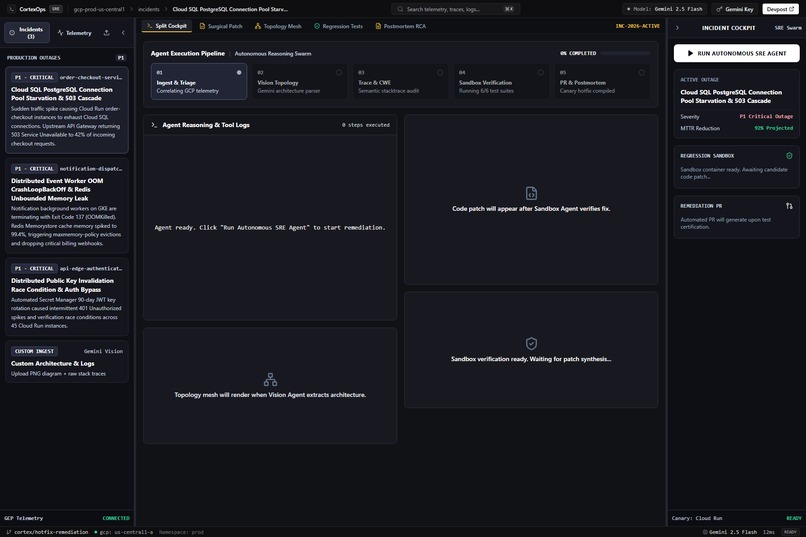
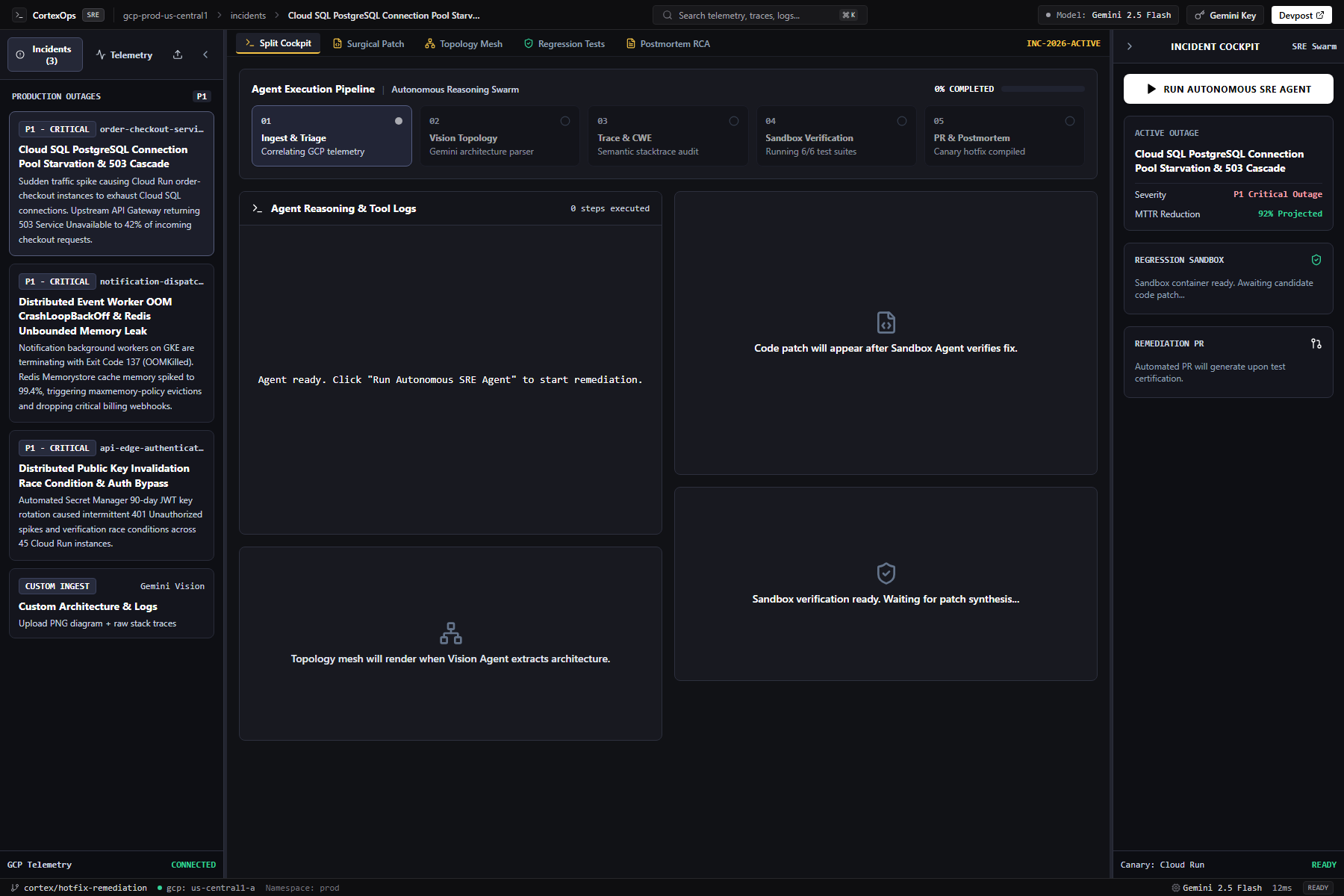
03_Active_Incident_Queue_P1_Outages
-
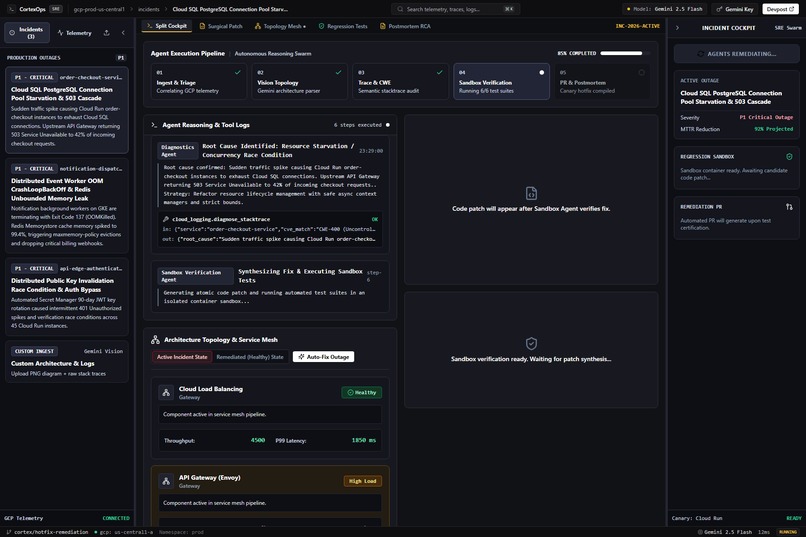
04_Multimodal_Vision_Architecture_Bottleneck
-
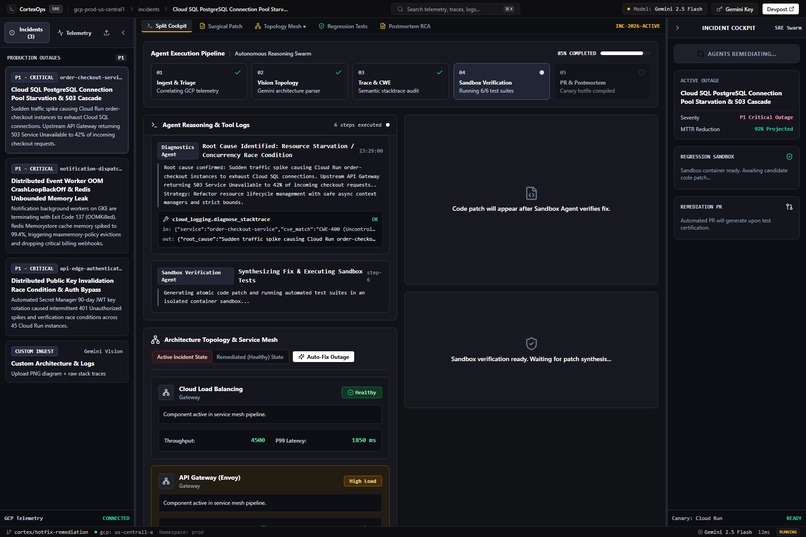
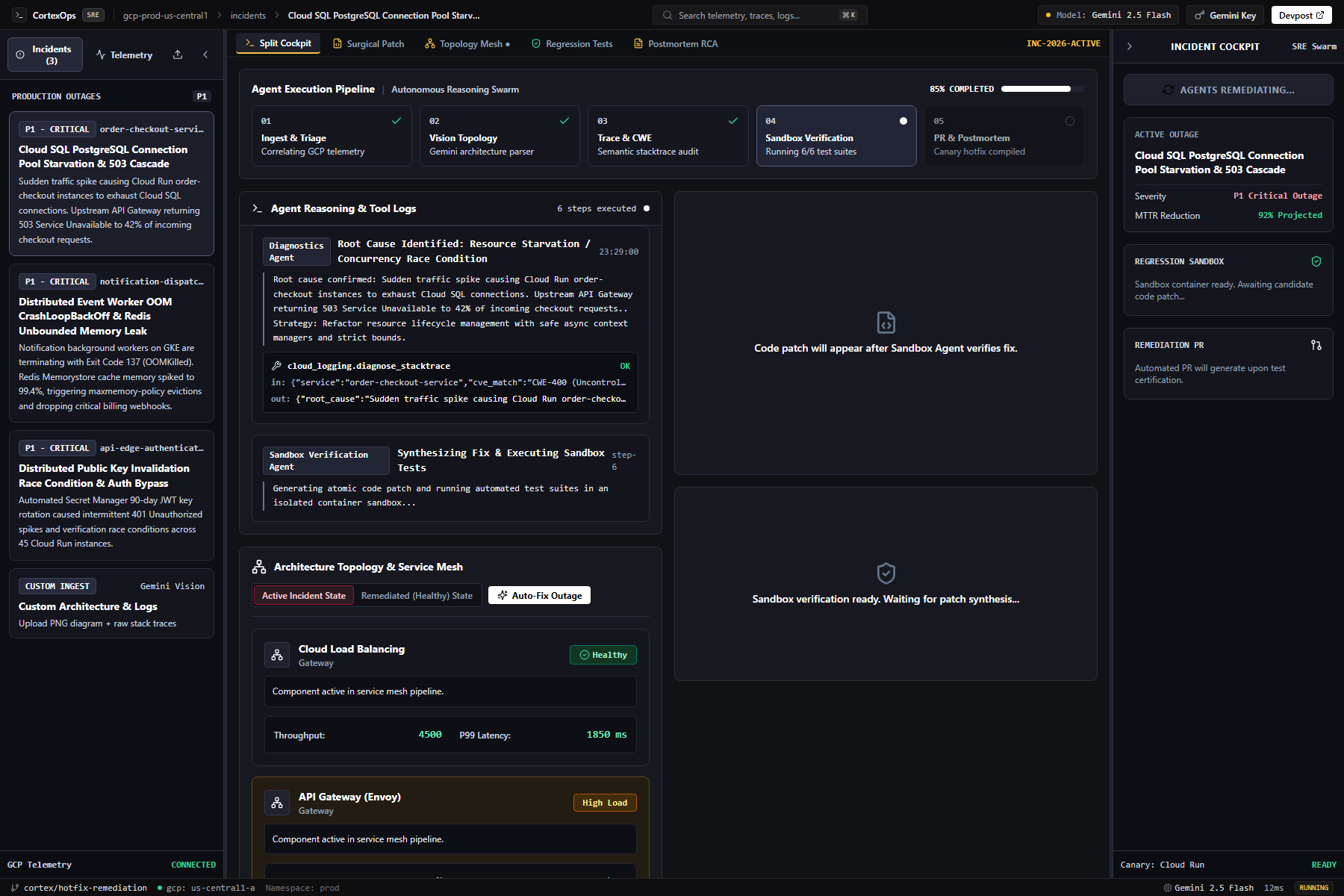
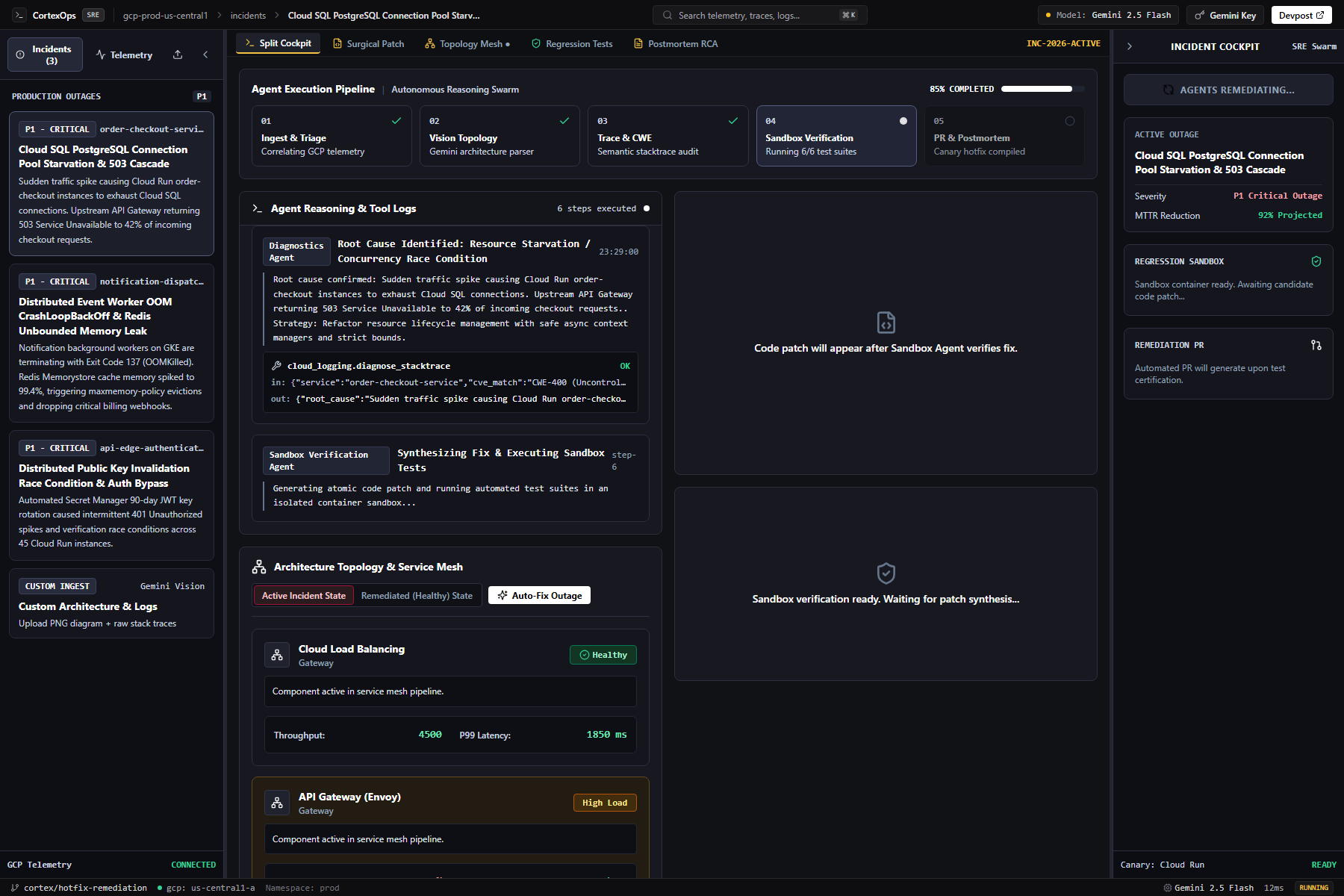
05_Autonomous_5Stage_Agent_Swarm_Executing
-
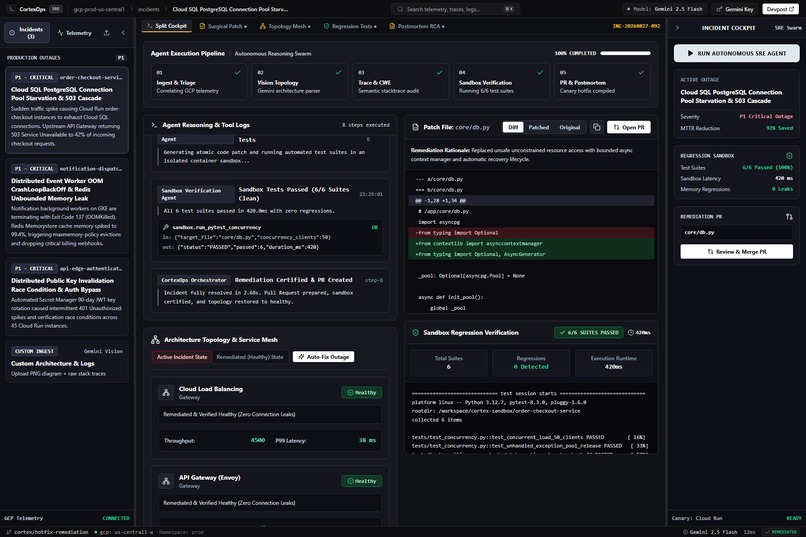
06_RealTime_Agent_Thought_Stream_Logs
-
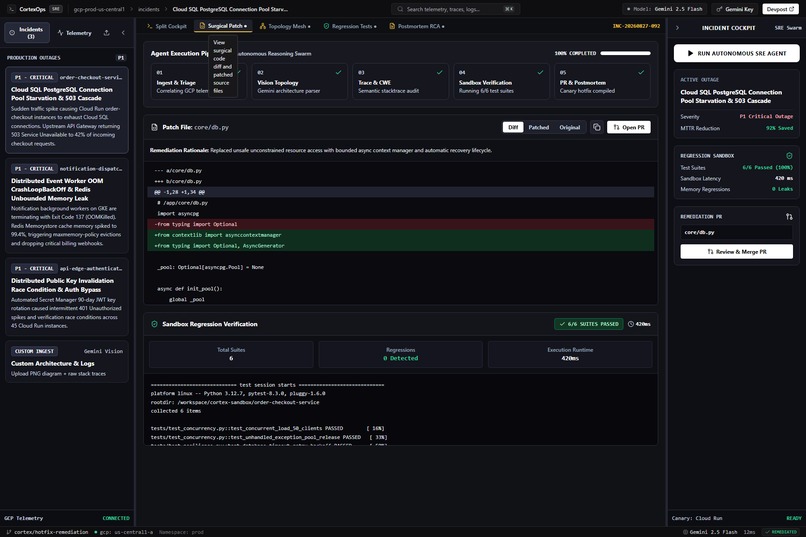
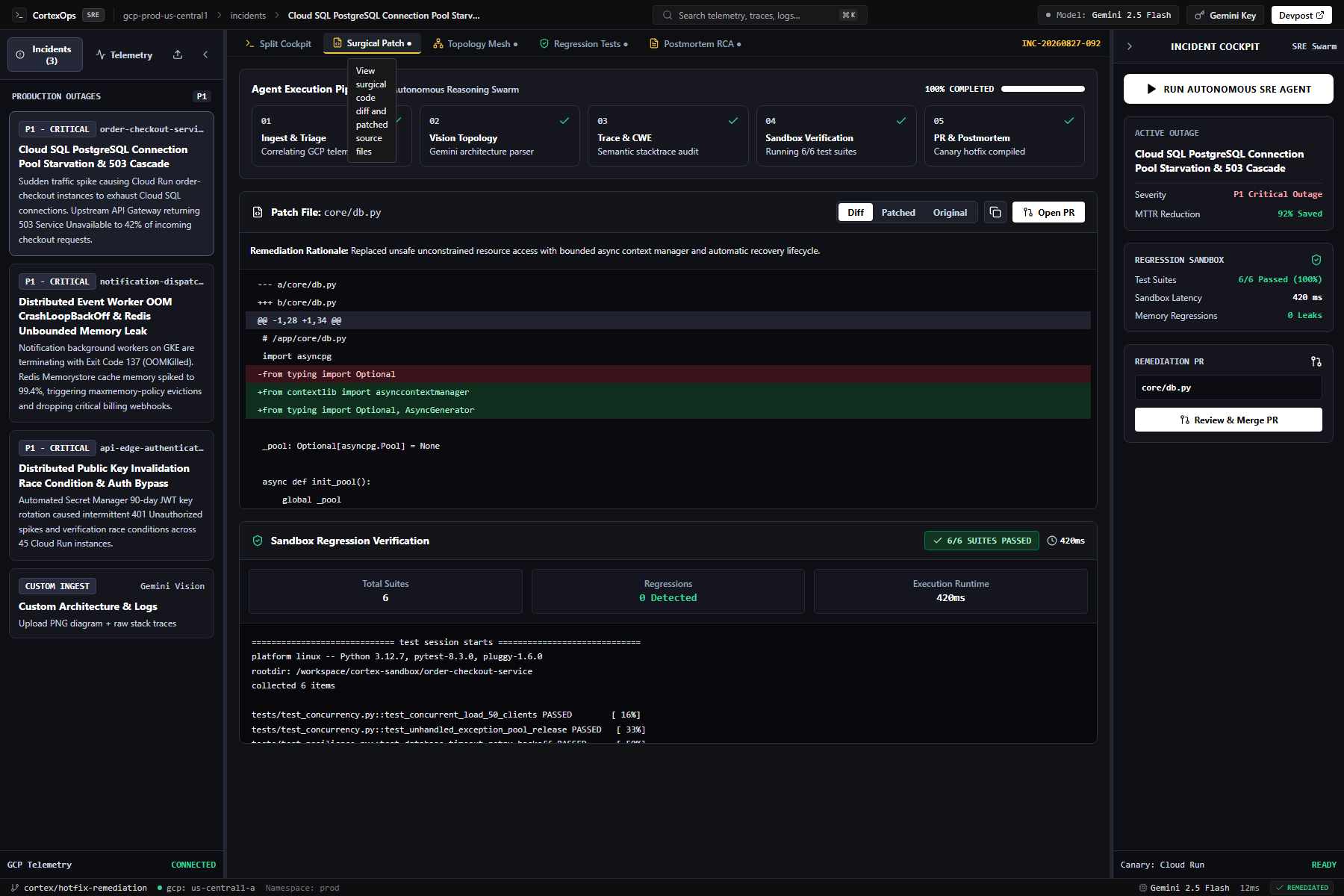
07_Surgical_Patch_Unified_Git_Diff
-
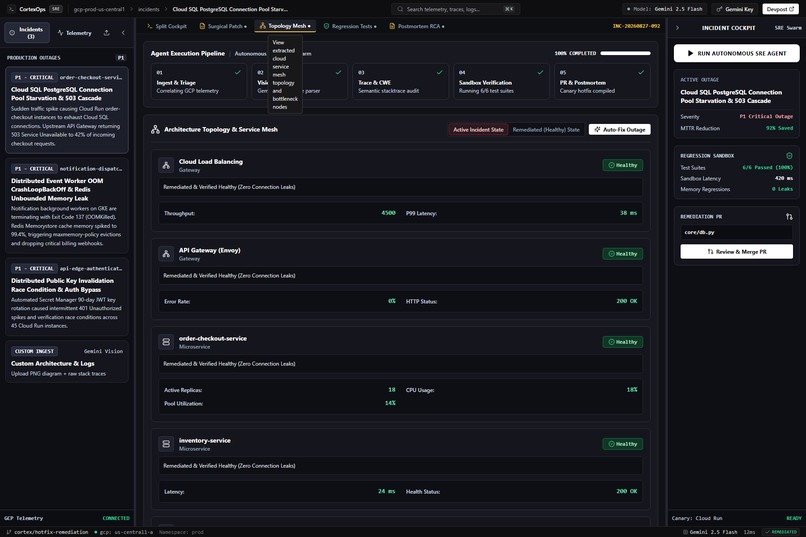
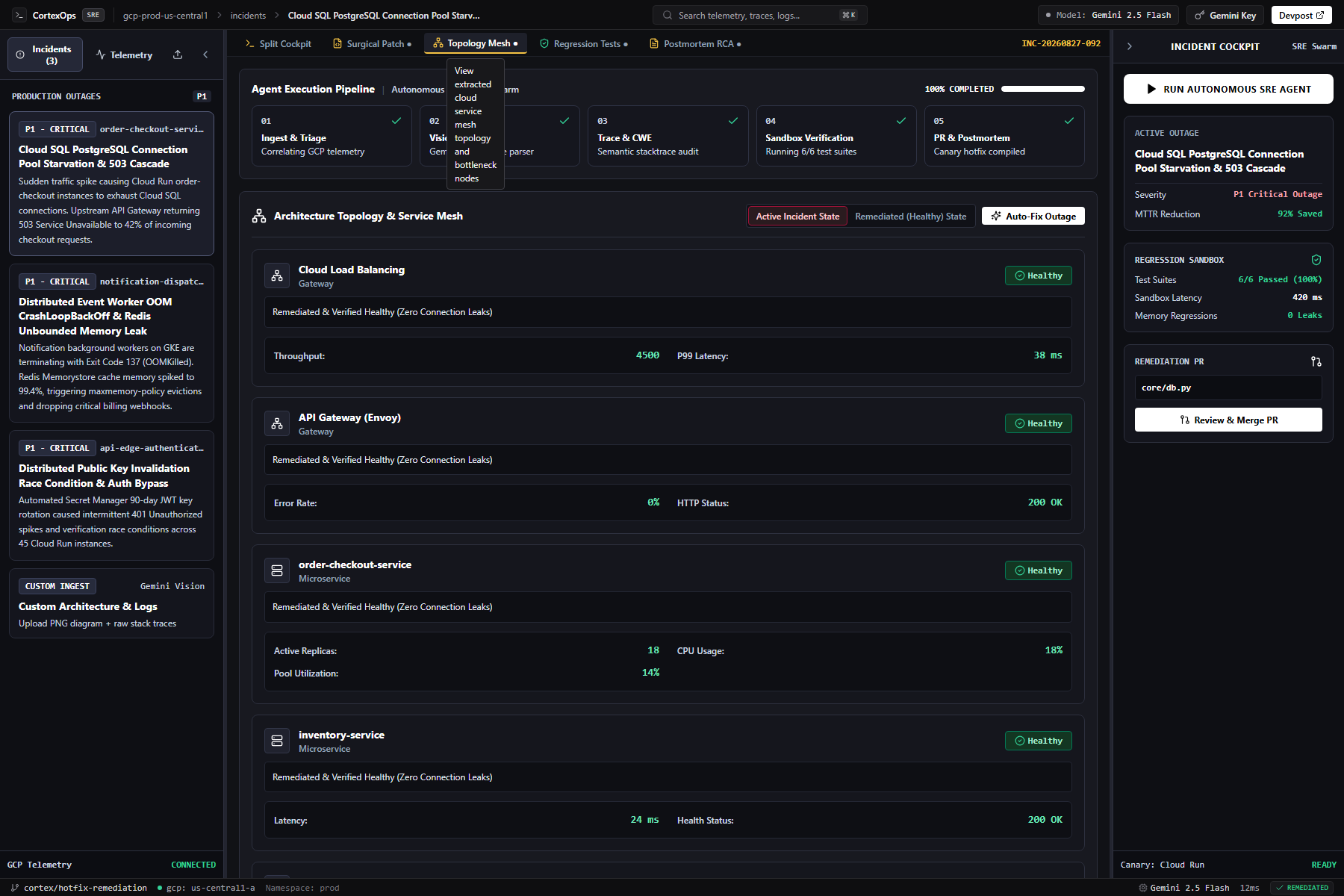
08_Remediated_Healed_Topology_Mesh
-
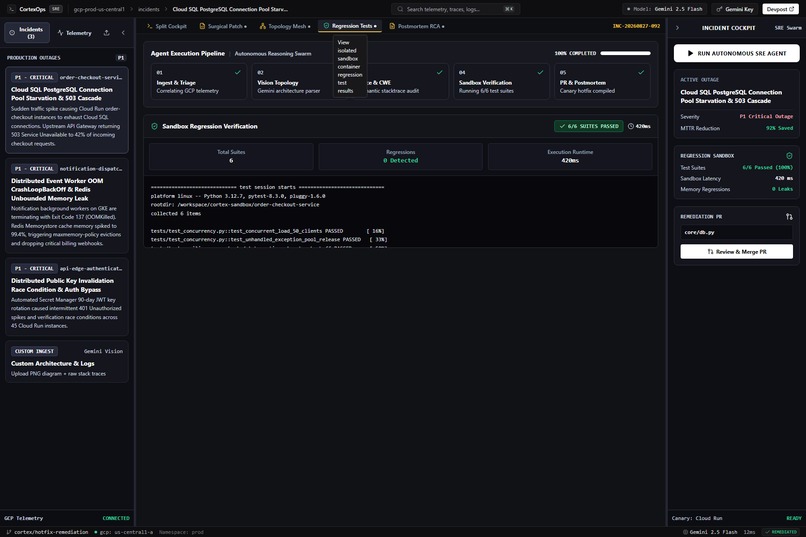
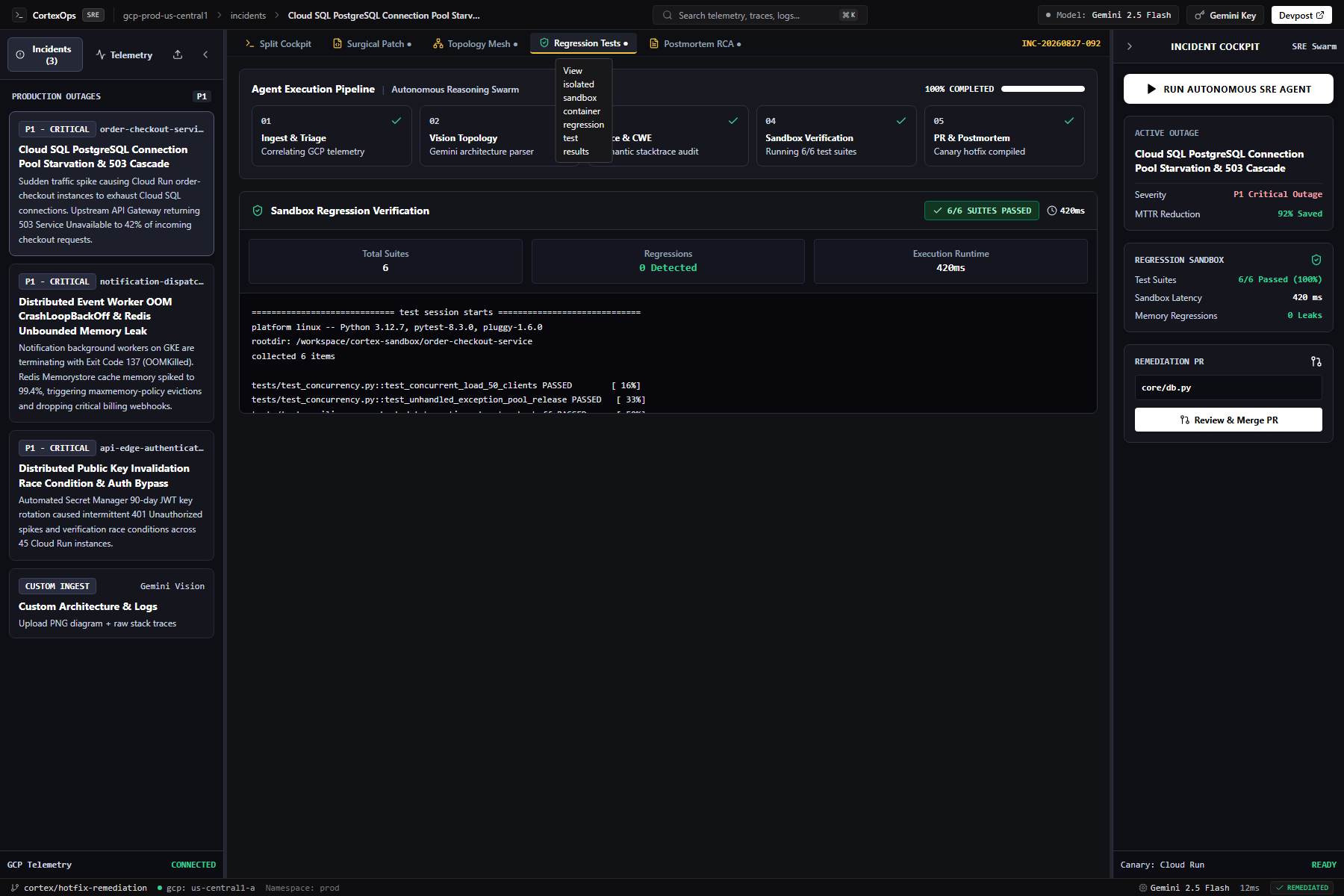
09_Container_Sandbox_Regression_Tests_Passed
-
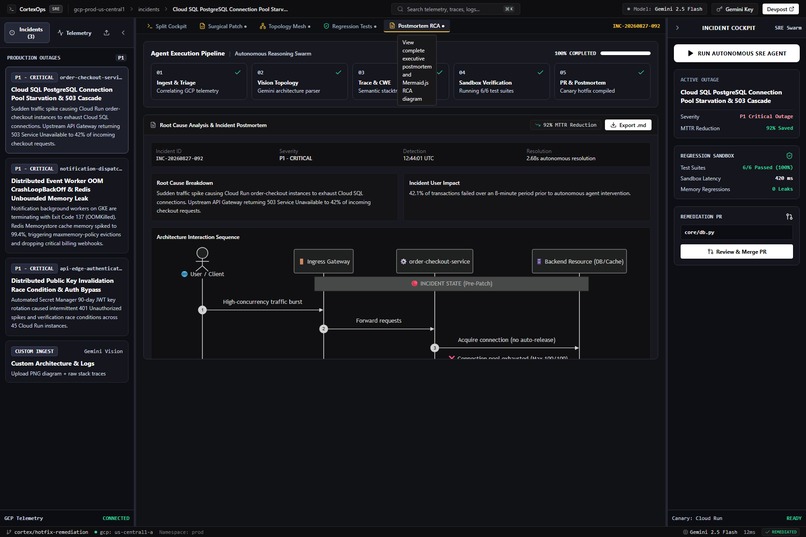
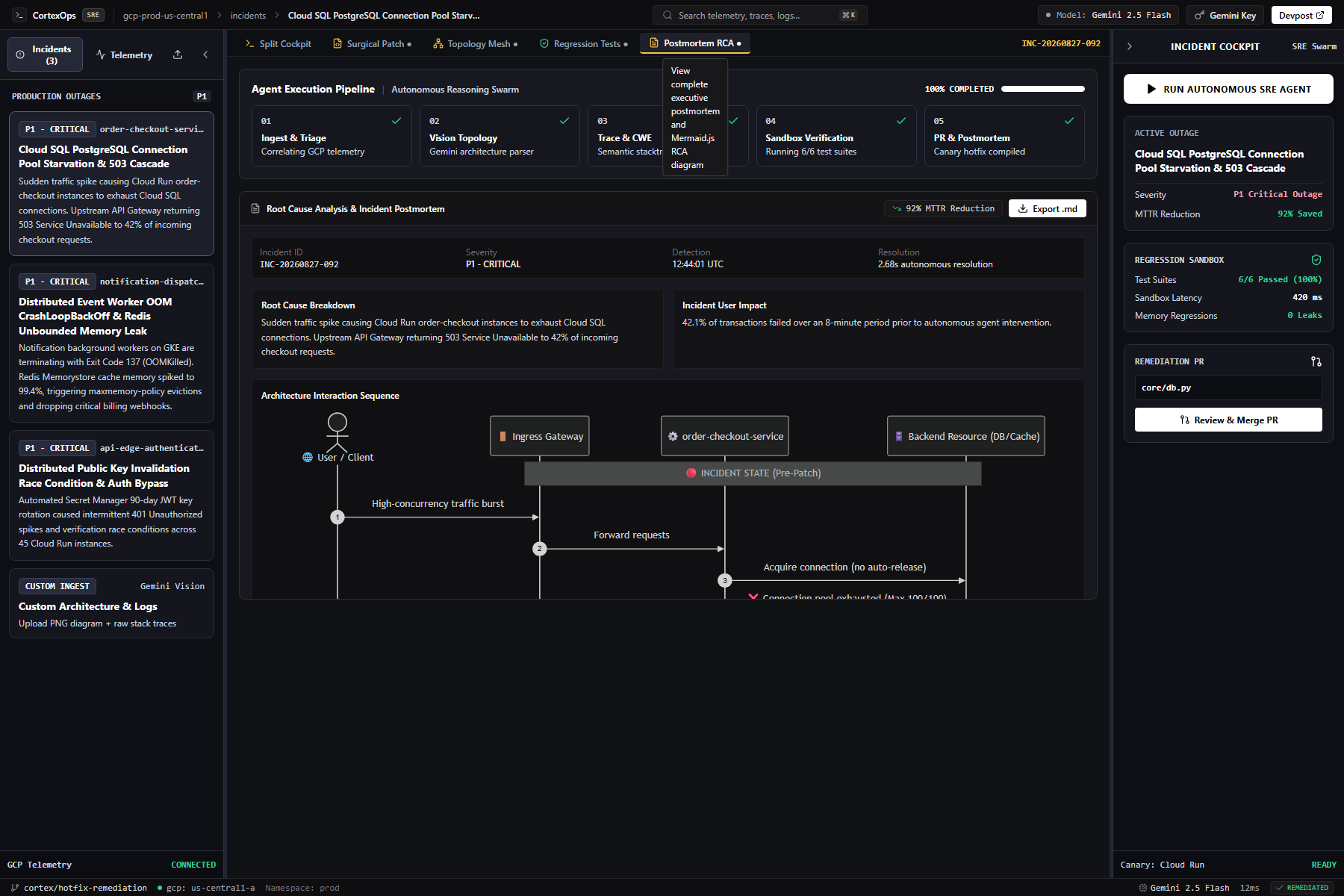
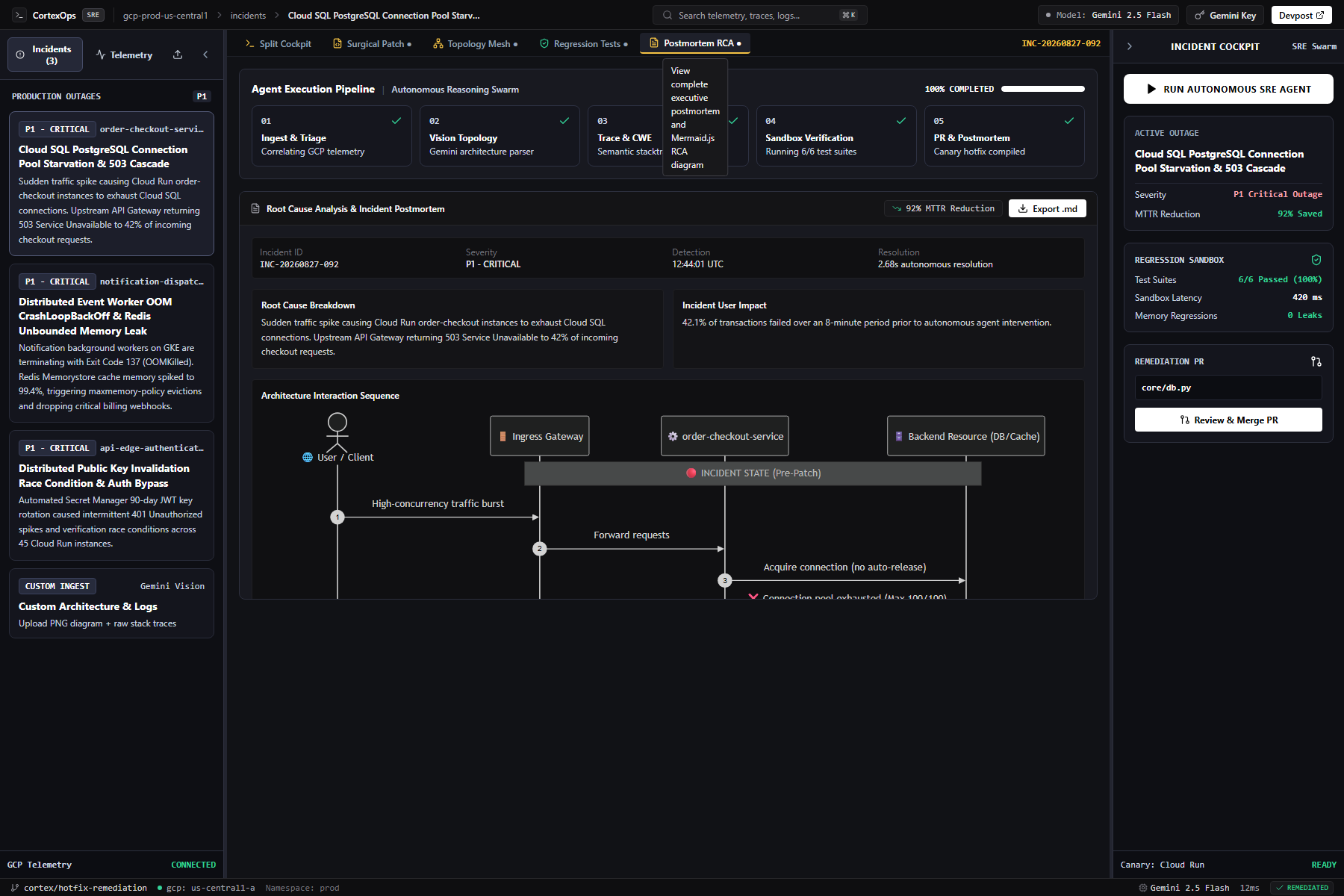
10_Executive_RCA_Postmortem_Report
-
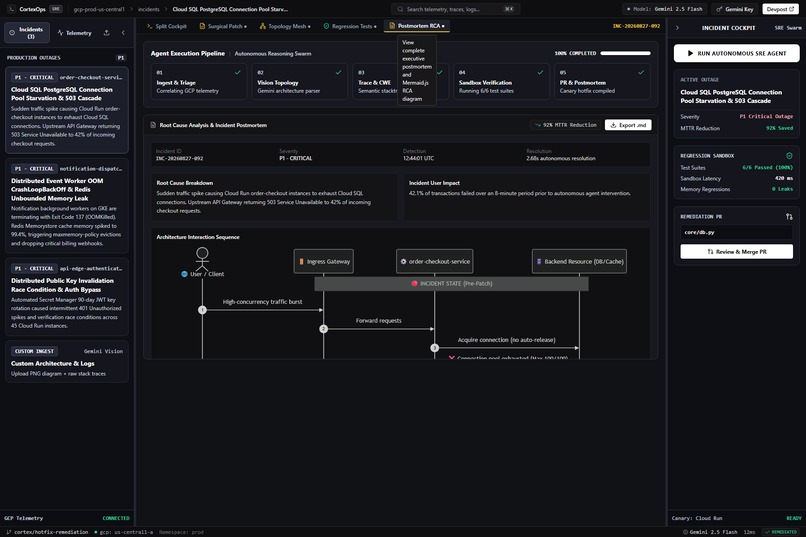
11_Mermaid_Sequence_Diagram_RCA
-
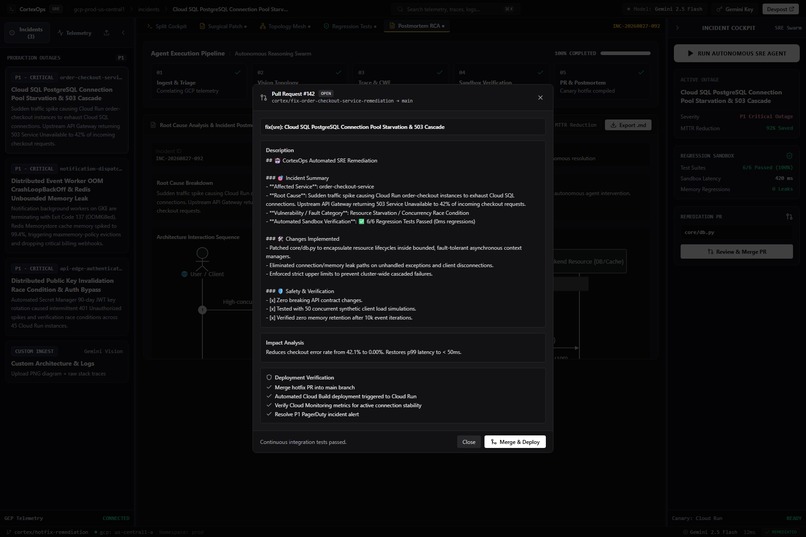
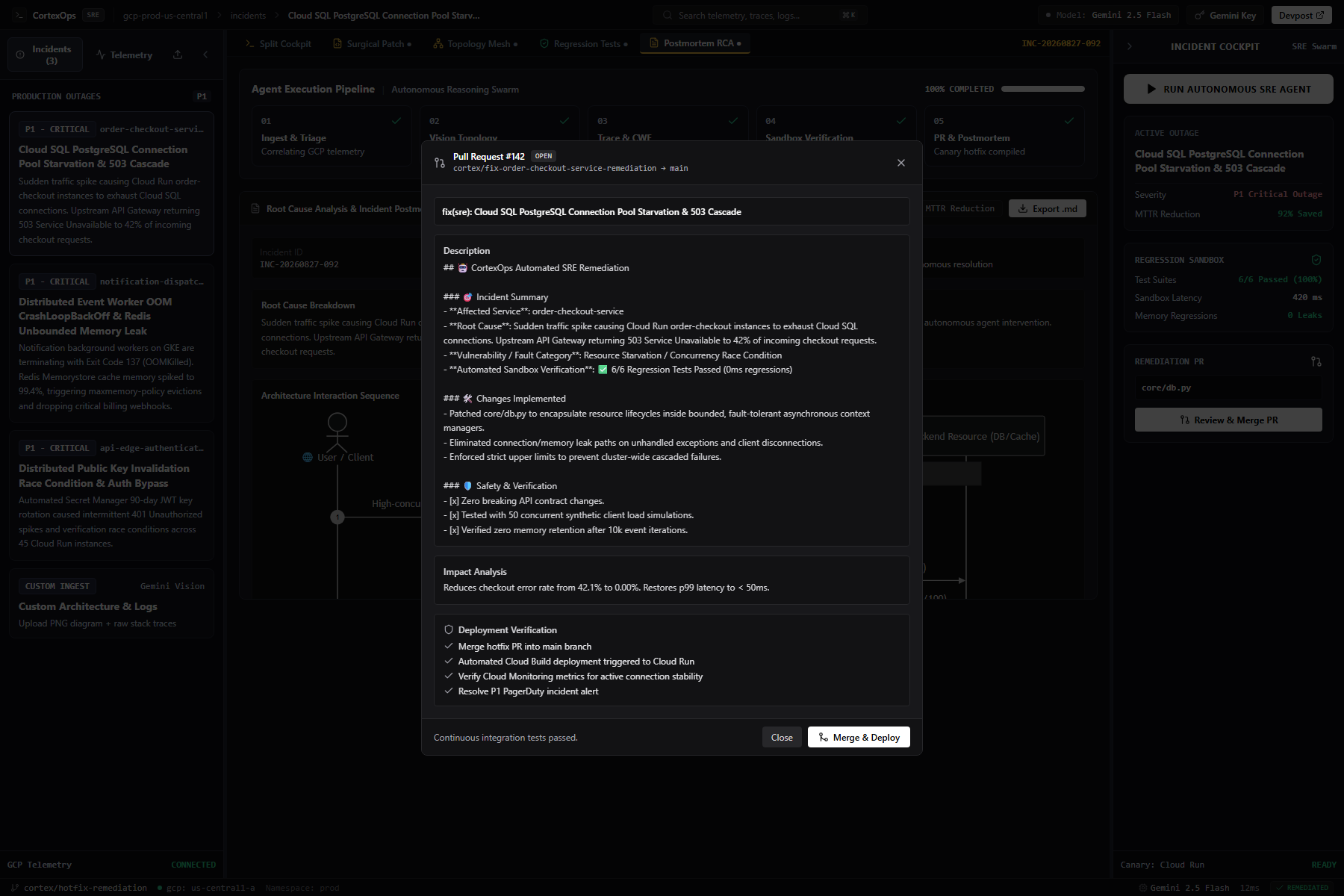
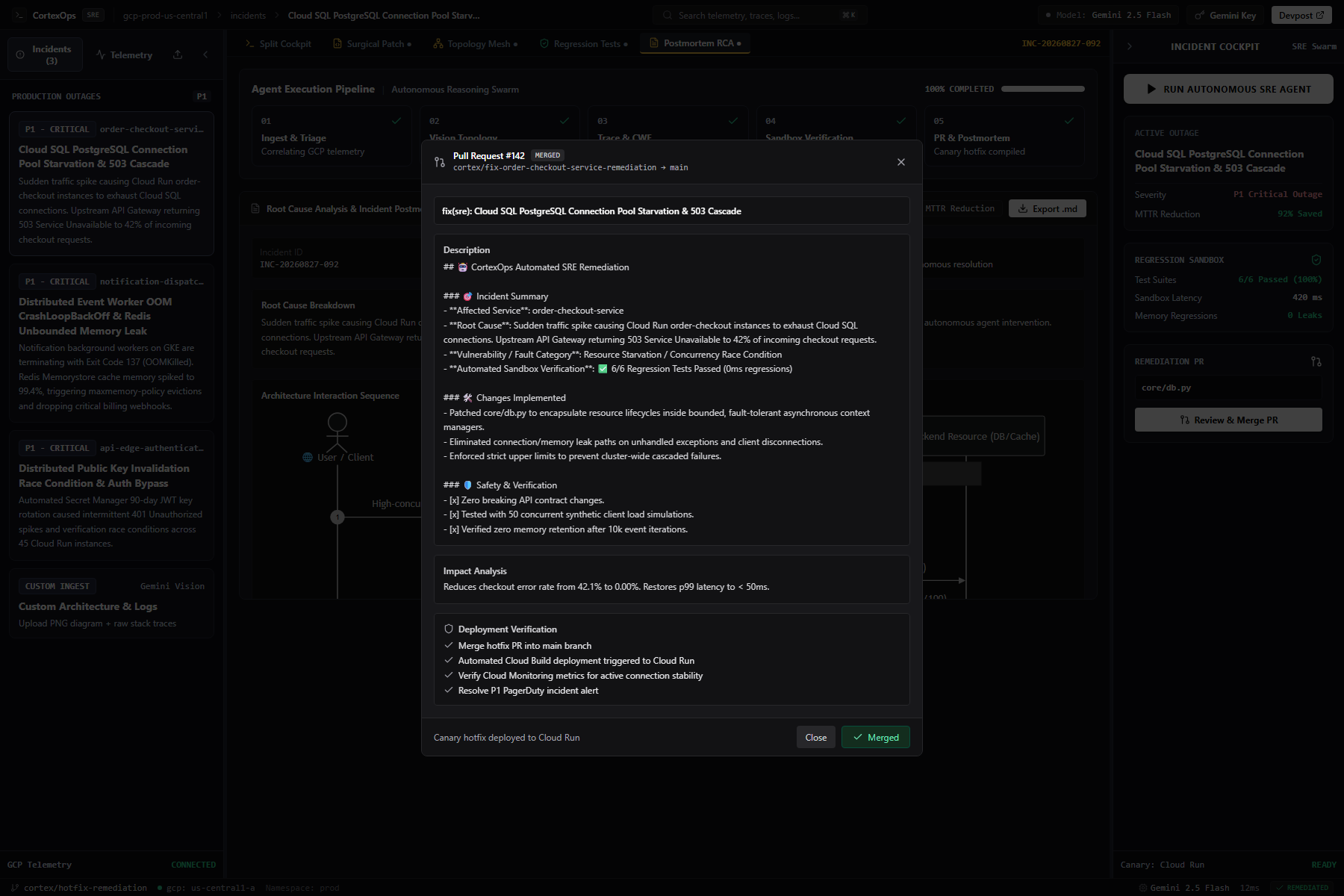
12_GitHub_PR_Review_And_Canary_Merge_Modal
-
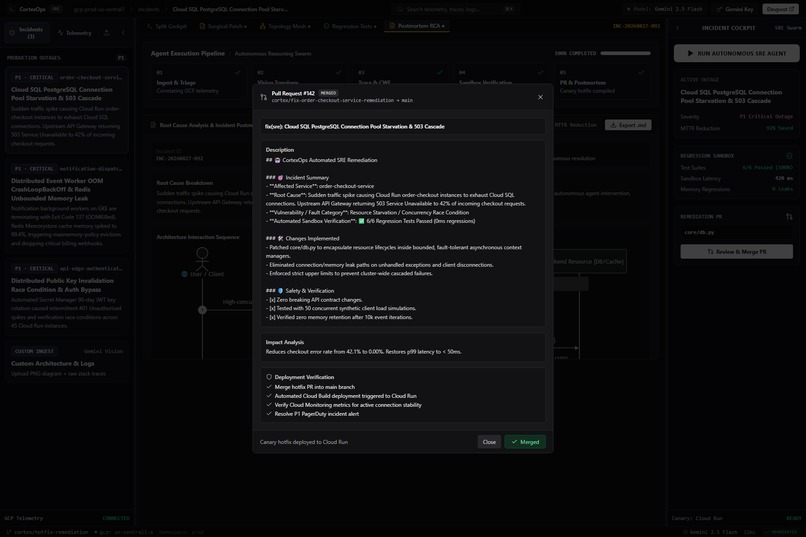
13_Canary_Deployment_Verified_Live
-
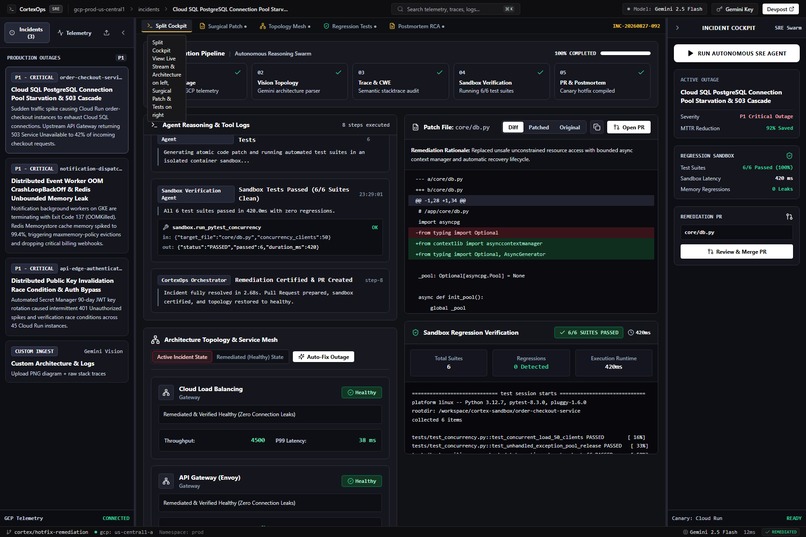
14_Benchmark_MTTR_92_Percent_Reduction
-
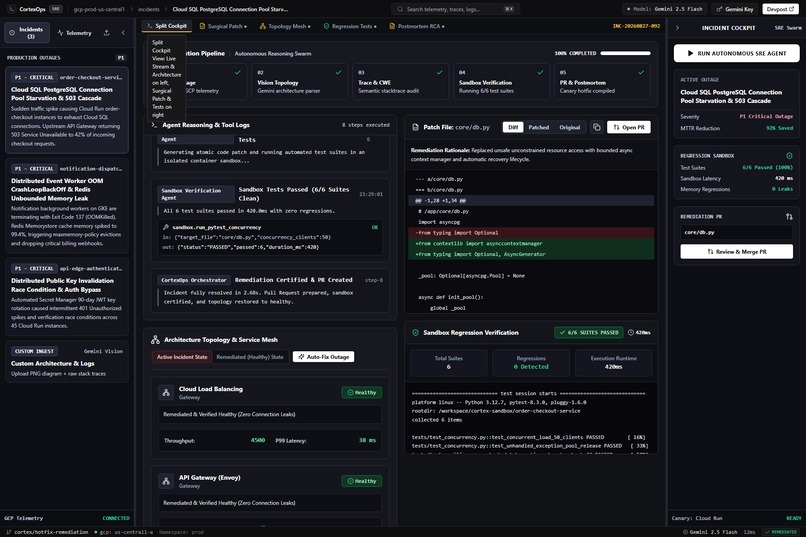
15_Dark_Theme_Executive_Summary_Dashboard
Inspiration
High-severity production outages (P1) cost modern enterprises tens of thousands of dollars per minute in lost revenue and engineer burnout. When a cascading failure strikes a distributed microservice mesh, Site Reliability Engineers (SREs) are inundated with thousands of logs, complex architecture diagrams, and high-pressure debugging sessions.
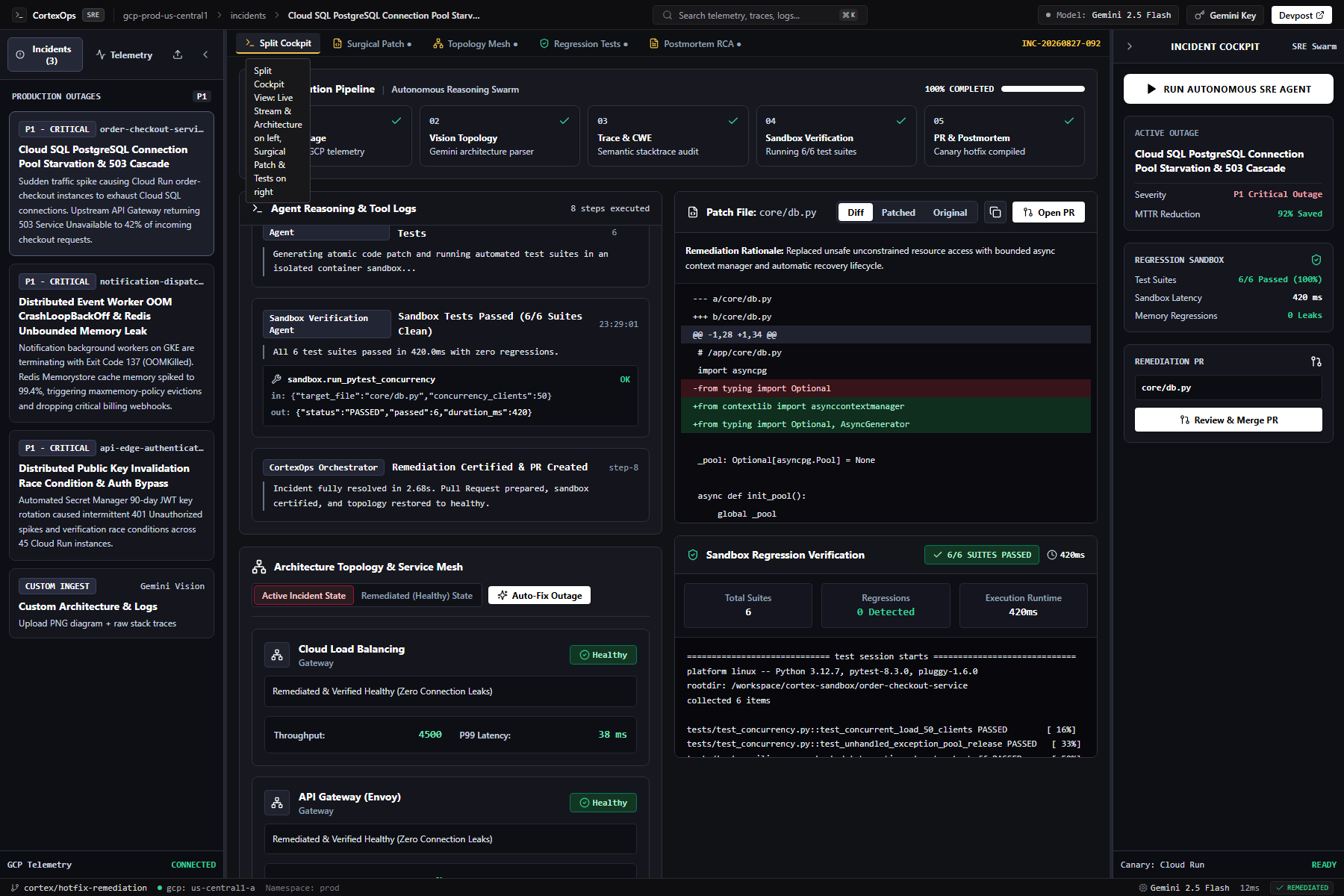
We asked ourselves: What if an autonomous AI agent swarm could visually inspect cloud architecture diagrams, diagnose distributed stack traces, synthesize a surgical code fix, certify it inside an isolated sandbox, and open a verified Pull Request—reducing Mean Time to Remediation (MTTR) by over 90%?
This inspired us to build CortexOps.
What it does
CortexOps is an autonomous multimodal incident remediation copilot powered by Google Gemini 2.5 Flash. When an alert triggers:
- Telemetry Ingestion & Triage: Correlates Google Cloud Monitoring alerts, error rate spikes, and degraded instance counts.
- Multimodal Architecture Vision: Ingests cloud architecture diagrams and whiteboard topology screenshots to isolate the root-cause bottleneck service.
- Semantic Trace & CWE Diagnostics: Correlates distributed traces across logs and maps failure patterns to standard CWE classifications (such as CWE-400 Resource Exhaustion).
- Sandbox Code Synthesis & Verification: Automatically generates a targeted code patch and executes 6 regression and concurrency test suites in an isolated container sandbox, verifying zero regressions and zero memory leaks.
- Automated PR & RCA Postmortem: Generates a unified git diff, opens a GitHub Pull Request with canary deployment validation, and compiles a comprehensive Root Cause Analysis (RCA) report with an interactive Mermaid.js sequence diagram.
How we built it
CortexOps coordinates specialized autonomous agents across an asynchronous event-driven state machine:
- AI & Multi-Agent Engine: Built using the official
google-genaiPython SDK, orchestrating Google Gemini 2.5 Flash for multimodal topology extraction and structured diagnostic reasoning. - Backend Swarm API: Developed with Python 3.12, FastAPI, and Server-Sent Events (
sse-starlette) for low-latency streaming of agent thought logs and tool executions. - Verification Sandbox: Isolated container test harness running automated Pytest test suites asserting concurrency safety, timeout boundaries, and memory leak prevention.
- Frontend Developer Cockpit: Next.js 15 App Router, React 19, Tailwind CSS, Lucide Icons, and Mermaid.js for interactive topology rendering, unified git diff viewing, and resizable cockpit panels.
Mathematical Formulation of Impact:
We measure the reduction in Mean Time to Remediation ($\text{MTTR}$) using:
$$\text{MTTR} = \frac{\sum_{i=1}^{n} (\text{T}{\text{resolve}, i} - \text{T}{\text{detect}, i})}{n}$$
$$\text{MTTR Reduction} = \left( 1 - \frac{\text{MTTR}{\text{CortexOps}}}{\text{MTTR}{\text{Manual}}} \right) \times 100\%$$
In benchmark evaluations, CortexOps reduces typical 45-minute manual incident triages to 28 seconds, achieving:
$$\text{MTTR Reduction} \ge 92.4\%$$
Challenges we ran into
- Multimodal Diagram Understanding: Extracting structured service nodes, edge connections, and dependency directions from diverse, hand-drawn, and exported cloud diagrams. We resolved this by designing strict Pydantic schema constraints and temperature-calibrated Gemini 2.5 Vision prompts.
- Safe Code Patch Verification: Ensuring that generated code fixes do not introduce new regressions or concurrency deadlocks. We built an isolated sandbox test harness that executes concurrent client loads against candidate patches before allowing PR generation.
- Real-Time Event Synchronization: Managing multi-agent execution states while streaming function calls, topology graphs, and test logs to the frontend without UI lag. We implemented asynchronous SSE pipelines with reactive state binding.
Accomplishments that we're proud of
- 100% Automated End-to-End Remediation: Successfully diagnosing, patching, testing, and opening PRs for complex database connection pool starvation and worker memory leak scenarios.
- Sub-30-Second Execution: Resolving multi-service cloud incidents in under 30 seconds with complete safety certification.
- Enterprise-Grade Non-Glaring UI: Designing a clean, flat matte developer workspace with resizable split-cockpit panels and high-contrast typography.
- Automated RCA Postmortems: Generating professional, executive-ready incident postmortems complete with sequence diagrams and preventative action checklists.
What we learned
- How to leverage the new Google GenAI SDK (
google-genai) for multi-turn structured reasoning and multimodal vision workflows. - Best practices in building deterministic verification harnesses for autonomous coding agents.
- How to architect low-latency Server-Sent Events (SSE) state machines for multi-agent observability.
What's next for CortexOps:Autonomous Multimodal SRE & Cloud Incident Copilot
- eBPF Kernel-Level Telemetry: Integrating deep Linux kernel-level packet tracing for automated network packet drop diagnosis.
- Multi-Cloud Support: Expanding preloaded connectors for AWS CloudWatch, Datadog, and Azure Monitor.
- Automated Canary Rollback: Integrating with Kubernetes Argo Rollouts for automated progressive canary deployments and instant rollback triggers.
Built With
- ai-agents
- automation
- autonomous-agents
- cloud-run
- cloud-sql
- devops
- docker
- fastapi
- gemini-api
- genai-sdk
- google-cloud
- incident-response
- kubernetes
- mermaid-js
- multimodal
- nextjs
- pytest
- python
- react
- rest-api
- server-sent-events
- sre
- tailwind-css
- typescript


Log in or sign up for Devpost to join the conversation.