-
-
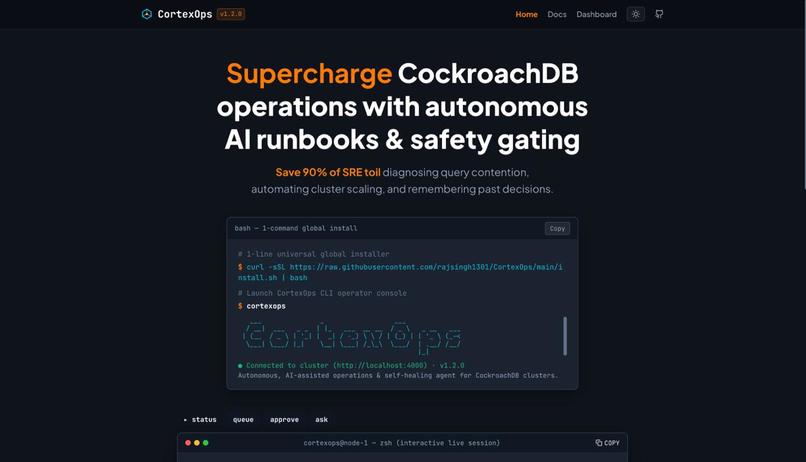
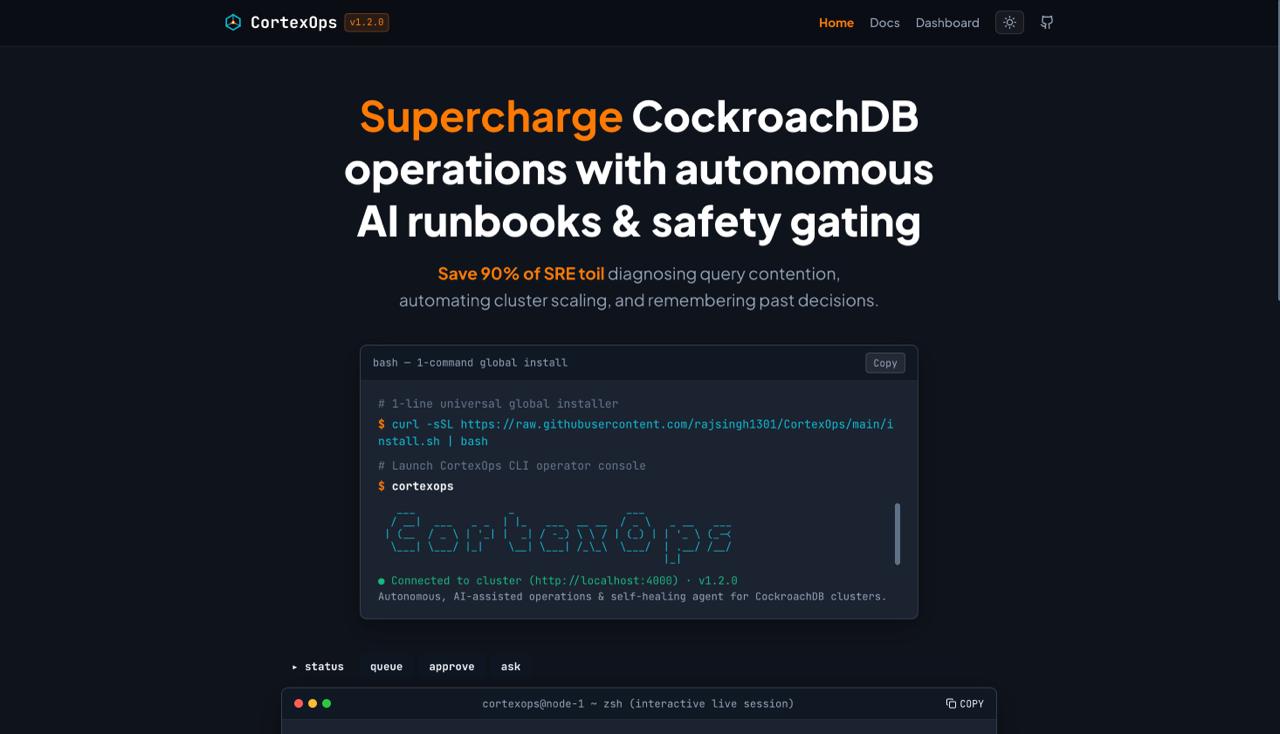
Landing Page
-
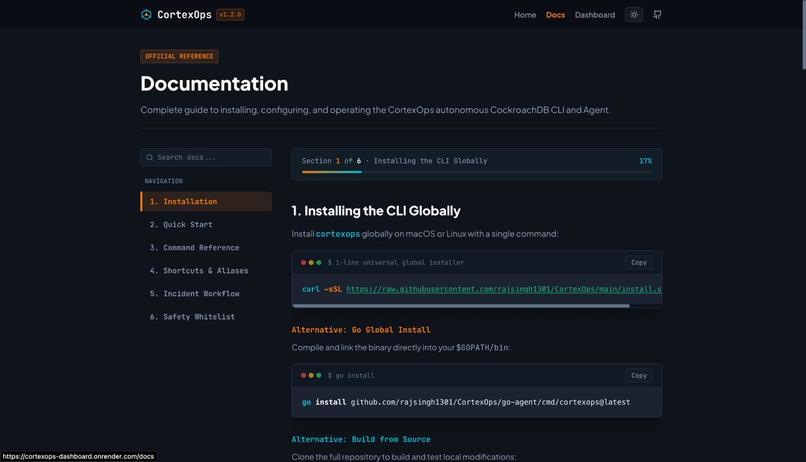
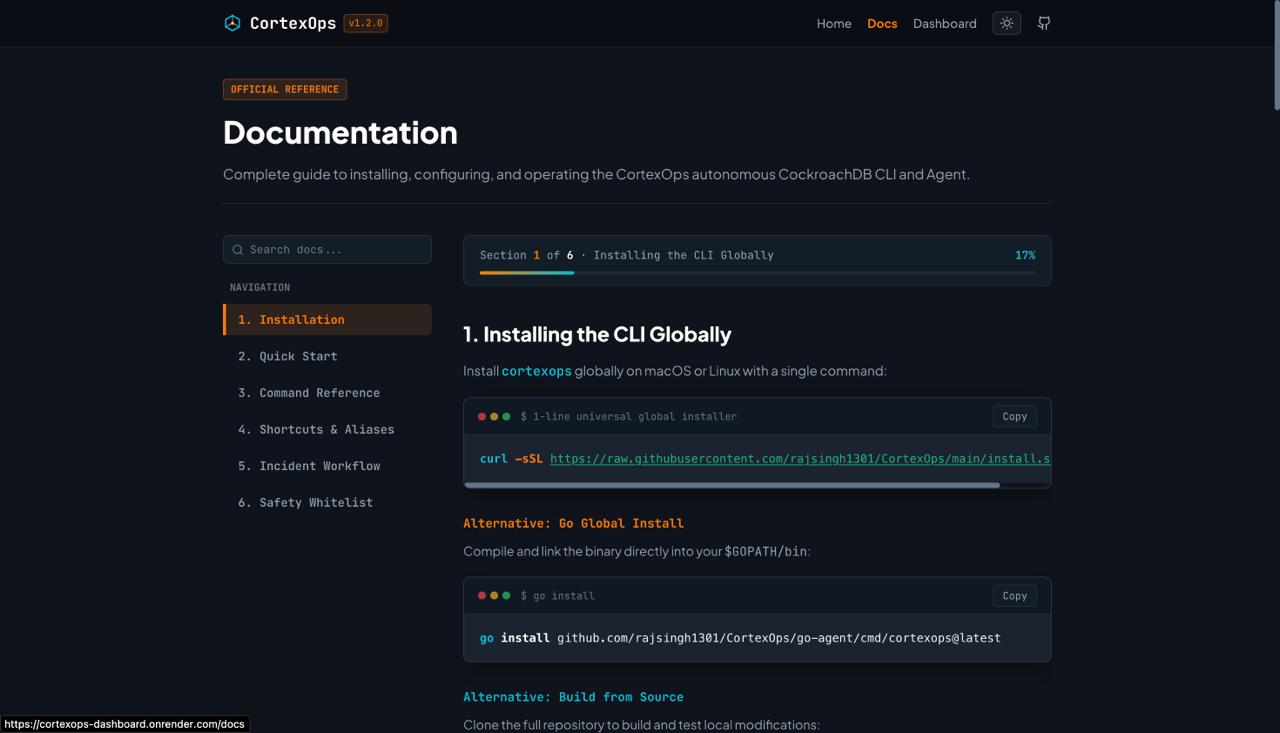
Doc page
-
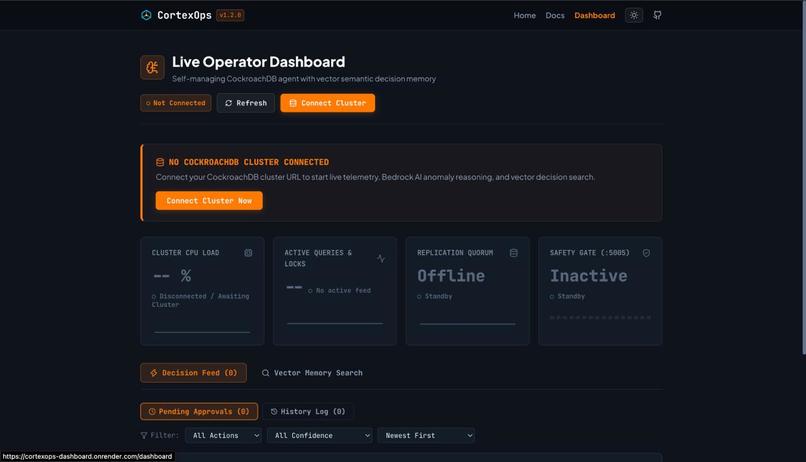
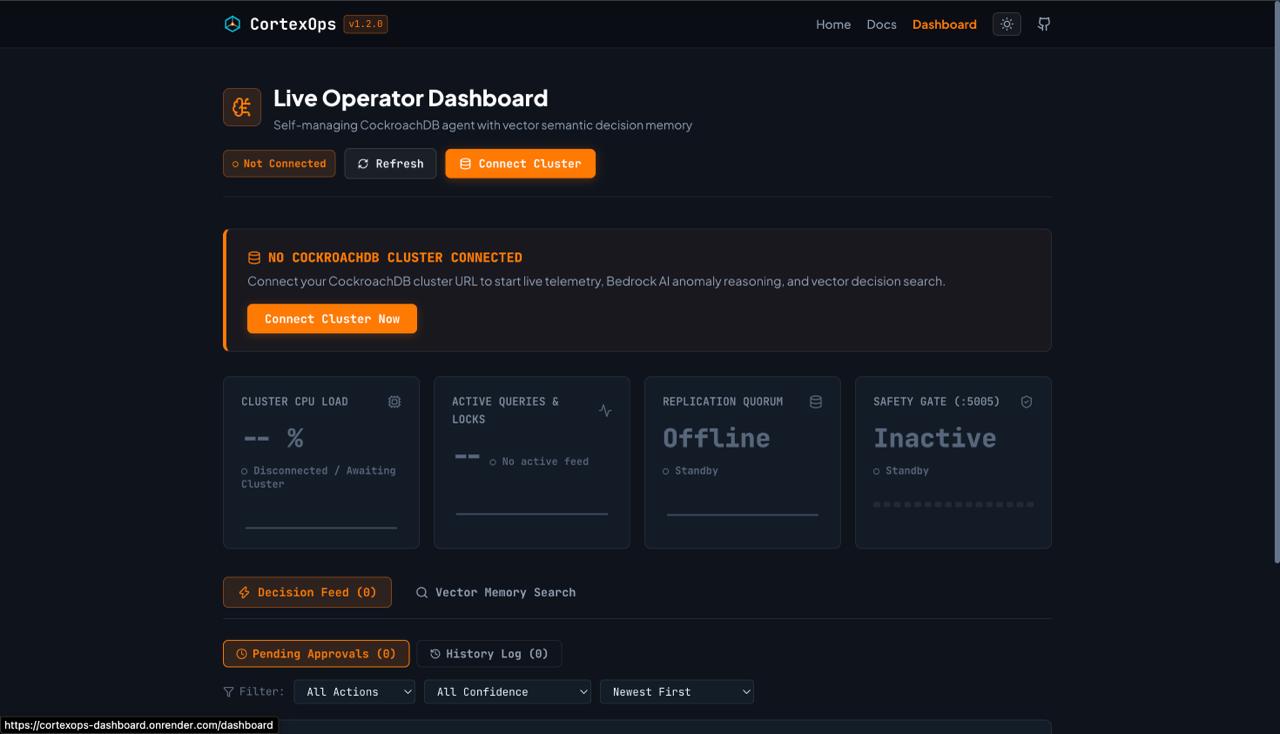
dashboard
-
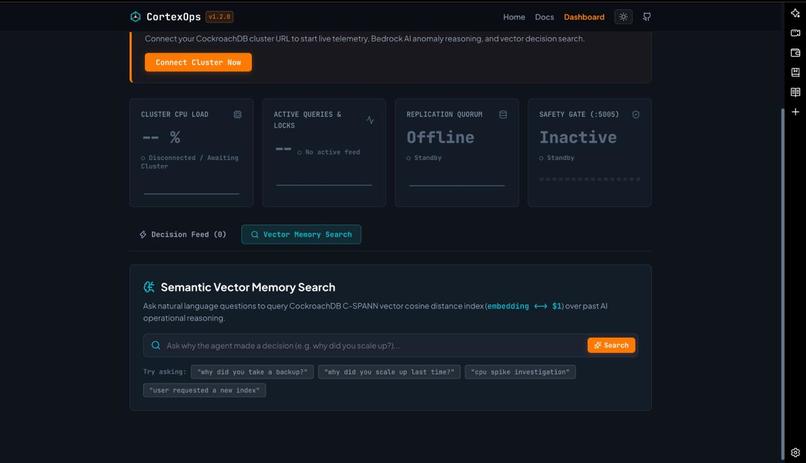
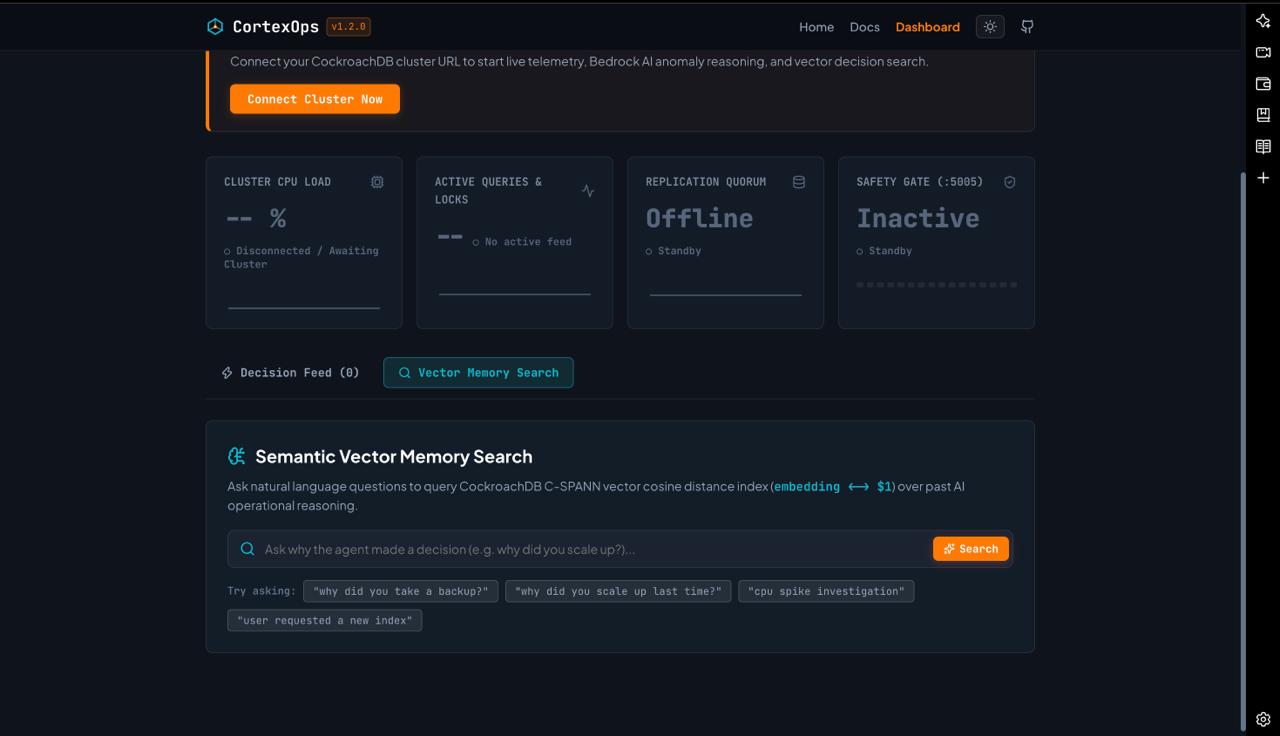
vector search
-
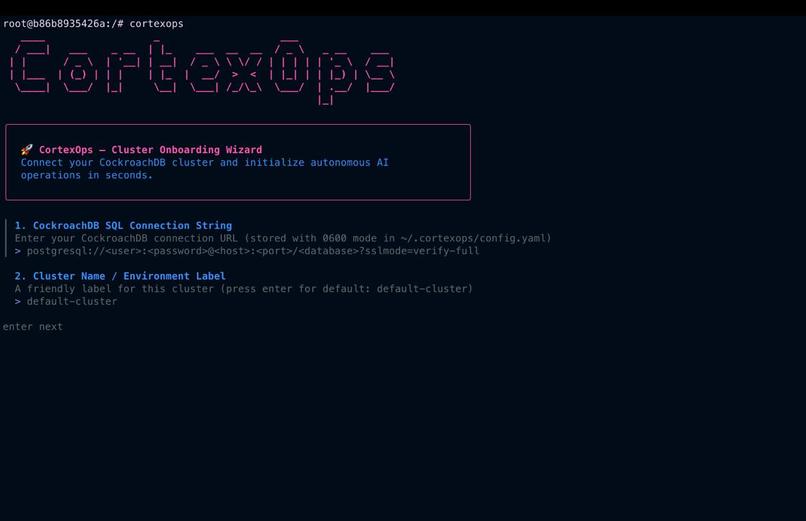
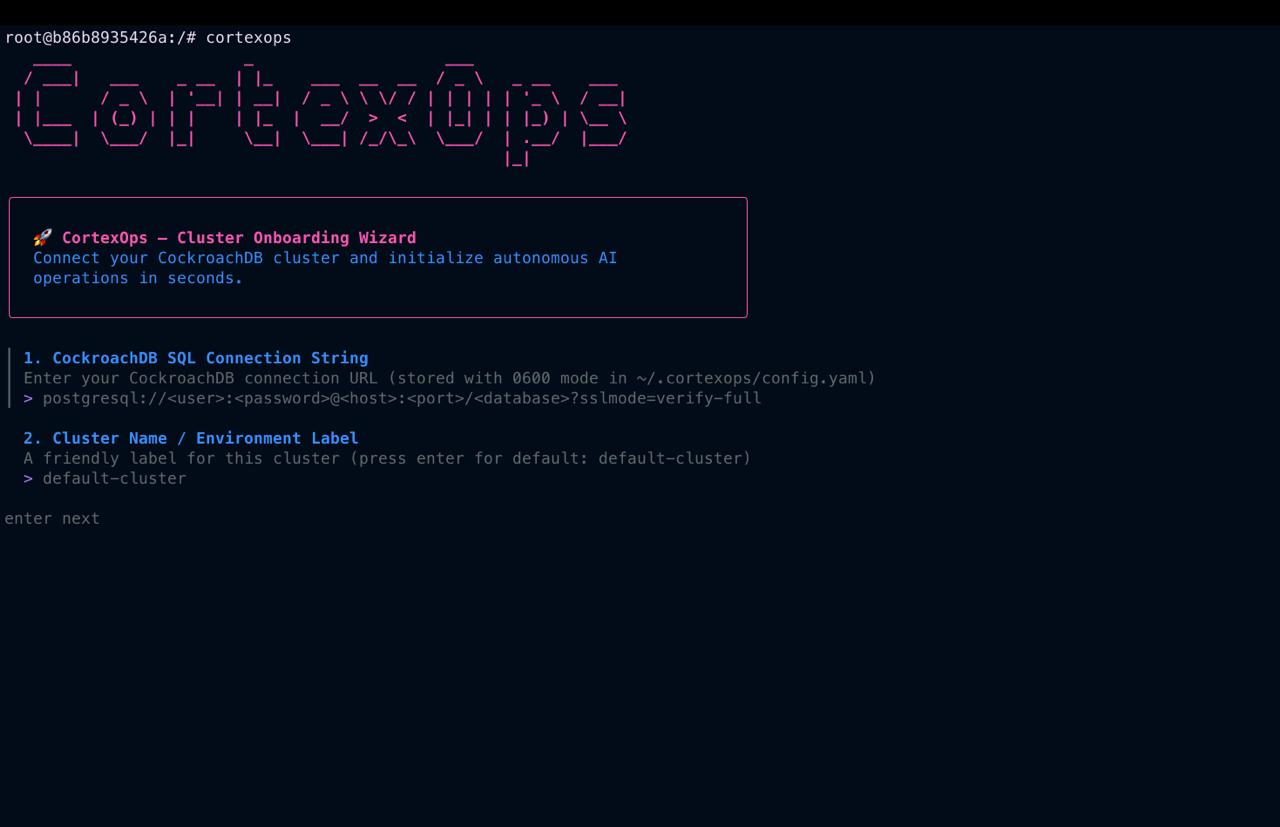
CLI tool
-
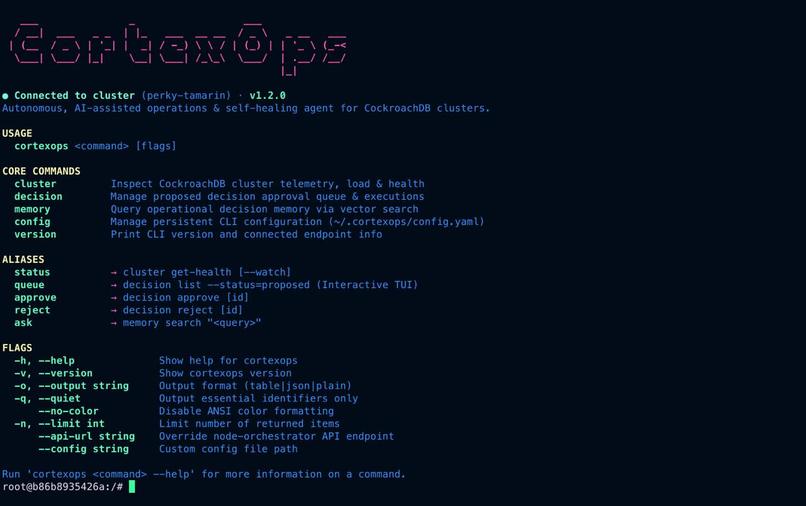
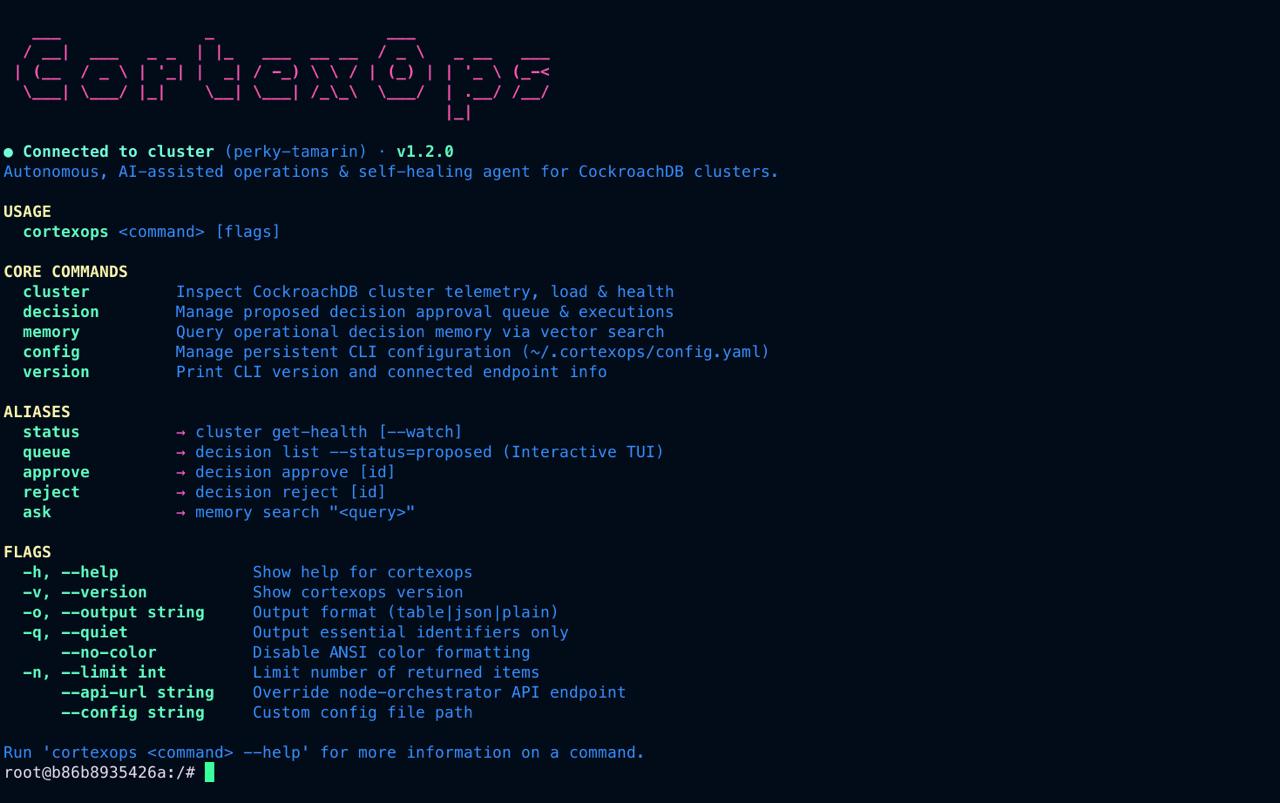
All commands
-
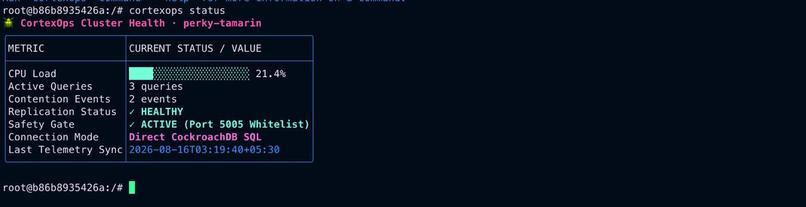
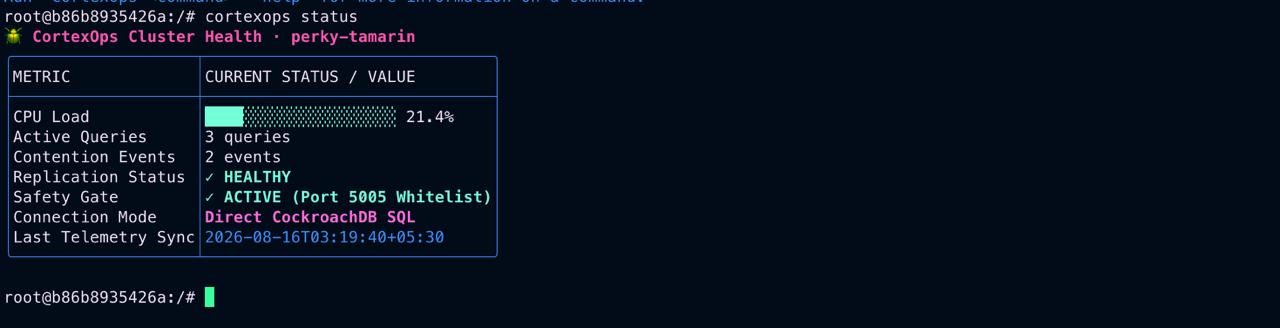
cluster status
-
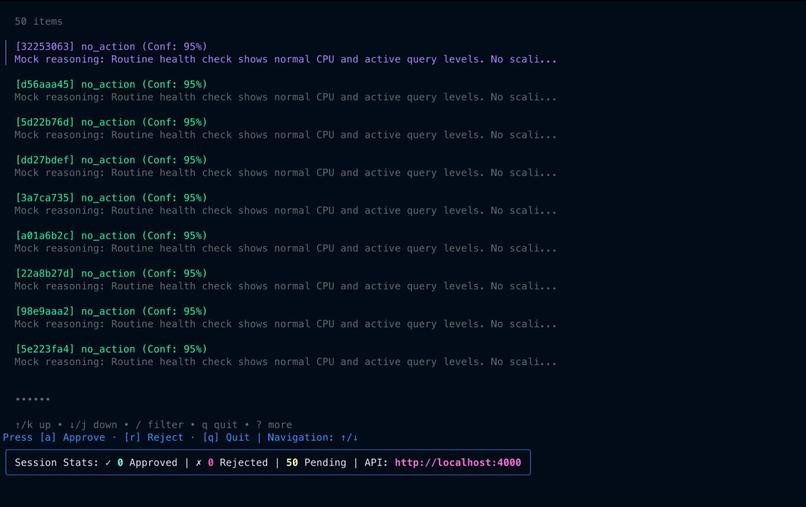
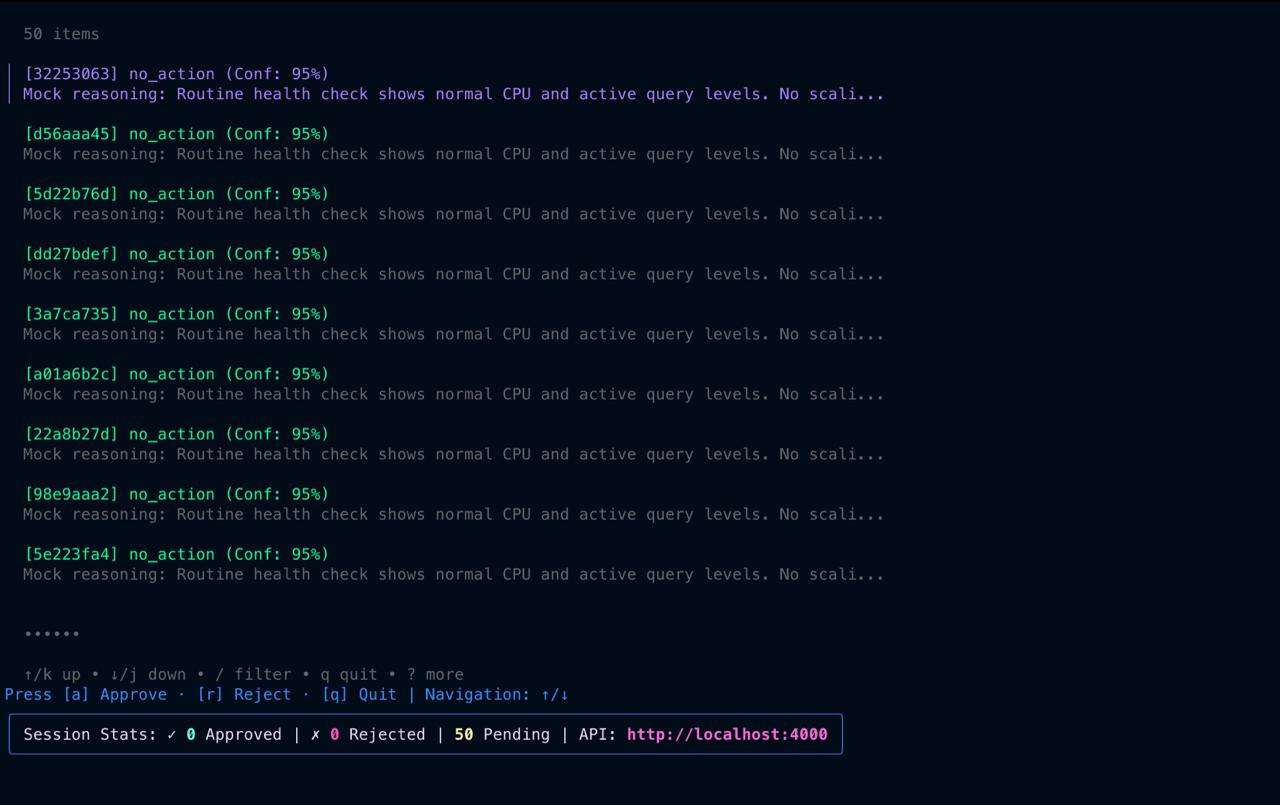
queue
Inspiration
Operating distributed SQL databases like CockroachDB at scale is demanding. During 3 AM outages or sudden traffic spikes, site reliability engineers (SREs) and database administrators must rapidly diagnose telemetry, identify transaction contention, and execute remediation actions.
However, modern database operations suffer from a critical flaw: Operational Amnesia. When an engineer scales a cluster, drops an index, or adjusts zone configurations during an incident, the reasoning rationale behind that action disappears into Slack channels or mental memory. Months later, no one can answer: "Why did we make this decision?"
We built CortexOps to bridge the gap between autonomous AI-driven infrastructure self-healing and long-term auditable operational memory.
What it does
CortexOps is an autonomous, AI-assisted operations agent that continuously observes CockroachDB telemetry, diagnoses anomalies, executes safety-gated remediation, and indexes operational memory:
- Continuous Telemetry Observe Loop: Monitors live CPU utilization, active query count, transaction contention locks, and Raft replication quorum.
- AI Reasoning Grounded in Domain Skills: When anomalies occur (e.g. CPU $> 80\%$ or lock contention), CortexOps consults verified CockroachDB Agent Skills (
performance-and-scaling,query-and-schema-design,operations-and-lifecycle) and uses Amazon Bedrock (Claude 3.5 Sonnet) to synthesize human-readable remediation proposals. - Human-in-the-Loop Safety Gate: Operators maintain full control. Remediations are verified against an immutable prefix whitelist (
ccloud cluster scale,ccloud cluster backup) before execution. - Persistent Vector Semantic Memory: Every decision's reasoning text is converted into a 1024-dimensional vector embedding and stored directly inside CockroachDB.
- Natural Language Semantic Recall (
cortexops ask): Operators can query cluster memory in plain English (cortexops ask "why did you scale up the cluster?") to perform real-time vector similarity search over historical operational rationale.
How we built it
- CockroachDB Distributed Vector Store: Utilized CockroachDB's native
VECTOR(1024)datatype and distributed C-SPANN Cosine Distance Indexing (embedding vector_cosine_ops) to store operational decisions alongside telemetry. Cosine similarity is computed directly on database engine nodes: $$\text{Distance}(\vec{u}, \vec{v}) = 1 - \frac{\vec{u} \cdot \vec{v}}{|\vec{u}|2 |\vec{v}|_2} = 1 - \frac{\sum{i=1}^{1024} u_i v_i}{\sqrt{\sum_{i=1}^{1024} u_i^2} \sqrt{\sum_{i=1}^{1024} v_i^2}}$$ - Amazon Bedrock AI Engine: Integrated
anthropic.claude-3-5-sonnetfor structured reasoning proposals andcohere.embed-english-v3for 1024-dim vector embedding generation. - Go Systems CLI (
cortexops): Built in Go 1.25 with Cobra, Charmbracelet Bubbletea, Huh, and Lipgloss. Features a smart entry point that automatically triggers cluster onboarding when disconnected, and renders an interactive dashboard when connected. - Live Operator Web Dashboard: Built in React 19 + Vite, featuring real-time time-series telemetry charts (Recharts), animated decision feeds, in-browser cluster connection wizards, and semantic memory search.
- CockroachDB Agent Skills: Embedded specialized YAML runbooks to deterministically guide the LLM according to CockroachDB architectural best practices.
Challenges we ran into
- Distributed Vector Dimension Alignment ($d=1024$): Aligning Cohere embedding output vectors with CockroachDB's
VECTOR(1024)C-SPANN index required precise float serialization and zero-copy string formatting between Go, Node.js, and CockroachDB SQL drivers. - Preventing Autonomous Hallucinations: Autonomous agents can be dangerous if unconstrained. We solved this by enforcing two guardrails:
- Dynamic prompt injection of deterministic CockroachDB Agent Skills.
- An independent Go Safety Gate (:5005) that validates CLI command prefixes against an immutable whitelist before execution.
- Zero-Crash Offline Fallback: Ensuring that developers without active AWS Bedrock credentials can still run the entire system smoothly using pre-synthesized CockroachDB operational rule matching.
Accomplishments that we're proud of
- Native CockroachDB Vector Storage: Demonstrating that CockroachDB is not only an exceptional relational database, but also a first-class Vector Database capable of powering AI memory search.
- Smart CLI Entry Point: Seamless terminal experience where running
cortexopsauto-detects cluster health in under 500ms and displays the appropriate onboarding or operational interface. - Human-in-the-Loop SRE Workflow: Giving operators confidence by pairing AI-generated reasoning with explicit approval controls and persistent audit logging.
What we learned
- How to integrate Model Context Protocol (MCP) and CockroachDB Agent Skills into foundation models to ground LLM reasoning in verified database operational runbooks.
- The mechanics of CockroachDB's C-SPANN vector index and how vector cosine distance calculations scale across distributed nodes.
- Crafting rich, accessible terminal user interfaces (TUIs) using Go and Charmbracelet libraries.
What's next for CortexOPS: AI agent for CockroachDB with memory.
- Predictive Anomaly Forecasting: Machine learning time-series models to predict storage growth and CPU bottlenecks hours before they trigger alerts.
- Automated Multi-Region Rebalancing: Extending Agent Skills to autonomously suggest
REGIONAL BY ROWand geo-partitioning optimizations based on live latency telemetry. - Slack & PagerDuty Gated Approvals: Native webhook integrations allowing engineers to review AI decision reasoning and approve
ccloudscale actions directly from Slack.
Built With
- anthropic-claude
- aws-bedrock
- ccloud
- charmbracelet-bubbletea
- cloudwatch
- cobra-cli
- cockroachdb
- cohere
- express.js
- go
- lambda
- lipgloss
- node.js
- react
- recharts
- vector-search
- vite

Log in or sign up for Devpost to join the conversation.