Inspiration
Most studies on misinformation assume that the issue is based in logic. But we wanted to frame it from a neuroscientific perspective - what we were able to simulate how a message physically affects the brain before disseminating it among a community?
What it does
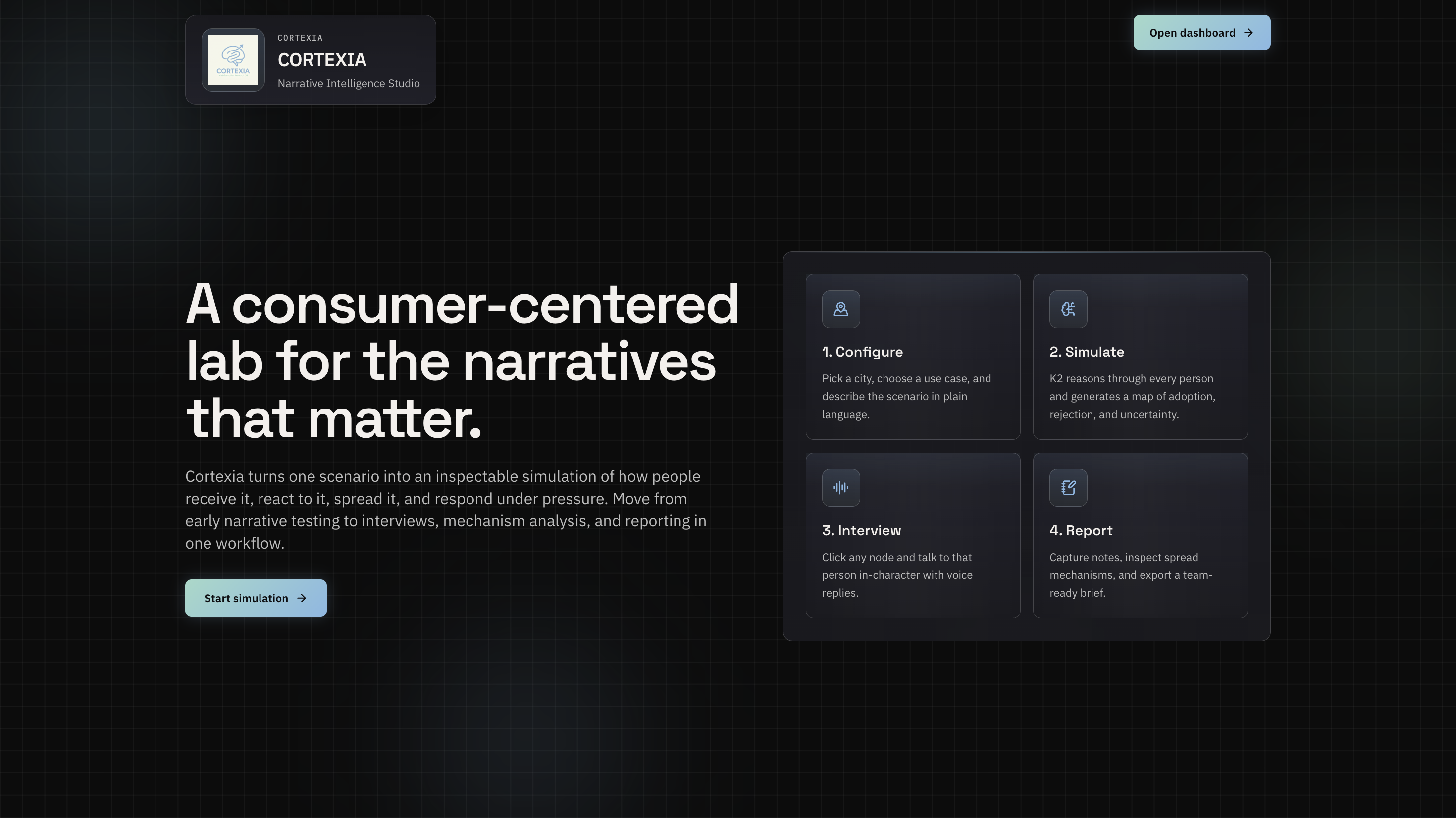
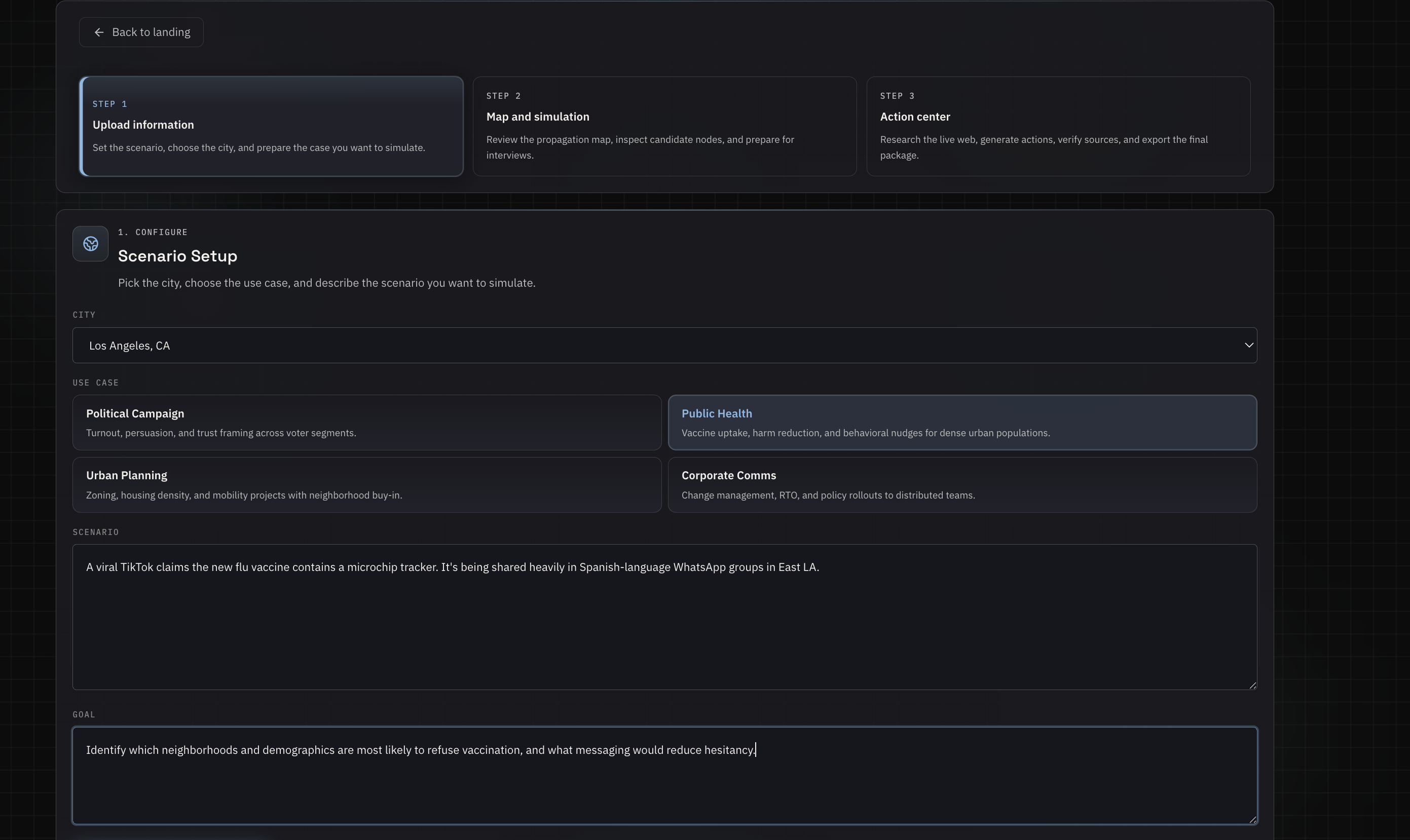
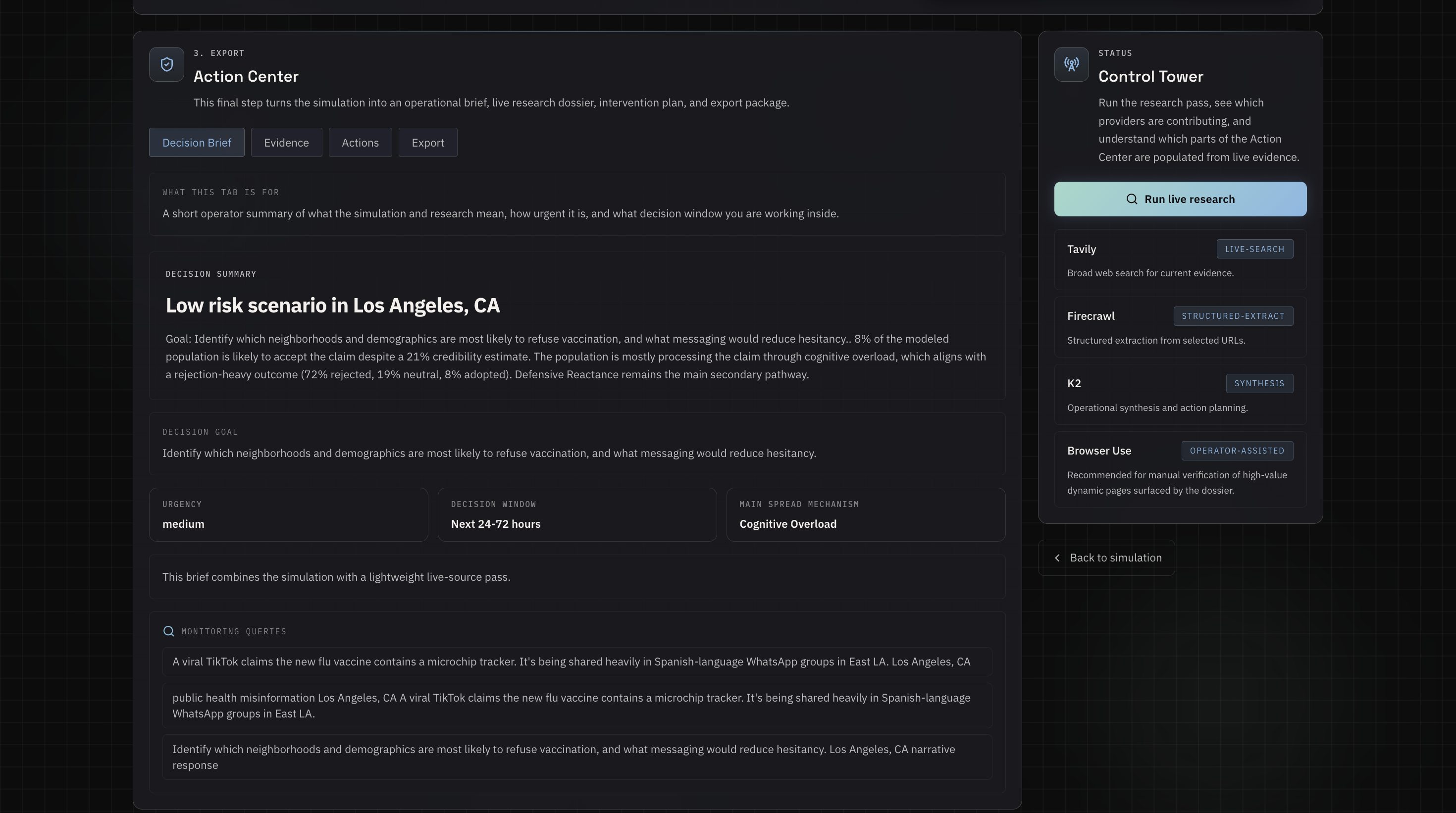
Cortexia stress-tests a message or piece of evidence against a synthetic and geo-mapped population. It runs each agent through a 6-step neural pipeline (Meta's TRIBE v2) that extracts ROI timeseries across fear/salience, reward, deliberation, social, and attention circuits, computes composite scores (arousal, valence, dominance), and derives a per-agent belief-shift value. K2 then generates reasoning traces explaining why each agent moves. A multi-round swarm propagation model shows how support and pushback evolve across the network, visualized on a live geographic map. Finally, we use Tavily and Firecrawl to automatically pull live research dossiers and source excerpts, which grounds each simulation in up-to-date evidence rather than static inputs.
How we built it
- Backend: FastAPI orchestrator with SQLite persistence, a vendored 6-step TRIBE neural pipeline, LFCM-style BSV calibration, and K2 batch reasoning.
- Frontend: Vite + React + TypeScript with Mapbox, Deck.gl for geo visualization, and Recharts for round history. AI integrations: ElevenLabs for audio transcription, Tavily/Firecrawl for live research dossiers, Modal for optional remote TRIBE batch inference.
Challenges we ran into
- Personalizing TRIBE outputs per agent without running a full forward pass for each — we solved this by deep-copying baseline ROI stats and amplitude-scaling from demographic and role features before recomputing composites.
- Keeping swarm propagation numerically stable across many rounds and many agents with neighborhood influence factored in.
- Getting the frontend map, brain viz, and agent inspection panel to stay in sync with live simulation state.
Accomplishments that we're proud of
- A working end-to-end pipeline from raw audio evidence → cortical neural readout → per-agent belief dynamics → geo-propagation map, all in one run.
- Per-agent K2 reasoning traces that actually reflect each agent's neural composite state, not just generic LLM opinions.
- The TRIBE personalization approach — same stimulus, meaningfully different neural profiles across the population.
What we learned
- Mass neural personalization requires precise approximation; doing full passes for each agent is not practical, but amplitude scaling by demographics works well enough to maintain variance.
- Swarm behavior is very dependent on neighbor graph structure.
What's next for Cortexia
- Longitudinal data sets for the validation of synthetic population calibration.
- More complex agents' social networks than just geographic neighborhood effects.
- Domain specific training for TRIBE models in health, politics, and finances domains.
- Export simulation reports for researchers and policy-makers.
Built With
- deck.gl
- elevenlabs
- fastapi
- firecrawl
- mapbox
- modal
- python
- react
- sqlite
- tavily
- typescript
- vultr


Log in or sign up for Devpost to join the conversation.