-

Logo
-
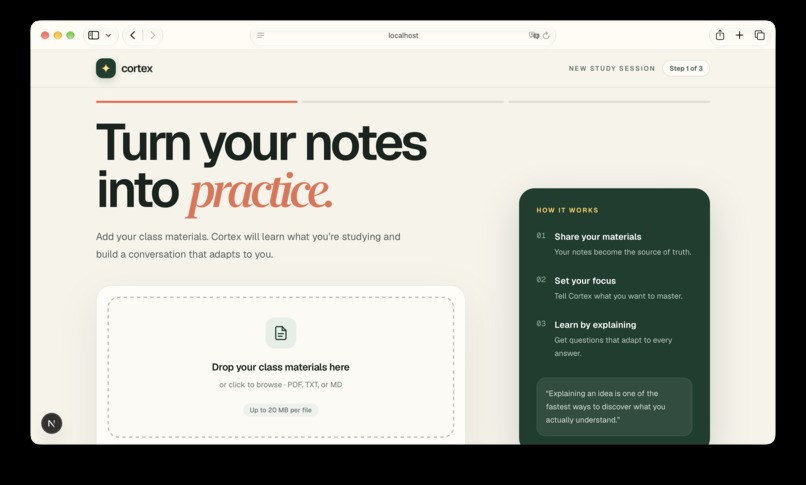
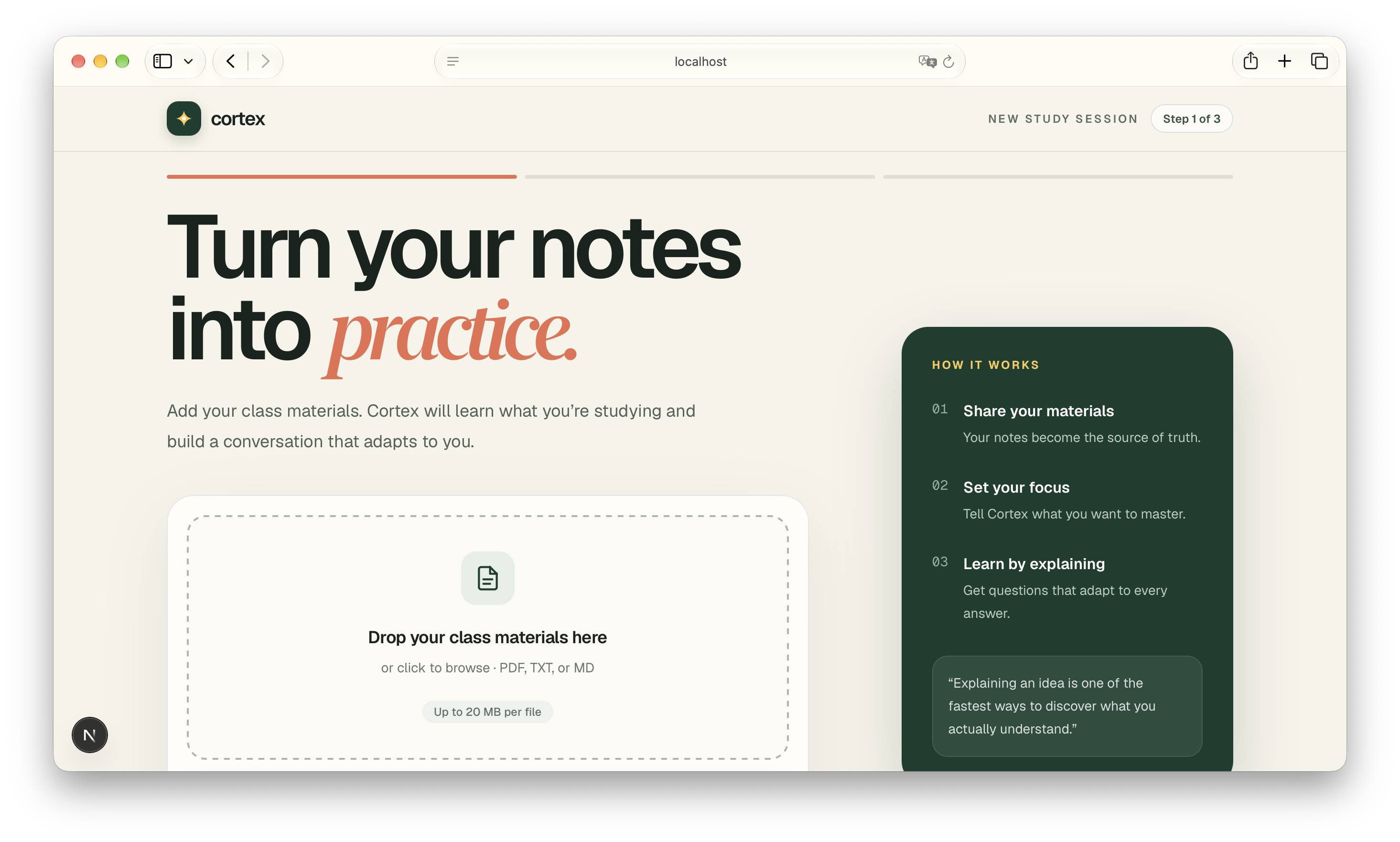
Landing Page
-
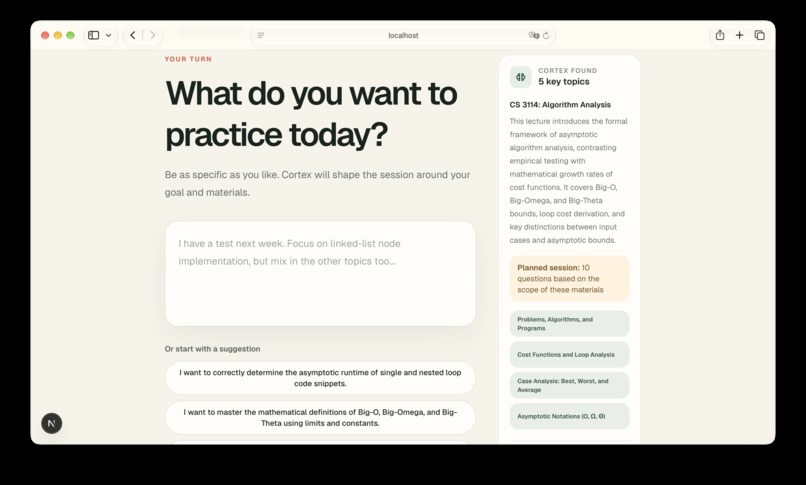
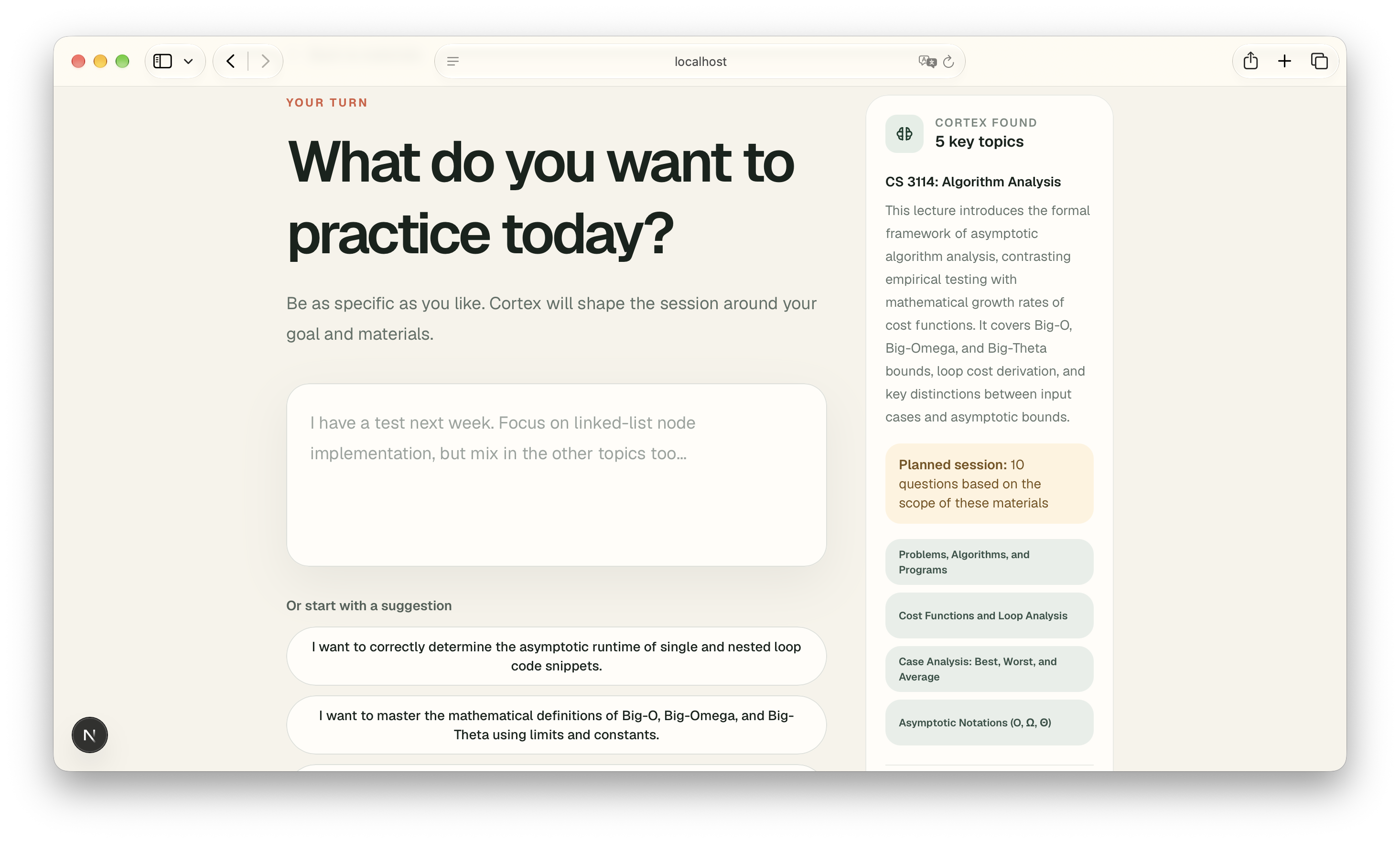
Step 2

Inspiration
As students, we spend a lot of time rereading slides, lecture notes, and study guides, but simply reviewing material does not always show us what we actually understand.
We wanted to build something that makes studying more active. Instead of giving students another AI tool that immediately provides answers, Cortex acts more like a tutor: it asks questions, listens to the student's reasoning, identifies gaps in their understanding, and asks follow-up questions until they can explain the concept correctly.
Our goal was to turn static class materials into an interactive learning experience.
What it does
Cortex transforms uploaded course materials—such as lecture slides, notes, and documents—into personalized study sessions.
After uploading their materials, students can start an interactive session where Cortex:
- Generates questions based specifically on their course content
- Evaluates the student's answers for correctness and completeness
- Identifies misconceptions or missing information
- Asks adaptive follow-up questions based on the student's response
- Explains and corrects concepts when the student is struggling
- Keeps the conversation focused on the material the student actually needs to learn
Rather than simply giving students answers, Cortex encourages them to recall and explain information themselves.
How we built it
We built Cortex as a web application centered around the Gemini API.
When a student uploads their course materials, Cortex processes the content and provides the relevant context to Gemini. We use Gemini to understand the material, generate meaningful questions, evaluate student responses, and dynamically decide what question should come next.
The key part of the system is the feedback loop:
Course Material → Question → Student Answer → Evaluation → Adaptive Follow-up
Instead of generating a fixed quiz ahead of time, every next question can depend on how the student answered the previous one. This allows Cortex to behave much more like a real tutor than a traditional flashcard or quiz application.
Gemini serves as the reasoning engine behind this process, allowing Cortex to understand both the uploaded educational material and the student's natural-language responses.
Challenges we ran into
One of our biggest challenges was making the AI behave like a tutor instead of simply acting like a chatbot.
We needed Cortex to distinguish between answers that were completely correct, partially correct, or contained misconceptions, and then generate an appropriate follow-up without immediately revealing the answer.
Another challenge was keeping the model grounded in the student's uploaded materials. Course content can contain terminology and explanations that are very specific to a professor or class, so we wanted Cortex's questions and feedback to remain focused on the provided material.
We also had to balance the amount of context given to Gemini while keeping interactions responsive and maintaining a natural conversational study experience.
Accomplishments that we're proud of
We're especially proud that Cortex creates a study experience that is dynamic rather than predetermined.
A student can give an incomplete answer, and instead of simply marking it wrong, Cortex can recognize what they understood, identify what is missing, and ask another question designed specifically to guide them toward the complete answer.
We are also proud of how deeply Gemini is integrated into the core functionality of the application. It is not just an additional chatbot feature—Gemini powers the understanding, questioning, evaluation, and adaptation that make the entire experience possible.
Most importantly, we built a working concept that turns something students already have—their class materials—into an interactive AI tutor.
What we learned
We learned a lot about designing applications around large language models rather than simply adding an LLM to an existing interface.
Prompt structure, context management, and controlling model behavior became just as important as the traditional application logic. We also learned how difficult it can be to evaluate open-ended human responses, since there may be many different ways to correctly explain the same concept.
Building Cortex showed us how powerful Gemini can be when it is given both structured instructions and contextual information, especially for applications that require understanding rather than simple text generation.
What's next for Cortex
We want Cortex to become a complete AI-powered learning companion.
Future versions could include:
- Long-term tracking of concepts a student has mastered or struggled with
- Spaced-repetition sessions that automatically revisit weaker topics
- Difficulty levels that adapt to each student's performance
- Progress dashboards showing strengths and knowledge gaps
- Support for additional course-material formats
- Voice-based study sessions that feel like talking directly with a tutor
- Automatically generated practice exams before upcoming tests
Ultimately, we want Cortex to understand not only what a student is studying, but also what that student actually understands, and use that information to make every study session more effective.

Log in or sign up for Devpost to join the conversation.