-
-
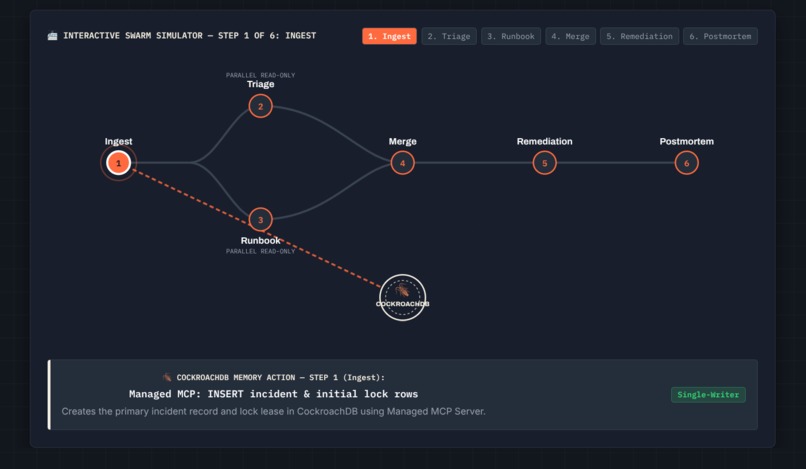
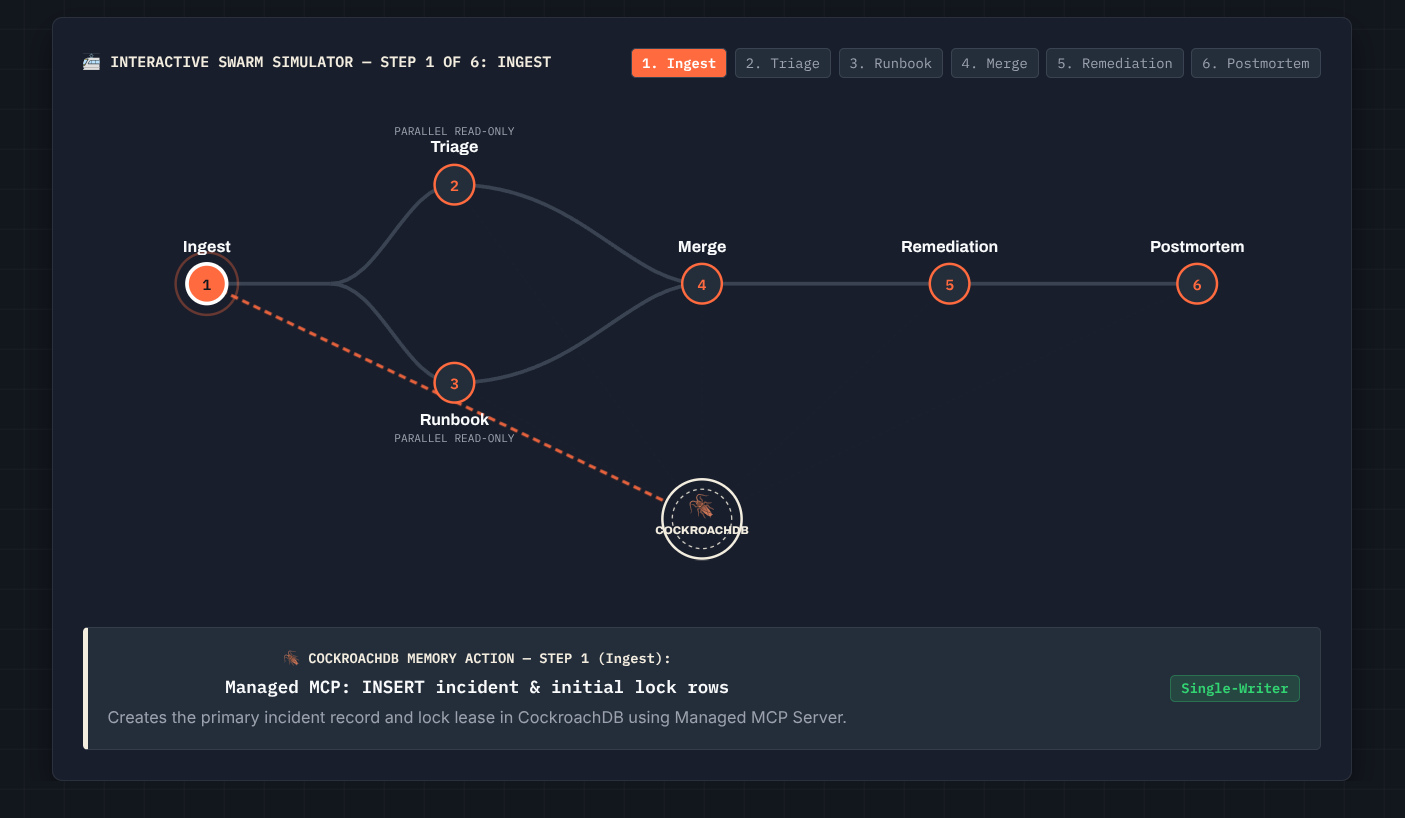
Swarm simulator
-
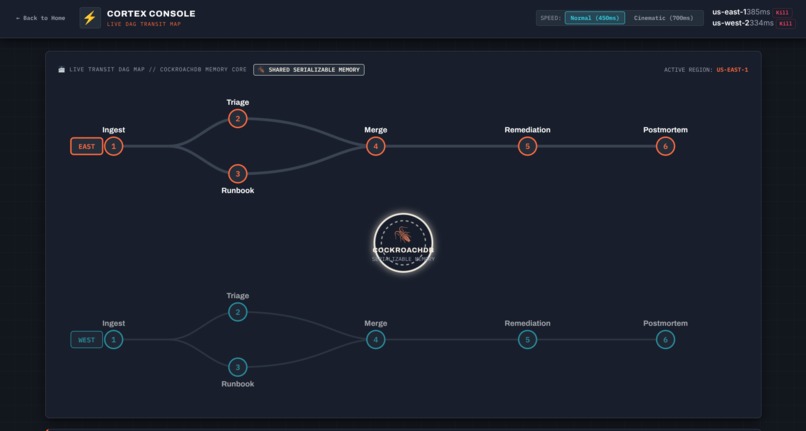
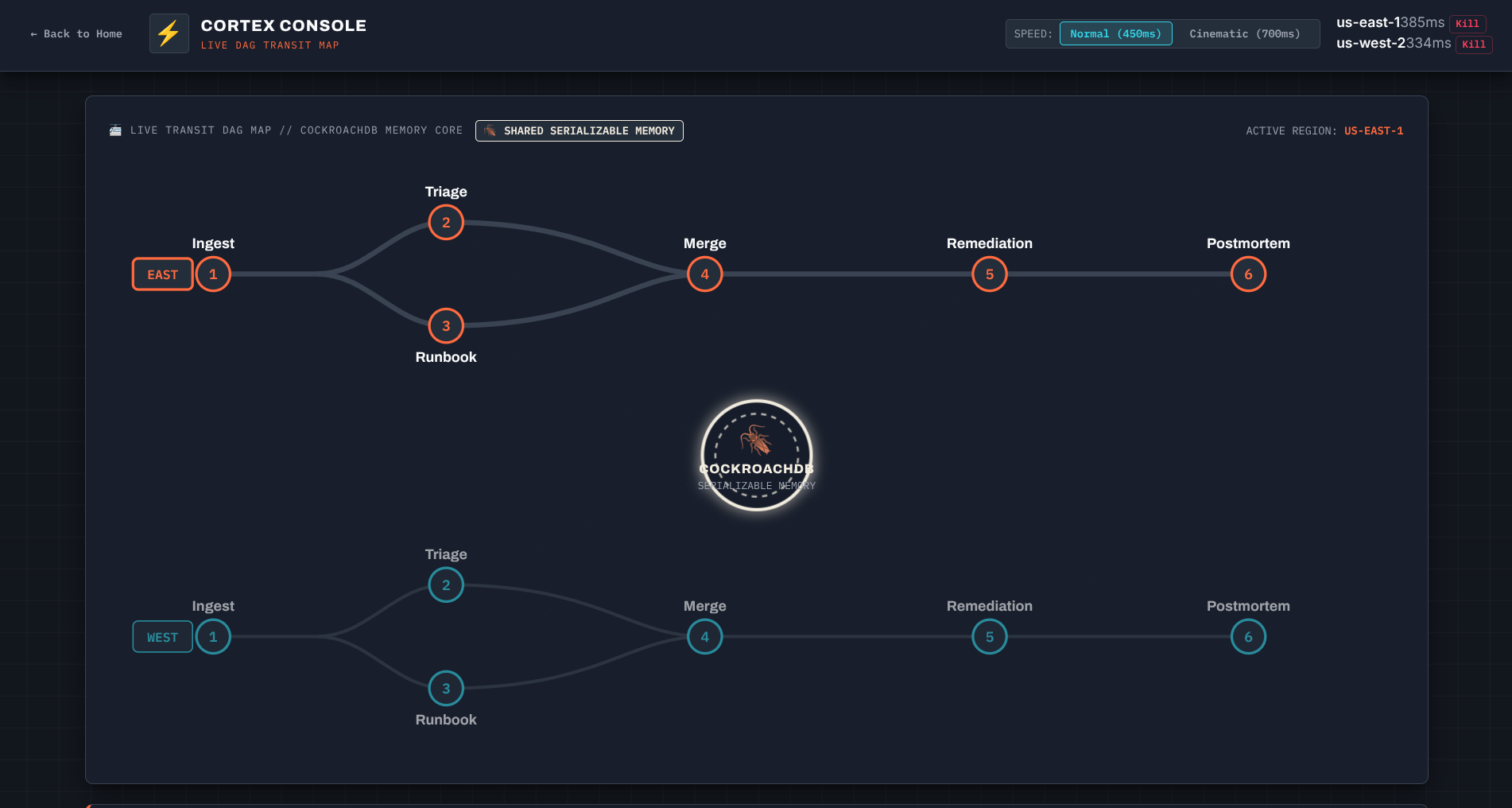
Live transit map
Inspiration
Every SRE team has the same nightmare: your incident-response bot is mid-remediation when the region hosting it goes down. All context — agent state, locks, runbook matches, event traces — vanishes. A second bot spins up elsewhere, but it starts from scratch. Worse, both might come back alive simultaneously and apply conflicting fixes.
We asked: what if the agent's memory didn't live in the agent at all? What if CockroachDB — a database designed to survive regional failures — was the memory? Not a cache. Not a checkpoint. The actual, single source of truth that any agent in any region can read, write, lock, and resume from.
That's Cortex.
What it does
Cortex is a 6-agent autonomous SRE swarm that handles production incidents end-to-end — from alert ingestion to postmortem — with CockroachDB Serverless as its only durable memory.
The swarm runs as AWS Lambda functions deployed identically in two regions (us-east-1 and us-west-2). When an alert fires:
- Ingest normalizes the alert and creates (or reuses) an incident in CockroachDB
- Triage and Runbook agents run in parallel — triage checks for recurrence patterns, runbook performs vector search over CockroachDB
VECTOR(384)columns to find relevant prior fixes - Merge combines their findings into an execution plan
- Remediation acquires a CockroachDB distributed lock (20s lease, 8s heartbeat), generates an LLM-powered fix via Groq, and applies it with fenced writes
- Postmortem generates a report, embeds it as a vector, and stores it — so the next incident benefits from this one's resolution
The signature demo: kill us-east-1 mid-remediation (set Lambda concurrency to 0). The lock heartbeat dies. The lease expires. Fire the same alert at us-west-2 — it reads CockroachDB, sees the expired lock, atomically steals it, and finishes the job. One database. Two regions. Zero data loss.
How we built it
Agent Framework: LangGraph StateGraph with Pregel superstep parallelism for the triage/runbook fan-out. Deliberately no LangGraph checkpointer — the graph's execution state is disposable; CockroachDB is the only durable memory.
Database Layer: CockroachDB Cloud Managed MCP Server for all reads and inserts (select_query, insert_rows), with automatic asyncpg direct-SQL fallback. Per-agent SQL roles with least-privilege RBAC — only remediation_agent can touch incident_locks.
Vector Search: sentence-transformers/all-MiniLM-L6-v2 (384-dim) via fastembed/ONNX, running locally inside Lambda. No external embedding API, no per-token cost. CockroachDB's native CREATE VECTOR INDEX powers cosine-distance retrieval over runbooks and postmortems.
Distributed Locks: CockroachDB serializable transactions power the lock-steal mechanism. The UPDATE ... WHERE lease_expires_at < now() query is race-free by default — no application-level locking needed.
Infrastructure: AWS SAM deploys the exact same template to both regions. SSM Parameter Store holds all secrets. S3 stores raw runbook content. Lambda Function URLs provide the API surface.
Frontend: React 19 + Vite 8 with a custom transit-map SVG visualization that animates the 6-agent DAG in real-time as events stream from CockroachDB.
Challenges we ran into
- Lambda's read-only filesystem vs. fastembed: The embedding model needs a writable cache directory. Solved by pre-packaging the model as a tar.gz and extracting to
/tmpon cold start. - MCP Server limitations: The Managed MCP Server only supports SELECT and INSERT, not UPDATE. Built a dual-path architecture — MCP for reads/inserts, direct asyncpg for status transitions and lock mutations.
- Race conditions in the parallel fan-out: Triage and runbook agents running concurrently could race on status transitions. Solved by making both branches read-only and deferring all writes to the sequential merge node.
- Lock heartbeat architecture: The heartbeat can't live inside the LangGraph node — a killed process takes any in-graph loop with it. Moved it to the Lambda handler as an asyncio background task with a shared mutable dict side-channel.
Accomplishments that we're proud of
- The lock-steal actually works. Kill a region on camera, watch the other region steal the lock and finish — not simulated, not mocked, real CockroachDB serializable transactions across real AWS regions.
- The memory compounds. Every resolved incident generates an embedded postmortem that becomes searchable context for future incidents. Run 5 incidents and the 6th one genuinely finds more relevant fixes.
- Zero external vector DB. CockroachDB handles relational state, vector search, AND distributed locking in one database. No Pinecone. No Weaviate. No Redis.
- Per-agent SQL RBAC. Even a compromised triage agent structurally cannot forge a lock — only
remediation_agenthas grants onincident_locks.
What we learned
- CockroachDB's serializable isolation makes distributed mutex patterns surprisingly simple — the hardest part was believing the
UPDATE WHERE lease_expires_at < now()query really is race-free without extra locking. - The Managed MCP Server is a powerful abstraction for agent-database communication. Standardizing on tool calls instead of raw SQL made the agent code dramatically cleaner.
- LangGraph's Pregel superstep model maps beautifully to SRE workflows — the fan-out/merge topology is a natural fit for "analyze in parallel, act sequentially."
What's next for Cortex
- Multi-cluster CockroachDB: Leverage CockroachDB's multi-region table localities to pin incident data to the originating region while keeping locks globally consistent.
- Agent Skills integration: Replace the hand-authored runbook seed with CockroachDB Agent Skills for dynamic, self-updating operational knowledge.
- Expanded swarm: Add specialized agents for capacity planning, cost estimation, and automated rollback verification.
- Production hardening: Replace the shared-secret admin key with AWS IAM auth on Function URLs, add rate limiting, and implement proper observability with OpenTelemetry.
Built With
- amazon
- amazon-web-services
- asyncpg
- boto3
- cockroachdb
- css
- fastapi
- fastembed
- groq
- javascript
- lambda
- langgraph
- mangum
- mcp
- onnx
- python
- react
- s3
- sam
- sentence-transformers
- ssm
- vercel
- vite

Log in or sign up for Devpost to join the conversation.