-
-
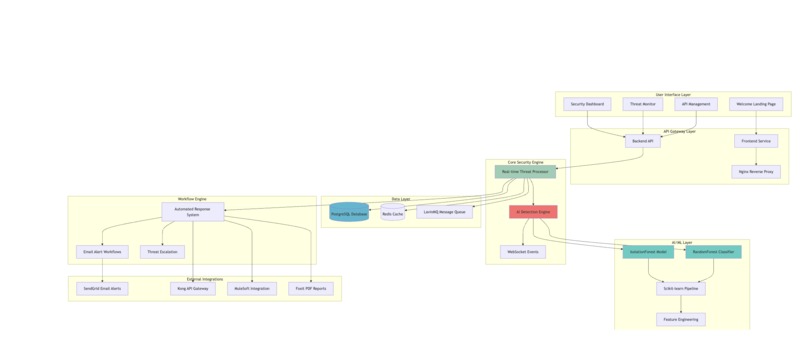
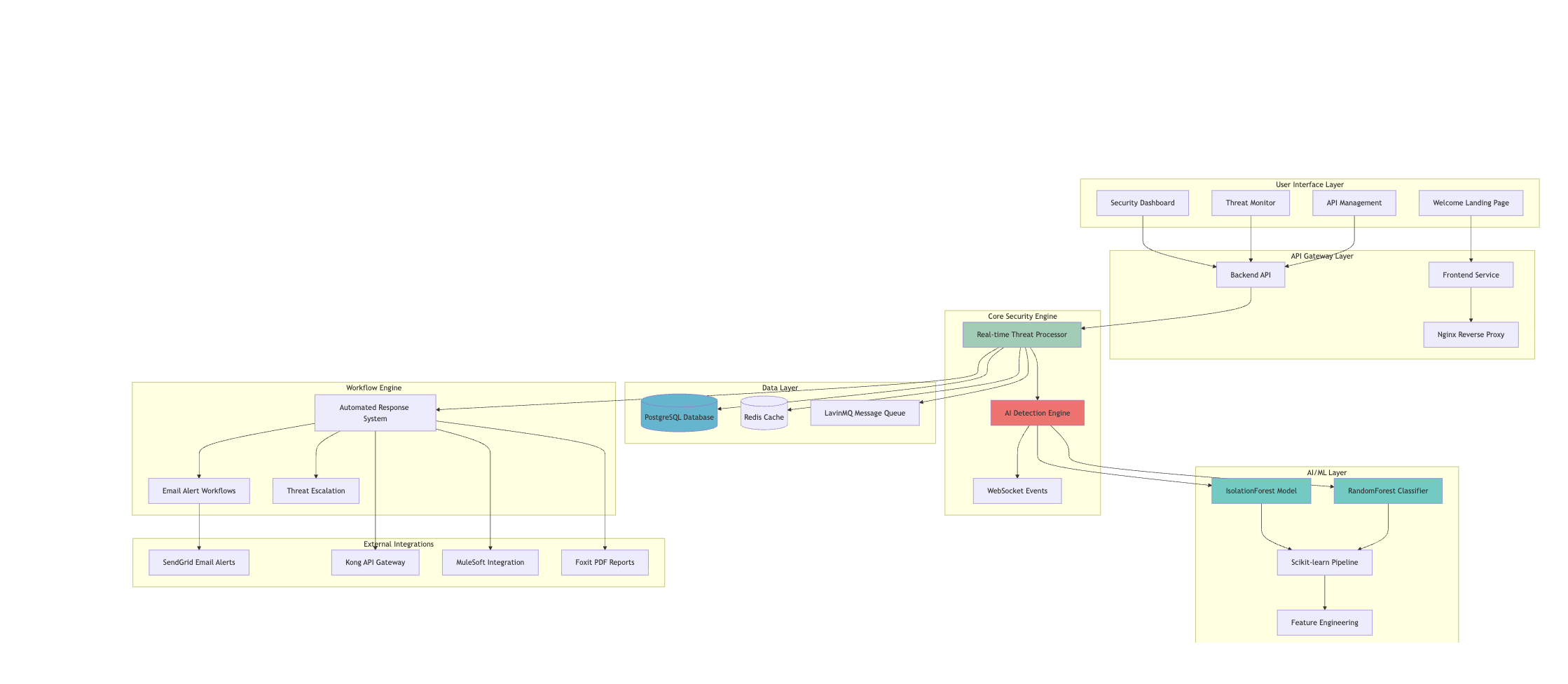
Architecture Overview
Inspiration
The inspiration for Cortex API Guardian came from the critical need to secure APIs in modern distributed architectures. With the exponential growth of API-first applications and microservices, organizations face increasing threats from malicious actors targeting API endpoints. Traditional security tools often lack real-time threat detection and automated response capabilities specifically designed for API ecosystems. We were inspired to create a comprehensive solution that combines AI-powered threat detection with automated incident response workflows.
What it does
Cortex API Guardian is an intelligent API security platform that provides:
- Real-time Threat Detection: Monitors API traffic using AI models to identify SQL injection, XSS attacks, rate limiting violations, and unauthorized access attempts
- Automated Response Workflows: Executes predefined security workflows like IP blocking, API isolation, and alert notifications
- Multi-Gateway Support: Integrates with Kong Gateway and other popular API management platforms
- Comprehensive Dashboard: Provides real-time visibility into API health, threat landscape, and security metrics
- Integration Ecosystem: Connects with messaging platforms notification services, and security tools
- LavinMQ Integration: Uses message queuing for reliable event processing and workflow execution
How we built it
Architecture:
- Frontend: React TypeScript application with Tailwind CSS for responsive UI
- Backend: Node.js with Express.js REST API and WebSocket support for real-time updates
- AI Engine: Python-based threat detection service using machine learning models
- Database: PostgreSQL for data persistence with Redis for caching
- Message Queue: LavinMQ for reliable event processing and workflow orchestration
- Deployment: Docker containerized services with docker-compose orchestration
Key Integration Components:
API Gateway & Platform Integrations:
- Built custom adapters for Kong Gateway with authentication and traffic monitoring
- Developed AWS API Gateway integration for cloud-native API management
- MuleSoft Anypoint Platform integration for enterprise API management and monitoring
- Created flexible gateway abstraction layer supporting multiple API management platforms
Message Queue & Event Processing:
- LavinMQ (AMQP): Core message broker for reliable event streaming, threat processing, and workflow orchestration
- Event-driven architecture using publish-subscribe patterns for scalable threat detection
- Queue-based workflow execution with dead letter queues for error handling
Communication & Notification Integrations:
- Email Services: Sendgrid integration for critical alert delivery and compliance reporting
- Webhook Support: Generic webhook system for custom integrations with third-party security tools
External Service Integrations:
- Foxit PDF SDK: Document analysis and reporting capabilities for compliance and forensics
- Real-time WebSocket: Live dashboard updates and instant threat notifications
Key Technologies:
- React, TypeScript, Tailwind CSS
- Node.js, Express.js, Socket.io
- Python, scikit-learn, pandas
- PostgreSQL, Redis
- LavinMQ (AMQP messaging)
- Docker, nginx
- Kong Gateway, AWS API Gateway, MuleSoft Anypoint Platform
Challenges we ran into
- Real-time Event Processing: Implementing efficient real-time threat detection while maintaining low latency required careful optimization of the AI processing pipeline and message queuing architecture.
- Multi-Gateway Integration: Each API gateway has different authentication mechanisms and data formats, requiring flexible adapters and transformation layers.
- Workflow Orchestration: Building a reliable workflow execution engine that can handle failures, retries, and complex conditional logic proved challenging.
- UI State Management: Coordinating real-time updates across multiple dashboard components while maintaining performance required careful state management design.
- Docker Networking: Ensuring proper container communication and health checks across the multi-service architecture took significant debugging.
Accomplishments that we're proud of
- End-to-End Security Pipeline: Successfully built a complete threat detection and response system that works in real-time
- Scalable Architecture: Designed a microservices architecture that can handle high API traffic volumes
- User Experience: Created an intuitive dashboard that makes complex security data accessible to both technical and non-technical users
- Integration Flexibility: Built adapters for multiple API gateways and notification systems
- AI-Powered Detection: Implemented machine learning models that can identify sophisticated attack patterns
- Production-Ready: Containerized the entire application with proper health checks and monitoring
What we learned
- Message Queues are Critical: LavinMQ proved essential for handling high-volume event processing and ensuring workflow reliability
- Real-time UX Challenges: Balancing real-time updates with UI performance requires careful consideration of update frequency and state management
- API Security Complexity: The threat landscape for APIs is vast and constantly evolving, requiring adaptive detection mechanisms
- Container Orchestration: Docker networking and service dependencies require careful planning and testing
- Full-Stack Integration: Coordinating WebSocket connections, REST APIs, and message queues across multiple services requires robust error handling
What's next for Cortex API Guardian
Short Term:
- Enhanced AI Models: Implement advanced deep learning models for anomaly detection and behavioral analysis
- Kubernetes Deployment: Migrate from docker-compose to Kubernetes for better scalability and orchestration
- More Integrations: Add support for Azure API Management, Google Cloud Endpoints, and additional notification channels
Medium Term:
- Threat Intelligence: Integrate with external threat intelligence feeds for enhanced detection capabilities
- Compliance Reporting: Add automated compliance reports for SOC 2, PCI DSS, and other security frameworks
- Mobile App: Develop mobile applications for security team alerts and incident management
- Advanced Analytics: Implement predictive analytics to forecast potential security risks
Long Term:
- Zero-Trust Architecture: Expand into comprehensive zero-trust API security with identity verification and policy enforcement
- Multi-Tenant SaaS: Convert to a multi-tenant SaaS platform for enterprise customers
- API Marketplace: Create a marketplace for custom security workflows and integrations
- Regulatory Compliance: Add automated compliance monitoring and reporting for various industry standards
The platform is designed to evolve with the changing API security landscape and provide organizations with the tools they need to protect their critical API infrastructure.
Built With
- docker
- express.js
- flask/fastapi
- foxit
- kong
- lavinmq
- ml
- mulesoft
- nginx
- node.js
- openapi/swagger
- postgresql
- python
- react
- redis
- sendgrid

Log in or sign up for Devpost to join the conversation.