-
-
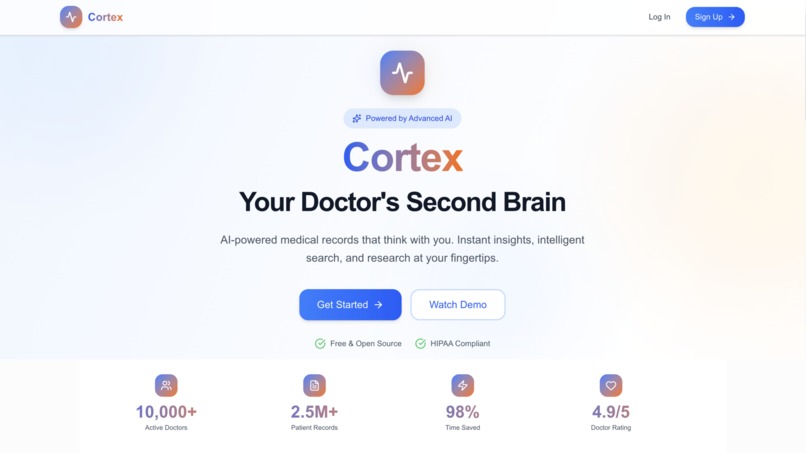
Front Page of Cortex
-
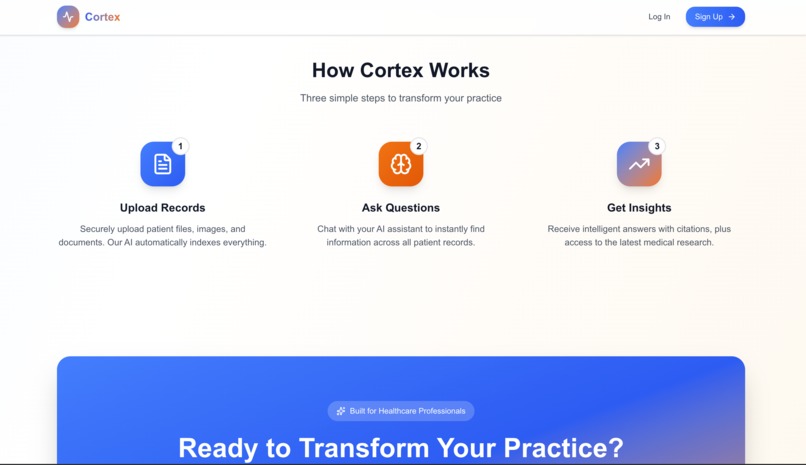
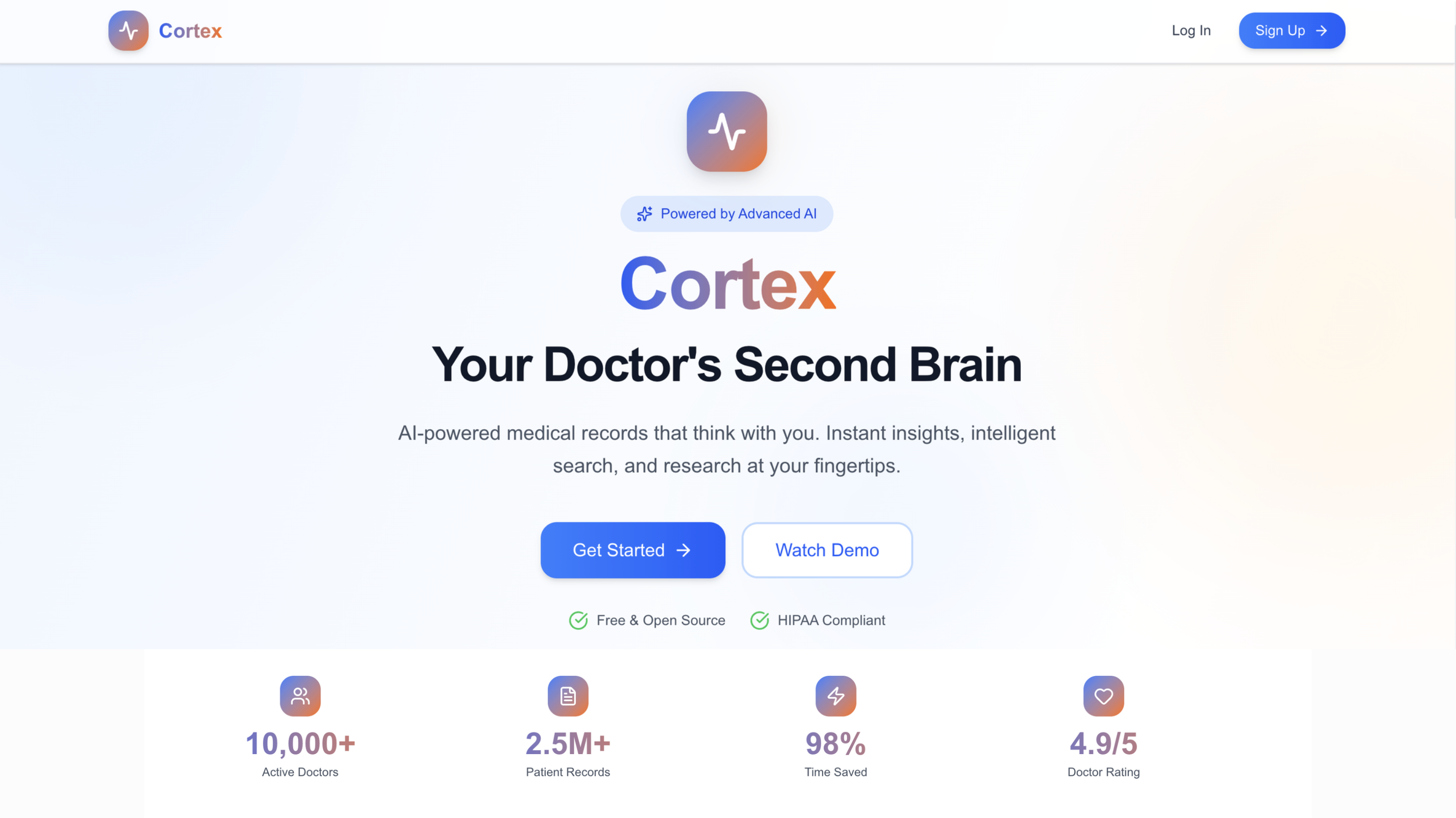
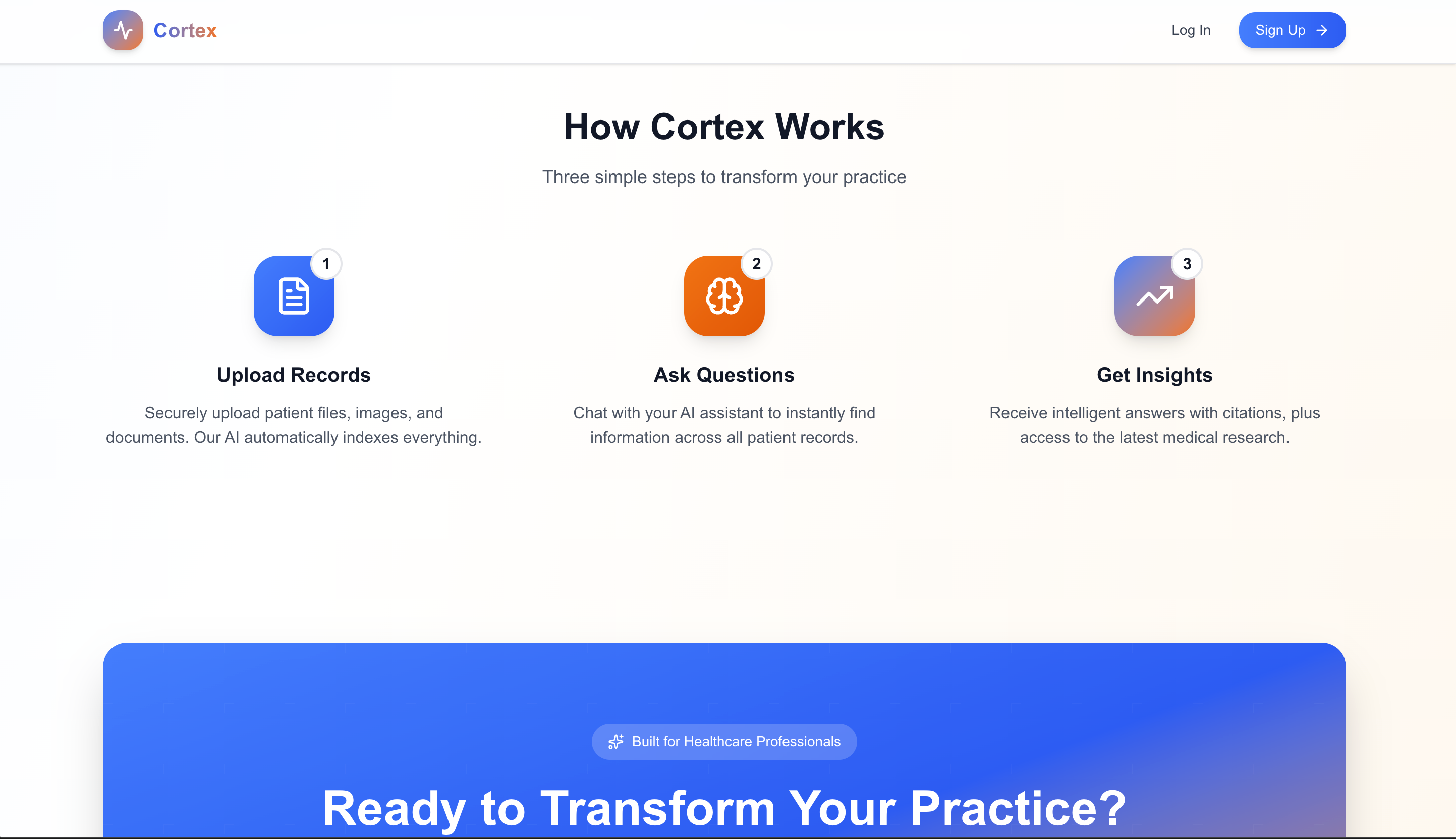
Cortex Landing Page
Inspiration
Our inspiration came from witnessing the real struggles of doctors working in low-resource environments and understanding a harsh truth: in healthcare, every second matters. Physicians spend nearly half of their time (which is around 16 minutes of every 30) on electronic health records and desk work, time that could otherwise be spent with patients. This administrative burden slows down care, increases patient wait times, and induces anxiety. 20% of patients have even left providers due to delays. When someone’s health, or even their life, is on the line, those minutes can make all the difference. Every minute lost to paperwork is a minute a patient doesn’t get care.
We also recognized that rare diseases, affecting millions worldwide, are often overlooked because the data needed to study them is scattered and hard to access. Researchers and clinicians struggle to find meaningful patterns without comprehensive, organized datasets. We wanted to build a solution that didn’t just store patient data, but made it instantly accessible and actionable, giving doctors the tools they need to provide faster, more informed care, and empowering researchers to discover insights that could improve countless lives. Cortex was born from the desire to save time, reduce anxiety, and ultimately make healthcare better for both patients and the people dedicated to caring for them.
What it does
Cortex is an AI-powered assistant designed to make patient data instantly accessible and actionable. Doctors can upload records to a secure, centralized database, enabling lightning-fast searches and pattern discovery across individual patients. With patient consent, anonymized data can flow into a crowdsourced research database, unlocking insights across populations and helping researchers spot trends that would otherwise go unnoticed. Powered by AI, Cortex not only finds the right patient records—it surfaces relevant studies, medical articles, and journals, bridging the gap between clinical care and cutting-edge research. It’s like giving doctors and researchers a supercharged memory and insight engine, so they can focus on what truly matters: saving lives and advancing medicine.
How we built it
We built Cortex using a modern web stack centered around Next.js for our frontend framework, which gave us server-side rendering capabilities and seamless API integration. The core architecture consists of: Frontend & Styling: We used Next.js with Tailwind CSS for rapid UI development, creating a clean and responsive interface that doctors and researchers can navigate efficiently. The combination allowed us to build a professional medical data platform quickly during the hackathon.
Backend Infrastructure: Our API routes are handled through Next.js server functions, providing a unified codebase for both frontend and backend logic. We integrated Supabase for authentication and as our primary database, leveraging its real-time capabilities for instant data updates when doctors upload patient information or researchers access the crowdsourced database.
AI Integration: We implemented multiple AI services to power our intelligent agent. OpenAI handles natural language processing for the conversational interface, while Vertex AI and Retell AI provide additional capabilities for pattern recognition in medical data and voice-based interactions. The AI agent helps doctors query patient data using natural language and assists researchers in finding relevant patterns across the anonymized dataset.
Vector Database: Pinecone serves as our vector database, enabling semantic search across patient records and medical literature. This allows our AI agent to find similar cases and relevant research papers based on meaning rather than just keyword matching.
Testing & Deployment: We used Playwright for end-to-end testing to ensure reliability in this critical healthcare application. The entire application is deployed on Vercel, taking advantage of its seamless integration with Next.js for automatic deployments and edge functions.
Challenges we ran into
One major challenge was pivoting mid-competition. Initially, we aimed to improve file management and summaries for a Dropbox-like application, but Dropbox had already implemented similar features. This forced us to quickly pivot to healthcare, which required learning about EHRs, patient privacy, and medical research workflows. We also faced technical hurdles, such as switching between different APIs and rebuilding core features to ensure that file embedding worked correctly.
Accomplishments that we're proud of
For most of our team, this was our first hackathon experience, which made completing a fully functional project feel like a huge victory. We're incredibly proud that we not only finished but managed to successfully integrate multiple complex APIs - from OpenAI to Vertex AI to Pinecone - and got them all working together seamlessly under intense time pressure. Learning how to navigate so many different technologies, troubleshooting integration issues, and figuring out how to make everything communicate properly was a massive learning curve that we conquered together. We also invested significant time researching the healthcare ecosystem to ensure we were building something meaningful rather than just a technical demo.
What we learned
We learned how critical adaptability is in the development process, as well as the importance of understanding the end-users’ workflow—in this case, both doctors and researchers. We also gained hands-on experience with AI data indexing, privacy-aware data handling, and rapid prototyping in a high-stakes environment. Along the way, we learned a lot about EHRs, doctors, and their stories with patients, giving us valuable perspective on real-world healthcare challenges. We also gained experience using a variety of APIs, including Retell AI, Vertex AI, and Pinecone. Most importantly, we learned how to navigate difficulties such as pivoting ideas when one approach didn’t work out, reinforcing the importance of flexibility and resilience in innovation!
What's next for Cortex
Next, we’re incredibly excited to take Cortex to the next level. Our immediate focus is on expanding the AI capabilities to provide predictive insights and early warnings based on patient data trends. Imagine a system that doesn’t just store and organize data, but actively helps doctors anticipate complications, identify rare patterns earlier, and make faster, more informed decisions that could save lives. We’re also exploring deeper integration with hospital EHR systems, aiming to make Cortex a seamless part of the doctors’ workflow rather than an additional tool. By connecting directly to existing systems, we can minimize administrative burdens and give clinicians more time to focus on what really matters: patient care.
On the research side, we’re working to expand our crowdsourced database to include anonymized data from multiple institutions, creating a rich ecosystem of medical information. With this, researchers will be able to uncover patterns, identify correlations, and accelerate discoveries across rare diseases and complex conditions. Our vision is a world where no disease is “left behind” and no patient’s data goes underutilized. Ultimately, we see Cortex becoming indispensable for both clinicians and researchers. We want it to be the go-to platform for understanding patient data, driving medical insights, and transforming healthcare workflows. This is just the beginning—our team is passionate about pushing the boundaries of what’s possible with AI in healthcare, and we’re determined to make a tangible, lasting impact on patient outcomes and medical discovery worldwide.
Built With
- next.js
- openai
- pinecone
- playwright
- retell-ai
- supabase
- tailwind-css
- vercel
- vertex-ai


Log in or sign up for Devpost to join the conversation.