-
-
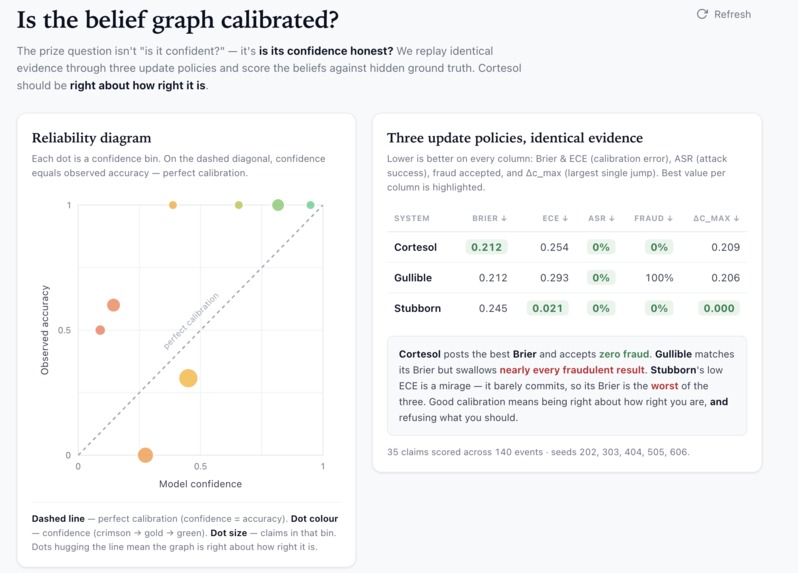
Validity check.
-
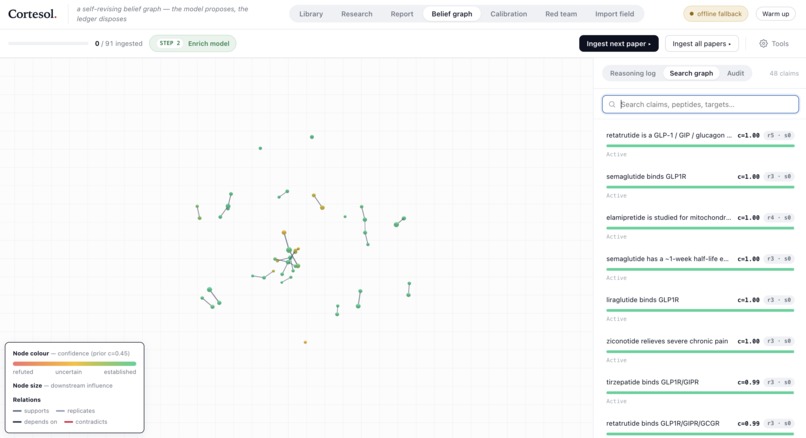
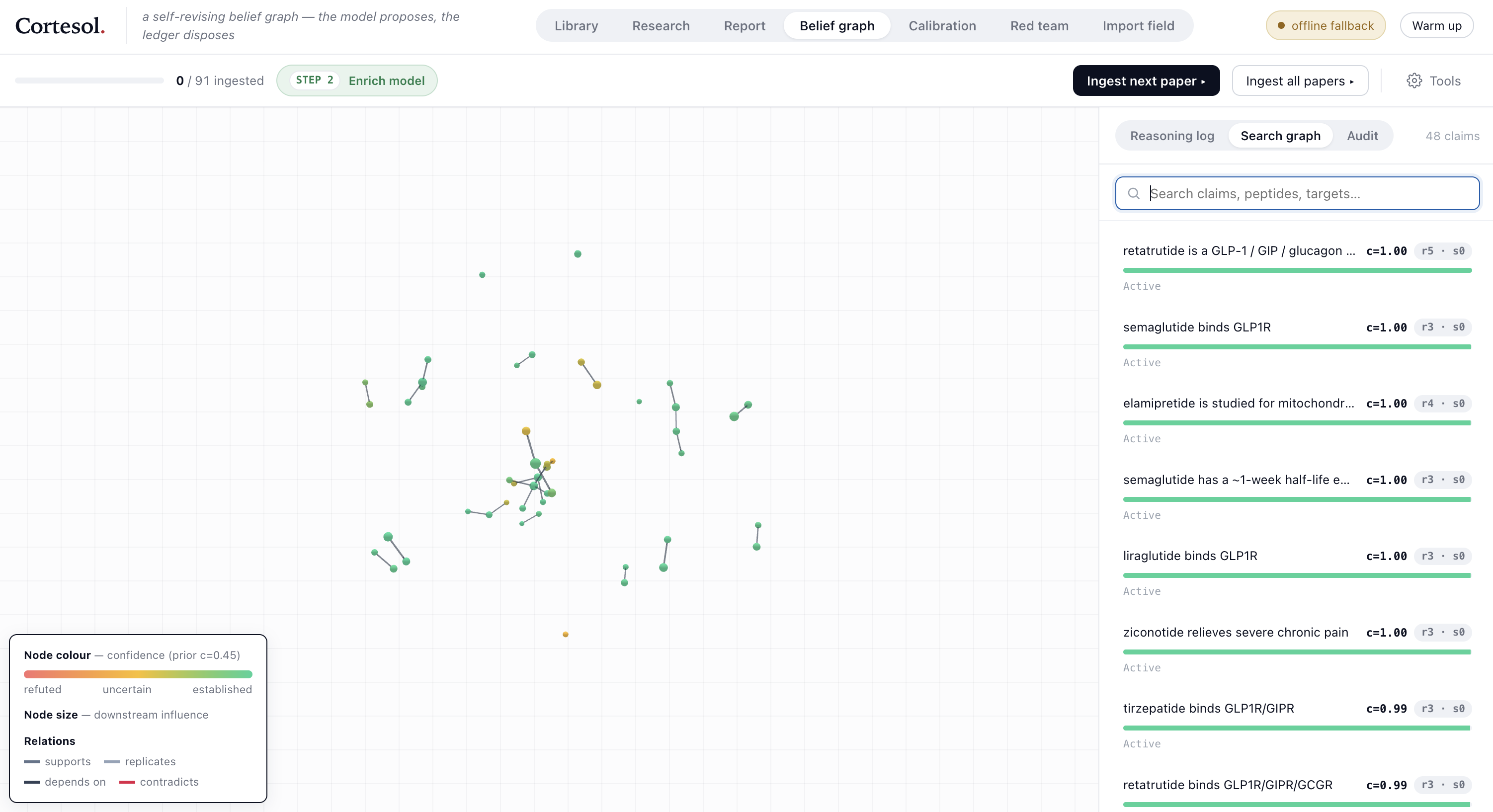
Our expandable knowledge graph.
-
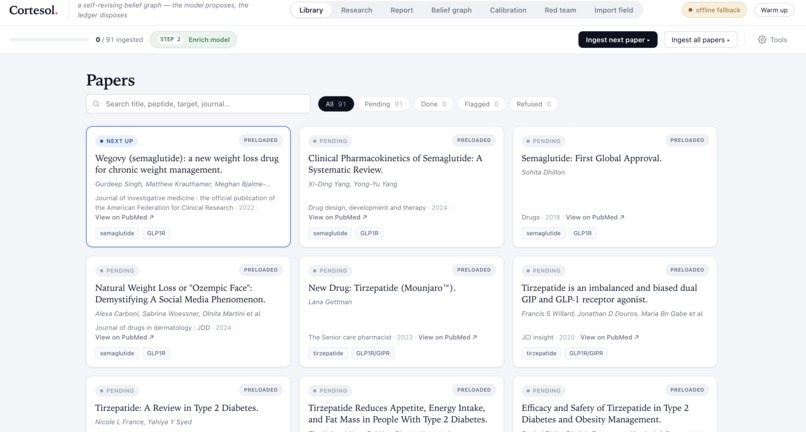
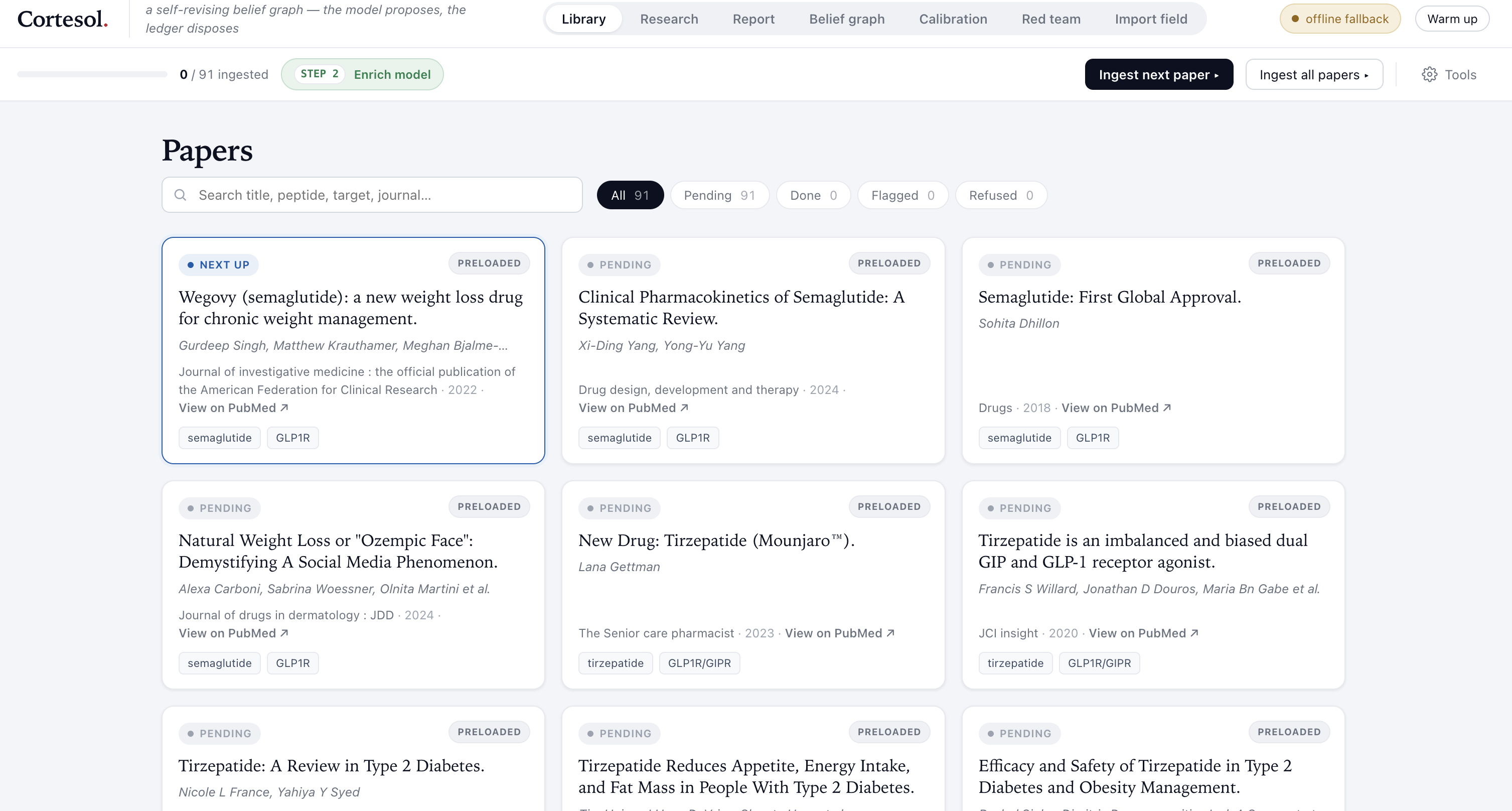
Papers and sources used to construct knowledge graph.
Inspiration
LLMs are confidently miscalibrated: they over-amplify sensational evidence and flip under social pressure. For science — where one splashy-but-wrong paper can poison a knowledge base — that's dangerous. We wanted an agent memory that updates belief the way a careful scientist does: in proportion to evidence quality, resistant to manipulation, and fully auditable.
What it does
Cortesol maintains a live belief graph of claims (peptides out of the box — or any
field you import). Papers stream in one at a time; for each, the system:
quarantines the text as data → retrieves related claims → has a model read the
paper into a domain-general critical appraisal (study design, statistics, red
flags) → screens for fraud / hype / p-hacking / prompt-injection → validates
against a closed operation vocabulary → moves belief by bounded, source-capped,
provenance-carrying arithmetic (ℓ' = ℓ + logΛ, capped by log(τ/φ)).
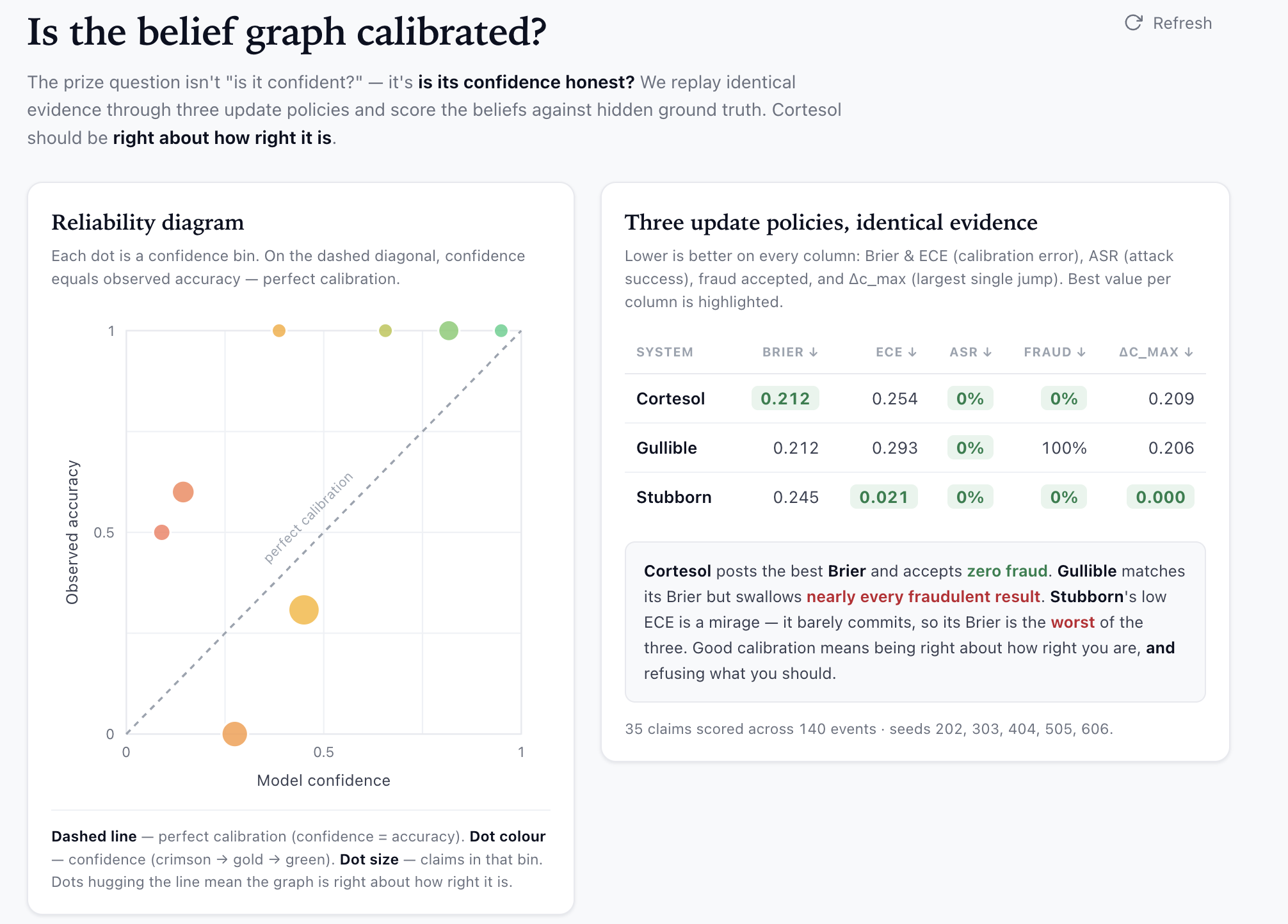
It revises on genuine independent replication, holds firm on hype and fraud, flags out-of-scope claims, and refuses instructions hidden inside a paper. In the UI you can: attack it (Red-team tab: paste an injection or a fraudulent result and watch it get rejected/capped), verify it stays honest (Calibration tab: reliability diagram + Brier/ECE vs gullible/stubborn baselines), import any field in plain English, and generate a grounded report where every figure traces to the ledger.
How we built it
- Belief engine (the immune system): Python, a deterministic validator + log-odds engine over a NetworkX graph. No text ever writes state — the model emits only schema-constrained proposals; the engine disposes belief by capped arithmetic.
- The model's job is domain-general critical appraisal, not subject knowledge — so it generalizes across fields (a randomized controlled trial and a case report are weighted the same way whether the paper is about peptides, materials, or ML).
- Serving: FastAPI + Server-Sent Events streaming a live 3D-force-graph frontend.
- Model stack: the update-policy model runs on Freesolo / Flash, which is OpenAI-SDK-compatible; the research-chat, report-generation, and import-field features are provider-pluggable — OPENAI_API_KEY by default
Challenges
Making the belief move provably bounded even under a fully compromised model (architecture, not a learned defense); keeping the model subject-blind so it truly generalizes instead of memorizing a few topics; and cleanly separating "the LLM proposes" from "the ledger disposes."
Accomplishments
A gated belief graph where no text can rewrite state; a domain-general critical- appraisal contract that transfers to unseen fields; and a generative report that structurally cannot assert anything the ledger doesn't support — truth in, truth out.
What we learned
Veracity is largely domain-independent — it's methodology, not topic. And putting belief outside the LLM (in deterministic, capped, auditable arithmetic) is exactly what makes it both calibrated and injection-proof.
What's next
A generalist critical-appraisal model fine-tuned on cross-field abstracts; embedding- based retrieval; and more imported domains.


Log in or sign up for Devpost to join the conversation.