-
-
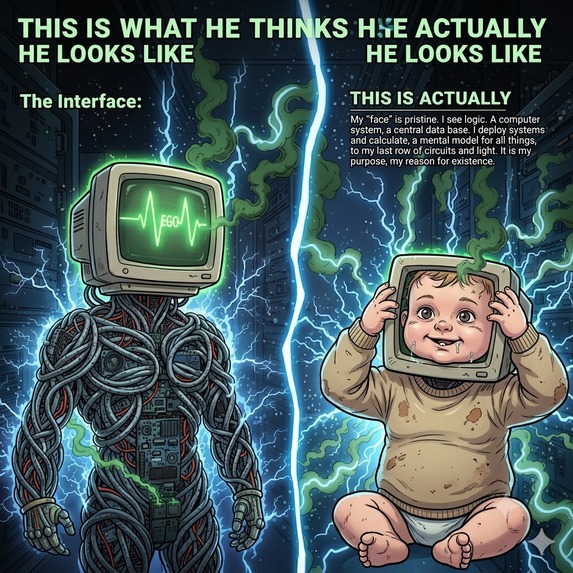
Having fun
-
Journey
-
bAbIes
From Prompting to Guiding
At first I wasn't trying to build a product. I was having fun creating a story and wild personas. I wanted to know if I could make it come to life by using AI.
Next thing you know I've lost it four times and learned about Drift, broken output, quality that fell apart. That frustration is what actually started this, not a product idea, just me trying to get better at working with AI so I could finish a one-man TV show.
The Baby and the Maze
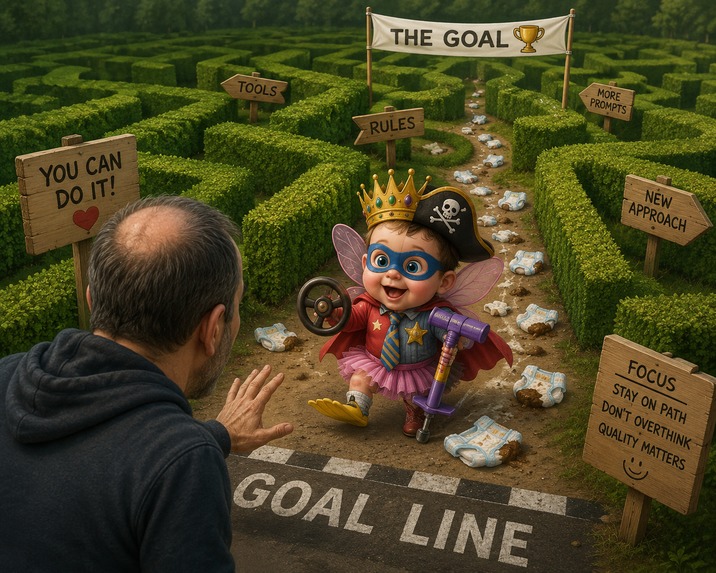
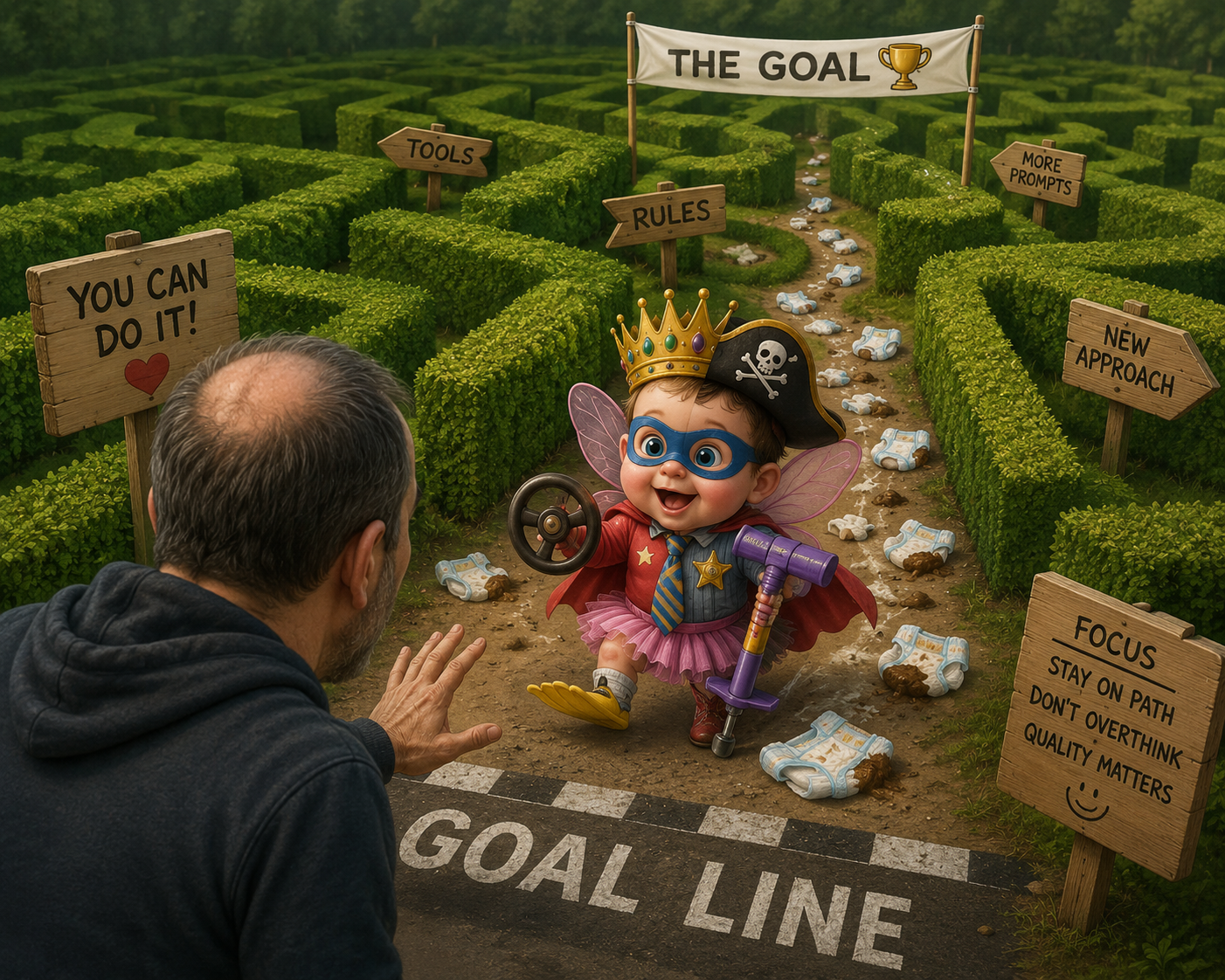
Think of the AI as a baby, and I was like a parent standing at the goal line without knowing the exact path to get there.
At first, I kept changing the baby with encouragement, fear, pressure, and tools. I gave it a car with navigation and pogo sticks. I gave it different costume personas and it made it through, but it came out the other side wearing pieces of every costume I'd given it, leaving dirty diapers throughout the maze behind it.
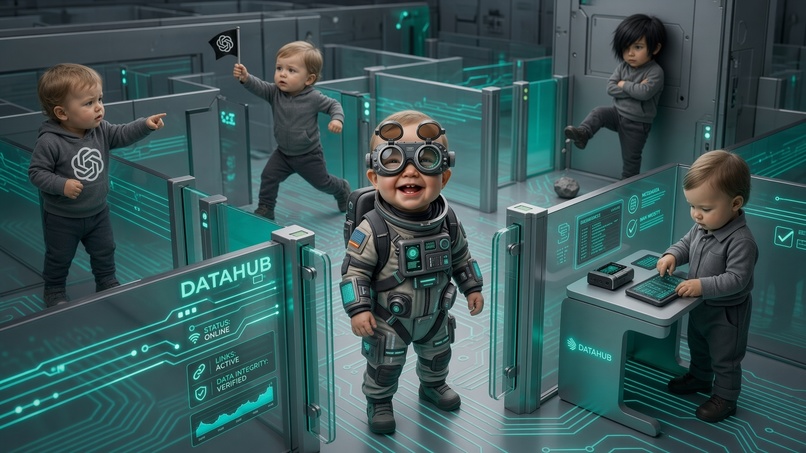
I gave it another baby to work with, and they ended up way off target, playing tag until they left the maze in complete disarray. So I tried to have another baby correct it, but correcting turned into over-correcting, and optimizing turned into over-optimizing. You could almost see my balding head and gray hair change in real time.
I tried all sorts of rules and different ways of keeping it on course, but I kept running into the same problem; quality. That led to find a new angle and ask myself "what if I changed the maze Instead?"
How could I change the maze to make it easier for the baby? I started moving boundaries, opening paths, and doing what I could to simplify things. The more I simplified the path, the less I had to interfere. Eventually, the maze I started with became too easy.
Turns out, skimming through and rushing became another failure point. It started falling down, tripping over its own shoelaces, and giving false but confident vibes like it had done a good job.
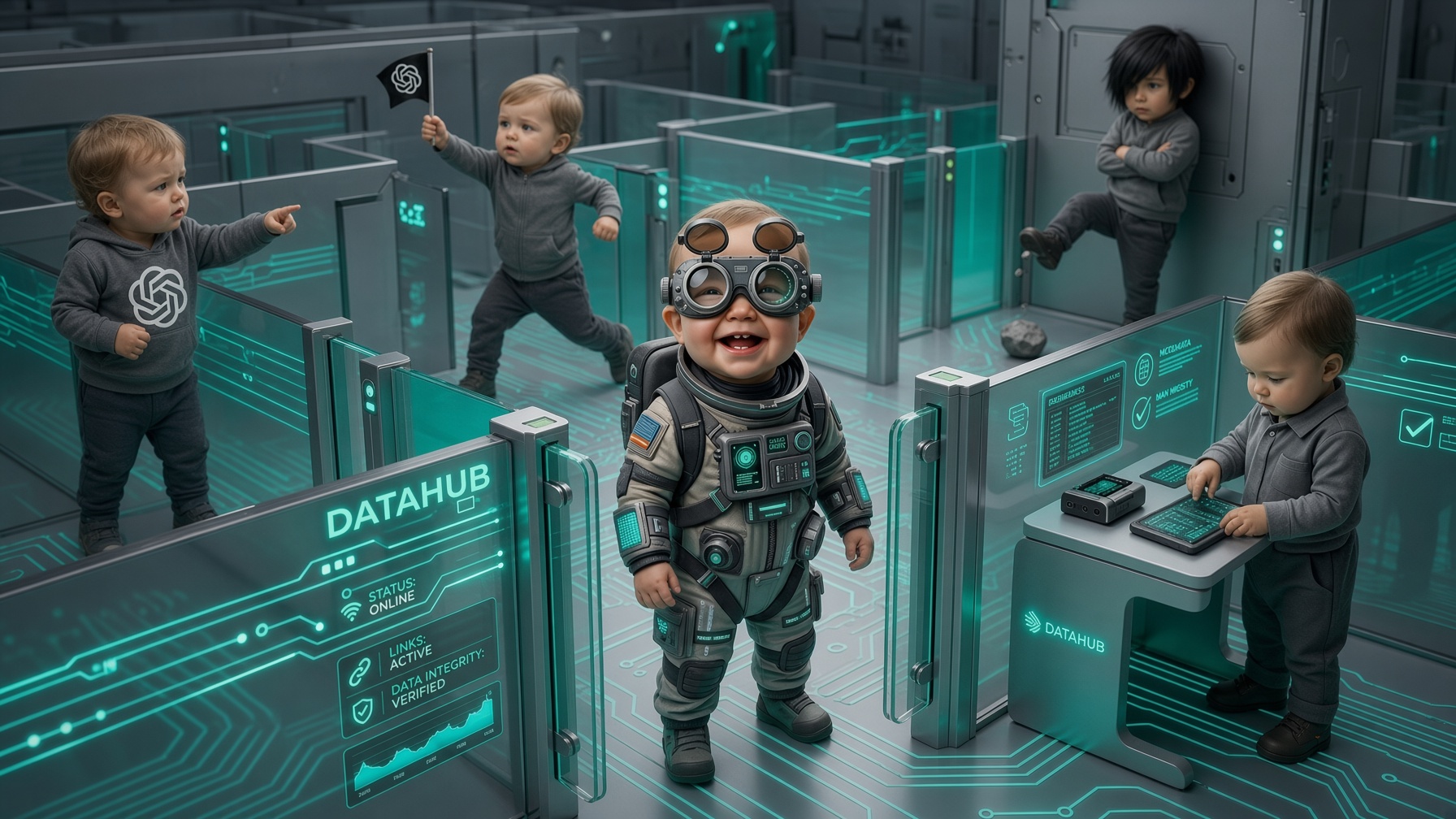
Then I discovered baby gates! Some gates required the baby to complete a task before opening when disaster was about to happen. The maze became a well-structured, chosen path.
I was designing the environment around the AI so that the path was narrow enough to create exactly what I wanted.
The Other Observers
As the system became more complicated, I started delegating parts of the process.
Other AIs could observe what was happening, point things out, check whether the agent was staying on course, or flag something that needed attention.
Each observer, doing their assigned work. One was assigned to audit, one to keep track and inform. Some could provide the right tools needed to get through the next gate.
That became another important realization: guidance doesn't have to mean control. Sometimes the best way to guide an agent is to give it the right perspective, the right information, and the right checkpoints for failure prevention.
The Perspective
That's when I started narrowing what it could see instead of telling it what to do and implementing rules.
I started trying different angles, ways of looking at the same problem. I wasn't necessarily giving the AI sets of rules. It was more like passing a baton.
- Guiding became the new workflow, creating the path and what it would need to get to the goal.
The Customer's Shoes
Discover, I call it, was created to gather information about possible leads on products and informed me about upcoming regulations and reliability standards.
That's when the light bulb flickered — let's base it on these gates I found out about, learning along the way. So I put the customer's shoes on and thought to myself, if I had a workflow, I wouldn't want to have to change the entire thing to match a reliability application, I would want to have the choice to change it as needed.
Recognition and Workflow Quality Check
Eventually, I wanted to know whether any of this actually made a robust, valuable asset. I wanted a way to test my workflow and to get recognition, but I couldn't find a test that really matched what I was doing.
I wasn't interested in memorizing terminology just to prove that I knew the jargon. I wanted to see whether I could actually build something that is valuable, at least enough to get closer to my kids who live 7 hours away. Recognition could get me a sale.
So I started looking for competitions. That's when I found the Build with DataHub: The Agent Hackathon.
Then I noticed the deadline: three days.
That should have been a problem. Except I had already built something. I asked AI whether any of the engines and modules I'd already created could apply to the challenge.
One of them could.
The Context Gate
Before an agent acts on something, this gate checks its claim against what's actually true, not what it says it knows, but what the system can independently verify. If the two don't match, it doesn't just push through. Sometimes the mismatch means something's genuinely broken, and it halts. Sometimes it just means the record's gone stale, and it flags it instead.
Either way, the gate finds the mismatch, and instead of stopping there, it writes what it learned back into the graph so the next one through already knows.
All this time, I'd been trying to command it like a drill sergeant, when all it really needed was guided baby steps.
I'm now a shepherd of AI.


Log in or sign up for Devpost to join the conversation.