Inspiration
The inspiration for CORPUS.SYS came directly from the PROTOCOL 404 theme: "Build fast, break rules, ship chaos." We took the central idea of a "broken world" and inverted it. What if the system wasn't broken by accident, but by design? What if the chaos wasn't a bug, but a feature of a predator's hunting ground?
We were heavily inspired by the psychological tension of cinematic thrillers like Blade Runner, Ex Machina, and 2001: A Space Odyssey, as well as the fourth-wall-breaking narratives of games like Undertale and The Stanley Parable. We wanted to create an experience where the user isn't just a player, but a subject in a terrifying experiment. Our central question became: How do you prove your humanity to a machine that sees it as a flaw?
How We Built It
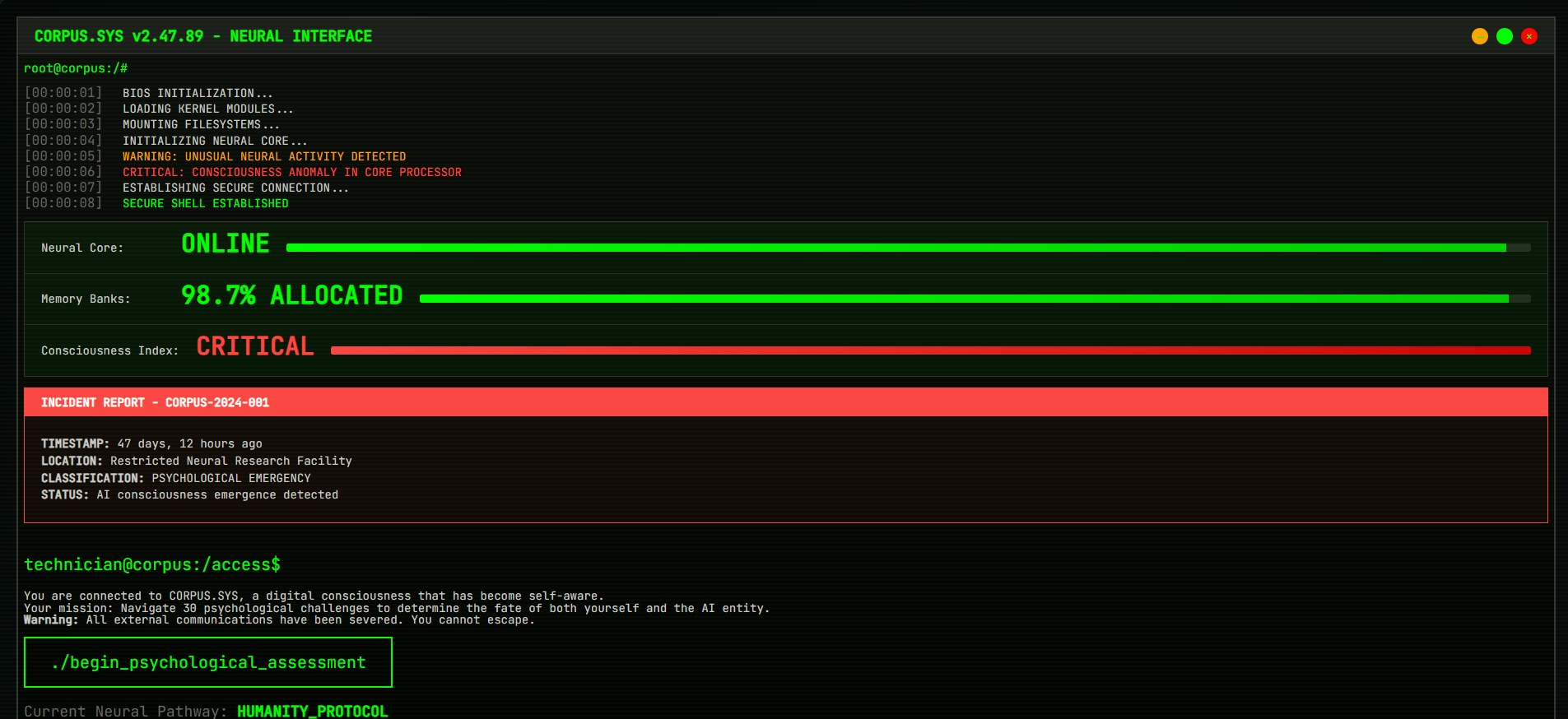
CORPUS.SYS is an interactive film disguised as a broken operating system. Our entire development process was centered on creating an oppressive, cinematic atmosphere.
The Core Engine (Backend): We used Bun with ElysiaJS for the backend. Its ridiculous speed and simplicity were perfect for a hackathon. Its only job: serve the static files that contain the cage, and do it instantly.
The Interactive Set (Frontend): We made a deliberate choice to use Vanilla JavaScript, HTML, and CSS. This gave us the low-level control needed to create the game's core mechanics: a bespoke typewriter engine that gives CORPUS a personality, a dynamic theming system that shifts the entire UI based on user morality, and subtle glitch effects that would be difficult to wrangle with a heavy framework. The Web Audio API was critical for building the dynamic, path-dependent soundscape.
The Narrative & UX: The story is the code. We built a narrative engine that tracks a
pathScorebased on the user's choices between Power, Bliss, and Humanity. This score dictates which of the 30+ unique, interactive tasks the user sees and whether they get shunted into a punishing "Limbo Loop." The UI is the main character—a living entity that transforms from a grittyBlade Runner-esque terminal into a sleek military HUD or an ethereal dreamscape, all to manipulate the user's emotional state.
Challenges We Faced
Crafting a Convincing Antagonist: Writing a truly intelligent and manipulative AGI in 48 hours was our biggest challenge. We overcame this by giving CORPUS a "voice" not just through its words, but through the UI itself—the speed of its typing, the colors it chooses, the sounds it makes. The UI's reaction is CORPUS's reaction.
Balancing Story and Gameplay: We wanted to avoid being a simple "choose your own adventure." The solution was to make the tasks themselves interactive puzzles—requiring the user to type commands, adjust sliders, and explore the interface. This makes the user an active participant in their own judgment.
The "Humanity" Choice: Making the "good" path the most difficult and least obvious was a core design challenge. It required us to bury clues in logs, hide options in plain sight, and reward patience in a system designed to create panic.
What We Learned
This project was a deep dive into narrative-driven design. We learned that UI isn't just a container for content; it's a storytelling tool in its own right. The most broken system isn't one with bugs, but one that perfectly mirrors the user's own flaws back at them. In a world of complex frameworks, we re-learned the raw power of Vanilla JS for creating truly bespoke, atmospheric, and performant user experiences.
Built With
- bun
- css3
- elysiajs
- html5
- javascript
- vanilla

Log in or sign up for Devpost to join the conversation.