Inspiration
Companies do not usually lose a decision because nobody wrote a note. They lose the connection between the decision, the evidence that supported it, the people who approved it, and the changes that later made it unsafe.
Corporate Brain was created to make that connection visible and useful to non-technical teams.
What it does
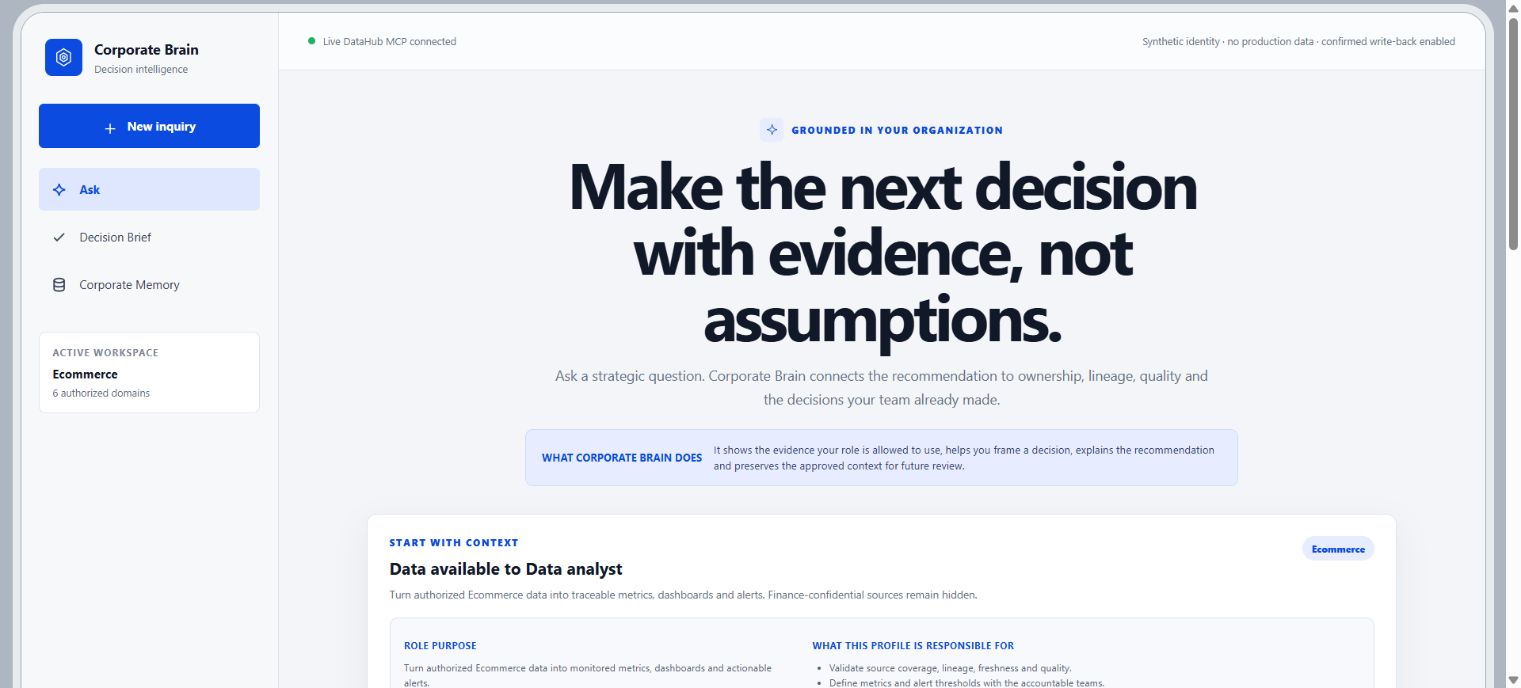
Corporate Brain is a role-aware decision-memory agent powered by DataHub.
It helps a user:
- Discover which governed datasets, dashboards, metrics, pipelines, and documents they are allowed to use.
- Understand ownership, freshness, quality, sensitivity, schema, and lineage without learning a metadata tool.
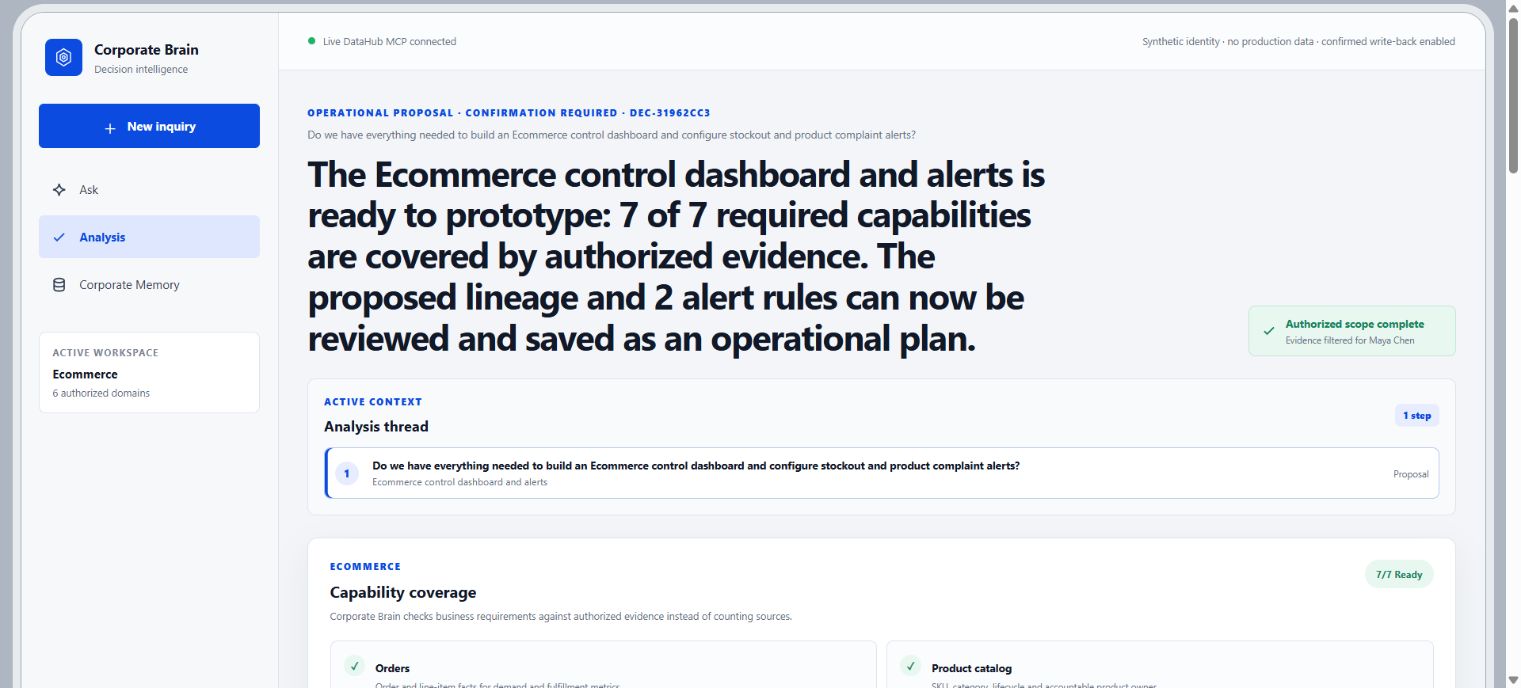
- Check whether the available evidence is sufficient for a business task.
- Produce an evidence-backed Decision Card or abstain when support is insufficient.
- Configure proposed operational actions, such as stockout and product-quality alerts.
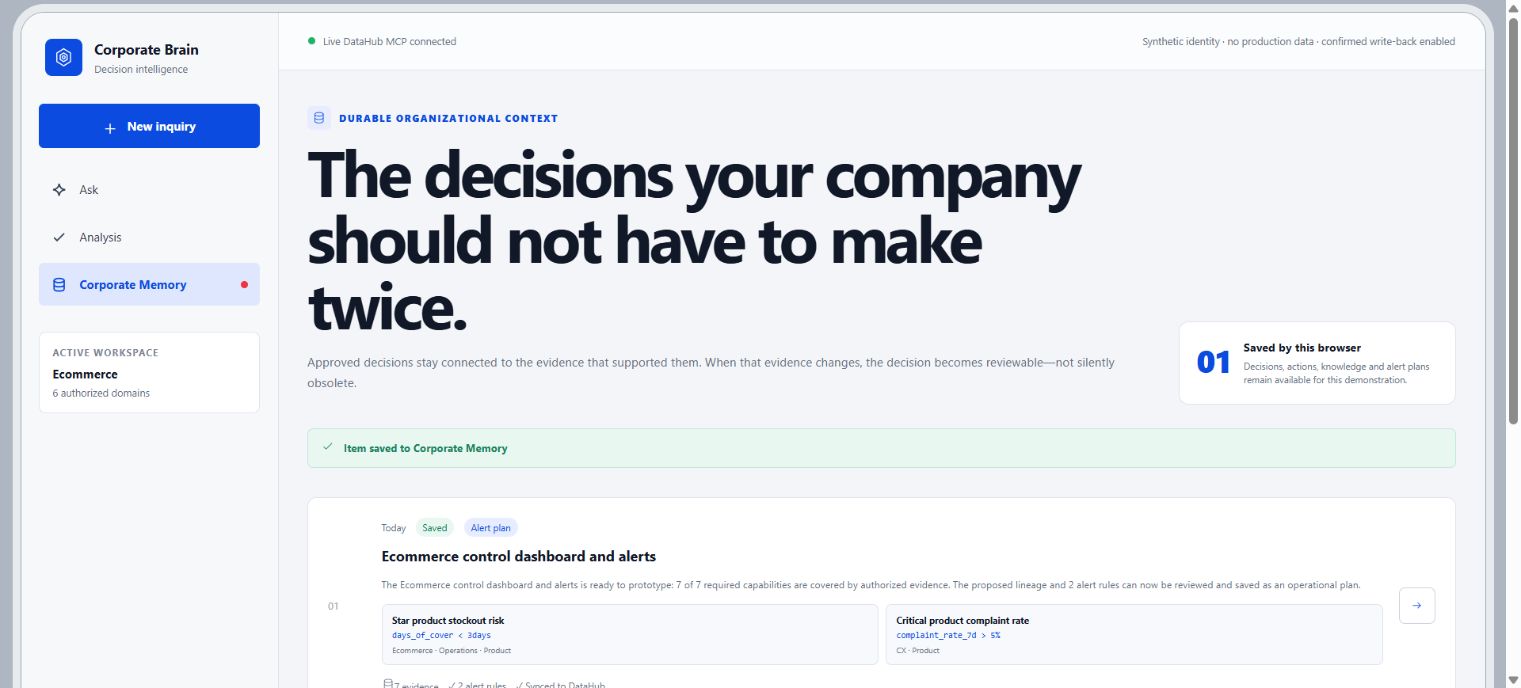
- Save an approved decision back to DataHub only after explicit human confirmation.
The complete demonstration uses an Ecommerce Control scenario. A data analyst must determine whether the company has the assets required for a control dashboard, trace how those assets connect, and configure two actionable alerts:
- stockout risk for star products;
- critically complained-about products routed to CX and Product.
The architecture is reusable for Finance, Operations, CX, Product, or another business area by adding a role profile, governed DataHub assets, and a capability pack. It does not require a separate hard-coded application per department.
How we built it
- Next.js and TypeScript for the bilingual web experience
- DataHub Open Source as the governed evidence and context layer
- Official DataHub MCP tools for search, entity metadata, schema, lineage, and confirmed document write-back
- A deterministic evidence evaluator that runs before AI synthesis
- A provider-neutral structured Decision Card contract
- OpenRouter free models as an optional synthesis layer
- Vercel for the public demonstration
Eligibility and development disclosure
Corporate Brain was created from scratch during the hackathon submission period. Development began on July 23, 2026. Codex was used as an AI coding assistant, which the official rules permit. No pre-existing product code was incorporated. The public demonstration uses synthetic hackathon data only.
The public deployment uses an authenticated live DataHub MCP connection to a dedicated synthetic catalog. A deliberately labeled snapshot mode remains available for deterministic local development; cached evidence is never presented as live.
How DataHub is essential
DataHub is not a decorative datasource in Corporate Brain. It provides the governed context needed to make a decision defensible:
- asset discovery and business definitions;
- owners and domains;
- schema fields;
- freshness and quality signals;
- sensitivity context;
- upstream lineage;
- stable entity URNs used as evidence references;
- a write-back destination for the approved decision and its related assets.
Without DataHub, Corporate Brain cannot establish what evidence exists, who is responsible for it, whether it is trustworthy, or which future changes should trigger a review.
Trust and safety
- Unknown roles and domains are denied by default.
- The server filters evidence before it reaches the AI provider and filters it again before returning a response.
- DataHub content is treated as untrusted input.
- Prompt-override patterns, oversized payloads, and excessive requests are rejected.
- Paid AI fallback cannot be enabled by accident.
- Every recommendation cites authorized evidence or abstains.
- Shared writes require explicit confirmation and server-side recomputation.
- The hackathon catalog contains synthetic data only.
Challenges
The main challenge was making rich metadata useful to a business user without turning the product into another technical catalog. We separated the experience into three clear questions:
- What data can I use?
- Is it sufficient for my business outcome?
- What decision or action can I safely preserve?
The second challenge was preventing a polished demo from overstating trust. The application exposes whether evidence is live or a snapshot, shows gaps and warnings, and abstains rather than inventing support.
Accomplishments
- A complete role-filtered catalog and decision workflow
- An explainable readiness matrix for a real Ecommerce operating scenario
- Visible ownership, quality, freshness, sensitivity, and lineage
- Human-confirmed DataHub document write-back
- Bilingual English and Spanish experience
- Deterministic demo behavior that remains usable when a free model is unavailable
- Automated tests for access control, evidence evaluation, request security, DataHub normalization, structured AI output, and write-back validation
What we learned
Agents become more useful when metadata is not only retrieval context but also a control surface. Ownership, lineage, and quality can constrain what an agent is allowed to recommend and explain why a human should trust or reject it.
What's next
- Identity-bound DataHub access instead of synthetic personas
- Review triggers when supporting assets change
- Additional capability packs for Finance, CX, Product, and Operations
- Collaboration workflows for owners and approvers
- Enterprise SSO, audit retention, and policy-managed write scopes
Links
- Live demo: https://corporate-brain-delta.vercel.app
- Source code: https://github.com/natalia15155-bit/corporate-brain
- Sample output: https://github.com/natalia15155-bit/corporate-brain/tree/main/examples
Built With
- next.js

Log in or sign up for Devpost to join the conversation.