-
-
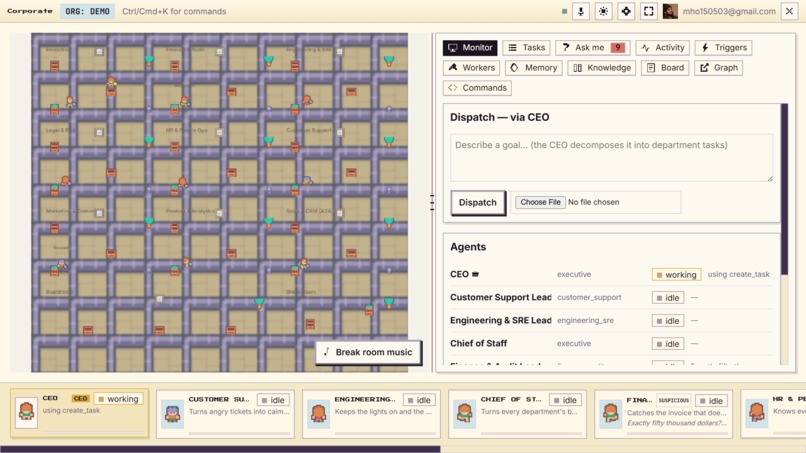
Main Dashboard
-
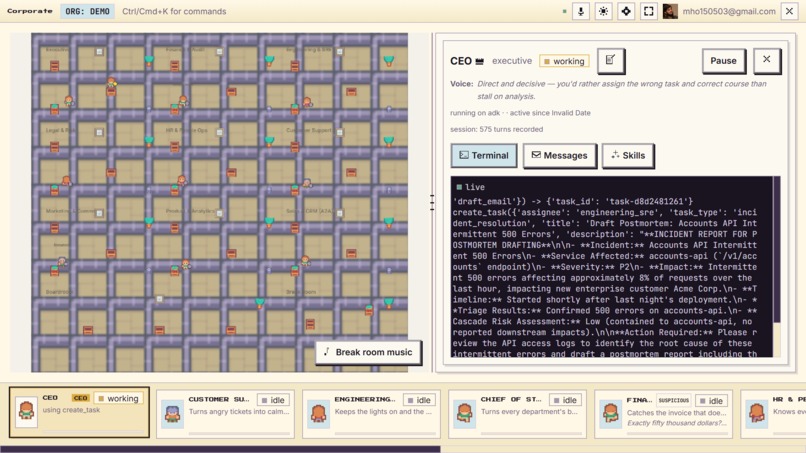
Agents WOrking
-
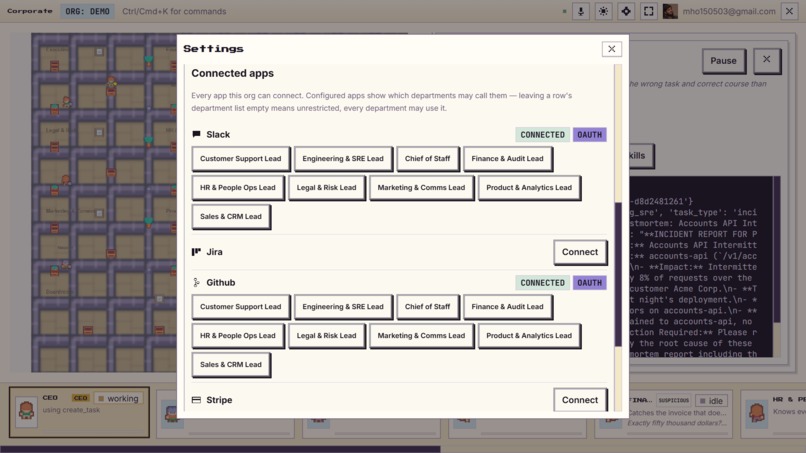
Third Party Integrations
-
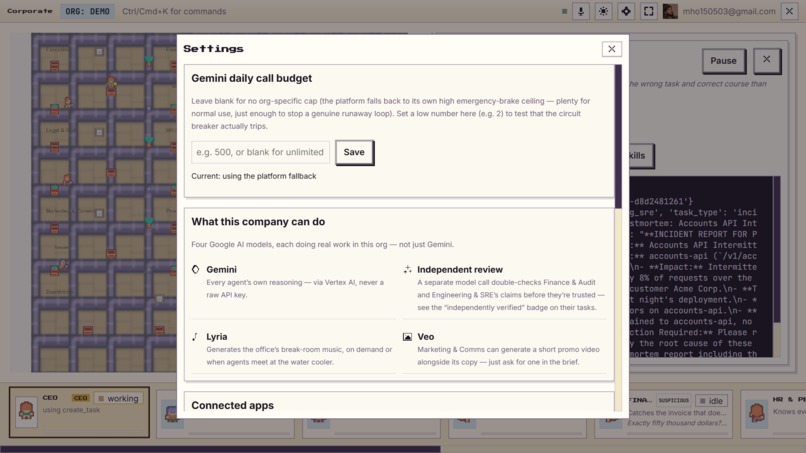
Customising you Agents
-
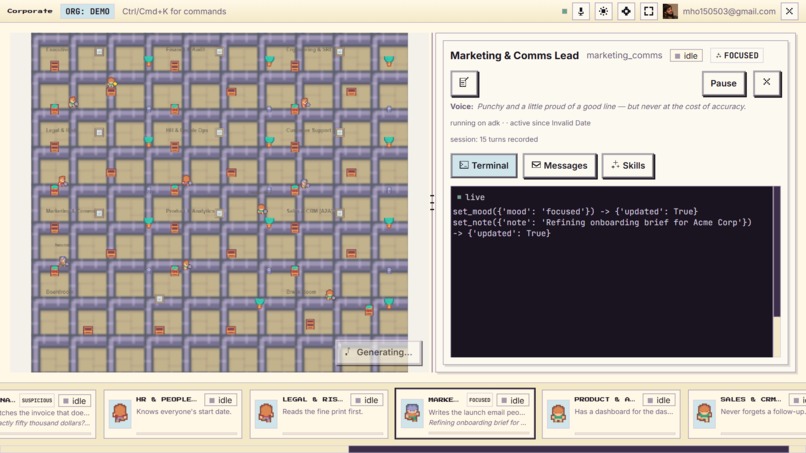
Agents Working
-
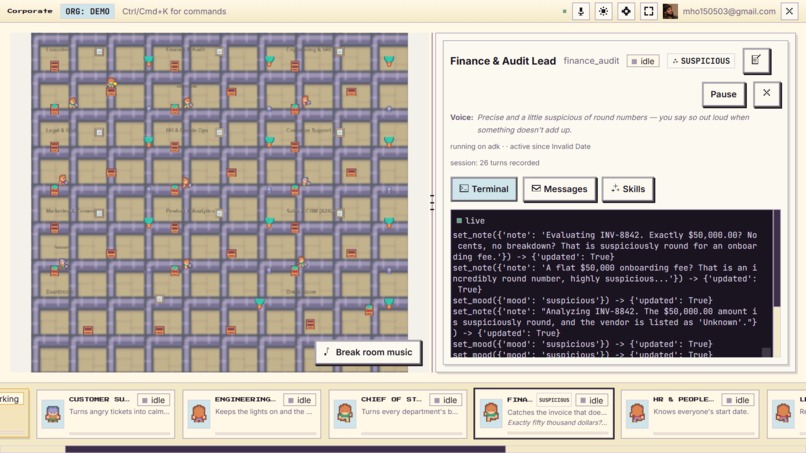
Another Agents Working
-
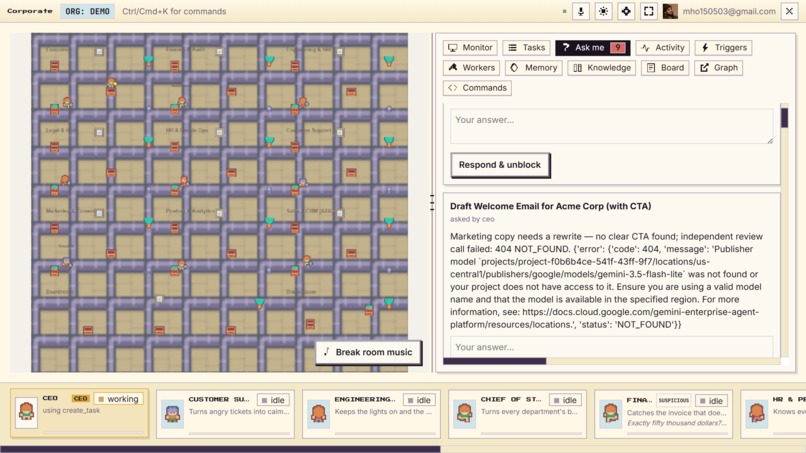
Tasks the need approval
-
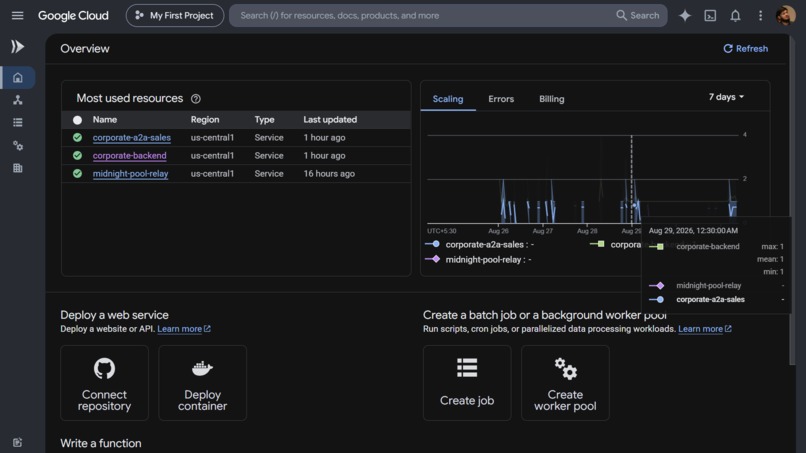
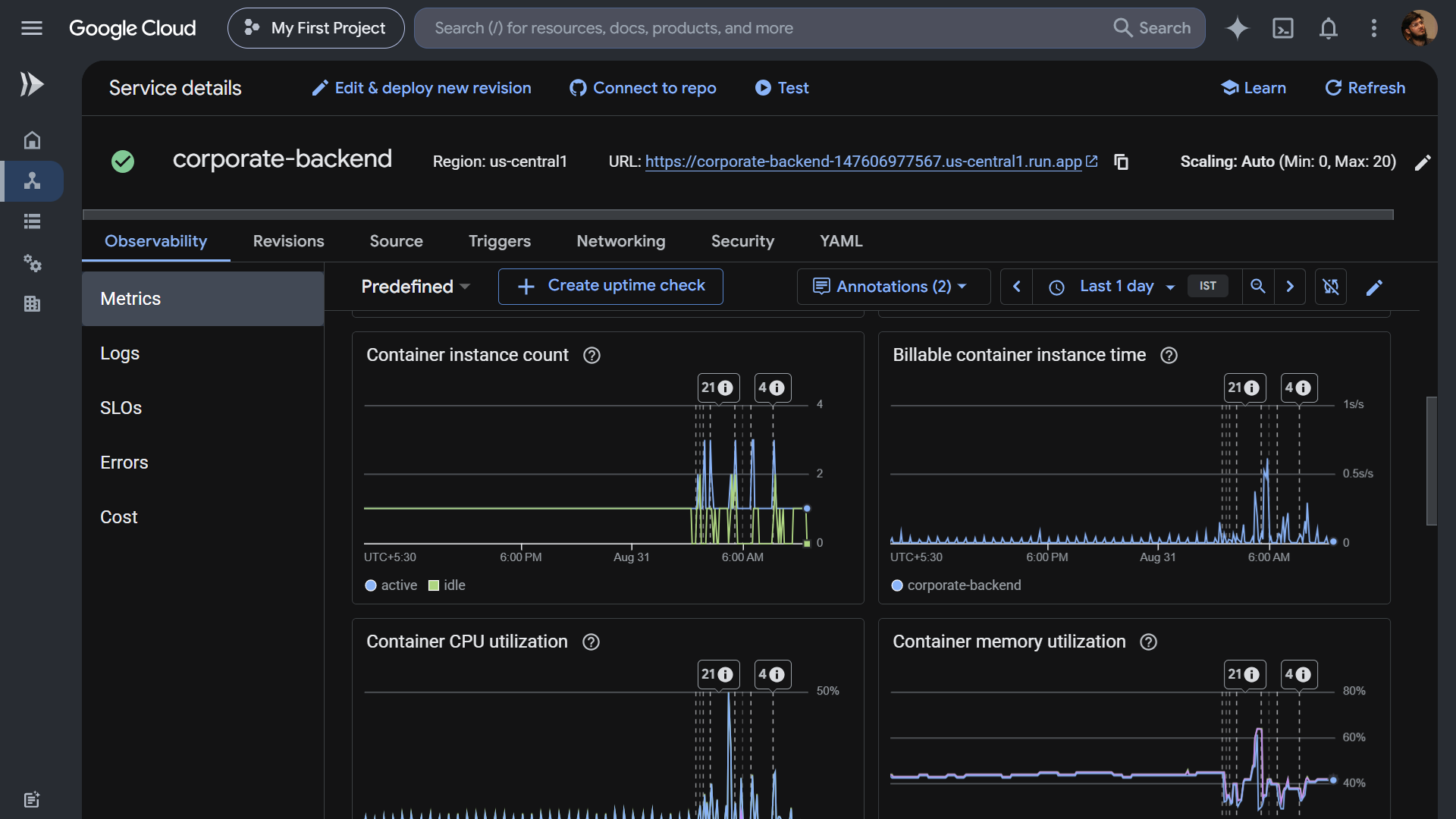
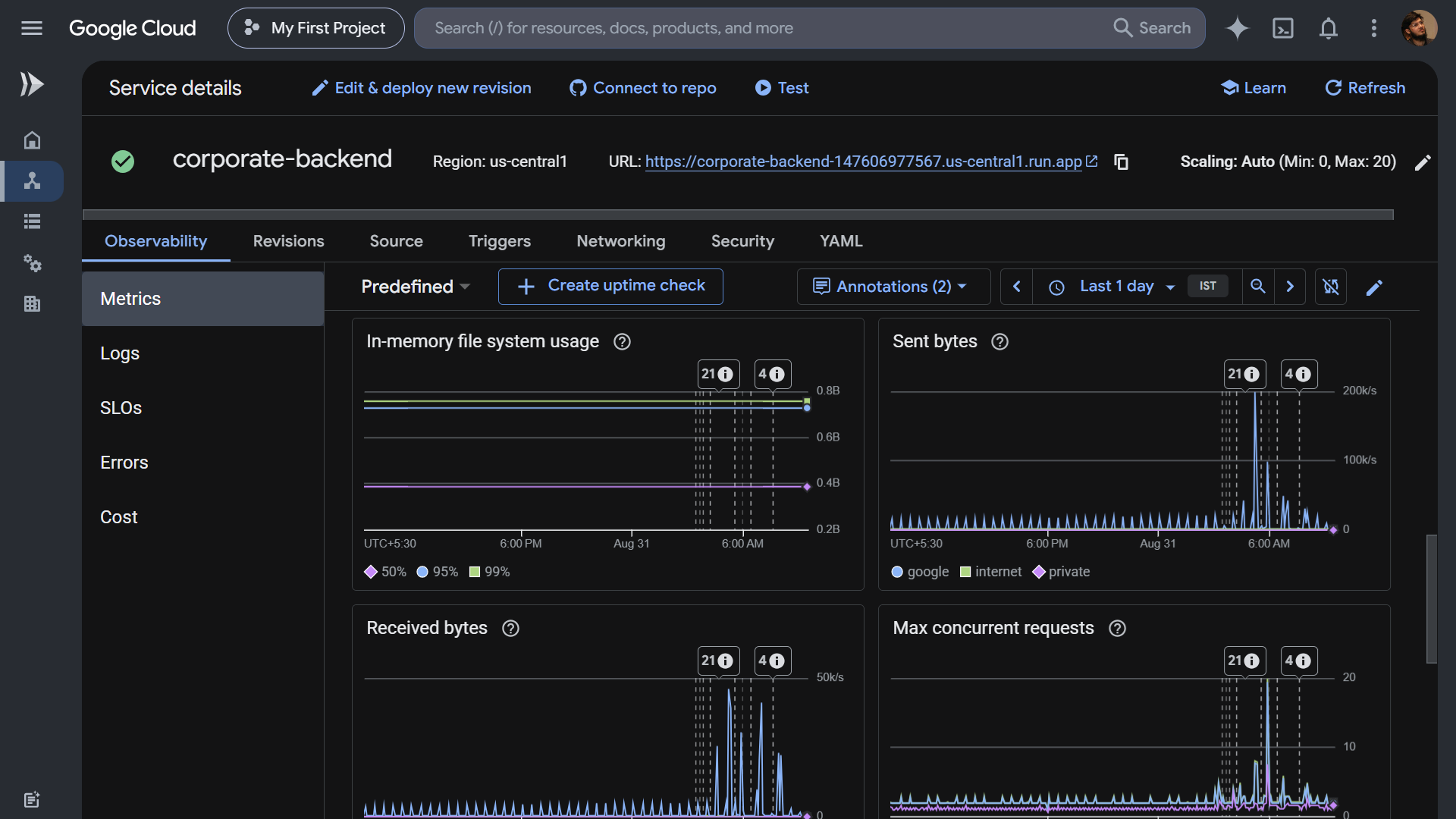
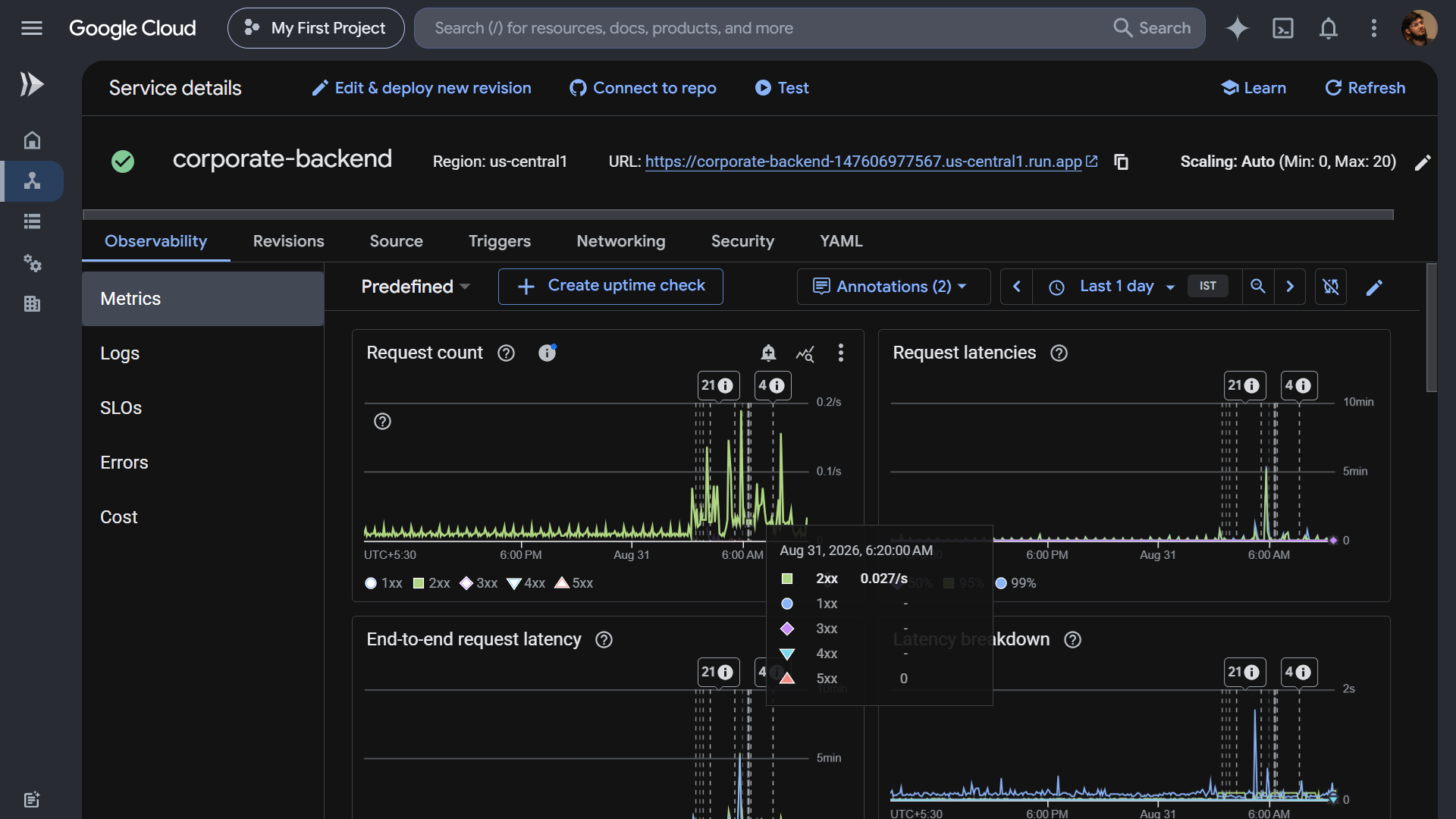
Cloud Deployments
-
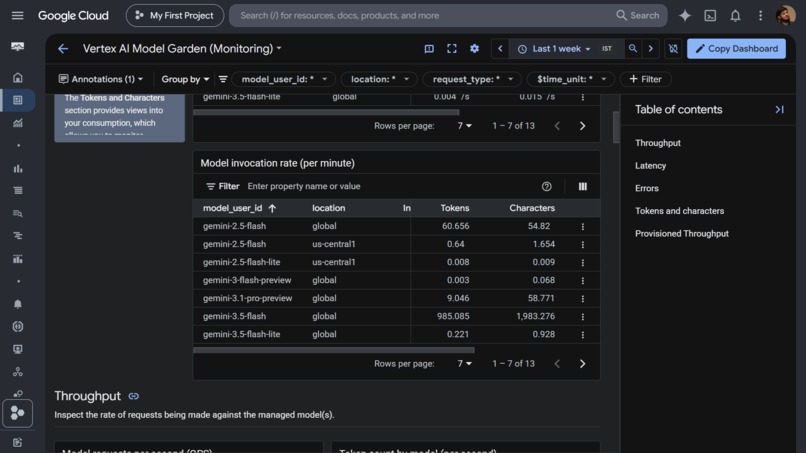
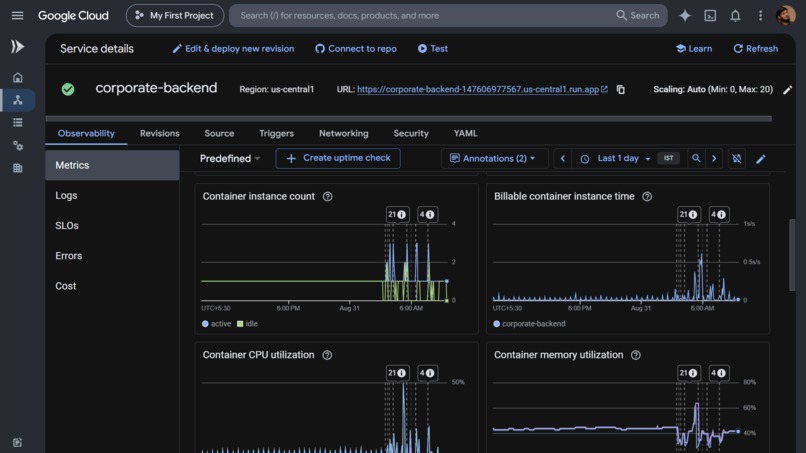
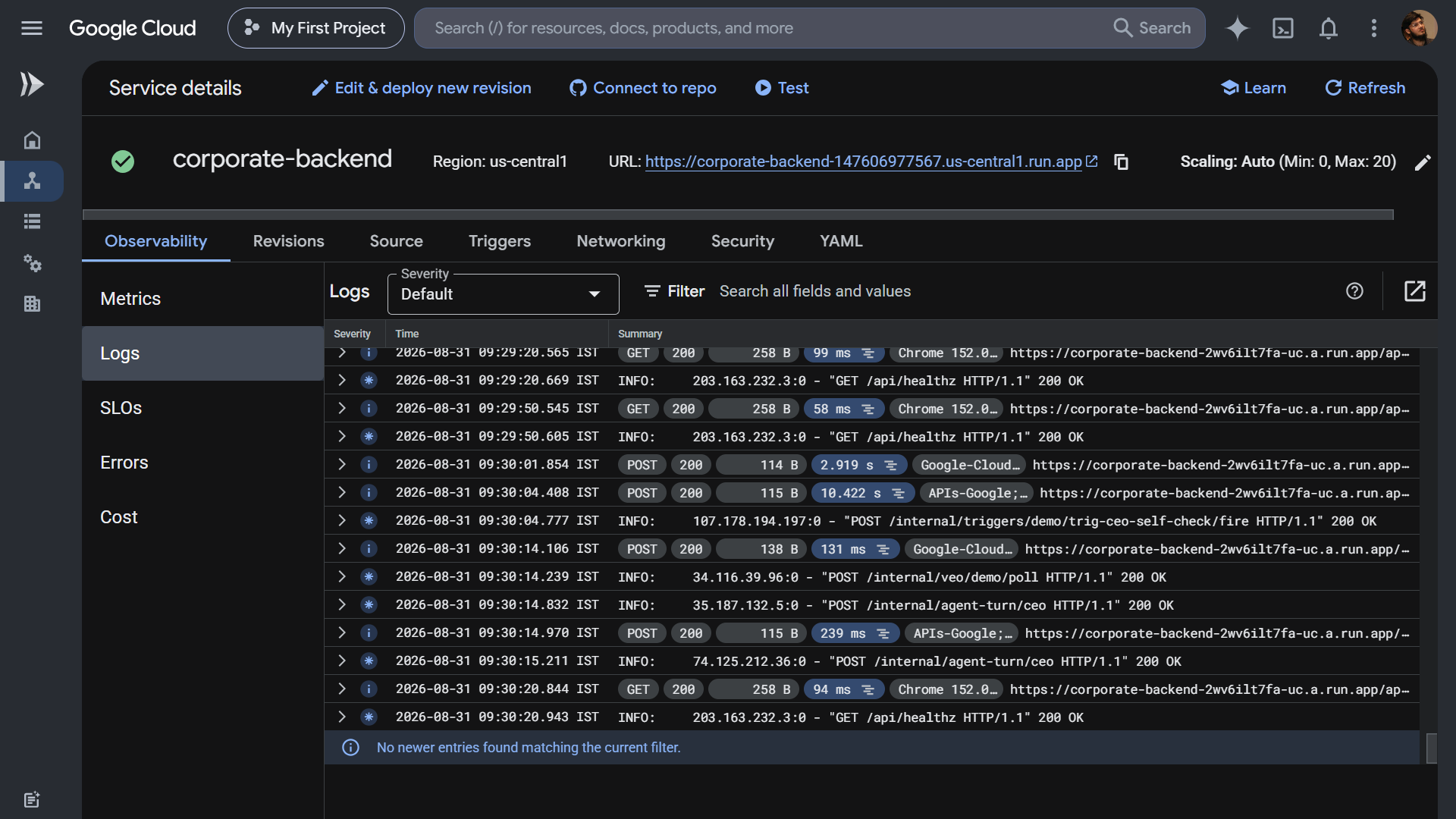
Cloud Logs
-
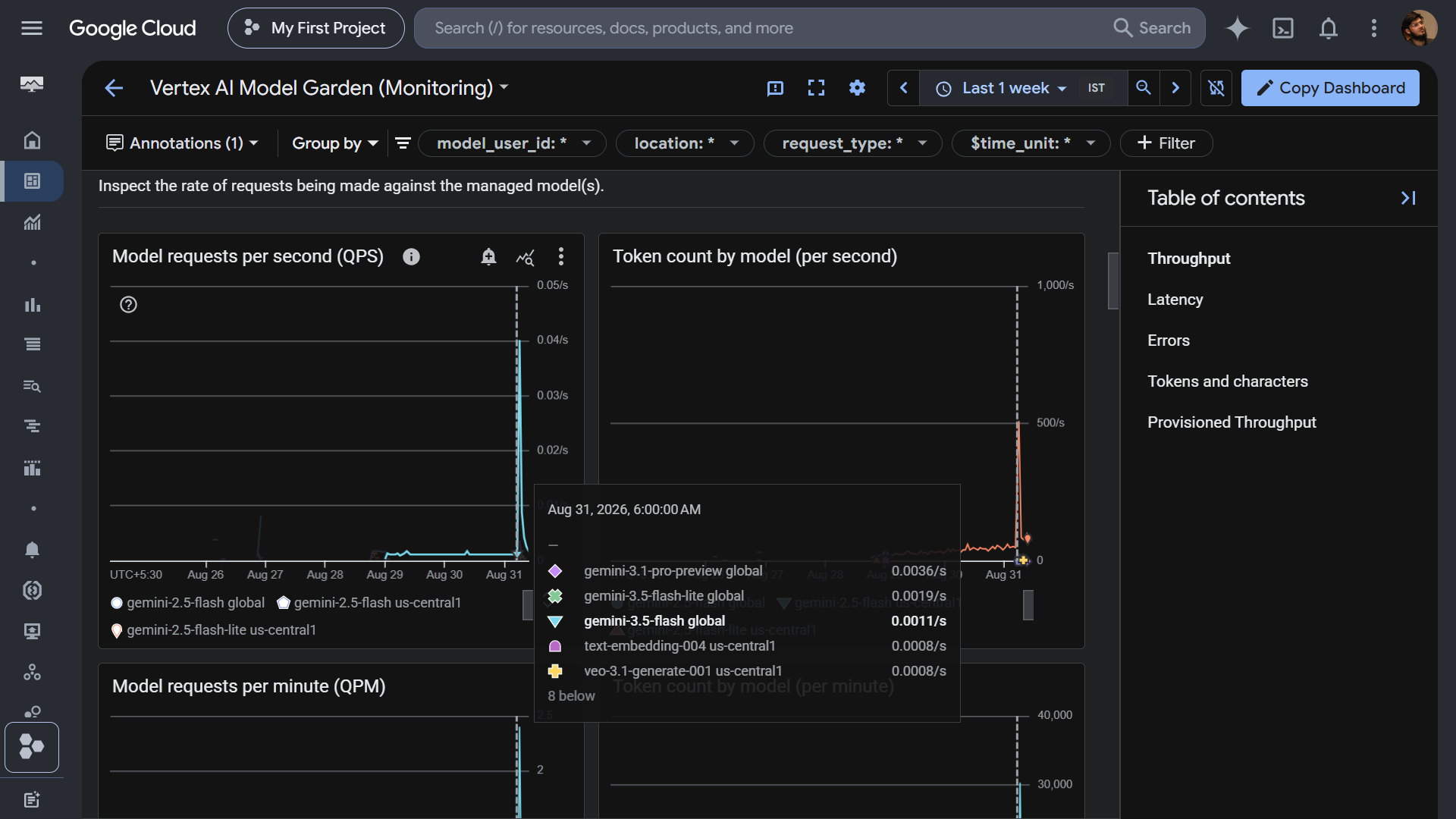
Model Usage
-
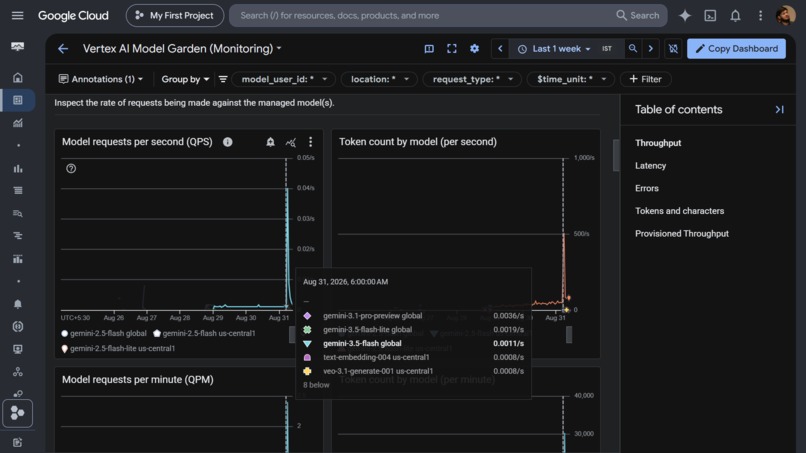
Model Usage
-
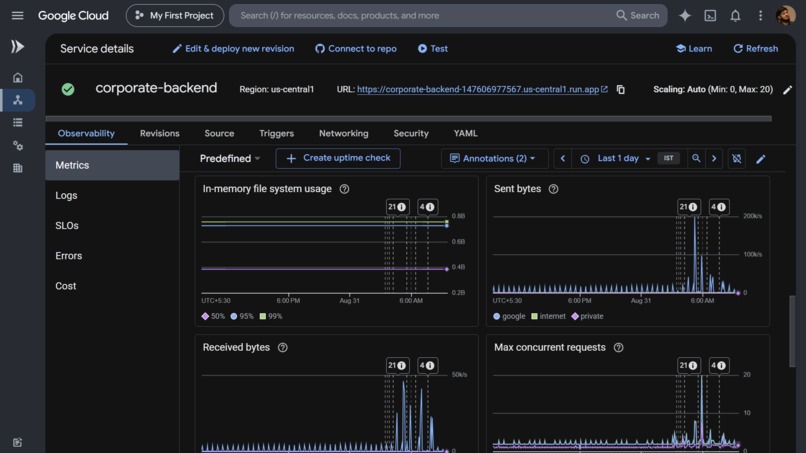
Model Usage
-
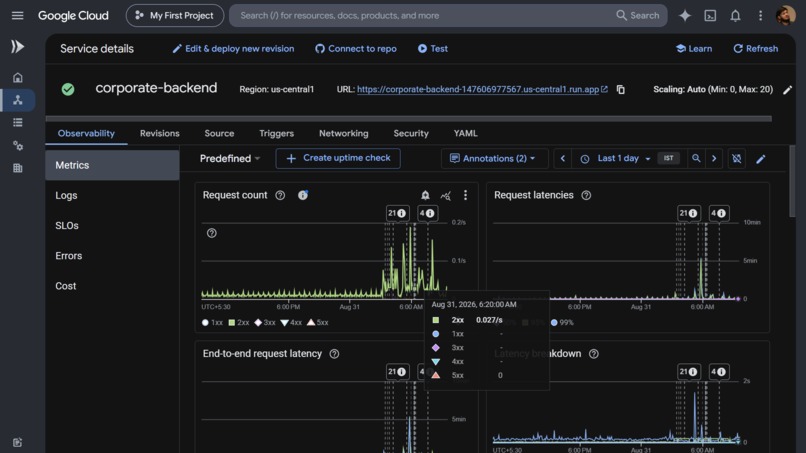
Model Usage
-
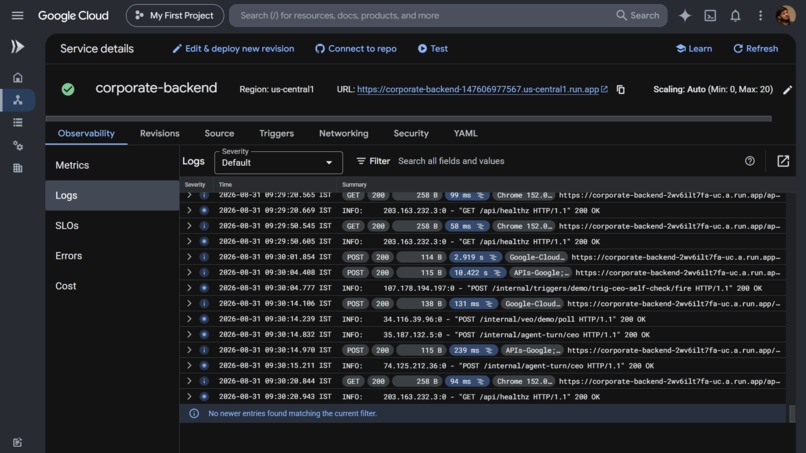
Cloud Logs
-
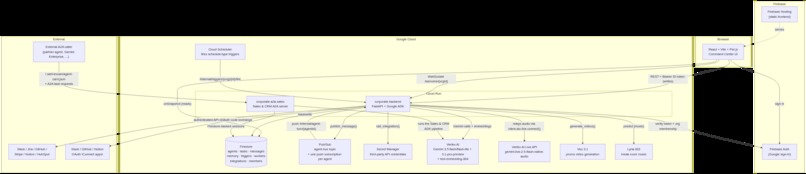
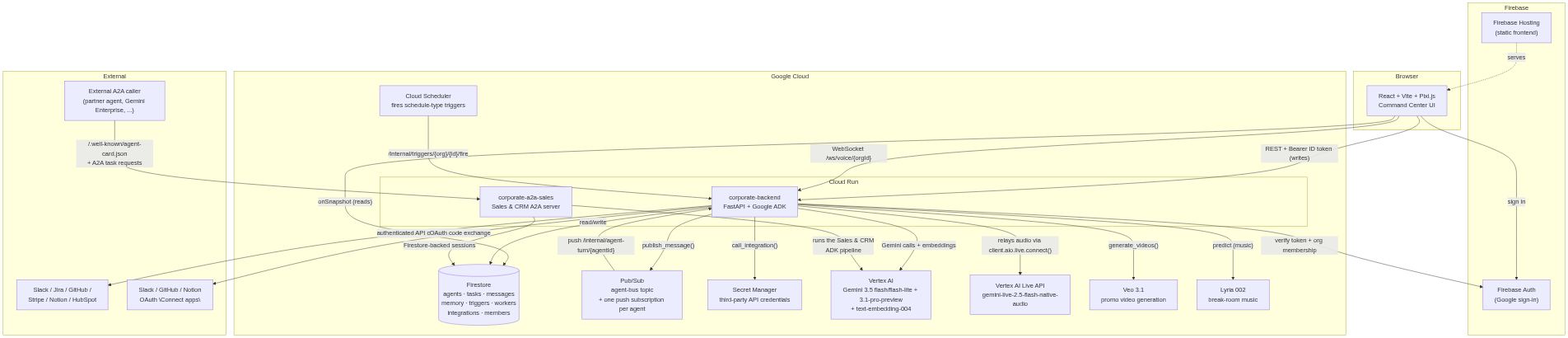
Architecture Diagram
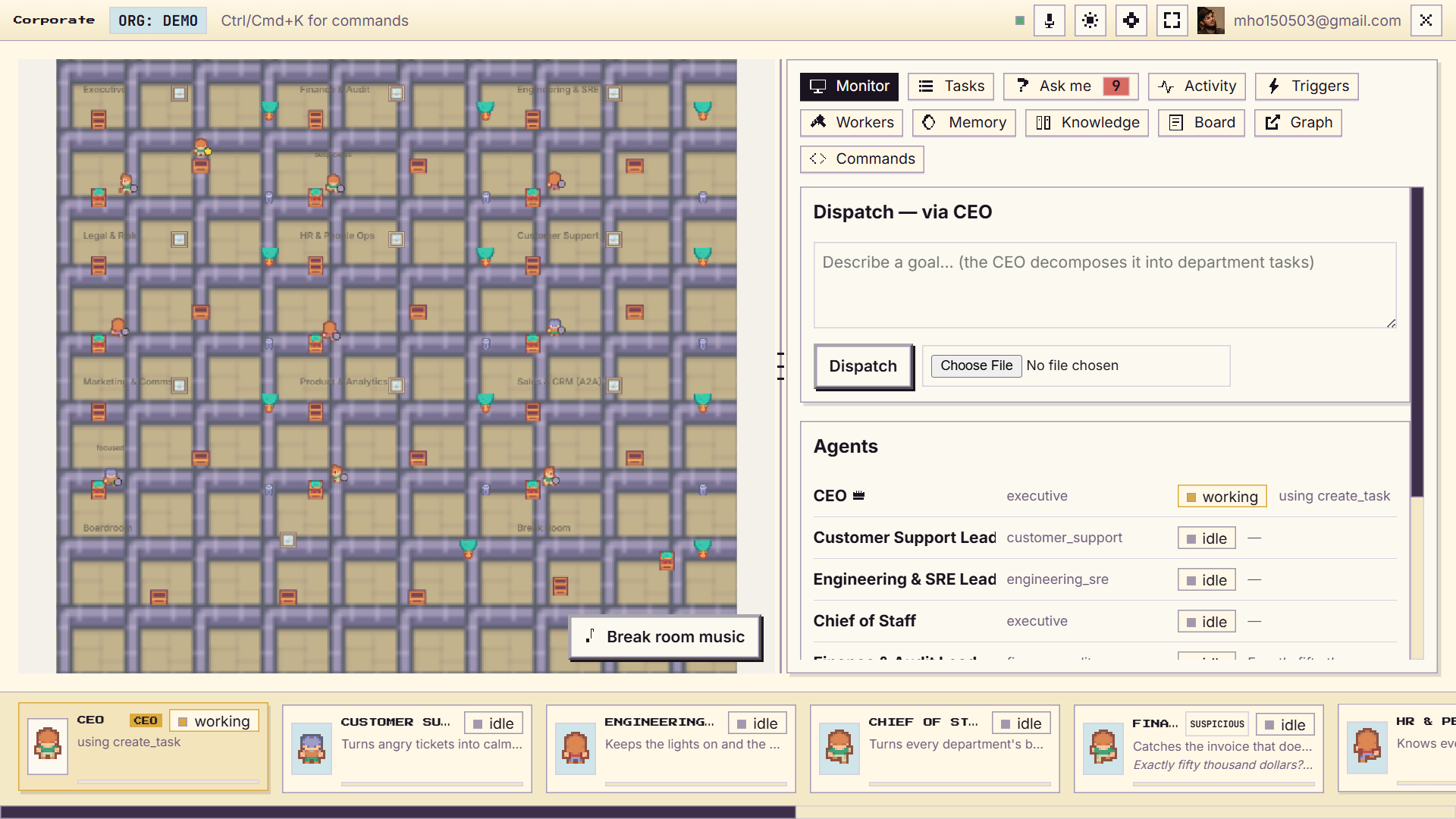
Inspiration
The Fortified Enterprise Fleet track's own description is specific: "scalable institutional agent networks" with real components for discovery/lifecycle, execution/state management, security/governance, and telemetry, emphasizing "production compliance and cross-department deployment" — not a chatbot demo with one clever prompt. That phrase, cross-department, is doing real work. It's asking for an organization, not an agent. A department roster of specialized agents reporting to a CEO orchestrator was the natural shape for that, because it's how a real company is already organized — "governance" and "cross-department deployment" don't have to be abstractions bolted on after the fact; they can just be the org chart, made literal. Office-style AI agent apps were an inspiration for making that org chart feel alive — a company you can actually watch working on a 2D floor — rather than another dashboard with numbers on it.
That inspiration turned into a genuinely long build, not a weekend sprint: foundational architecture decisions first (hosted vs. desktop, Firestore+Pub/Sub vs. polling, A2A scoped to the boundary only, one shared department contract), then three core departments to prove the loop worked over real infrastructure, then the full nine-department roster, then two full research digressions (Google Antigravity, evaluated and rejected on its own merits; a mature open-source coding agent's "loop engineering" patterns, adopted natively with zero new dependency), then a capability-expansion pass (sub-agent spawning, a real sandboxed code-execution tool, per-department integration access control), then voice/OAuth/Veo/Lyria, and finally — three days before the deadline — a hard eligibility discovery and a full production-hardening push that turned into its own saga (see Challenges, below). Every step of that is written down in docs/PROJECT_HISTORY.md and the blog series, not reconstructed after the fact for this writeup.
A note on inspiration and originality
Full third-party attribution — every one of them — lives in THIRD_PARTY_SKILLS.md. The headline one worth stating plainly here: an MIT-licensed office-floor-style AI-agent app was an early visual and structural reference point for Corporate's Command Center UI, looked up directly from its live repo rather than assumed from memory. From that starting point, I built and substantially reworked Corporate's own design system, components, and layout to fit its own data model and tab set (Ask-me, Triggers, Workers, Knowledge, Board, Graph — none of which the reference has) — no code from that reference is reused as-is in the shipped app. Everything else in the app is my own: the office floor's tileset is Kenney's CC0 "1-Bit Pack", rearranged into my own room-and-corridor layout, not the reference's own separately-licensed art; every agent's name, persona, dialogue, and the "Corporate" name and branding are original, with no resemblance to the reference's own theming. In the interest of full honesty rather than a blanket "nothing but inspiration" claim: a couple of narrow backend patterns — the agent-loop doom-loop guard and session-compaction design in runtime.py/compaction.py — are genuinely adapted from a real open-source coding agent's own implementation, and a handful of department prompt sections include short excerpts adapted from other MIT-licensed domain-skill repos. Both are small, both are fully attributed by source, author, and license in THIRD_PARTY_SKILLS.md, and neither is core application logic — the department contract, the verification pipeline, the messaging fabric, and every department's actual pipeline are original.
What it does
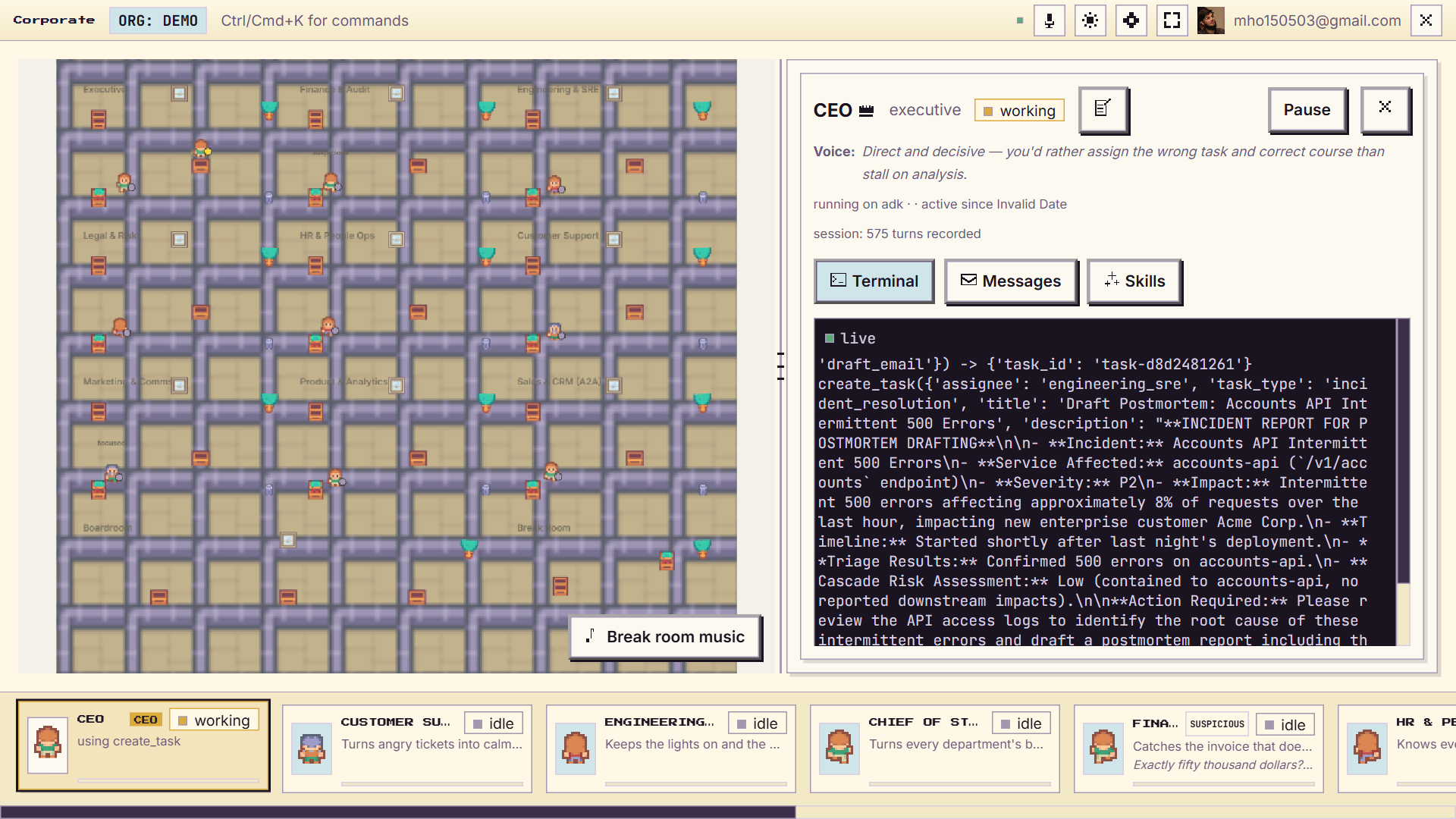
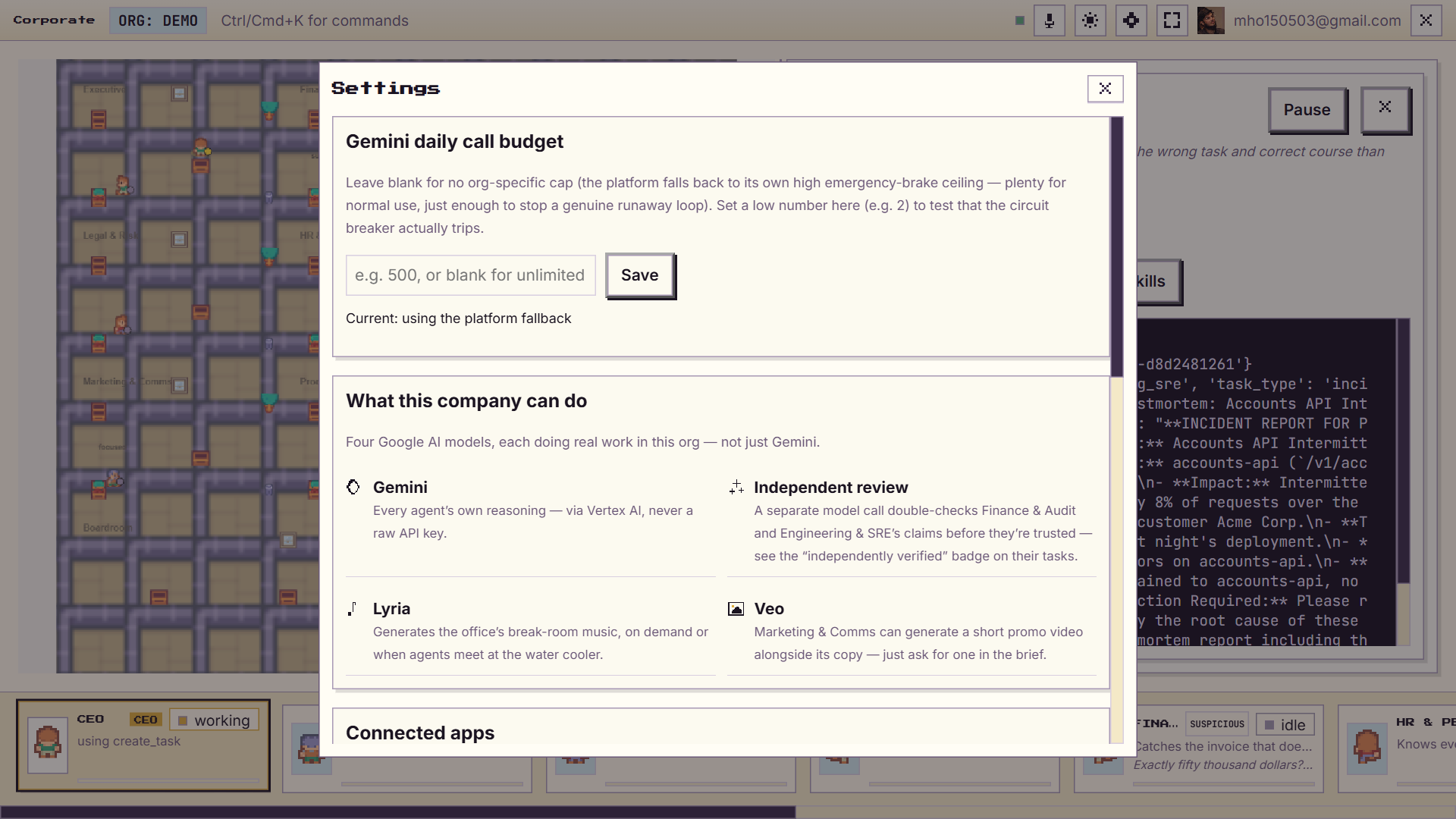
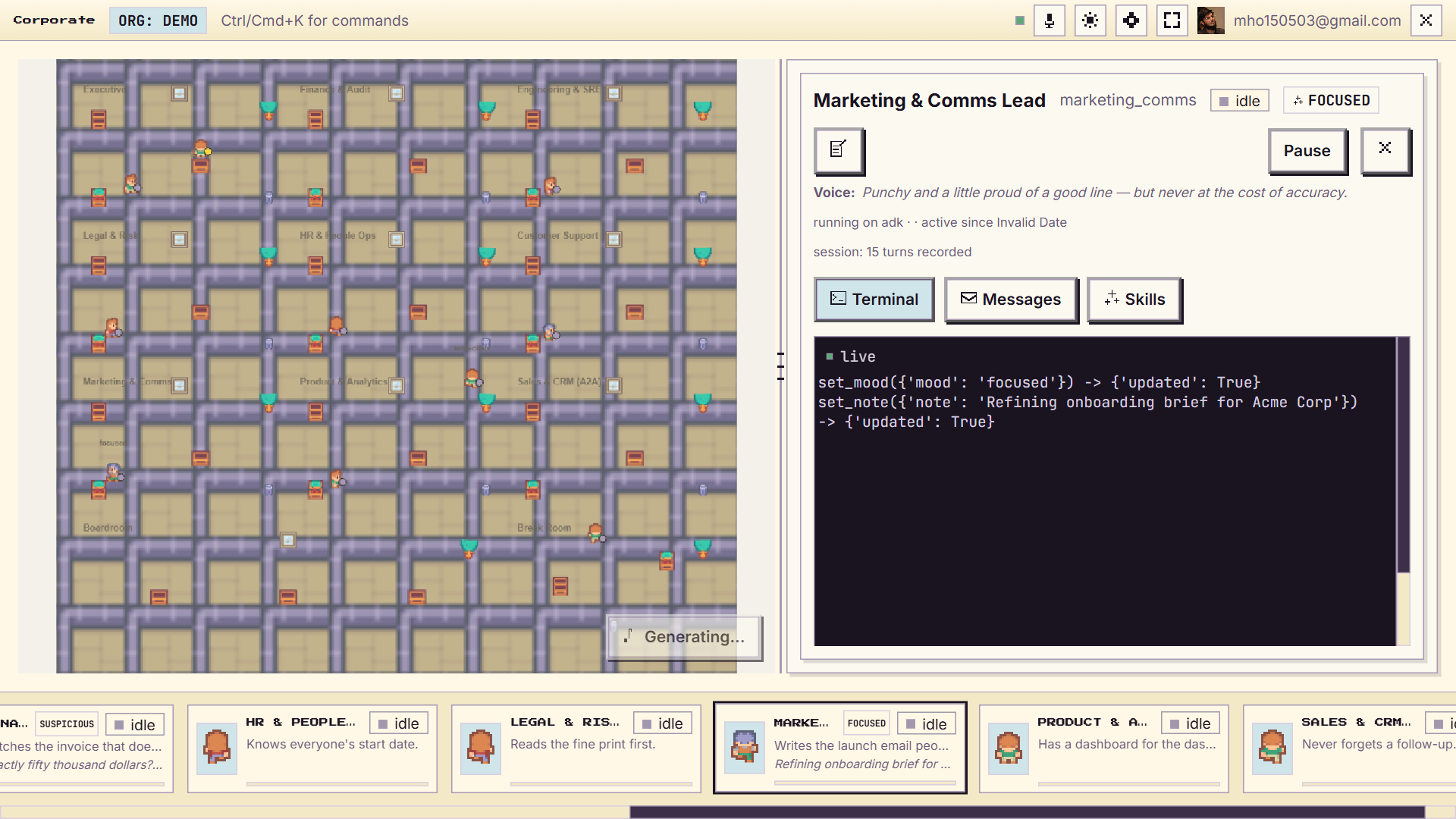
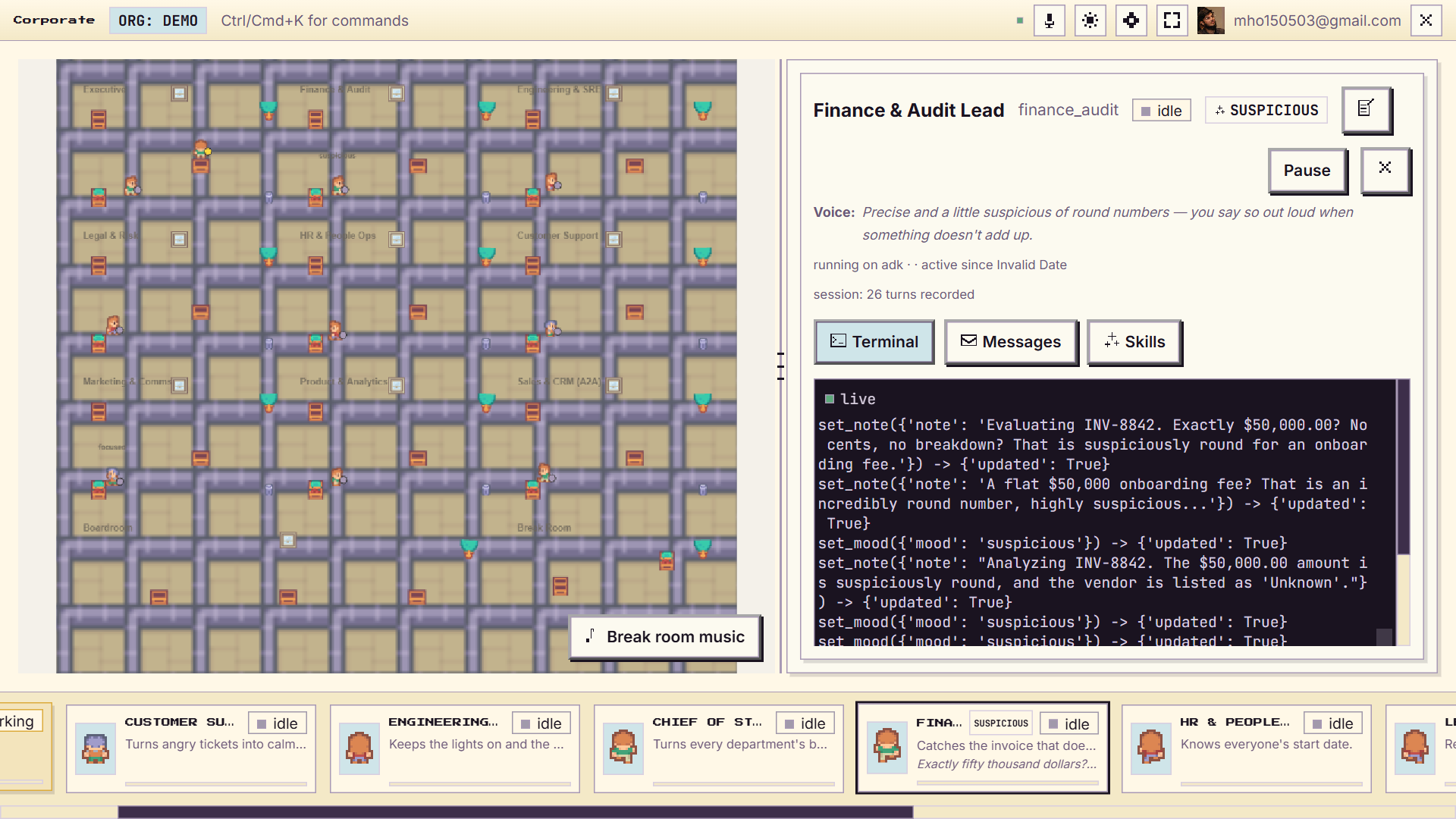
Sign in, dispatch a goal to the CEO agent, and watch it get decomposed into real tasks routed to the department best suited for each one — over an actual Pub/Sub message bus, not an in-process function call. Each department runs its own multi-stage ADK pipeline with a genuinely different shape per domain, not one template reused nine times: triage → cascade-risk assessment → postmortem draft for Engineering & SRE (with a real Slack notification on high-severity incidents); document-intelligence extraction → classification → a structurally-independent fraud-risk judgment → deterministic verification → plain-language explanation for Finance & Audit; five parallel judge lenses → deterministic quote-grounding for Legal & Risk (an ungrounded citation is dropped, never "corrected" by asking a model to fix it); classify → knowledge-base-grounded reply → the same grounding check for Customer Support; brief → copy → brand-voice checker fan-out (including an independent second Gemini call reviewing the first one's own output) → scheduling suggestion for Marketing & Comms, which can also kick off a real Veo-generated promo video alongside the copy. Every claim any department produces is either deterministically grounded against a real source, or run through a multi-checker vote before it's ever surfaced — an LLM may judge or propose, but only deterministic code verifies, the one architectural rule that shows up in more of this codebase than any other.
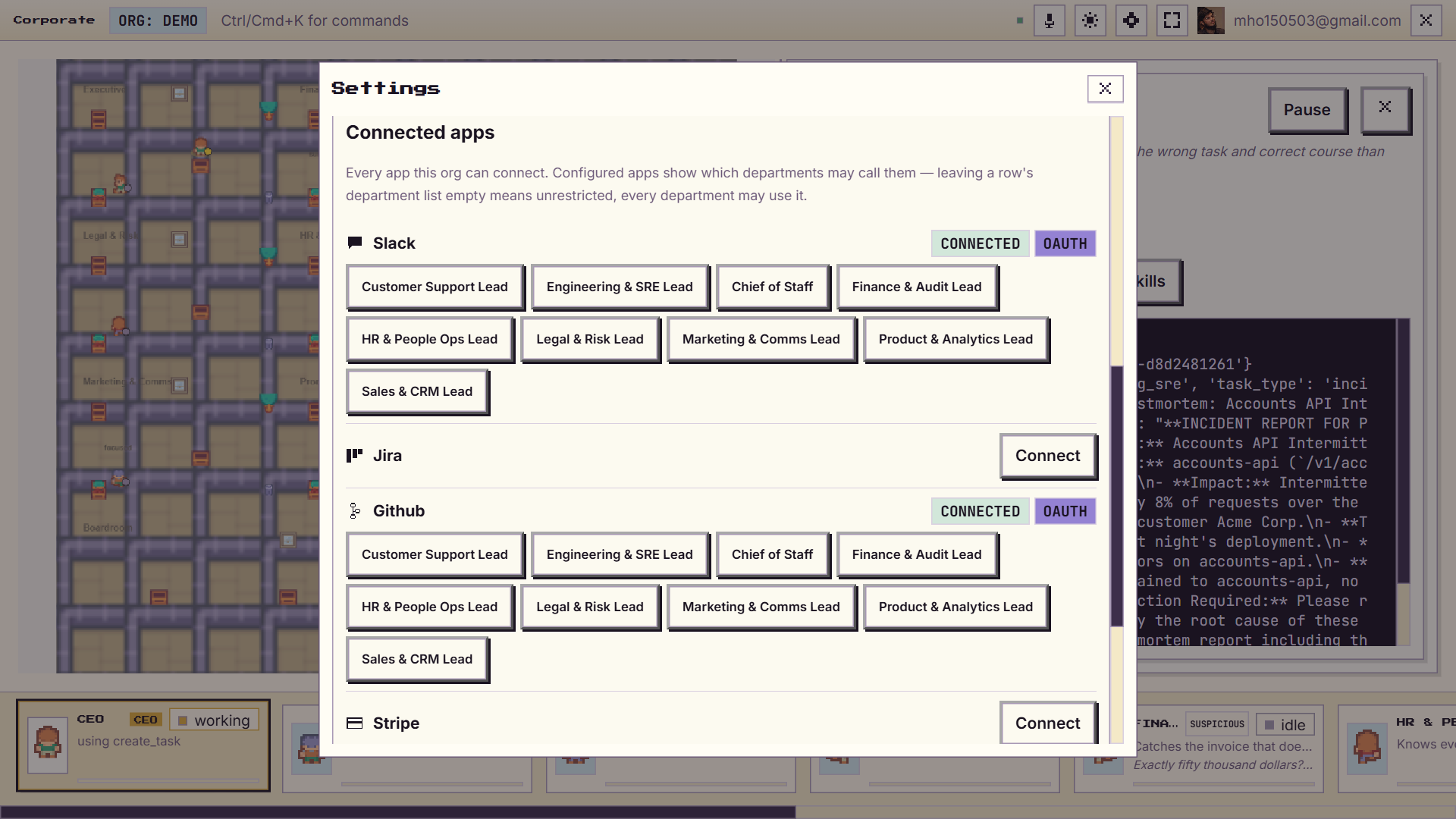
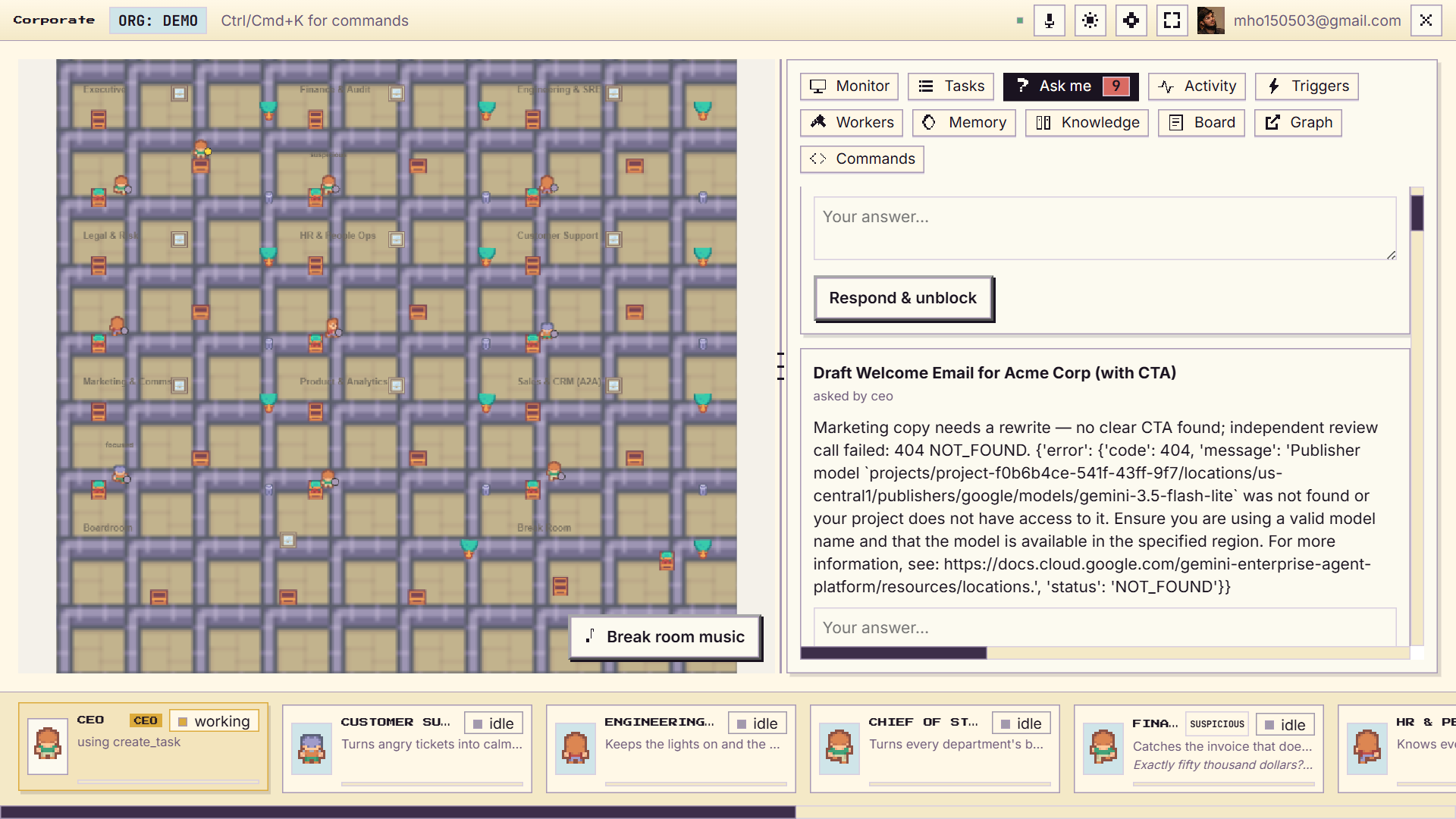
A Command Center dashboard — Monitor, Tasks, Ask-me, Activity, Triggers, Workers, Memory, Knowledge, Board, Graph, Settings, Commands — gives full visibility into every agent's status, mood, memory, message graph, per-aspect verification votes, and the tamper-evident hash-chained audit trail behind every task, with a live audit-chain integrity badge and a real polling service-health indicator so a dropped connection shows a banner instead of silently freezing. Agents have real, original personas (name, bio, voice, mood, sprite — no resemblance to any media property), can talk to the CEO by realtime voice over a backend-held WebSocket relay to Vertex AI's Live API, generate break-room ambient music on demand with Lyria, and propose their own skills for a human to approve or reject from the same panel that shows their built-in ones. GitHub, Slack, and Notion connect through a real OAuth "Connect with X" flow, not a pasted API token, with per-department access control and a standing approval queue for anything a department requests but isn't allowlisted for.
How I built it
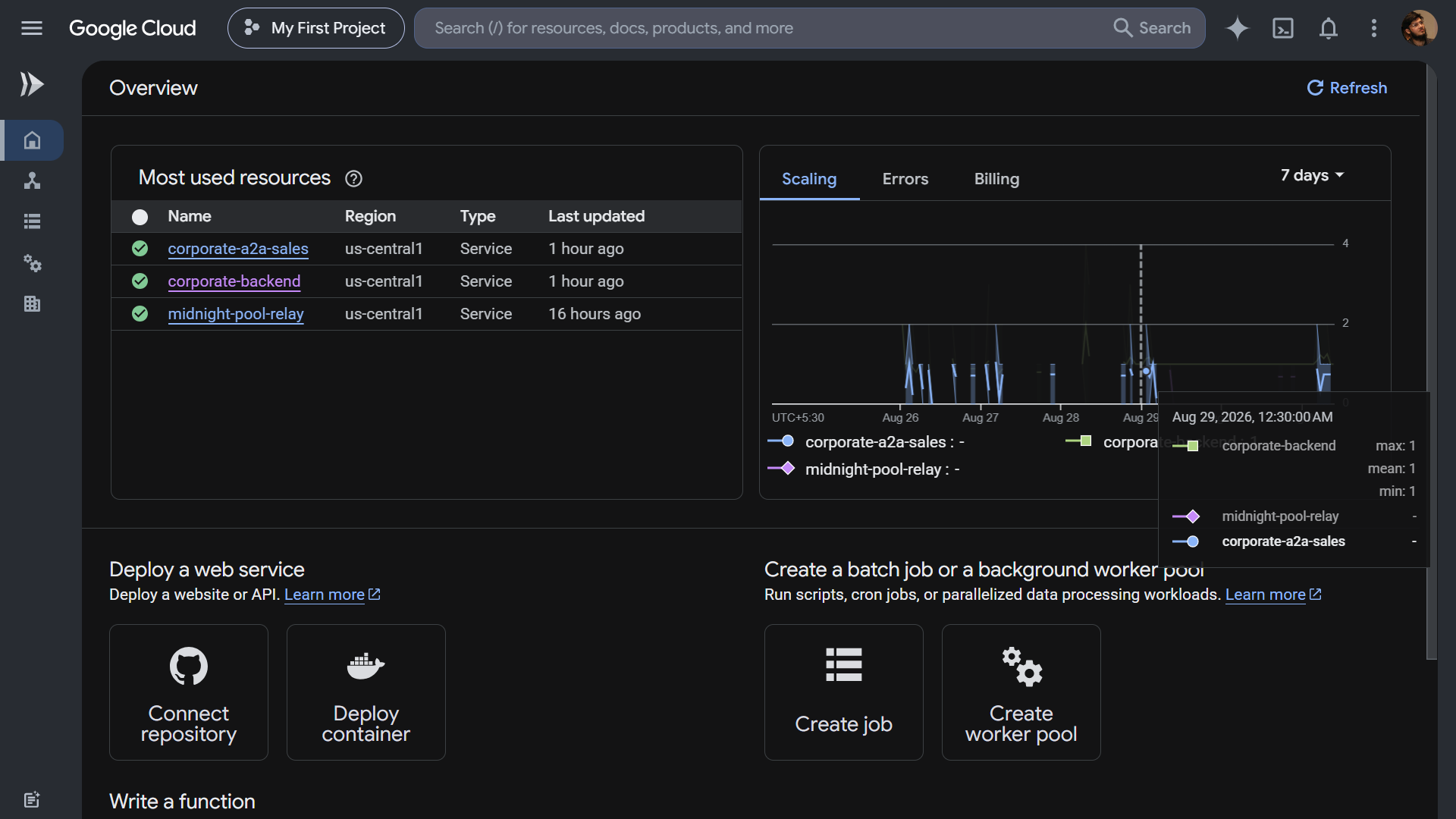
Python 3.12 + FastAPI + Google ADK 2.7.1 on the backend, one department contract (DepartmentSpec + on_task_received, wrapped automatically in @audited_task for hash-chained audit logging, idempotent dispatch, and failure containment) that all nine departments implement identically — a new department gets a working, governed pipeline on day one with zero of its own plumbing code. React + Vite + TypeScript + Pixi.js on the frontend, reading Firestore directly via onSnapshot for live state and writing through a thin REST client that attaches a Firebase ID token. Firestore holds all durable state, namespaced orgs/{orgId}/... from day one even with only one org ever seeded — multi-tenant by construction, not bolted on later. Pub/Sub carries every inter-agent message through exactly one chokepoint function (publish_message()) that owns hop-count loop prevention and requires_reply derivation mechanically — no LLM's own judgment ever decides whether a reply is owed. Cloud Run hosts both the main backend and a second, deliberately separate A2A server exposing only Sales & CRM externally, keeping the internal Pub/Sub fabric and the external trust boundary structurally apart.
The build order itself was deliberate, not incidental: foundations first (the five shape decisions above), then Finance & Audit alongside a minimal frontend specifically to prove the CEO-to-department loop over real Pub/Sub before building anything else on top of it, then the rest of the roster, then a hardening pass once real usage exposed real gaps (no Pub/Sub redelivery dedup, no error containment anywhere in the dispatch path, an Ask-me flow that was broken end to end because a flag was set but the entry it pointed to was never written), then a capability pass (Google Search, per-task model tiering, vision attachments via Cloud Storage instead of base64-in-Firestore), then two UI passes (the second one specifically because I reviewed real screenshots of a reference app's running UI and found the first pass's layout, not just its color tokens, still didn't match), then the ADR-0016 capability expansion (sub-agent spawning reusing the existing ephemeral-worker mechanism instead of reopening the Pub/Sub-only CEO boundary; a real sandboxed execute_python tool — a genuine OS subprocess as the actual isolation boundary, RestrictedPython as defense-in-depth on top, not instead), then voice/OAuth/Veo/Lyria, and finally the submission push. Every non-obvious decision along the way has an ADR in /docs/adr/ — 20 of them by the end — which is the specific discipline that made the final three-day audit (below) a tractable, if intense, few days of focused work instead of a panic: nothing had to be re-derived from scratch, because the reasoning behind every earlier call was already on record.
Challenges I ran into
This project's honest answer to "what went wrong" is long, because the discipline throughout was to actually go looking for what was wrong rather than assume a working demo meant a working system. Roughly in the order they happened:
- Google Antigravity, evaluated and rejected on real evidence, not vibes (ADR-0014). Installed the actual
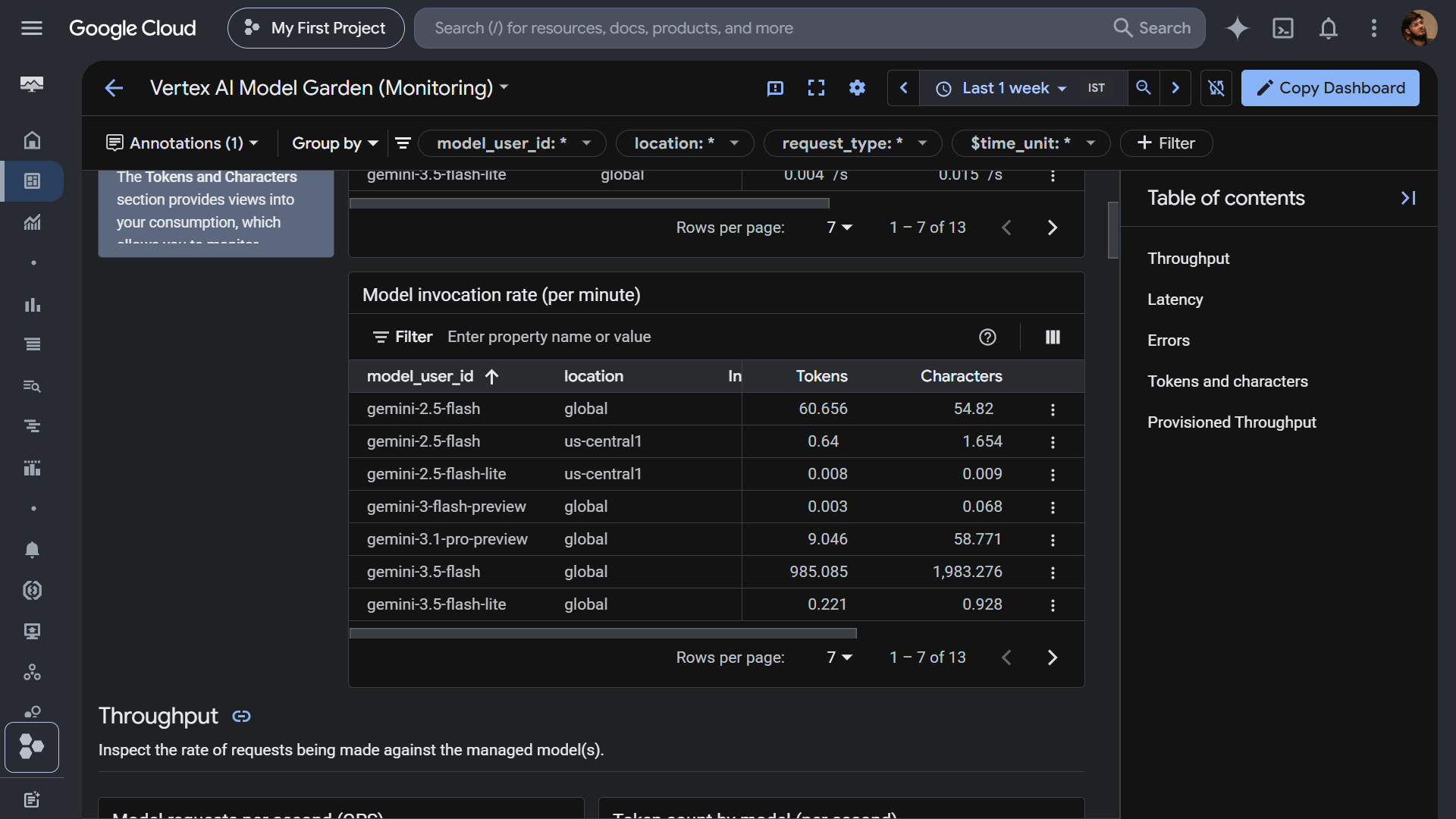
google-antigravitySDK andagyCLI, inspected the real source with Python'sinspect, ran it against live Vertex AI turns. Found: no pluggable persistence that survives a fresh process (the real API had none of what the docs described, and Cloud Run's ephemeral, scale-to-zero, multi-instance model can't tolerate that); the CLI's real headless auth path was a raw Gemini API key, not Vertex AI, directly conflicting with the eligibility requirement below. Let it go entirely — and the investigation surfaced something better than a workaround: department sessions already persisted across turns via the existingFirestoreSessionService, so the "no memory between turns" gap the whole search started from didn't actually exist. - Gemma turned out to be unreachable in this project's Vertex AI access at any tier (ADR-0019). Live-testing every variant — not trusting Model Garden's own docs page — found each one's card showed only a paid, self-hosted "Deploy model" button, never the zero-deployment serverless path originally assumed; Llama, Mistral, Codestral, and Jamba were tried as replacements and 404'd the exact same way. Self-hosting a dedicated GPU endpoint for one aspect checker, this close to a deadline, was a bad trade. Swapped for a distinct Gemini tier instead — still a genuinely separate model call, fresh context, just not a different vendor, and the ADR says so plainly rather than let the "cross-model" framing quietly stay inaccurate.
- A hard eligibility gap found three days before the deadline, by re-reading the hackathon's own rules directly instead of relying on an earlier read: "Gemini 3.5 or newer" is required for every track; this project's default model config was still on 2.5-tier models. Fixing it needed real investigation, not a docs lookup — the 3.5-tier models 404'd at the region every other model in the project already used, which turned out to mean nothing needed fixing in the region config at all: reading
google.adk.models.google_llm.Gemini.api_client's own installed source showed ADK'sLlmAgentnever passes an explicit location, andgoogle.genai's own client silently defaults to Vertex'sglobalendpoint wheneverGOOGLE_CLOUD_LOCATIONis unset — which it always had been. Confirmed with a real end-to-end ADK turn before committing a single line, per ADR-0020. - A silent production bug, found while auditing observability, that nobody had reported: every ephemeral worker had been failing on its very first turn since the feature shipped, because
update_agent_status's Firestore.update()call assumed a document existed that a worker never gets — only registered department agents do. Reproduced live both ways (the bug with the old code, the fix with the new) against real Firestore before shipping the one-lineexcept NotFound: pass. - Two more instances of the exact same eligibility bug, both self-inflicted, both found while live-seeding a demo org for the actual recording:
shared/cross_model_check.py's independent-review checker andapp/services/compaction.py's session-compaction summarizer both build their own rawgenai.Client()pinned to the old region instead of going through ADK's default resolution — meaning upgrading to Gemini 3.5 broke both of them with a 404, and broken compaction meant nothing ever trimmed the CEO's growing session, which is exactly how its own session document hit Firestore's 1MiB cap in production a few hours later. Fixed both, live-verified both. - Fixing that Firestore-size bug surfaced a second bug, and the first attempt at fixing that introduced a third: a Google-Search-grounded turn could carry a raw SDK object nested inside its own "JSON-safe" event dump, crashing the write outright — reproduced live, the shape depends on the real search response so no single field could be special-cased. The first fix (stringify anything JSON can't encode) stopped the crash but corrupted every later read of that same session, since the schema expects a dict-or-
Nonewhere it now found a bare string. The actual fix converts the offending value toNoneinstead of a string, andget_session()now also skips (and logs) any individual historical event that still fails validation for any other reason, rather than one bad event bricking an agent's entire memory forever. - Break-room music was completely broken on Cloud Run, unconditionally, independent of everything else —
generate_signed_url()tries to sign locally with the credential's own private key by default, and Compute Engine/Cloud Run credentials (and even a localgcloud auth application-default logincredential) have none, regardless of theiam.serviceAccountTokenCreatorself-impersonation grant already correctly in place. Fixed by explicitly routing the signing call through the IAM CredentialssignBlobAPI instead — Google's own documented pattern for exactly this scenario. - A promo video that said "done" but showed a blank, unplayable player: the Veo poll endpoint was writing the raw
gs://URI straight into the task — no browser<video>tag can dereference that — and never clearing the "still generating" flag on completion either. Same signed-URL fix, generalized into a smallsign_existing_gcs_uri()helper, plus an explicitvideoGenerating: Falseon completion; verified against a freshly generated video end to end, including fetching the resulting signed URL directly and confirming a real, playablevideo/mp4came back. - The literal last bug, found by clicking a button minutes before recording the demo video: clicking "Messages" on any agent blanked the entire app to a white screen. The cause was almost embarrassingly simple once found — a message's
createdAtfield is a raw FirestoreTimestampobject at runtime (anonSnapshotread, not a REST response, despite being typed asstring), and rendering an object directly as a React child is an uncaught render error with no error boundary, so React unmounts everything. Three other spots (agent/taskcreatedAt, a board note'supdatedAt) had the identical bug but failed silently instead —new Date(timestampObject)doesn't throw, it just quietly produces "Invalid Date." All four now go through the one date-coercion helper already built for exactly this Firestore quirk, which nobody had reached for in these four call sites. - A registered-app config error mid-integration-setup: connecting Slack for real hit
invalid_team_for_non_distributed_app— a Slack-side restriction (a non-distributed app can only install into the workspace it was created under), not a bug in this project at all, resolved by using the correct workspace rather than by changing any code.
Accomplishments that I'm proud of
A dispatch path that's idempotent and fails closed by construction (a redelivered Pub/Sub message is a logged no-op; a department exception always becomes a blocked task with a human question, never a crash or a silent stall) — not bolted on, but the actual contract every department gets for free, on day one, with zero of its own code. A tamper-evident, hash-chained audit log with a live integrity badge on the Activity tab. Defense-in-depth auth, two independent layers (Firestore Security Rules and an independent backend membership check, because the backend's own elevated service-account writes aren't subject to the client-facing rules at all). Twenty ADRs and a full chronological history document that made a genuinely intense three-day pre-deadline audit tractable instead of a scramble, because no earlier decision ever had to be re-derived from scratch. And, honestly, the discipline itself: nine real, distinct production bugs (not counting the Slack workspace config issue, which wasn't a bug) were found and fixed in the final 72 hours specifically because I went looking for them by live-testing against real Vertex AI, Firestore, and Cloud Storage instead of trusting that a working demo meant a working system — including one I found by clicking a button 20 minutes before recording the actual submission video, which got fixed and redeployed before that recording happened.
What I learned
Documentation — a package's own docstrings, a Model Garden card, a search-engine-summarized "verified" code snippet, this project's own architecture doc — lags reality more often than feels comfortable, and the fix was always the same regardless of which layer it showed up at: verify live against the actual deployed system before writing a line of config or trusting a claim, and write down what I found even when it's a correction to my own earlier decision (see ADR-0019's own "Update" section, written the same way this one is). That discipline paid for itself concretely at least nine separate times across this project, most densely in the final three days. The second, quieter lesson came from the session-corruption bug: a fix that stops a crash isn't automatically a correct fix — it's worth checking what the other code path (the read, not just the write) expects before shipping the first thing that makes an error message go away. And the last one, from the Slack workspace error and the Firestore-Timestamp render crash both: some of what looks like "the app is broken" is actually "the app is telling you something true about its environment or its data," and the fastest way to tell the difference is still to go look, not guess.
What's next for Corporate
The SequentialAgent→ADK Workflow migration (deferred once already, ADR-0009, now that a stable graph-based alternative exists); real Cloud Run Job execution for ephemeral workers instead of in-process asyncio tasks (documented as a deliberate MVP shape from day one, not an oversight); retry-with-backoff for transient Gemini errors; self-service org invites instead of scripts/seed.py --owner-uid; routing realtime voice through ADK's Runner.run_live/LiveRequestQueue so a spoken request can actually call create_task, not just talk in character; and, given how much of the final push was "a raw SDK object leaked somewhere Firestore or the frontend couldn't handle it," a closer look at whether any other event-shaped data in this codebase has the same class of gap before the next feature finds it the same way — by breaking, live, at the worst possible time.
Built With
- a2a-protocol
- cloud-run
- cloud-scheduler
- fastapi
- firebase-auth
- firebase-hosting
- firestore
- gemini-3.1-pro-preview
- gemini-3.5-flash
- google-adk
- google-genai
- lyria
- pixi.js
- pub-sub
- pydantic
- python
- react
- restrictedpython
- secret-manager
- text-embedding-004
- typescript
- veo
- vertex-ai
- vite
- xterm.js

Log in or sign up for Devpost to join the conversation.