-
-
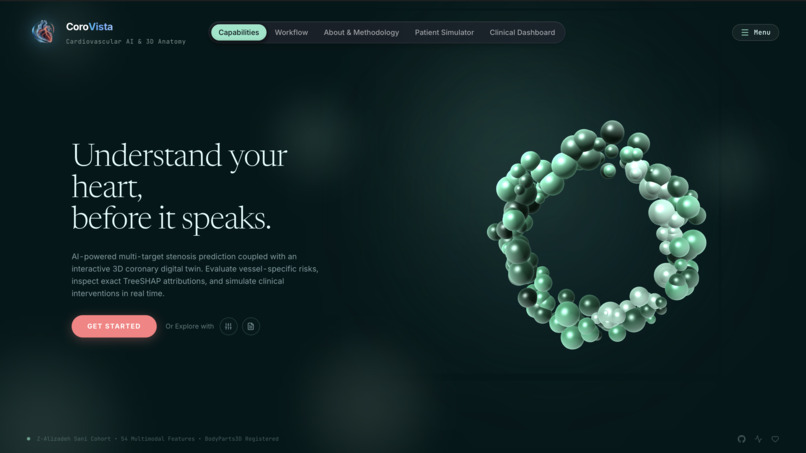
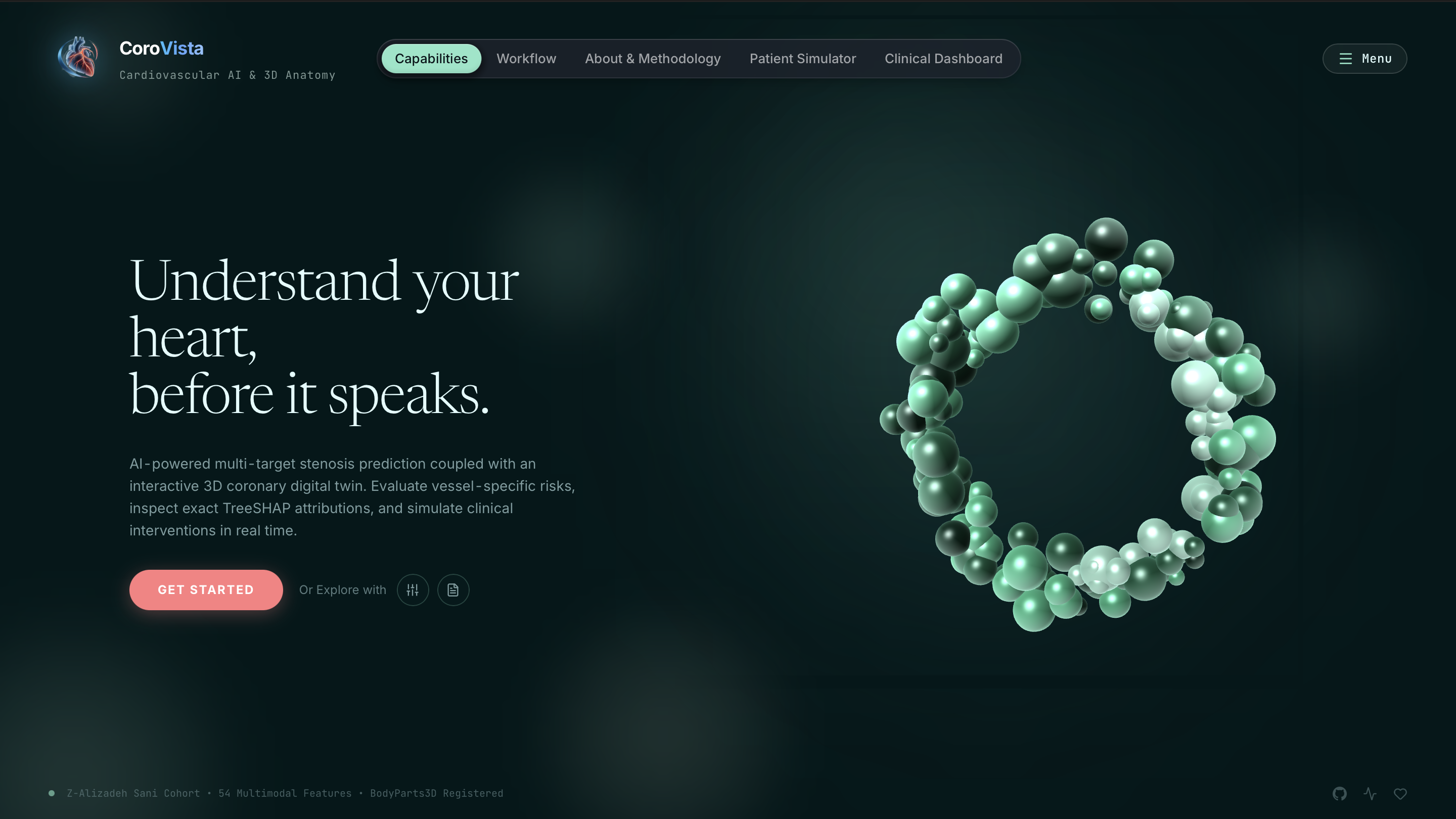
Explore CoroVista's AI-powered cardiovascular risk platform and interactive 3D coronary visualization.
-
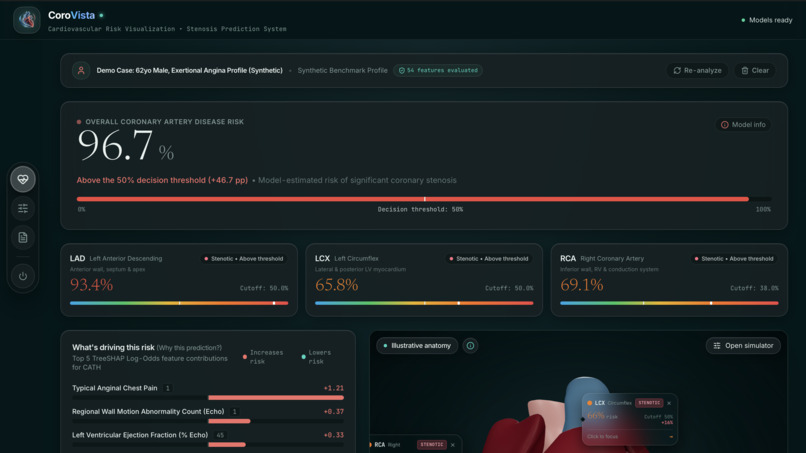
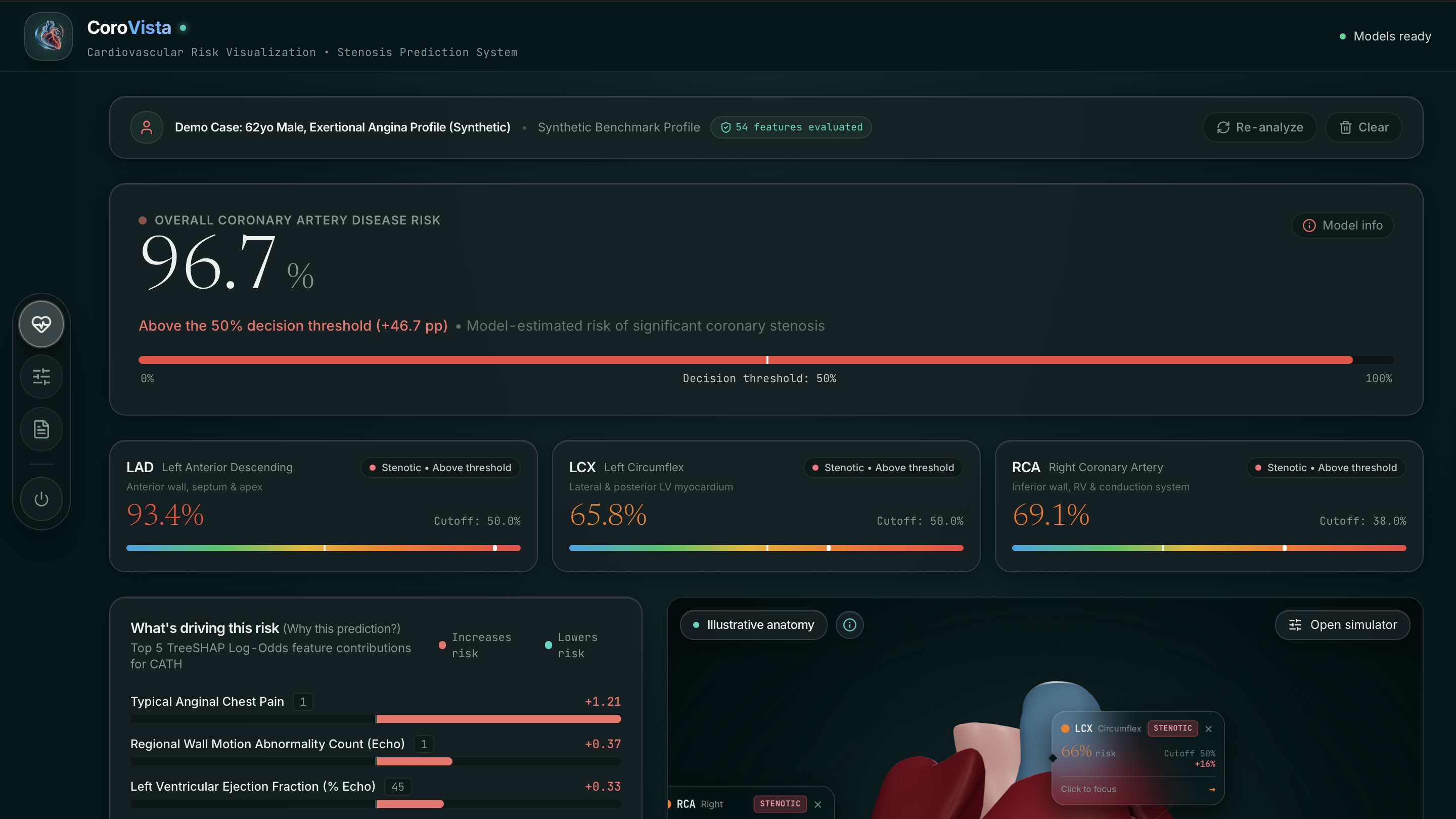
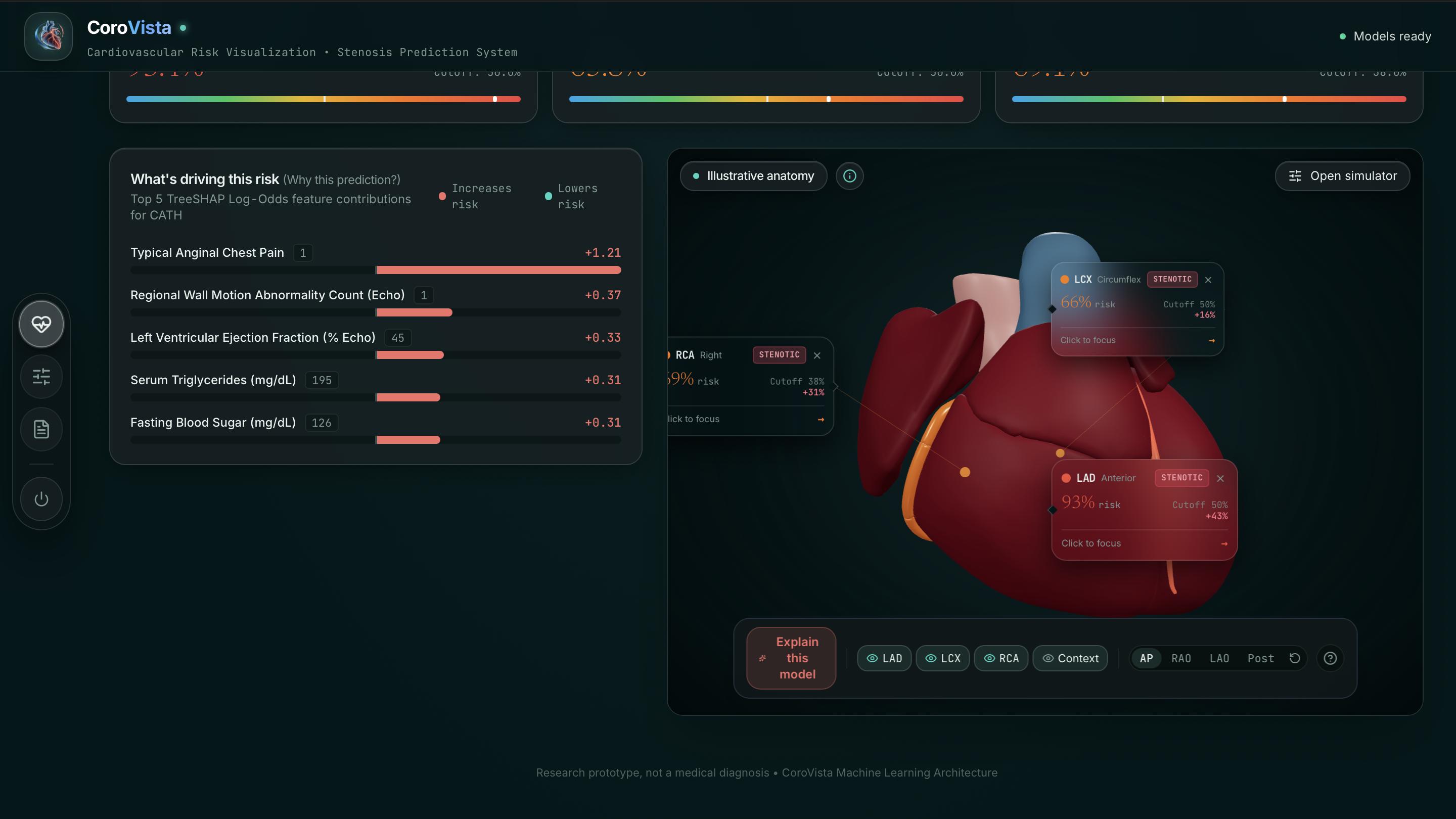
View overall CAD risk, vessel-specific predictions for LAD, LCX, and RCA, and SHAP-based feature contributions in one dashboard.
-
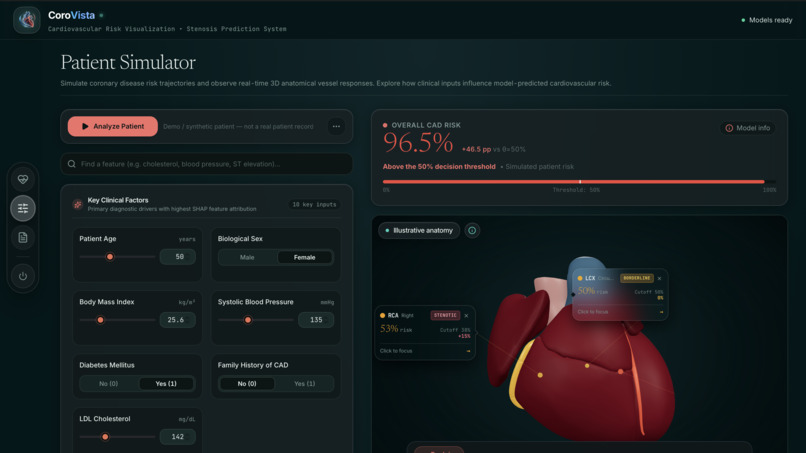
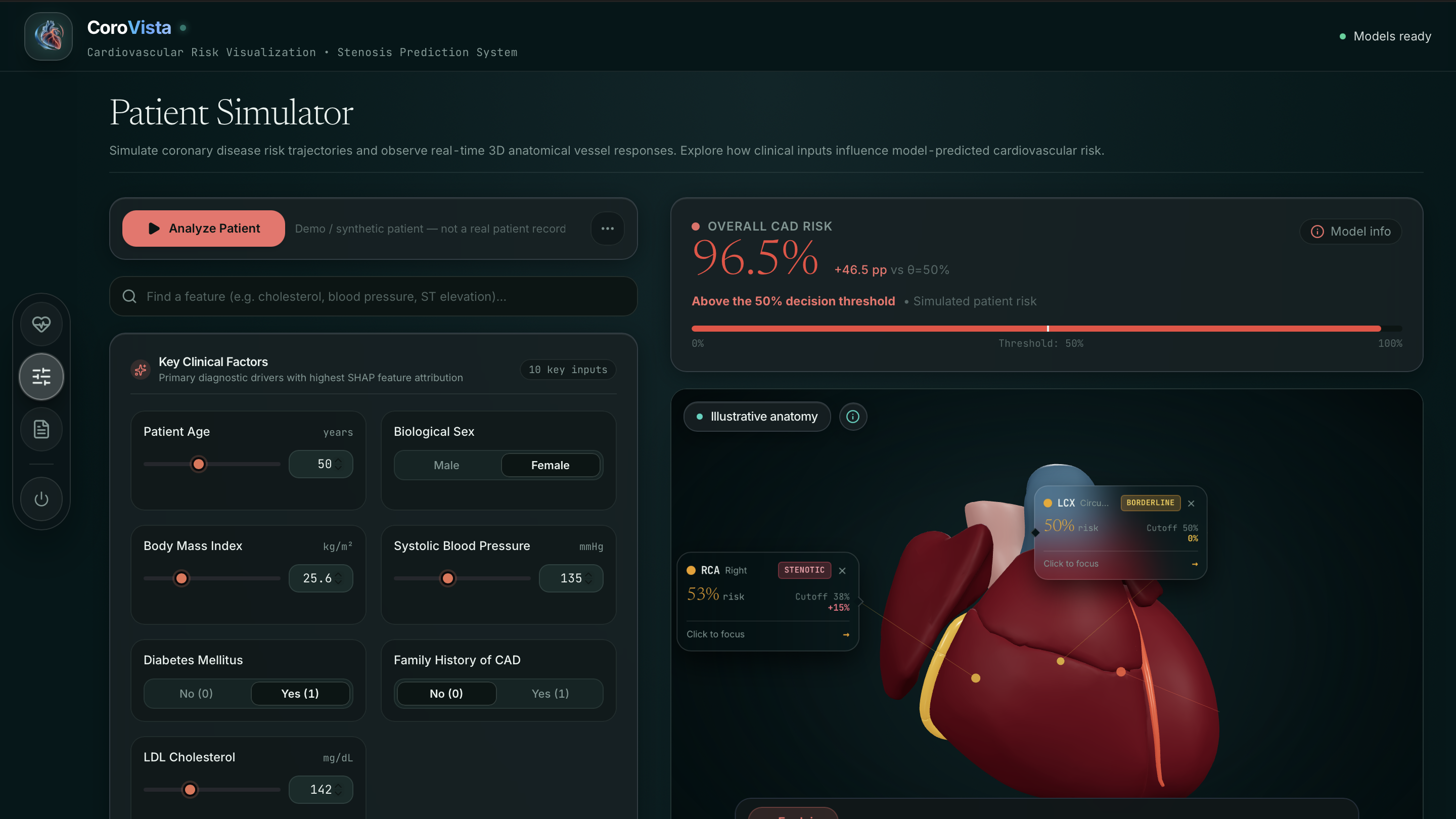
Adjust patient characteristics and explore how clinical inputs affect model-estimated cardiovascular risk and 3D vessel responses.
-
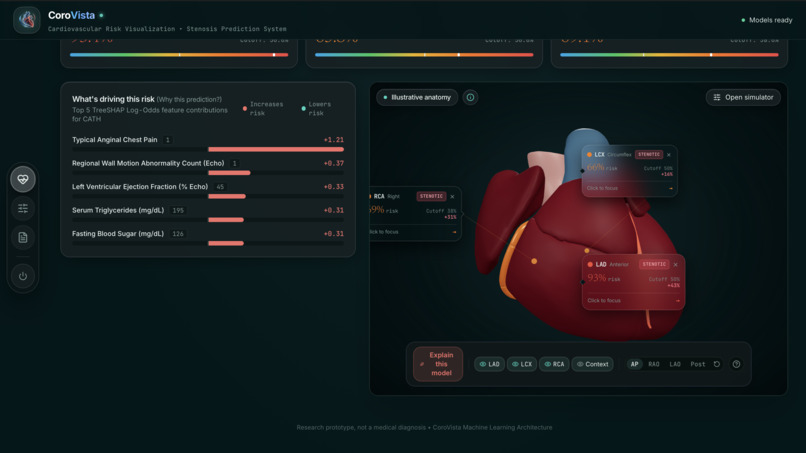
Explore the features influencing model predictions alongside an interactive 3D heart with vessel-level risk indicators.
-
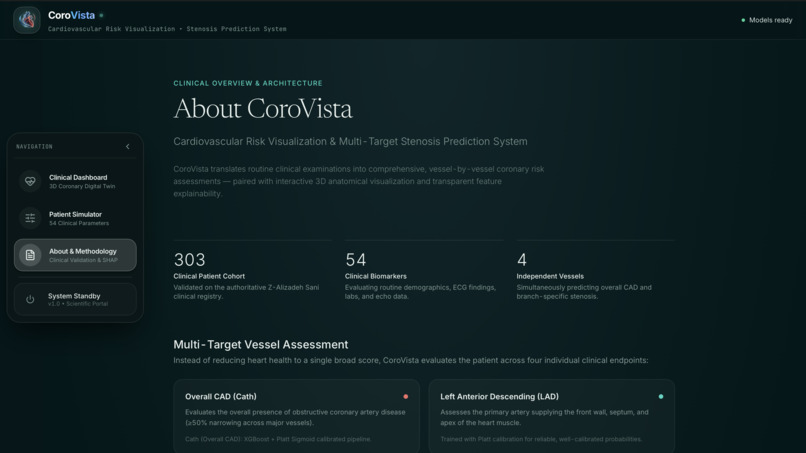
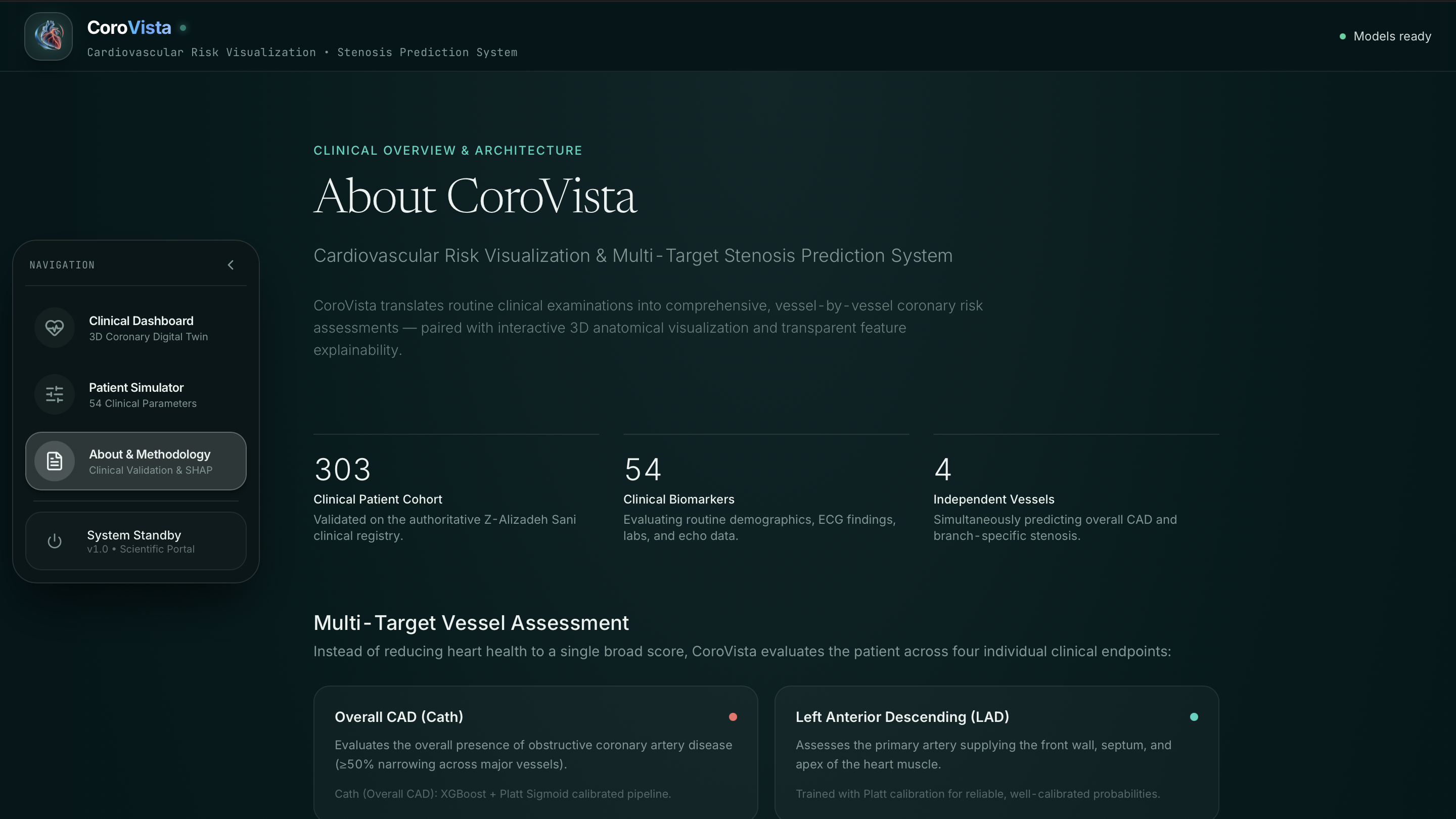
Learn about CoroVista's 303-record dataset, 54 clinical features, four prediction targets, and machine learning methodology.
Inspiration
We started CoroVista with a simple thought: understanding cardiovascular risk should be about more than just looking at numbers. Machine learning can make predictions, but those predictions become more useful to explore when we can understand what influenced them and visualize the anatomy involved.
We wanted to bring these ideas together in one platform. That led us to build CoroVista, combining AI-based coronary stenosis prediction, explainable AI, and interactive 3D heart visualization.
What it does
CoroVista is an AI-powered platform that helps explore coronary stenosis risk at the vessel level through predictions, explanations, and 3D visualization.
- Vessel-specific predictions: Generates predictions for Cath, LAD, LCX, and RCA targets.
- Explainable AI: Uses SHAP to show which patient features contribute to model predictions.
- Interactive 3D heart: Allows users to explore coronary anatomy from different viewing angles.
- Patient simulator: Provides 54 input features for experimenting with patient profiles and exploring model outputs.
- Unified dashboard: Brings prediction results, feature explanations, and 3D visualization together in one interface.
Our aim is to make complex model outputs easier to explore and understand, rather than presenting users with a prediction alone.
How we built it
We built CoroVista by combining a machine learning backend with a modern, interactive web frontend.
For the frontend, we used React, TypeScript, Three.js, and React Three Fiber to create the dashboard and 3D heart visualization. The backend is built with Python and FastAPI, which handles prediction requests and provides endpoints for model information, patient features, and explainability.
We integrated scikit-learn and XGBoost-based models for vessel-specific predictions, along with a logistic regression model for the RCA target. SHAP helps us explore the features influencing the predictions.
Our modeling workflow uses the Extended Z-Alizadeh Sani dataset, which contains 303 patient records and 54 features. We connected the models to the frontend through APIs so users could interact with patient inputs and explore the resulting predictions within a single application.
Challenges we ran into
One of our biggest challenges was bringing all the components together. The machine learning models, FastAPI backend, frontend, SHAP explanations, and 3D visualization each had their own requirements, and getting them to work smoothly as one application took time.
We encountered issues with API connectivity, CORS configuration, port conflicts during local development, and compatibility between our scikit-learn version and saved models. Resolving these problems helped us understand the importance of dependency management, debugging, and testing the complete application instead of focusing only on individual components.
Another challenge was dealing with differences in model performance across the four targets. We learned that each target needs to be evaluated on its own merits rather than assuming a single approach will perform equally well everywhere.
Accomplishments that we're proud of
We're proud to have brought together several different technologies in one working project. CoroVista is not just a prediction interface; it combines vessel-specific machine learning, SHAP-based explanations, and interactive 3D coronary visualization.
We're particularly happy with the way the dashboard connects these elements, allowing users to move between predictions, contributing features, and anatomical views without treating them as separate tools.
We also worked through local integration and model compatibility issues to get the frontend and backend communicating successfully. Seeing these individual pieces come together into one application was an important milestone for us.
What we learned
Building CoroVista taught us that developing an AI application involves much more than training or integrating a model. We gained practical experience with API development, frontend-backend integration, model serving, SHAP explainability, and 3D visualization using web technologies.
We also learned that model performance can vary across prediction targets and that explainability does not automatically guarantee that a prediction is correct. Communicating the limitations of AI is just as important as presenting its capabilities, especially in a healthcare-related project.
Most importantly, we learned how much coordination and debugging it takes to turn an idea into an integrated application.
What's next for CoroVista
CoroVista is a starting point, and there are several areas we'd like to improve next.
- Improve model evaluation: Continue evaluating vessel-specific performance, calibration, and reliability.
- Enhance 3D visualization: Make the coronary anatomy views more interactive and informative.
- Improve deployment: Make the application easier to set up, run, and maintain through containerization and deployment improvements.
- Explore healthcare interoperability: Investigate standards such as HL7 and FHIR for potential future integrations.
- Refine the user experience: Make predictions and their explanations easier to explore and interpret.
Our long-term goal is to explore how AI, explainability, and visualization can work together to make complex cardiovascular risk information more understandable.
CoroVista is currently a research and demonstration prototype, not a clinically validated diagnostic system. Its predictions should not be used as a substitute for professional medical judgment.
Built With
- 3d-visualization
- artificial-intelligence
- data-visualization
- explainable-ai
- fastapi
- healthcare
- machine-learning
- medical-ai
- predictive-analytics
- python
- react
- react-three-fiber
- rest
- scikit-learn
- shap
- three.js
- typescript
- xgboost


Log in or sign up for Devpost to join the conversation.