-
-
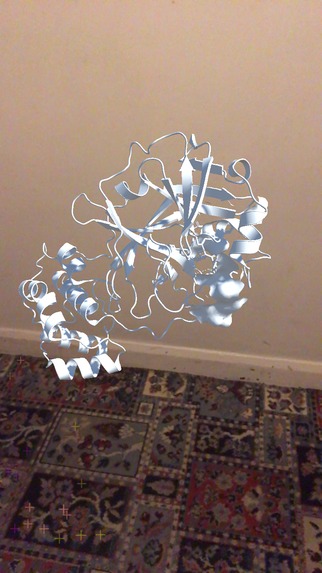
Demo of iOS visualisation
-
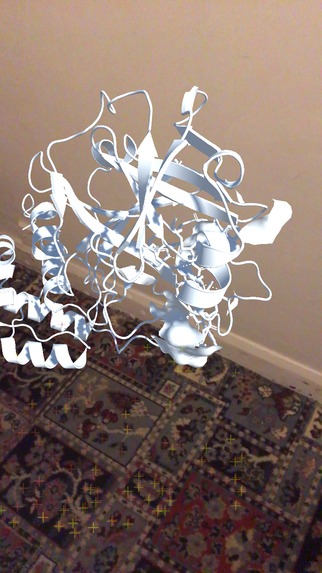
Demo of iOS visualisation
Inspiration
COVID-19 is a complex disease and the SARS-CoV-2 coronavirus is not yet fully understood. The hope is that eventually, following advancements in VR/AR, scientists may be able to utilise better tools for more life-like visualisation of complex molecules such as the coronavirus. Such technology may also be used as a learning tool to aid students of subjects such as medicine and biochemistry, but also anyone with even a mild interest in the subject, in exploring the chemical structures behind many biological processes.
What it does
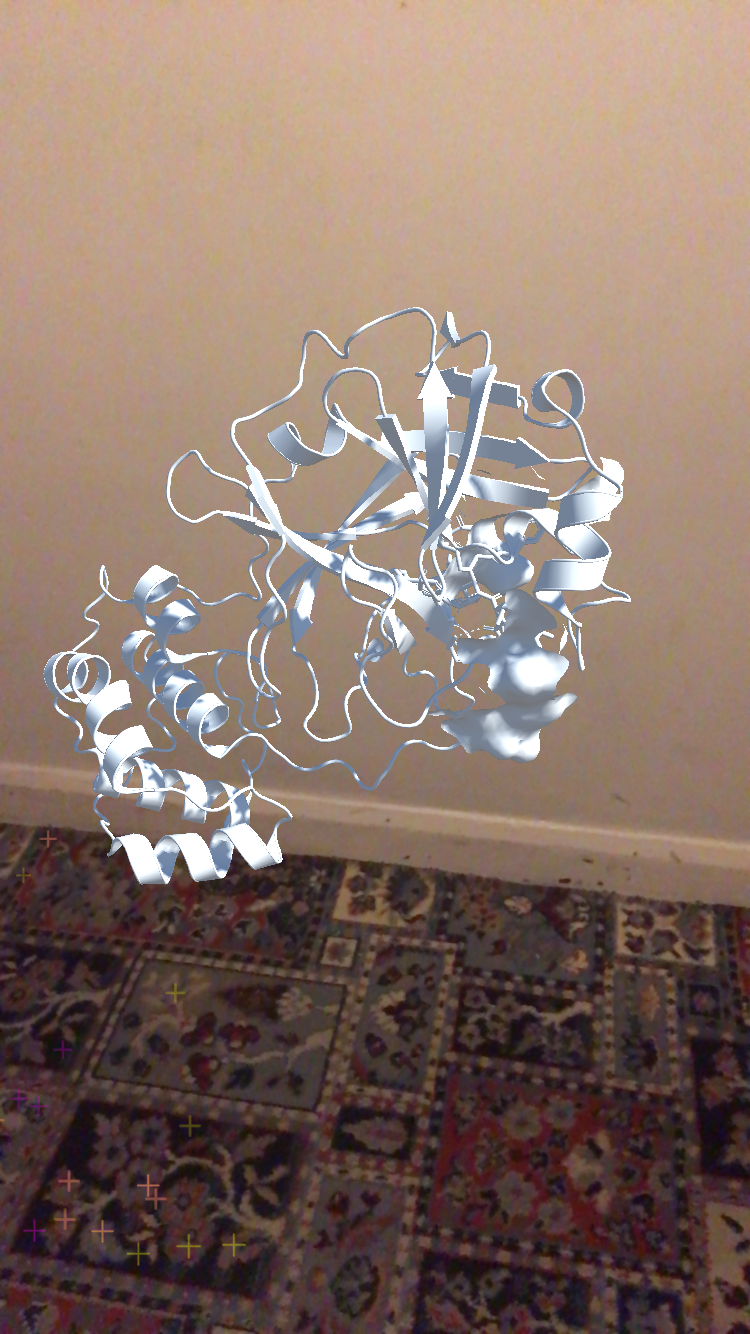
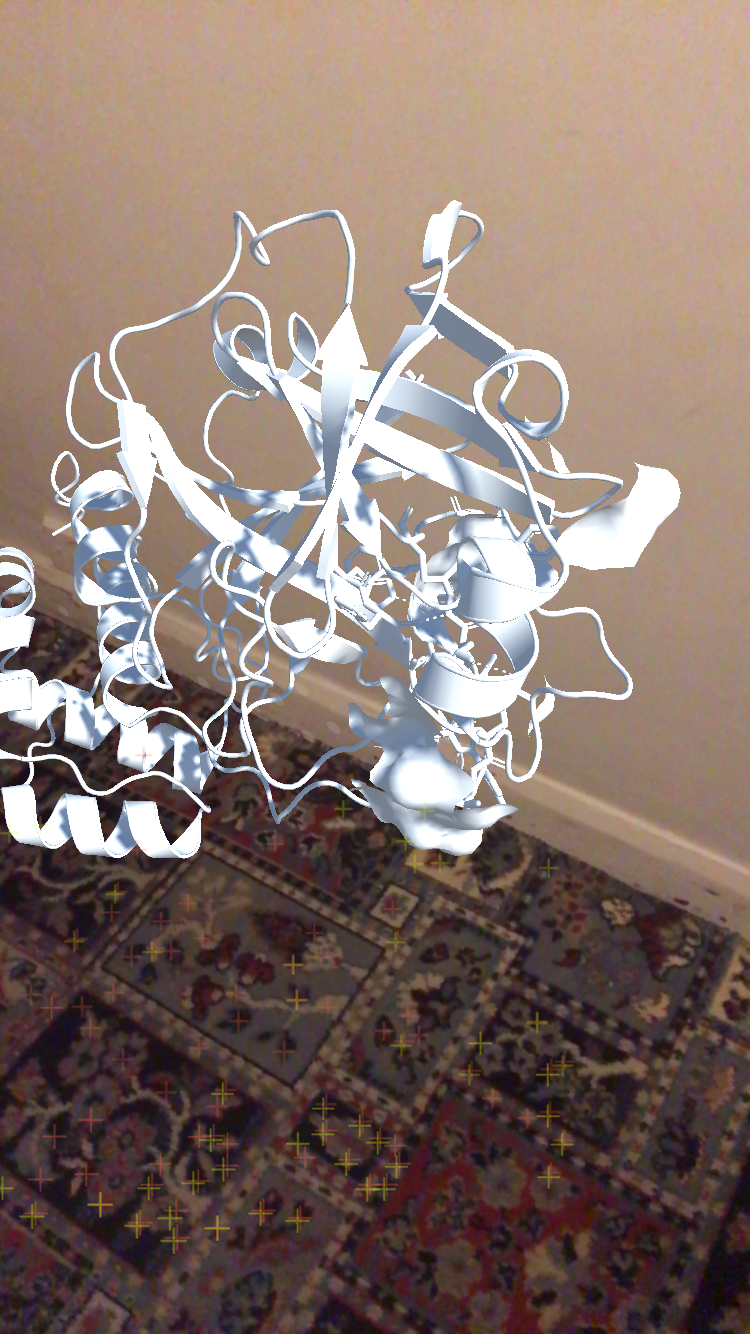
This project is an early, rudimentary demonstration of how such tools could work in the coming years. In its most basic form, it is an AR system that can render and display a 3D model of one or more molecules, which in this case, is a SARS-CoV-2 main protease molecule, along with an associated inhibitor called N3. The user can place a view of the molecules in their immediate surroundings, scale the model, rotate it and walk around it to view even the areas that may usually be hidden in a 2D image in a book.
How I built it
After attending the echoAR workshop and discovering how straightforward it can be to create basic cloud-connected AR apps using the echoAR platform, I strived to perform a similar task of my own. I set up my echoAR account and the latest Unity installation. From here, I followed the easy-to-use documentation on the echoAR website and used the provided example project upon which to build my app.
Challenges I ran into
Since I was new to Unity and VR/AR development, it took some time to become familiar with the interface and learn the basics of how to successfully build a project in Unity and then deploy it to any platform.
Accomplishments that I'm proud of
Though this project is a very basic and early demonstration of how the technology involved could be used, I found it intriguing and definitely something worth exploring further as I develop this project and build more in the future. I did not seek to build a highly complex app with a lot of functionality, but instead the starting blocks for something that can be taken further. My primary aim at the start was to end up with a product that I can at least run independently, whether on a laptop or a phone. In the end, I achieved this and am pleased with the results.
What I learned
The main lesson I learned from this is that developing VR/AR apps is not as daunting as it may initially seem. echoAR did a fantastic job of proving this. I was also fascinated to explore the potential of cloud-connected VR/AR experiences, whereby a user can change settings in their console on a web browser and see the changes take effect in the app in real time.
What's next for CoronaViewer
I believe this project has a lot of potential and a large scope for development. Just some of the many things that can be improved/implemented include:
- Add more models, especially realistic models from scientific databases
- Add labelling to various parts of the molecules to help as a learning tool
- Add colour coding to identify various molecular groups
- Add functionality to show different molecules interacting
- Allow the user to pick apart a molecule and explore its constituents in more depth
- Incorporate a database of scientifically accurate information pertaining to the current molecule(s), allowing the user to learn as they explore in 3D

Log in or sign up for Devpost to join the conversation.