Inspiration
CornerOS started with a simple question: what if a neighborhood corner store could operate with the same intelligence as a modern supply chain, without losing the human scale that makes it essential to its community?
We were inspired by the daily reality of small-store owners who must make decisions with limited time, limited data, and tight margins. Fresh produce can spoil quickly, SNAP demand shifts throughout the month, and grant opportunities are often hard to find or act on. CornerOS was built to close that gap by turning real operational signals into practical decisions.
What it does
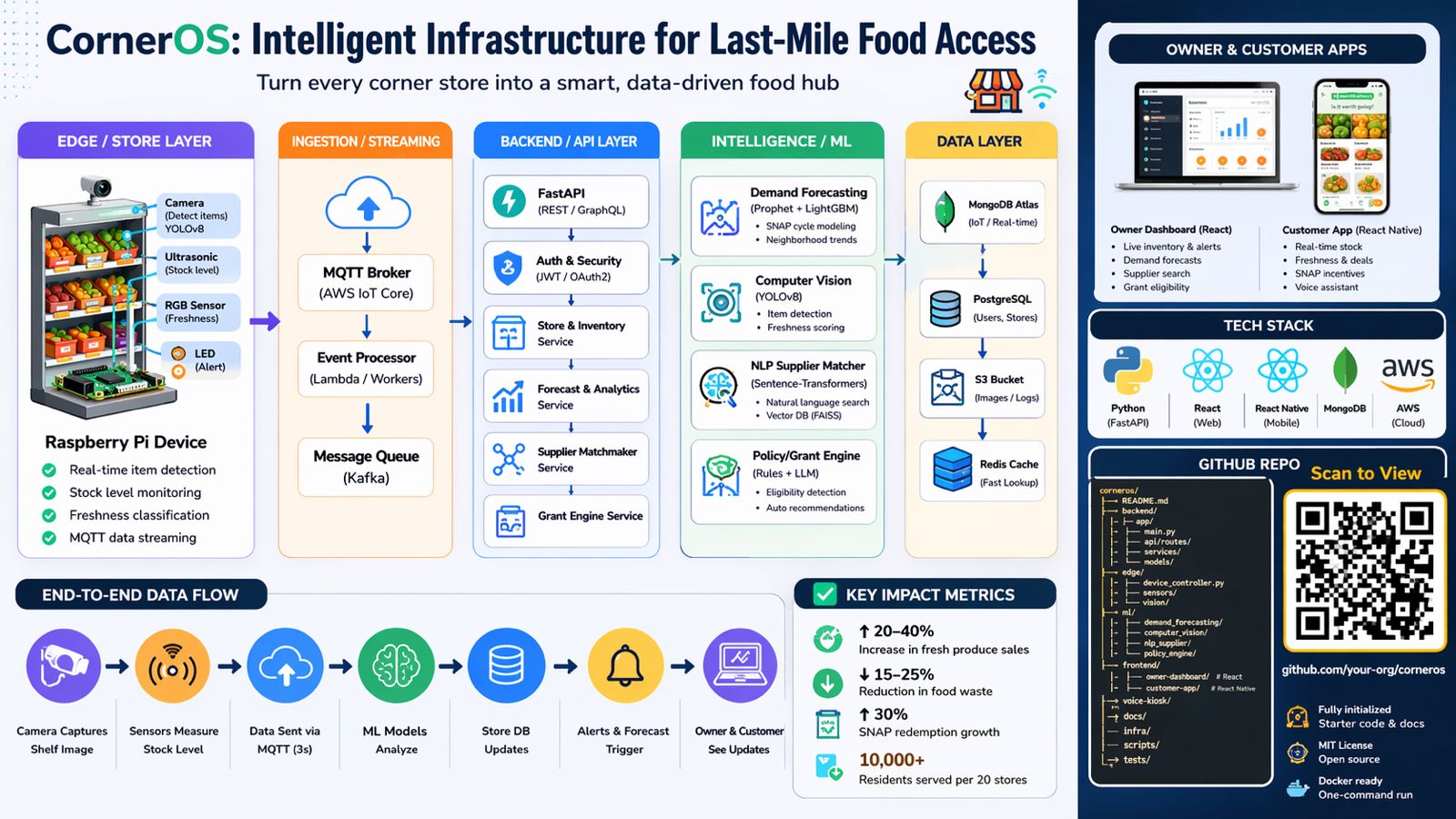
CornerOS is an intelligent infrastructure platform for last-mile food access. It combines an owner dashboard, a customer-facing experience, edge telemetry, forecasting, supplier search, and grant matching into one connected system.
At its core, the platform helps stores answer questions like:
- What should I stock today?
- What is likely to sell next week?
- Which suppliers fit this store’s needs?
- Which grants are realistically available?
- Is the shelf healthy enough to keep items on display?
The system uses live and seeded data to drive these workflows. For example, freshness alerts can trigger when the freshness score drops below a threshold such as $freshness_score < 0.3$, and forecasts help stores prepare for SNAP-cycle demand swings before they become stockouts.
How we built it
We built CornerOS as a merged full-stack system so each layer could reinforce the others.
- The backend uses FastAPI to expose REST endpoints for health, forecast, suppliers, grants, and shelf monitoring.
- The data layer uses MongoDB Atlas for operational collections such as suppliers, grants, impact metrics, and inventory snapshots.
- The owner dashboard and customer app were built in React so the experience stays responsive and easy to iterate on.
- The edge layer simulates shelf readings and MQTT events so the system can behave like a live IoT deployment even in a demo environment.
- The ML and service modules handle demand forecasting, NLP supplier matching, and policy logic for grant eligibility.
We also built scripts to reseed Atlas data and keep the demo environment reproducible, which made it possible to restart the system quickly and present a clean, coherent story end to end.
Challenges we ran into
One of the biggest challenges was making multiple parts of the system feel like one product instead of separate demos. The backend had both legacy compatibility routes and newer modular routes, so we had to keep behavior aligned while preserving older client expectations. On the hardware side, the main challenge was simulating reliable shelf sensing when real devices were not always available, which meant making the edge layer behave consistently across camera, ultrasonic, RGB, and MQTT event flows.
We also had to deal with noisy or intermittent sensor-like data, make sure the demo still looked credible when readings changed quickly, and keep the hardware story aligned with the dashboard so alerts, freshness scores, and stock levels all told the same story.
We also had to make the frontends resilient to different response shapes and empty states. That meant shaping API responses carefully and making the dashboards useful even when some live data was missing.
Another challenge was balancing realism and speed. We wanted the platform to feel credible for judges and investors, but we also needed it to run reliably in a hackathon timeframe. That meant simplifying some ML logic, using seeded data where appropriate, and focusing on the flows that mattered most.
Accomplishments that we're proud of
We are proud that CornerOS is not just a concept slide. It is a working system with a clear operational loop from sensing to action.
We connected shelf monitoring, forecasting, supplier discovery, grant matching, and impact reporting into one story that is easy to understand and demo. We also created a startup flow that can bring up the stack against Atlas-backed data, which makes the project feel much closer to a deployable product than a static prototype.
Most importantly, the platform connects technical execution with community impact. It is designed to help stores make better decisions, reduce waste, and improve access to fresh food.
What we learned
We learned that strong product design is often about reducing friction between systems, not just adding features.
We learned how important data contracts are across backend and frontend layers, especially when multiple apps depend on the same services. We also learned that even simple models can be valuable if they are embedded in a workflow that people can actually use.
From a technical perspective, we reinforced that small architectural choices matter. Clear service boundaries, repeatable data seeding, and well-structured endpoints made the whole system easier to reason about and demo.
What's next for CornerOS
Next, we want to harden CornerOS for a real pilot.
That means tightening API contracts, adding stronger authentication and authorization, improving frontend modularity, and expanding test coverage. We also want to add better observability so store owners and operators can see not just what happened, but why it happened.
Longer term, we want to evolve CornerOS into a field-ready platform for small retailers, with richer forecasting, more adaptive supplier recommendations, and clearer reporting for community partners and funders.
Closing Note
CornerOS was built around a simple idea: better data should help small stores serve their communities better. By combining operational intelligence with a community-first design, we created a platform that is practical, measurable, and ready to grow.


Log in or sign up for Devpost to join the conversation.