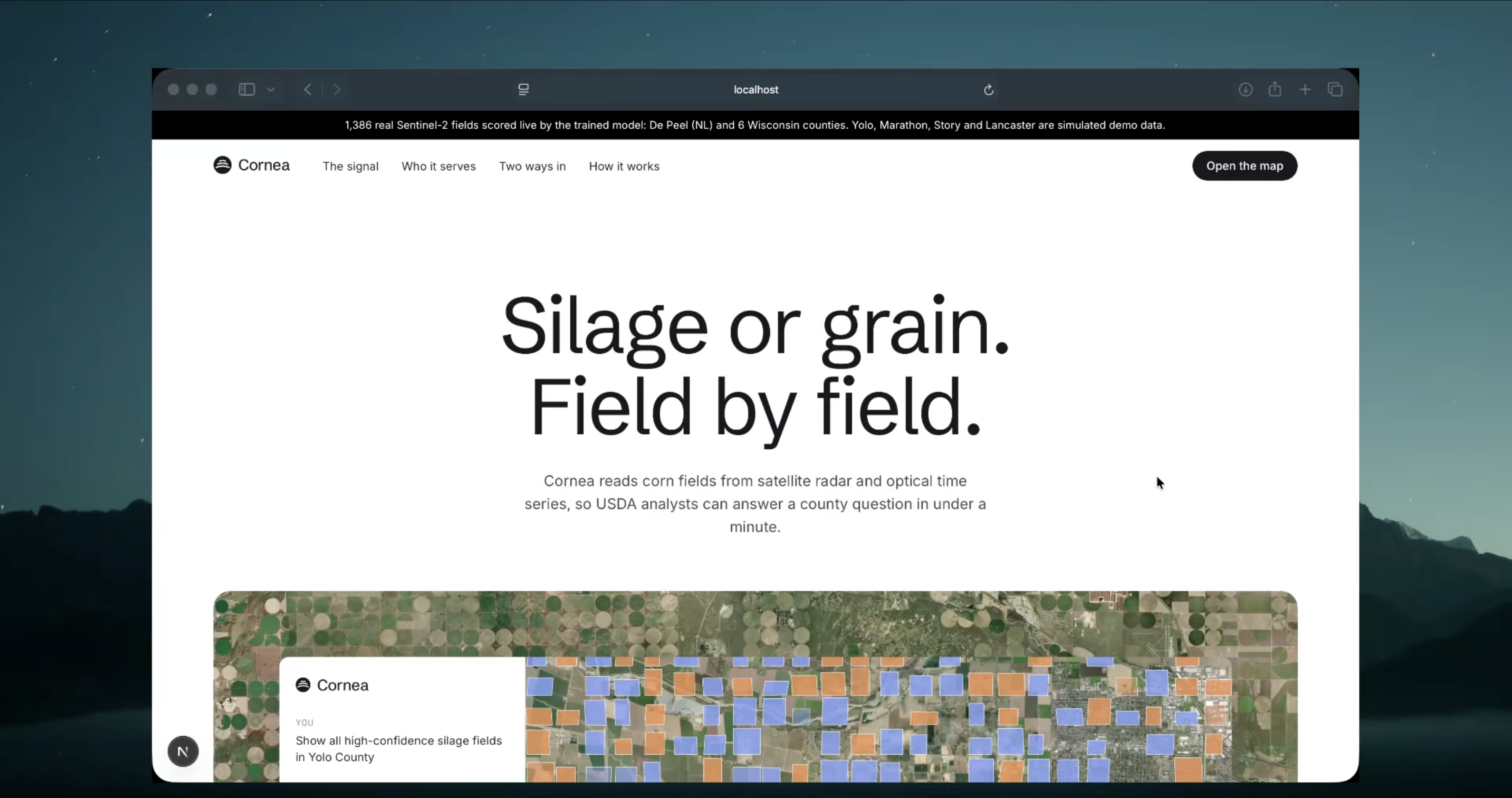
Inspiration
We were inspired by transformers, the architecture behind modern AI. Transformers are built to read sequences and work out which moments matter most, and a growing season is exactly that: a sequence of satellite images where one week can tell you everything.
Every fall, farmers decide field by field whether to chop corn for silage or combine it for grain. USDA only learns the split about four months after harvest begins, from farmer surveys that are slow, expensive, and answered by fewer farmers each year (about 40% now respond). We asked whether the same sequence-reading idea could give USDA analysts an earlier, independent answer.
What it does
Cornea reads corn fields from satellite imagery and labels each one silage or grain, then rolls the results up by county. With NVIDIA Nemotron 3.5 Super VL, analysts can also ask "what if?": give it a scenario such as a wildfire, and it rewrites a field's values into a new image that Cornea re-analyzes.
How we built it
- Find the fields: USDA's Cropland Data Layer locates the cornfields (1,226 clusters across 10 Wisconsin counties).
- Watch the season: Sentinel-2 imagery from April to November, turned into three indices per field:
$$NDVI = \frac{NIR - Red}{NIR + Red} \qquad NDMI = \frac{NIR - SWIR_1}{NIR + SWIR_1} \qquad NDTI = \frac{SWIR_1 - SWIR_2}{SWIR_1 + SWIR_2}$$
- Learn the signal: silage fields drop from green to bare soil in a single pass, while grain fields fade over about six weeks. Taking our cue from transformers, our model reads each field's full season and learns that difference.
- Stress-test it: Nemotron 3.5 Super VL generates modified field matrices for scenarios we can't wait to observe.
- Tech stack: [list your tools here]
Challenges we ran into
- No US field labels. USDA doesn't publish per-field silage or grain, so we trained on 4,030 farmer-declared fields from the Netherlands and France and used USDA county totals as the US check.
- Uneven classes. Grain fields outnumber silage fields by more than four to one in our test set, so we tracked balanced accuracy, not just overall accuracy.
- Honest testing. We held out whole spatial blocks so the model was never tested on fields next to ones it trained on.
Accomplishments that we're proud of
On 639 held-out real fields, Cornea reached 95.9% accuracy (93.4% balanced, ROC AUC 0.967) and caught 89.5% of silage fields.
What we learned
The timing of the harvest tells you more than any single image. We also learned how far public data can go when the labels you want don't exist, and that ideas from modern AI architectures carry over well to problems like agriculture.
What's next for Cornea
Test on a held-out year and state, deliver county silage share within two weeks of harvest, and pilot weekly maps with one state agriculture department.
Built With
- fastapi
- keedoh
- next.js
- python
- pytorch
- raq
- typescript
- uvicorn
