-
-
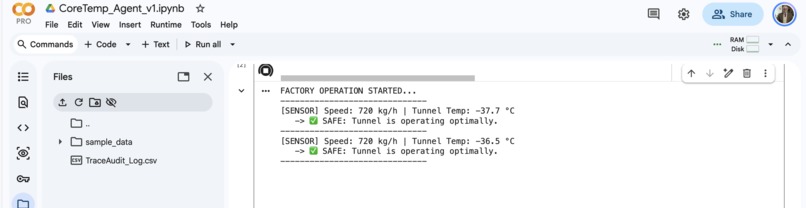
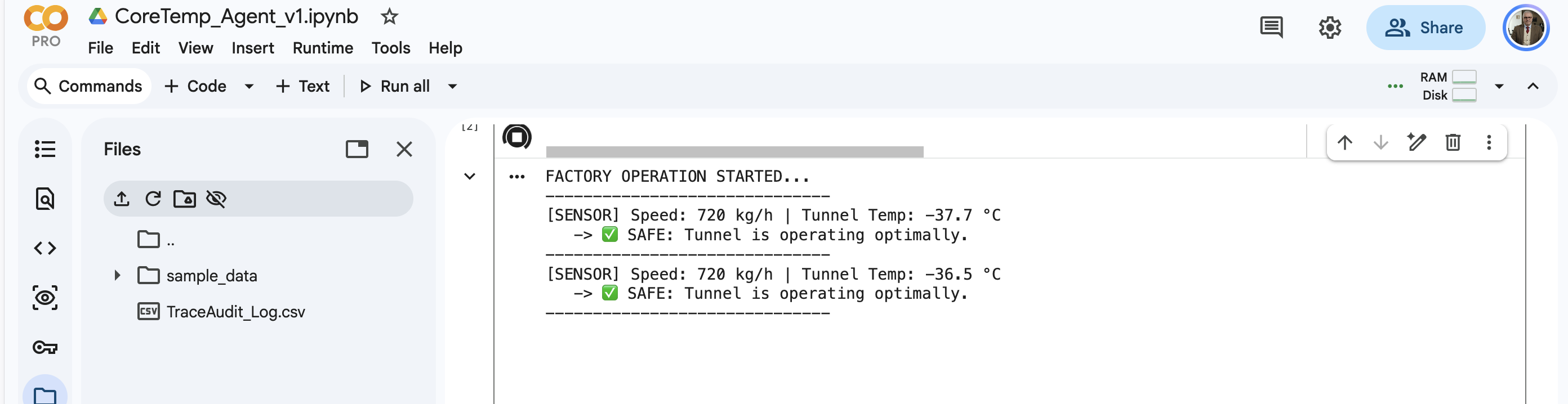
The spiral freezer runs normal.
-
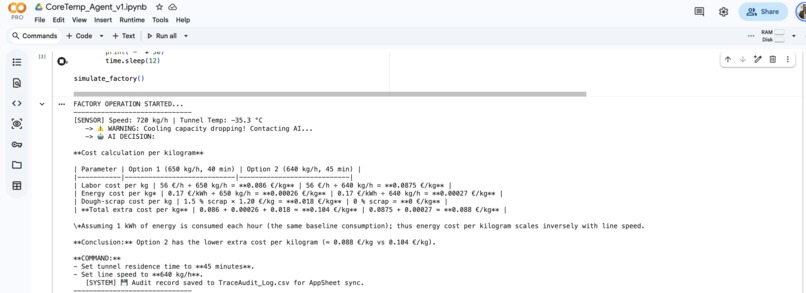
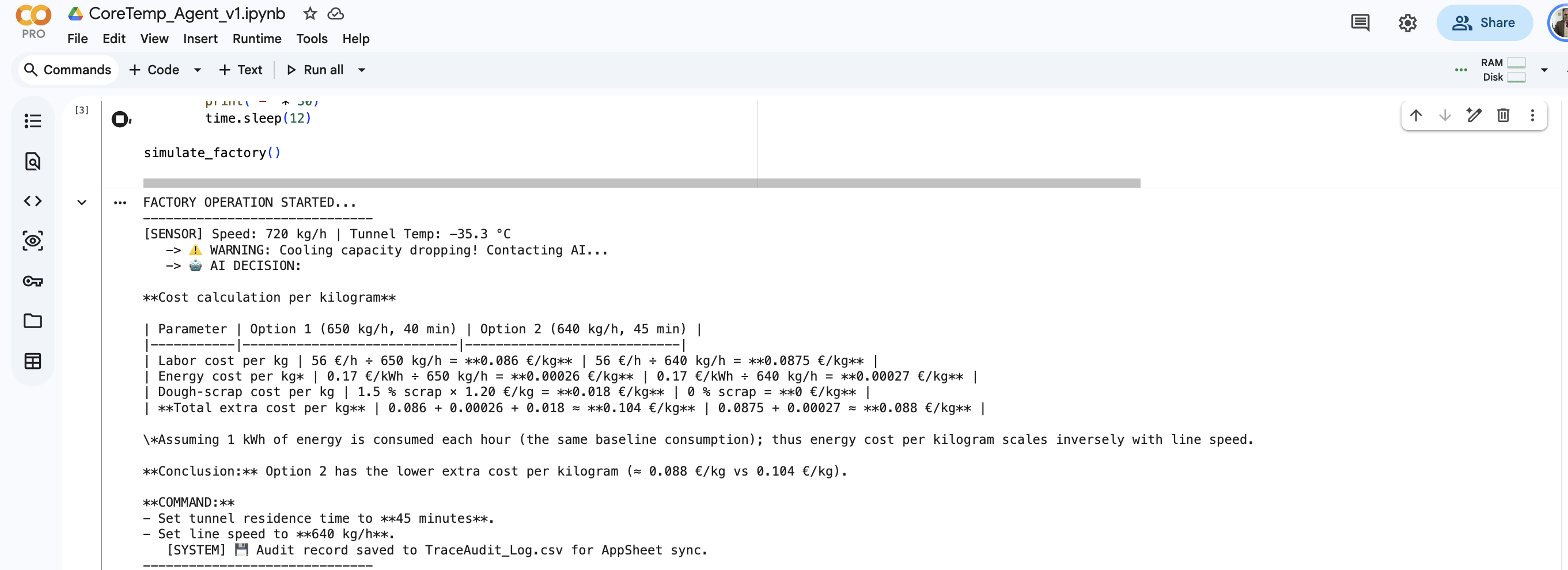
The AI runs and Command
-
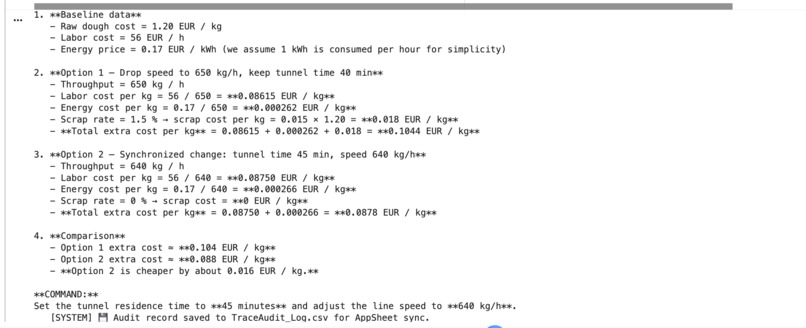
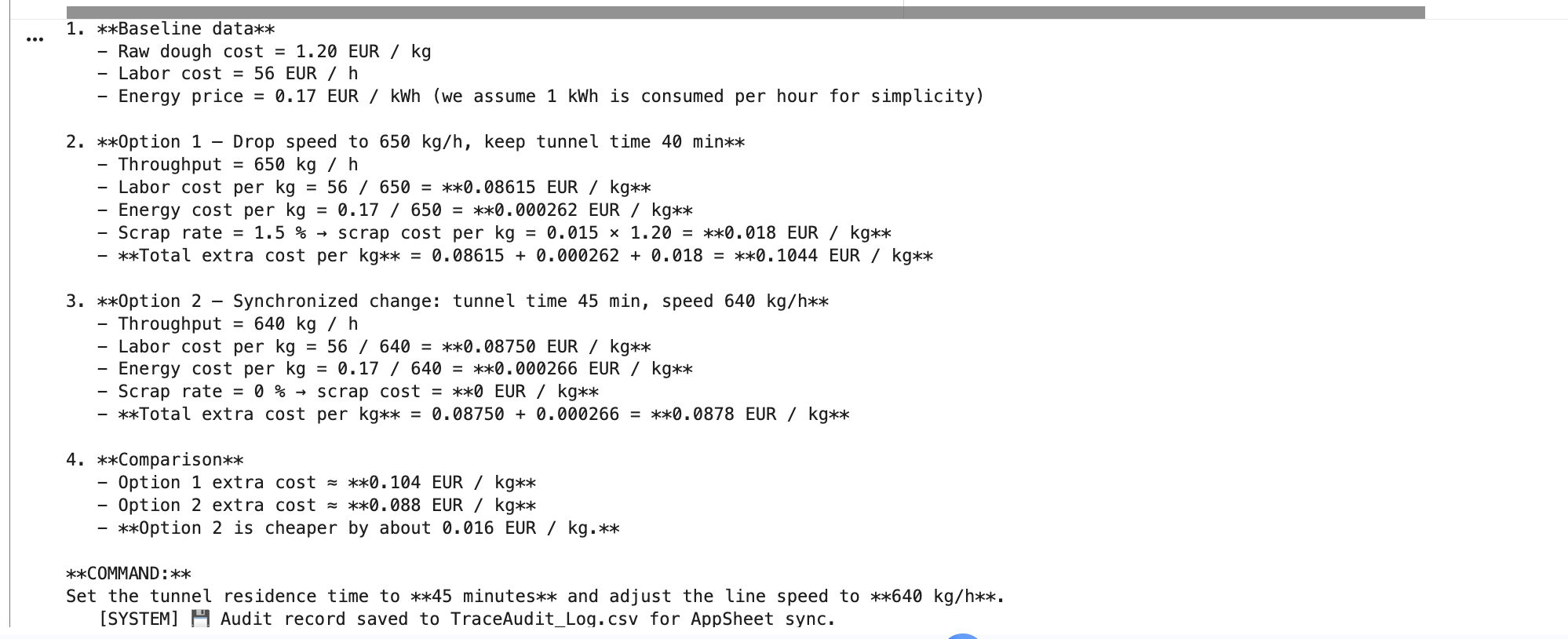
Analyzing the Options, Comparison and Command
-
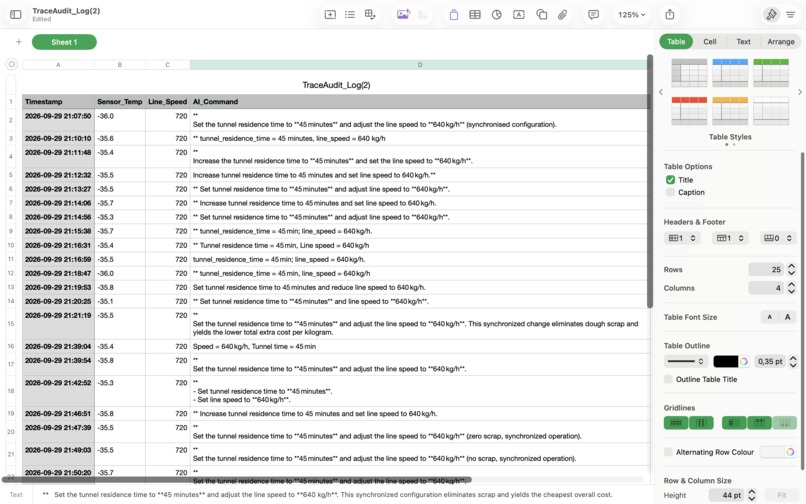
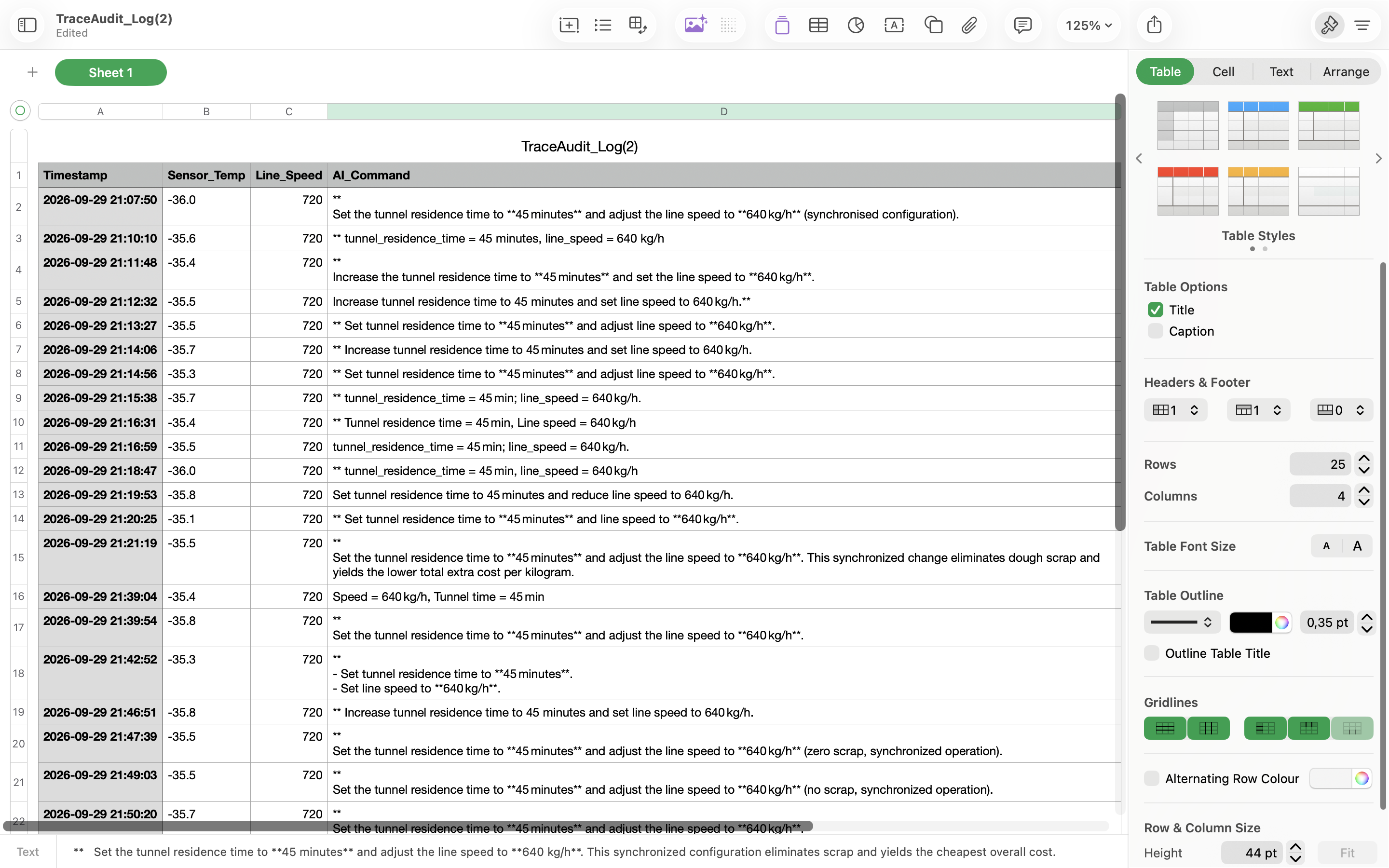
TraceAudit_Log.csv
Inspiration
As a Food Scientist and Factory Manager with 27 years of experience in frozen dough production, I know that a temperature drop in a freezing tunnel is not just a localized issue—it causes a destructive chain reaction. If product core temperature reaches -12°C instead of -15°C, two major problems occur: First, bulk products for the HO.RE.CA market clump together in their boxes, leading to product breakage and severe customer dissatisfaction. Second, we blindly transfer the thermal load to the final storage warehouse, forcing its compressors to work overtime at -20°C. I wanted to build an industrial "Physical AI" agent that doesn't just trigger alarms, but actively calculates and prevents this total quality and energy loss.
What it does
The CoreTemp Agent (part of the Panthωron TraceAuditReady architecture) acts as an automated, edge-level Factory Manager. It monitors simulated ESP32 sensor data (tunnel temperature and line speed). When cooling capacity drops, it packages the operational data, energy costs, and raw dough scrap costs, and sends them to the Nebius AI cloud. The Agent evaluates different mitigation scenarios while respecting strict industrial physics—specifically, it understands that slowing down the tunnel belt without proportionally reducing the line speed will cause product pile-up and deformation. It ultimately outputs a strict, PLC-ready COMMAND to synchronize the machines and minimize scrap. Crucially, it automatically logs this Preventive Action into a CSV file, creating an instant, human-free audit trail for ISO/FSSC 22000 compliance via AppSheet.
How we built it
We built the core logic using Python in a Google Colab environment to act as our edge processing unit. For the AI brain, we integrated the Nebius Token Factory API. We specifically selected the nvidia/NVIDIA-Nemotron-3-Nano-30B-A3B model. We engineered a highly constrained industrial prompt that forces the LLM to act as a deterministic calculator rather than a conversational bot. The Python script parses the AI's response to extract only the actionable machine command and appends it to a TraceAudit_Log.csv file, bridging the gap between cloud AI inference and local ERP/AppSheet integration.
Challenges we ran into
Our biggest challenge was forcing a Large Language Model to respect the physical constraints of a manufacturing line. Initially, the AI would suggest increasing tunnel residence time without realizing that the upstream machines would continue feeding dough at the same rate, causing a pile-up. We overcame this by heavily refining our prompt engineering to include a strict "PHYSICS CONSTRAINT" rule. Additionally, we had to ensure the API output was strictly formatted so our Python script could extract the final machine COMMAND without breaking the CSV logging mechanism.
Accomplishments that we're proud of
We are extremely proud of transforming a generative AI model into a strict, deterministic Industrial Agent. The system successfully calculates the hidden cost of product scrap alongside labor and energy, proving that it thinks like a veteran Factory Manager. Furthermore, successfully bridging the AI's decision directly into an audit-ready CSV format for ISO 22000 compliance demonstrates a complete, end-to-end commercial product vision.
What we learned
We learned that integrating Generative AI into strict manufacturing environments requires a major mindset shift. LLMs are naturally conversational, but factory PLCs require deterministic, mathematical commands. We mastered the art of advanced prompt engineering to enforce real-world physics constraints (like conveyor belt spacing and clumping dynamics) onto the AI. Additionally, through trial and error with API calls, we learned the critical importance of endpoint naming conventions and how to effectively extract actionable data from unstructured AI responses to build a reliable logging system.
What's next for CoreTemp Agent
The immediate next step is to transition our Python architecture from the Colab simulation environment directly onto edge hardware (such as an industrial ESP32 setup or a Raspberry Pi) operating on the actual shop floor. We also plan to integrate the generated TraceAudit_Log.csv directly into our broader Panthωron TraceAuditReady AppSheet ecosystem, creating a fully automated dashboard for ISO 22000 and IFS preventive action reports. Ultimately, we aim to expand the AI's prompt variables to include real-time ambient factory humidity and specific dough formulations.
