-
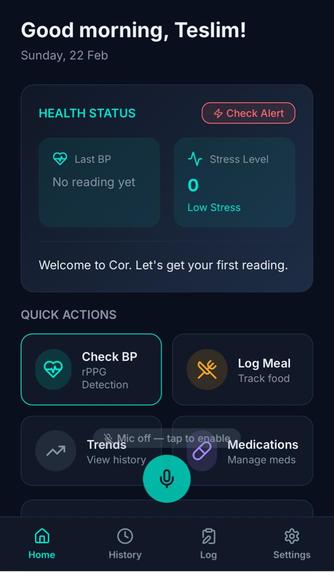
Home page
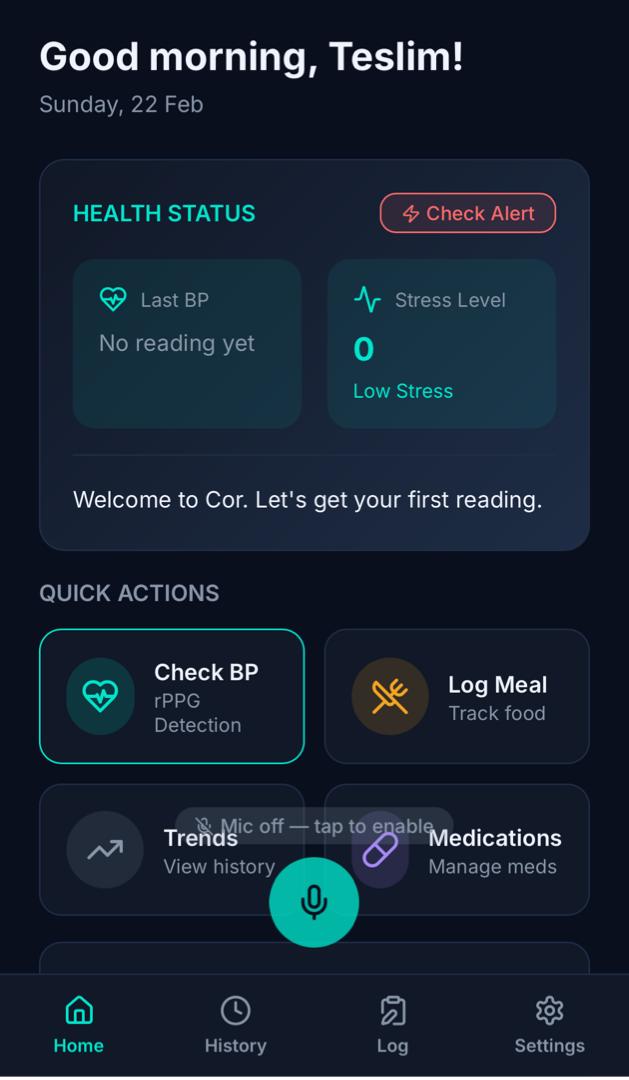
Cor — From Data to Early Cardiovascular Prevention
Inspiration
Hypertension is often called the silent killer — and for good reason. In Nigeria, a significant percentage of working-age adults live with high blood pressure without knowing it. It doesn’t interrupt daily life, it doesn’t cause immediate pain, and it often goes undetected until it results in stroke, heart failure, or sudden death.
What makes this problem worse is not ignorance, but time. Many people simply do not have the flexibility to visit hospitals regularly for routine monitoring. Yet almost everyone carries a smartphone every day.
We asked a simple but powerful question:
What if the device people already rely on could become an early cardiovascular warning system?
That question became Cor.
What Cor does
Cor is a proactive cardiovascular risk screening tool that uses remote photoplethysmography (rPPG) from a smartphone camera, combined with lifestyle signals and machine learning, to estimate blood pressure trends and detect rising cardiovascular risk early.
By placing a finger on the camera for a short measurement, Cor extracts optical pulse signals, analyzes heart rate variability and pulse morphology, and estimates blood pressure trends over time. These trends are then correlated with lifestyle factors such as sleep, activity, screen time, and dietary sodium intake.
Cor does not diagnose disease. It provides early warning signals that prompt users to seek medical confirmation before serious complications occur.
How we built it
The system is built around three core layers:
1. Signal extraction (rPPG)
We use camera-based optical sensing to extract pulse signals from reflected light. From this signal, we derive heart rate, heart rate variability (HRV), and pulse waveform features.
2. Machine learning & risk modeling
Extracted features are passed into regression models trained against cuff-based blood pressure measurements to estimate systolic and diastolic trends. Rather than relying on a single reading, Cor tracks deviation from a user’s personal baseline over time.
3. Lifestyle correlation & prevention layer
Using device sensors and food image analysis, Cor identifies lifestyle patterns that may contribute to rising blood pressure and provides actionable preventive recommendations.
The frontend prioritizes clarity and accessibility, including voice-guided interaction to make measurements seamless and intuitive.
Challenges we faced
One of our primary challenges was accessibility. From the beginning, we wanted Cor to be inclusive for users with disabilities, particularly people with visual impairments. Our goal was a fully voice-first experience similar to assistants like Alexa or Siri, where users could interact with the system through a simple call or wake phrase.
Due to time and platform constraints, we were unable to build a native mobile application within the hackathon timeline. This limited our ability to implement a true “one-call-away” experience. To address this, we implemented voice-based interaction within the app, allowing users to complete measurements and receive feedback through voice guidance.
Another challenge was hardware integration. We initially planned to support smartwatch connections to enrich heart rate variability and activity data. However, a significant portion of our effort went into stabilizing the rPPG and HRV signal pipeline. Prioritizing signal accuracy meant smartwatch integration could not be completed within the available time and was moved to future plans.
Finally, we faced the challenge of working in a novel and technically complex space. Camera-based cardiovascular risk estimation has limited reference implementations, requiring extensive experimentation and iteration to avoid overclaiming medical accuracy.
What we’re proud of
We’re proud of building something genuinely novel and technically demanding under tight constraints. Camera-based cardiovascular signal extraction is not a plug-and-play problem, and getting rPPG and HRV signals to work reliably required deep experimentation and persistence.
Successfully extracting pulse signals from a smartphone camera and translating them into meaningful HRV features was a major milestone. Seeing the system work end-to-end — from camera capture to signal processing to risk estimation — validated both the concept and the effort behind it.
We’re also proud of how we collaborated as a team. Responsibilities were clearly divided across research, engineering, and product design, allowing us to move efficiently while supporting one another.
Most importantly, we genuinely enjoyed the process. The challenge stretched us technically and creatively, reinforcing why we build — not just to ship, but to learn and grow.
What we learned
We learned that meaningful progress comes from focus and prioritization. In a constrained timeline, it’s not possible to solve every problem at once, and attempting to do so often weakens the core solution. Narrowing our scope allowed us to double down on what truly mattered and build something that actually worked.
Once we successfully extracted heart rate signals through the smartphone camera and derived HRV and rPPG features, it unlocked clarity across the rest of the system. Having the core signal pipeline working allowed us to refine the experience, make improvements, and stabilize the product before time ran out.
For the first time in a hackathon, we were able to submit more than an hour before the deadline — not to rush completion, but to focus on refinement and quality. This experience reinforced the value of deliberate trade-offs and iterative building.
What’s next for Cor
Cor was never intended to stop at a hackathon demo. What we built is a foundation, not a finish line.
Phase 1: Strengthen the core
- Improve rPPG signal robustness across lighting and motion
- Refine HRV feature extraction and pulse analysis
- Introduce signal quality scoring
- Collect paired validation data using certified blood pressure cuffs
This phase focuses on credibility and proof.
Phase 2: Mobile-first & accessibility
- Build a native mobile app
- Enable one-tap or wake-word voice interaction
- Expand voice support for visually impaired users
- Add multilingual voice guidance
This transforms Cor into a real-world prevention tool.
Phase 3: Wearables & personalization
- Integrate smartwatches for continuous heart rate and activity data
- Calibrate rPPG estimates using wearable signals
- Learn personalized baselines
- Enable proactive alerts based on trend deviation
Phase 4: Clinical framing & trust
- Position Cor as a screening and risk stratification tool
- Collaborate with clinicians or universities for pilot studies
- Publish validation summaries or whitepapers
Phase 5: Deployment & impact
Cor can ultimately be deployed through:
- Workplace health programs
- Insurance and risk reduction initiatives
- Public health screening efforts
- Telemedicine platforms
Closing reflection
Cor is not just about blood pressure.
Blood pressure is the entry point — a gateway into early detection of silent health risks. By combining everyday data, responsible modeling, and accessibility-first design, Cor demonstrates how prevention can be embedded into daily life rather than reserved for hospitals.
This project marks the beginning of a longer journey rooted in learning, responsibility, and impact.
Built With
- react
- typescript
- whisper
- yarngpt

Log in or sign up for Devpost to join the conversation.