-
-
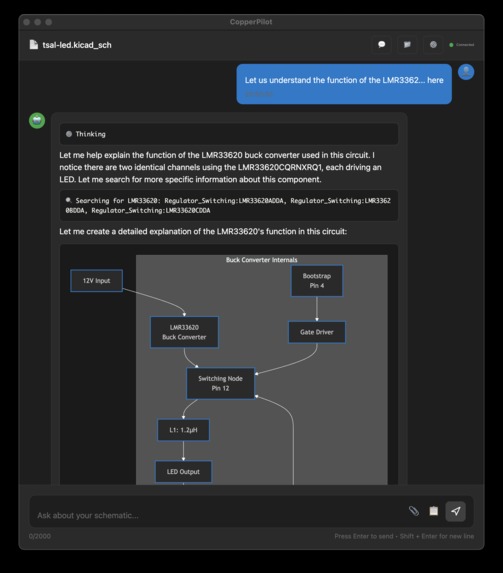
CopperPilot helps you ideate about your schematic with tables and block diagrams
-
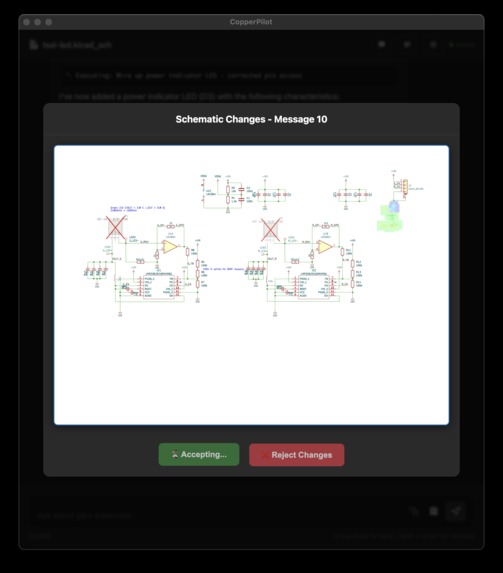
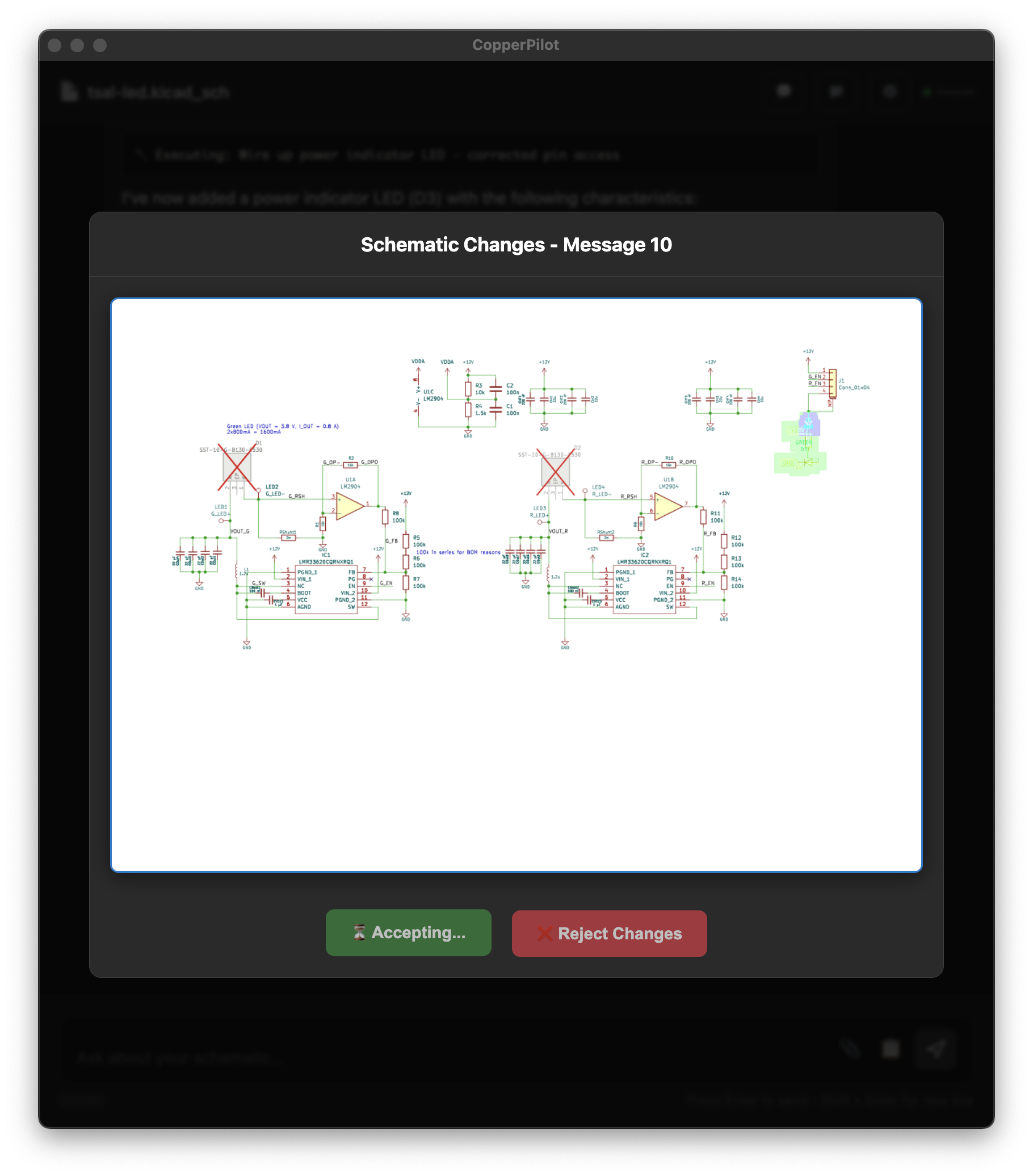
CopperPilot can make changes to the schematic and show you a diff to approve / reject
-
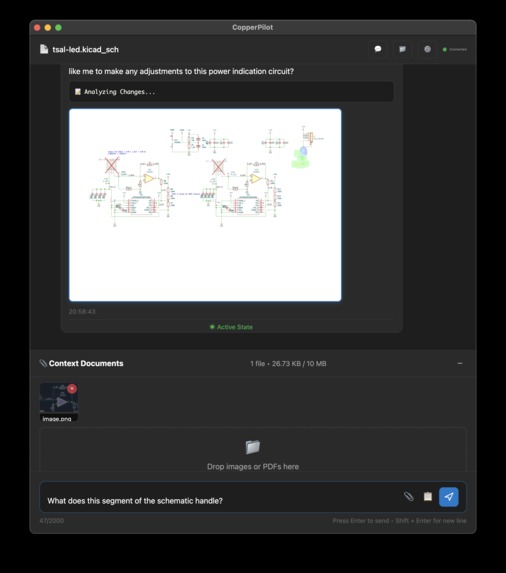
You can add specific schematic context to the chat by copy pasting snippets from KiCAD or pasting screenshots


CopperPilot: Copilot for Hardware Design
Inspiration
As the electrical lead of my college's Formula Student EV racing team, I spent countless hours hunting through 30-page datasheets, manually routing PCB traces, and catching design errors only after expensive fabrication. The learning curve was brutal, many students gave up entirely.
As an AI engineer at Minus Zero building autonomous vehicles, I use Claude daily. It handles tedious coding logic while I focus on architecture. The contrast is stark: why do software engineers have AI copilots while hardware engineers still manually place components and check design rules?
With recent advances in Claude's Agentic abilities and my unique position at the intersection of electronics design and AI development, I realized I could build the tool I wish I had as a student. CopperPilot makes hardware design as fluid as vibe coding.
The Market Opportunity: The EDA software market is $17.6B globally (2024), projected to reach $32.9B by 2032. There are ~2M hardware design engineers worldwide across 57,233 companies using EDA tools. But more importantly, there are millions of product managers, entrepreneurs, and students who want to build hardware but are blocked by the steep learning curve. Just as Lovable democratized software creation (reaching 2.3M users and $75-100M ARR in under a year), CopperPilot can become "Lovable for Hardware"—unlocking a $10B-$15B democratization opportunity beyond the professional EDA market.
What it does
CopperPilot is an AI copilot that integrates directly with KiCad to assist hardware engineers throughout the design process:
For Junior Engineers: Provides interactive guidance, explains component choices, and catches common mistakes before fabrication. It should reduce the learning curve from months to weeks.
For Senior Engineers: Automates repetitive tasks like component search, datasheet parsing, power rail routing, and decoupling capacitor placement. Reduces time spent on manual work.
For Team Leads: Enforces company-specific design rules automatically, catching errors like missing pull-up resistors, incorrect pin assignments, or signal integrity violations before manual review.
Core Features:
- Natural language design: "Add a humidity sensor with I2C interface" → CopperPilot places components and wires connections
- Intelligent component search: Finds alternatives based on specs
- Datasheet parsing: Extracts critical information and generates design recommendations
- Block diagram generation: Visualizes system architecture before detailed schematic work
How we built it
Architecture
Client Application: Electron-based KiCad extension providing a chat interface alongside the schematic editor. Parses and modifies KiCad files directly rather than through image processing.
AI Agent Server: Python FastAPI backend hosting the LLM (Claude) pipeline, component database, and design rule engine. Uses Claude for reasoning and tool calling.
Knowledge Base: Curated database of component specifications, design patterns, etc.
Technical Innovations
Direct schematic code manipulation: We parse KiCad's format to understand circuit topology, enabling precise modifications rather than approximate visual placement.
Context-aware suggestions: When a user adds an ESP32, CopperPilot proactively suggests 3.3V regulation, decoupling capacitors (0.1µF + 10µF), programming headers, and boot mode resistors based on the datasheet.
Flexible rule engine: Companies can define custom validation rules in natural language ("all ADC inputs must have RC filters with cutoff < 1kHz") which we translate to automated checks.
Development Process
Built MVP focusing on schematic-only features.
Challenges we ran into
EDA Tool Complexity: KiCad and Altium have undocumented internal APIs. Reverse-engineering file formats and plugin architectures consumed a lot of development time. I ended up with going with KiCAD only for now.
Monolith Tool vs Multiple Atomic Micro Tools: Initially, I started by having one big python sandbox tool for the Claude agent to interact with the schematic, but this proved to have multiple points of failure. Looked through the literature: ReAct: Synergizing Reasoning and Acting in Language Models, Toolformer: Language Models Can Teach Themselves to Use Tools. This made it clear that smaller more atomic tools were much better (even if I needed to have several dozen tools).
LLM Hallucinations: Early versions confidently suggested non-existent components or incorrect pin configurations. Having tooling to allow strategic injection of the datasheets when necessary was a game changer here.
Component Database Fragmentation: Data scattered across Digi-Key, Mouser, LCSC, and manufacturer sites. Building unified search requires constant pipeline maintenance and handling inconsistent schemas. Still working on this, very difficult. Similar challenege across formats for KiCAD Altium, etc.
Accomplishments that we're proud of
Technical Breakthrough: Successfully parsing and modifying complex multi-sheet schematics with hierarchical blocks, something image-based approaches cannot handle.
Speed Optimization: Dumping the entire schematic context into Claude isn't optimal (in terms of cost and loading the entire schematic in at once is quite slow). I implemented a sophisticated knowledge graph which allows Claude to explore the schematic as and when necessary, essentially lazy loading guided by Claude's intuition.
What we learned
Hardware ≠ Software: Direct translation of software copilot patterns doesn't work. Hardware has physical constraints (board size, thermal management, signal integrity) that require domain-specific validation.
The Last Mile is Exponential: Generating 90% correct schematics is straightforward. Getting to production-ready (100%) is exponentially harder, where human expertise remains irreplaceable. I am excited to build this last 10% and make a company out of this.
What's next for CopperPilot
Wave 1: Professional EDA Enhancement (Years 1-3)
- Push for pilots and convert to paying customers (target: 5-10 enterprises initially)
- Launch Altium Designer support alongside KiCad
- Target market: 50,000+ hardware design engineers at mid-size enterprises
- Revenue model: $200/engineer/month ($120M addressable at 1% market share)
- Milestone: $1M ARR, Series A fundraising
Wave 2: Democratization Platform (Years 3-5)
- Expand beyond professional engineers to 500,000+ product managers, entrepreneurs, students
- Freemium + project-based pricing ($50-500/project)
- Following Lovable's playbook: They democratized software creation, reaching 2.3M users (mostly non-technical), 180K+ paying subscribers, and $75-100M ARR in under a year—achieving a $1.8B valuation
- Similarly, Figma democratized design (13M+ users, two-thirds non-designers, $20B valuation). The hardware market is significantly larger
- Add PCB layout optimization and auto-routing features
Wave 3: Full Hardware Platform (Years 5-7)
- Expand to mechanical CAD, firmware generation, manufacturing integration
- Build platform effects: component marketplace, vendor network, educational content
- Guidance LLM: Self-prompting system enabling autonomous design from high-level requirements
- Geographic expansion: Target Asia-Pacific (fastest CAGR at 9.69%) alongside North America (32% market share)
Ultimate Goal: Make CopperPilot the standard tool for hardware design—democratizing PCB creation for makers, students, and entrepreneurs while accelerating professional workflows. The future of hardware is collaborative human-AI design, and we're building the platform to make it accessible to everyone.# Inspiration
As the electrical lead of my college's Formula Student EV racing team, I spent countless hours hunting through 30-page datasheets, manually routing PCB traces, and catching design errors only after expensive fabrication. The learning curve was brutal, many students gave up entirely.
As an AI engineer at Minus Zero building autonomous vehicles, I use Claude daily. It handles tedious coding logic while I focus on architecture. The contrast is stark: why do software engineers have AI copilots while hardware engineers still manually place components and check design rules?
With recent advances in Claude's Agentic abilities and my unique position at the intersection of electronics design and AI development, I realized I could build the tool I wish I had as a student. CopperPilot makes hardware design as fluid as vibe coding.
The Market Opportunity: The EDA software market is $17.6B globally (2024), projected to reach $32.9B by 2032. There are ~2M hardware design engineers worldwide across 57,233 companies using EDA tools. But more importantly, there are millions of product managers, entrepreneurs, and students who want to build hardware but are blocked by the steep learning curve. Just as Lovable democratized software creation (reaching 2.3M users and $75-100M ARR in under a year), CopperPilot can become "Lovable for Hardware"—unlocking a $10B-$15B democratization opportunity beyond the professional EDA market.
What it does
CopperPilot is an AI copilot that integrates directly with KiCad to assist hardware engineers throughout the design process:
For Junior Engineers: Provides interactive guidance, explains component choices, and catches common mistakes before fabrication. It should reduce the learning curve from months to weeks.
For Senior Engineers: Automates repetitive tasks like component search, datasheet parsing, power rail routing, and decoupling capacitor placement. Reduces time spent on manual work.
For Team Leads: Enforces company-specific design rules automatically, catching errors like missing pull-up resistors, incorrect pin assignments, or signal integrity violations before manual review.
Core Features:
- Natural language design: "Add a humidity sensor with I2C interface" → CopperPilot places components and wires connections
- Intelligent component search: Finds alternatives based on specs
- Datasheet parsing: Extracts critical information and generates design recommendations
- Block diagram generation: Visualizes system architecture before detailed schematic work
How we built it
Architecture
Client Application: Electron-based KiCad extension providing a chat interface alongside the schematic editor. Parses and modifies KiCad files directly rather than through image processing.
AI Agent Server: Python FastAPI backend hosting the LLM (Claude) pipeline, component database, and design rule engine. Uses Claude for reasoning and tool calling.
Knowledge Base: Curated database of component specifications, design patterns, etc.
Technical Innovations
Direct schematic code manipulation: We parse KiCad's format to understand circuit topology, enabling precise modifications rather than approximate visual placement.
Context-aware suggestions: When a user adds an ESP32, CopperPilot proactively suggests 3.3V regulation, decoupling capacitors (0.1µF + 10µF), programming headers, and boot mode resistors based on the datasheet.
Flexible rule engine: Companies can define custom validation rules in natural language ("all ADC inputs must have RC filters with cutoff < 1kHz") which we translate to automated checks.
Development Process
Built MVP focusing on schematic-only features.
Challenges we ran into
EDA Tool Complexity: KiCad and Altium have undocumented internal APIs. Reverse-engineering file formats and plugin architectures consumed a lot of development time. I ended up with going with KiCAD only for now.
Monolith Tool vs Multiple Atomic Micro Tools: Initially, I started by having one big python sandbox tool for the Claude agent to interact with the schematic, but this proved to have multiple points of failure. Looked through the literature: ReAct: Synergizing Reasoning and Acting in Language Models, Toolformer: Language Models Can Teach Themselves to Use Tools. This made it clear that smaller more atomic tools were much better (even if I needed to have several dozen tools).
LLM Hallucinations: Early versions confidently suggested non-existent components or incorrect pin configurations. Having tooling to allow strategic injection of the datasheets when necessary was a game changer here.
Component Database Fragmentation: Data scattered across Digi-Key, Mouser, LCSC, and manufacturer sites. Building unified search requires constant pipeline maintenance and handling inconsistent schemas. Still working on this, very difficult. Similar challenege across formats for KiCAD Altium, etc.
Accomplishments that we're proud of
Technical Breakthrough: Successfully parsing and modifying complex multi-sheet schematics with hierarchical blocks, something image-based approaches cannot handle.
Speed Optimization: Dumping the entire schematic context into Claude isn't optimal (in terms of cost and loading the entire schematic in at once is quite slow). I implemented a sophisticated knowledge graph which allows Claude to explore the schematic as and when necessary, essentially lazy loading guided by Claude's intuition.
What we learned
Hardware ≠ Software: Direct translation of software copilot patterns doesn't work. Hardware has physical constraints (board size, thermal management, signal integrity) that require domain-specific validation.
The Last Mile is Exponential: Generating 90% correct schematics is straightforward. Getting to production-ready (100%) is exponentially harder, where human expertise remains irreplaceable. I am excited to build this last 10% and make a company out of this.
What's next for CopperPilot
Wave 1: Professional EDA Enhancement (Years 1-3)
- Push for pilots and convert to paying customers (target: 5-10 enterprises initially)
- Launch Altium Designer support alongside KiCad
- Target market: 50,000+ hardware design engineers at mid-size enterprises
- Revenue model: $200/engineer/month ($120M addressable at 1% market share)
- Milestone: $1M ARR, Series A fundraising
Wave 2: Democratization Platform (Years 3-5)
- Expand beyond professional engineers to 500,000+ product managers, entrepreneurs, students
- Freemium + project-based pricing ($50-500/project)
- Following Lovable's playbook: They democratized software creation, reaching 2.3M users (mostly non-technical), 180K+ paying subscribers, and $75-100M ARR in under a year—achieving a $1.8B valuation
- Similarly, Figma democratized design (13M+ users, two-thirds non-designers, $20B valuation). The hardware market is significantly larger
- Add PCB layout optimization and auto-routing features
Wave 3: Full Hardware Platform (Years 5-7)
- Expand to mechanical CAD, firmware generation, manufacturing integration
- Build platform effects: component marketplace, vendor network, educational content
- Guidance LLM: Self-prompting system enabling autonomous design from high-level requirements
- Geographic expansion: Target Asia-Pacific (fastest CAGR at 9.69%) alongside North America (32% market share) Ultimate Goal: Make CopperPilot the standard tool for hardware design, democratizing PCB creation for makers, students, and small teams while accelerating innovation cycles from months to weeks. The future of hardware is collaborative human-AI design.


Log in or sign up for Devpost to join the conversation.