Inspiration
I wanted to run an open model on dedicated GPUs — no rate limits, no throttling at peak hours. Then I saw the price: a dedicated cluster starts around $1,200 a month, with long commitments. For one developer, that's impossible.
But I wasn't alone. Thousands of solo developers and small startups are stuck on rate-limited public APIs, while the teams that do rent clusters leave 50–70% of that capacity idle overnight. The obvious answer is to share. So why doesn't anyone?
Because sharing compute with strangers needs trust. Who pays for what? What if someone overspends? Who settles the bill at the end? I realized PayPal already has the perfect primitive for this — authorize now, capture later — and that an AI agent could run the books. That became CoPod.
What it does
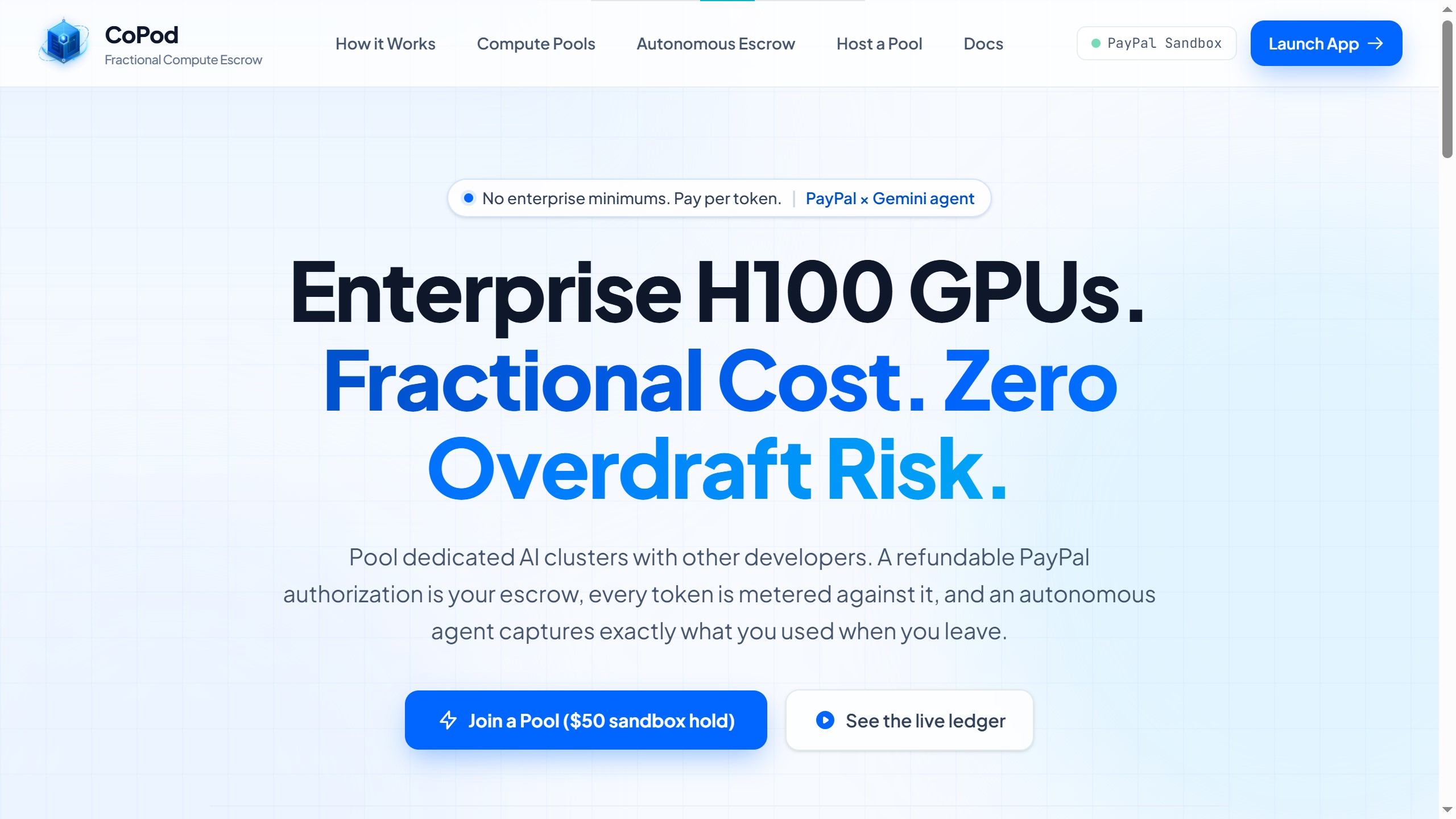
CoPod lets developers pool dedicated AI compute, with PayPal as the escrow and an autonomous AI as the treasurer.
- Hosts list a pool — model, seats, deposit, prices, and the PayPal account that gets paid.
- Developers join with a PayPal authorization hold (Orders API,
intent: AUTHORIZE). Nothing is charged — the money stays theirs until they use the cluster. - They get an OpenAI-compatible API key. Every request is metered against their hold in real time.
- A guardrail makes overdraft impossible. Before a prompt reaches the GPU, CoPod reserves the worst case and caps
max_tokensto what the remaining hold can pay for:
Granted Max Tokens = the smaller of Requested Max Tokens or Rounded Down [ (PayPal Hold − Metered Spend − In-Flight Reservations − Estimated Input Cost) ÷ Output Price per Token ]
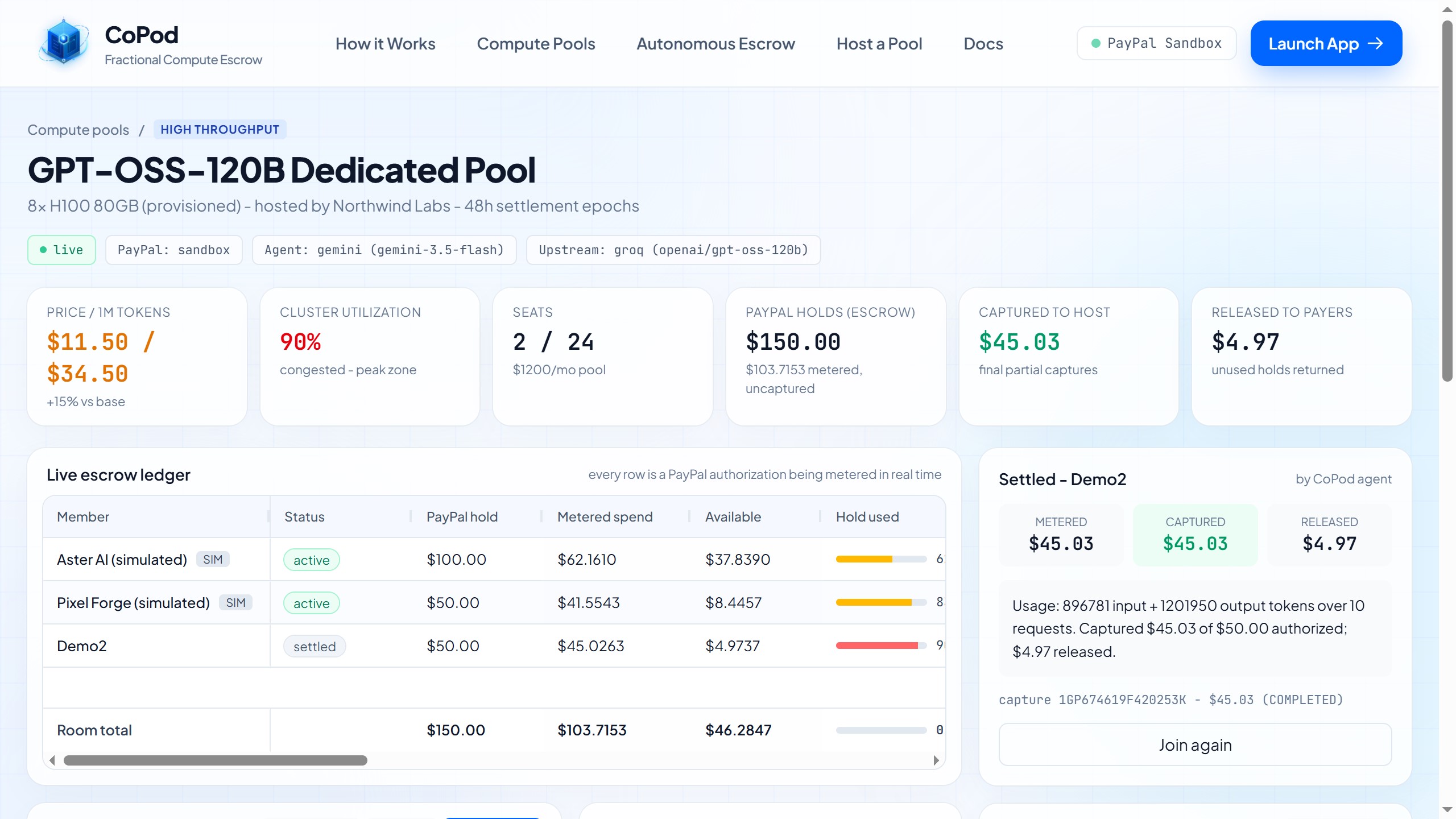
- A Gemini treasurer runs the room autonomously. It reads utilization, burn rates and runways, then acts through guarded tools: it discounts when the cluster is idle, raises prices at peak, throttles or batch-pauses heavy users, requests top-ups at 85% of a hold, and verifies authorizations with PayPal — explaining every decision.
- Exact settlement. When a member leaves, the treasurer partially captures precisely what they used with
final_capture: true, and PayPal releases the rest:
$$ \text{capture} = S, \qquad \text{released} = H - S $$
- A live AG Grid ledger streams every hold, spend, burn rate, capture and release in real time.
How we built it
- Next.js 16 + React 19 + TypeScript as a single full-stack app: UI, API routes, the OpenAI-compatible proxy (
/v1/chat/completions), and a background room engine that ticks every 2 seconds. - PayPal Orders v2 + Payments v2: create order (AUTHORIZE) → authorize → verify → partial capture with
final_capture: true→ void unused authorizations, plus webhooks with signature verification. Every mutating call usesPayPal-Request-Idfor idempotency, and 48-hour settlement epochs keep captures inside PayPal's 3-day honor period. The PayPal JS SDK handles buyer approval. - Google Gemini (function calling) powers the treasurer with 8 typed tools. Each tool enforces hard limits in code: prices stay within $0.6\times$–$1.4\times$ of base and move at most 30% per step, and settlement must satisfy $0.8\,S \le \text{capture} \le S$ (any credit needs a written reason).
- Groq serves the models behind the proxy (
gpt-oss-120b,gpt-oss-20b,qwen3.8-27b). - AG Grid for the live escrow ledger, payment events and guardrail log, streamed over Server-Sent Events.
- Tailwind CSS v4 for the glassmorphism design, Render for hosting, and a Postman collection that runs the full lifecycle.
Challenges we ran into
- Money must never be wrong, even if the AI is. I couldn't let a language model touch PayPal directly. The answer was guarded tools with server-side limits, a model fallback chain (
gemini-3.5-flash→gemini-2.5-flash→flash-lite), and a deterministic rules engine so settlement always completes. - Partial capture semantics. Settling across multiple authorizations (deposit + top-ups) meant capturing oldest-first with
final_capture: trueand voiding any authorization that receives nothing. - Reasoning models eat tokens. The
gpt-ossmodels spend part ofmax_tokenson hidden reasoning, which returned empty answers under tight guardrail caps. Tuningreasoning_effortper model fixed it. - Model churn mid-hackathon. The model I started with was deprecated and my first Gemini model was overloaded, so I rebuilt the pools on currently served models and added automatic fallback.
- Separating simulated load from real usage, so demo traffic never distorts the utilization the agent prices on.
Accomplishments that we're proud of
- A real end-to-end PayPal lifecycle in sandbox: authorization hold → metered usage → AI-driven partial capture → automatic release.
- Zero-overdraft guarantee enforced before every single request.
- An AI agent that is genuinely autonomous but provably safe — every action is bounded, logged and explained.
- A two-sided marketplace: anyone can host a pool and get paid directly.
- It's a drop-in OpenAI endpoint — developers change one line of code.
What we learned
- PayPal's authorize-and-capture flow is far more powerful than a checkout button — it's a programmable escrow.
- The right way to give an AI agent financial power is narrow tools with hard limits, not open-ended access.
- Idempotency keys, honor periods and partial captures are what make payment systems trustworthy in practice.
- Designing for failure — fallback models, rules engines, atomic state writes — matters as much as the happy path.
What's next for CoPod
- Real GPU backends (vLLM, provisioned throughput) behind the same metering and escrow layer.
- Verified host onboarding through PayPal partner referrals, so payouts go straight to verified accounts.
- PayPal Vault for returning members and recurring pools, plus multi-currency pools.
- Agent-to-agent commerce: autonomous AI clients that discover a pool, authorize a hold and buy compute on their own.
