Inspiration
In Bangladesh, many farmers, pharmacies, restaurants, and small businesses deal with products that are sensitive to temperature. However, temperature-controlled transportation can be expensive, especially when a business only needs to transport a small amount of goods.
We asked a simple question:
What if businesses didn't have to pay for an entire cold-chain vehicle when they only need a small portion of it?
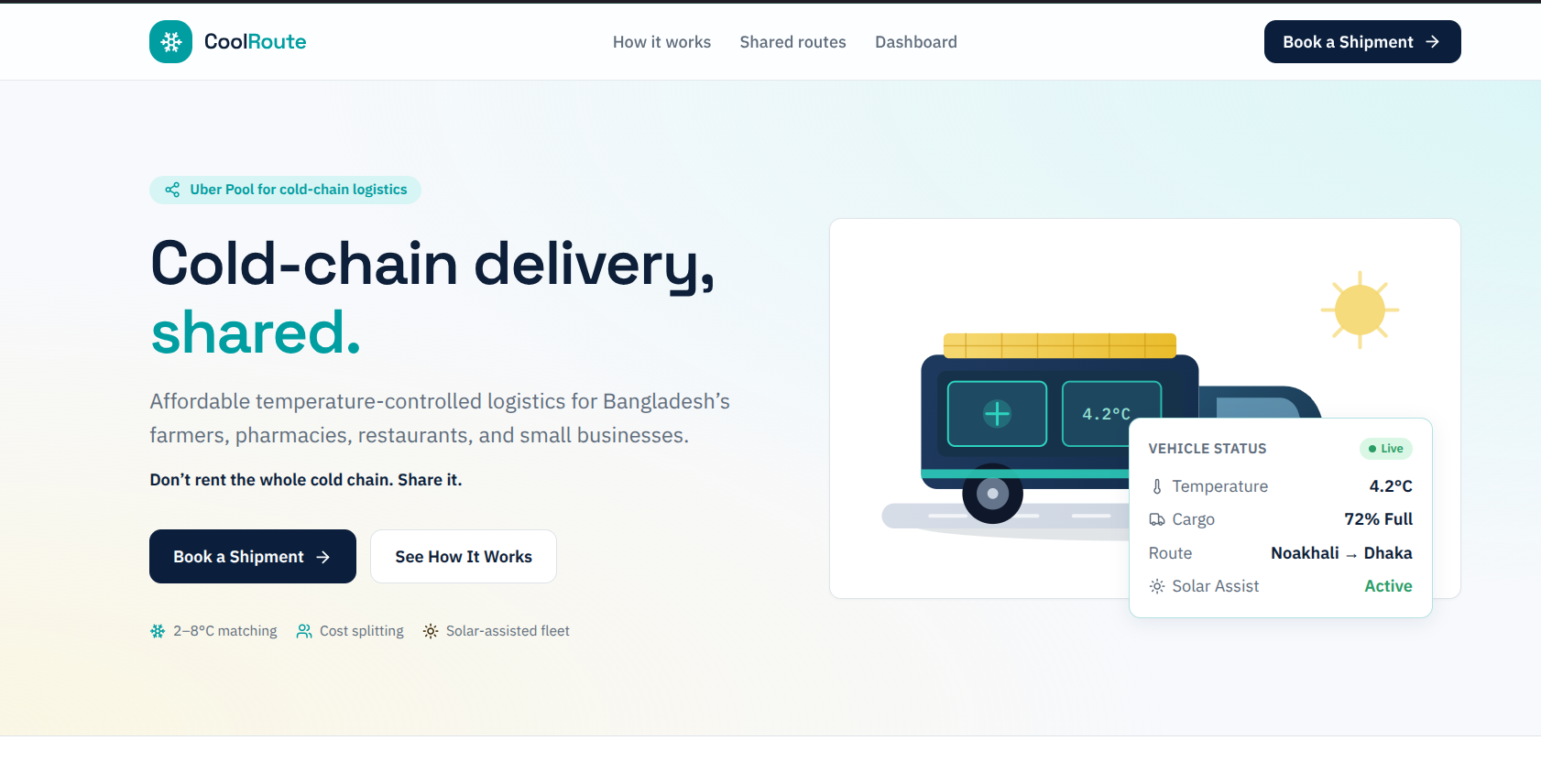
This led us to CoolRoute — a shared-route cold-chain logistics platform inspired by the idea of ride-sharing. Instead of one customer using an entire temperature-controlled vehicle, multiple compatible shipments can share the same vehicle and split the transportation cost.
Our core idea is simple:
Don't rent the whole cold chain. Share it.
What We Built
CoolRoute is a frontend prototype for a shared temperature-controlled logistics platform.
A customer can:
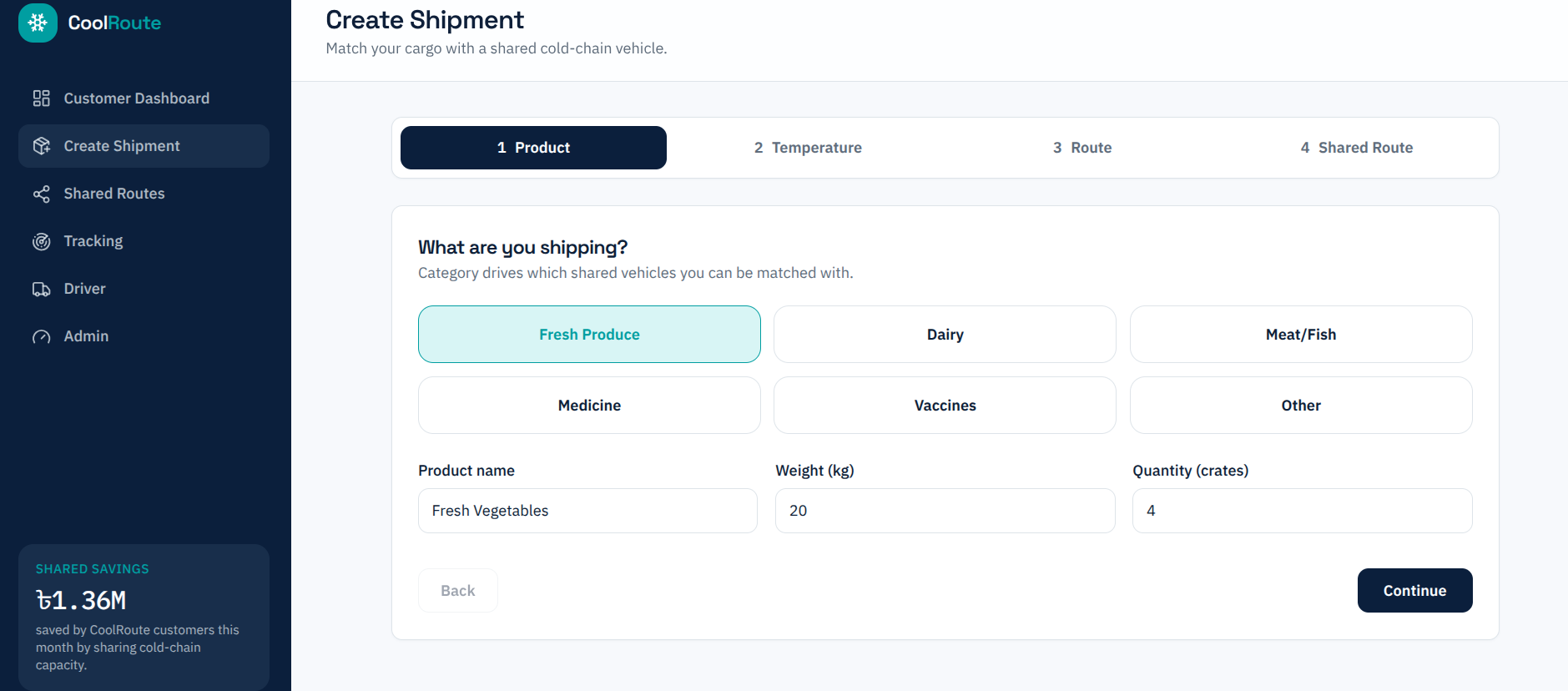
- Create a shipment
- Select the product and required temperature range
- Enter pickup and delivery locations
- Find compatible shared routes
- Compare estimated delivery costs
- Join a shared route
- Track the shipment
- Monitor temperature and vehicle status
For example, a farmer shipping vegetables, a pharmacy shipping medicine, and a restaurant shipping dairy products may be traveling along a compatible route.
Instead of three separate vehicles, CoolRoute demonstrates how they could share one temperature-controlled vehicle.
The prototype also includes:
- Customer Dashboard
- Shared Route Marketplace
- Shipment Creation Flow
- Shipment Tracking
- Temperature Monitoring
- Driver Dashboard
- Admin Logistics Dashboard
- Route utilization analytics
- Cost-sharing visualization
How It Works
The central concept is shared-route matching.
A shipment is matched based on several factors:
- Pickup location
- Destination
- Route compatibility
- Pickup and delivery time
- Required temperature range
- Available vehicle capacity
The conceptual matching process is:
$$ Shipment + Route + Temperature + Capacity \rightarrow Compatible Shared Route $$
Once compatible shipments are grouped together, the transportation cost can be divided according to factors such as cargo weight, occupied capacity, and distance.
This creates a simple network effect:
More shipments → Better route matching → Higher vehicle utilization → Lower cost per shipment → More customers
How We Built It
We built CoolRoute as a frontend-only MVP so that we could focus on demonstrating the product experience and the core logistics concept.
The prototype was built using:
- React
- TypeScript
- Tailwind CSS
- Recharts
- Lucide Icons
- Mock/demo data
- Responsive UI components
We used a modern dashboard-based interface for customers, drivers, and administrators.
The current prototype does not require a backend, database, authentication system, or external APIs. Instead, realistic demo data and frontend state are used to simulate the complete user journey.
Product Demo
The main demo flow is:
Create Shipment
→ Enter 20kg vegetables
→ Select 4–8°C temperature requirement
→ Select Noakhali → Dhaka
→ Find compatible shared routes
→ Join an available CoolRoute vehicle
→ See the shared cost
→ Track the shipment
→ Monitor temperature
For example, the prototype can demonstrate a vehicle carrying:
- 20kg vegetables
- 8kg medicine
- 15kg dairy products
The system shows how these shipments can share available vehicle capacity instead of requiring separate dedicated transportation.
All prices and operational figures shown in the prototype are illustrative demo values, not real-world quotations.
What We Learned
Building CoolRoute helped us understand that solving a logistics problem is not only about building hardware or transportation infrastructure.
The more interesting challenge is coordination.
A cold-chain vehicle that is only partially utilized can still be expensive. But if multiple businesses can reliably share that capacity, the economics can change.
We learned how product design, route optimization, logistics operations, and business models need to work together.
We also learned the importance of designing a solution around the actual needs of smaller customers rather than assuming that every customer needs a dedicated logistics service.
Challenges We Faced
One of our biggest challenges was designing a system that could communicate the shared-route concept clearly without making the user experience complicated.
We also had to think about compatibility between different shipments.
For example, medicine and fresh produce may require different temperature ranges, while different customers may have different pickup deadlines.
Therefore, simply matching shipments based on destination is not enough.
A real implementation would need to consider:
- Temperature compatibility
- Route overlap
- Delivery deadlines
- Vehicle capacity
- Product requirements
- Shipment priority
Another challenge was building a convincing prototype without implementing the entire backend and IoT infrastructure. We solved this by using realistic mock data and focusing the prototype on the most important user flows.
Future Plans
The current project is a prototype. A production version of CoolRoute could include:
Real-Time GPS Tracking
Vehicles could continuously transmit their location to the platform.
IoT Temperature Monitoring
Temperature sensors could monitor cargo conditions and automatically trigger alerts when the temperature leaves the required range.
Intelligent Route Matching
A backend optimization engine could match shipments using route overlap, capacity, temperature compatibility, and delivery deadlines.
Dynamic Cost Splitting
The system could automatically calculate each customer's share of the transportation cost based on distance, cargo volume, weight, and occupied capacity.
Fleet Partnerships
CoolRoute could partner with existing rickshaw/van/three-wheeler operators instead of building an entire fleet from scratch.
Expansion
The platform could initially focus on high-demand routes such as:
Noakhali → Feni → Comilla → Dhaka
and gradually expand to other major agricultural and commercial routes across Bangladesh.
Why CoolRoute?
Traditional cold-chain logistics often treats transportation capacity as something a single customer has to pay for.
CoolRoute treats that capacity as something that can be shared.
Our goal is to make temperature-controlled logistics more accessible to smaller businesses while improving vehicle utilization.
The hardware is important.
The temperature monitoring is important.
But our biggest innovation is the network connecting shipments that are already going in the same direction.
CoolRoute
Don't rent the whole cold chain. Share it.
Built With
- css
- react
- recharts
- tailwind
- typescript

Log in or sign up for Devpost to join the conversation.