
Inspiration
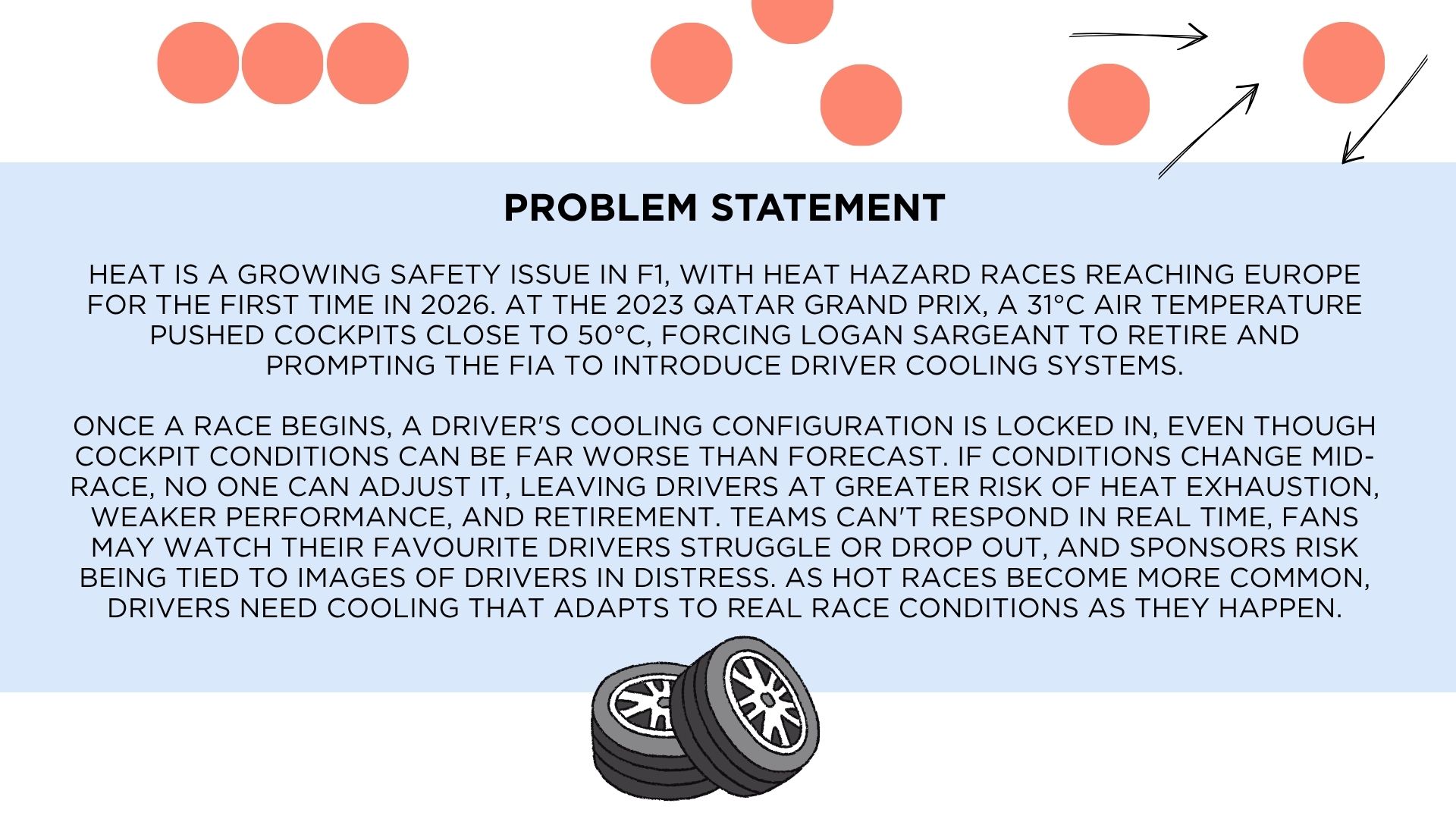
We were inspired by the 2023 Qatar Grand Prix, where extreme heat and cockpit conditions pushed several Formula 1 drivers to their physical limits. Drivers experienced symptoms including vomiting, blurred vision, and severe exhaustion, highlighting that even with F1's highly advanced safety technology, thermal and physiological risks remain a challenge.
This made us ask: What if a driver's physiological condition could be used to proactively manage their environment before the situation becomes dangerous?
We wanted to explore how AI, real-time biometrics, and physical hardware could work together to address this problem.
What it does
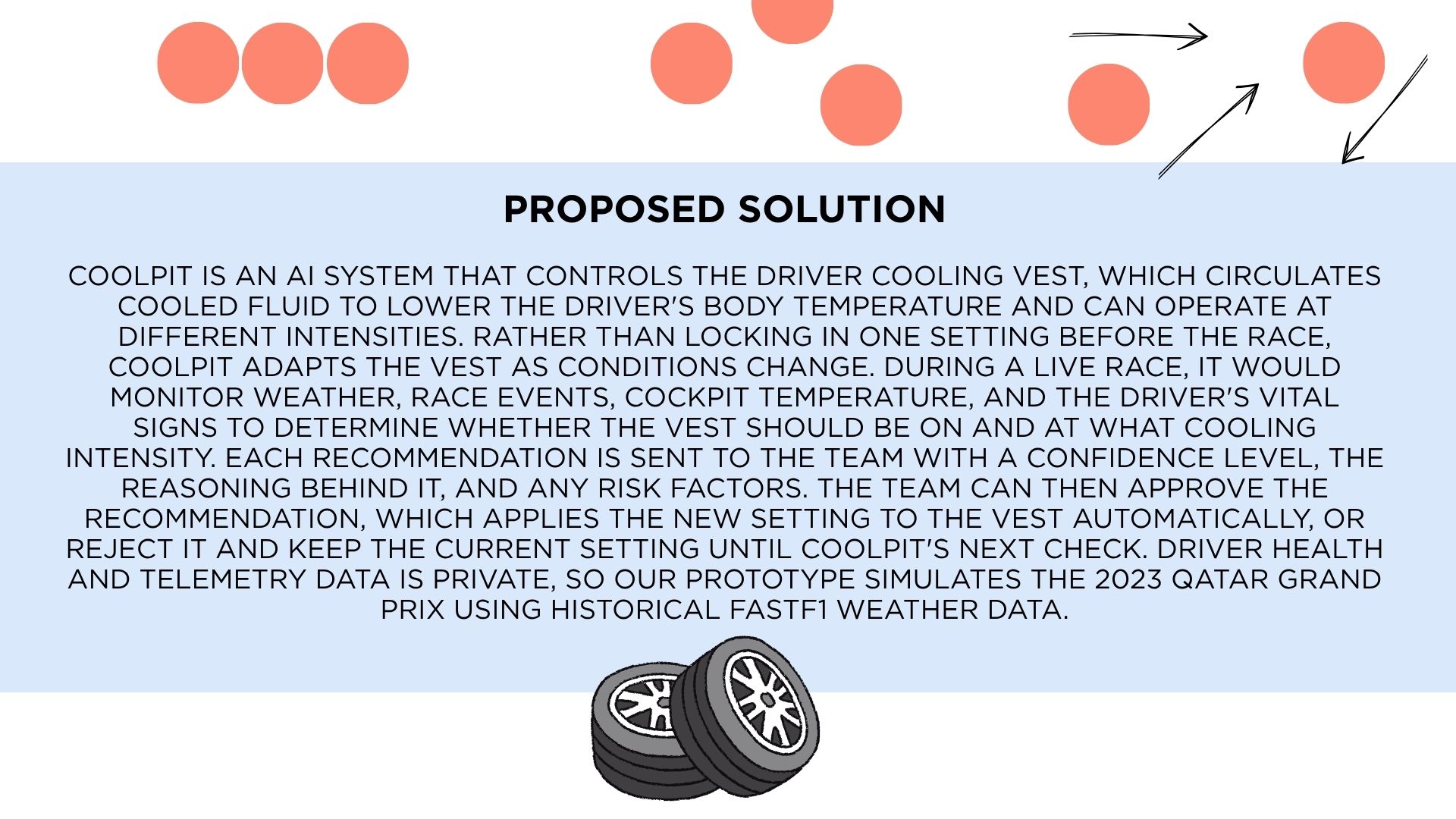
CoolPit is a human-in-the-loop system designed to help the pit wall respond to a driver's changing physiological and environmental conditions in real time.
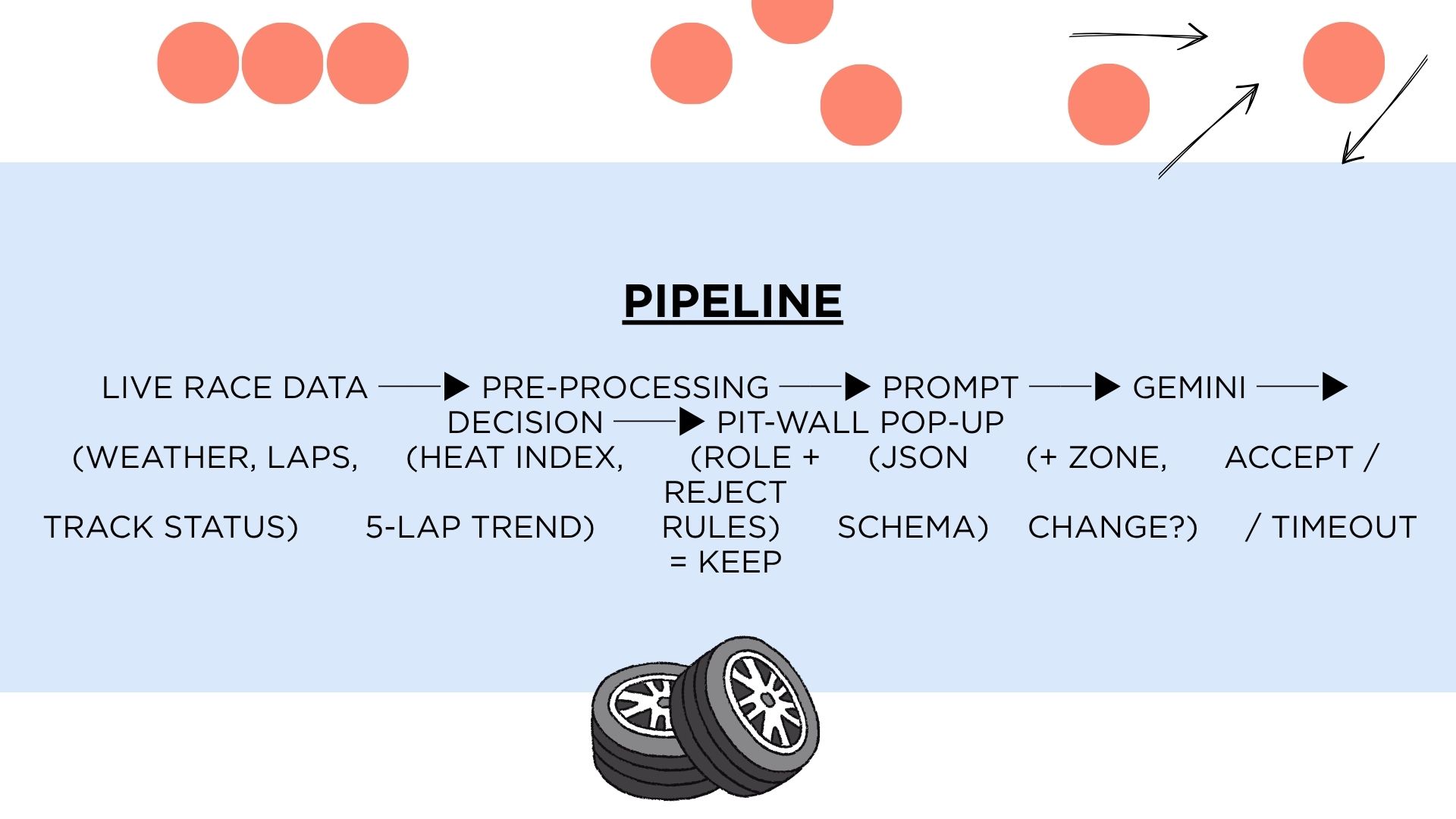
A live race-data agent takes in real-time telemetry and driver biometric data. AI agents analyse this information and generate a recommendation when a change to the driver's cooling system may be appropriate.
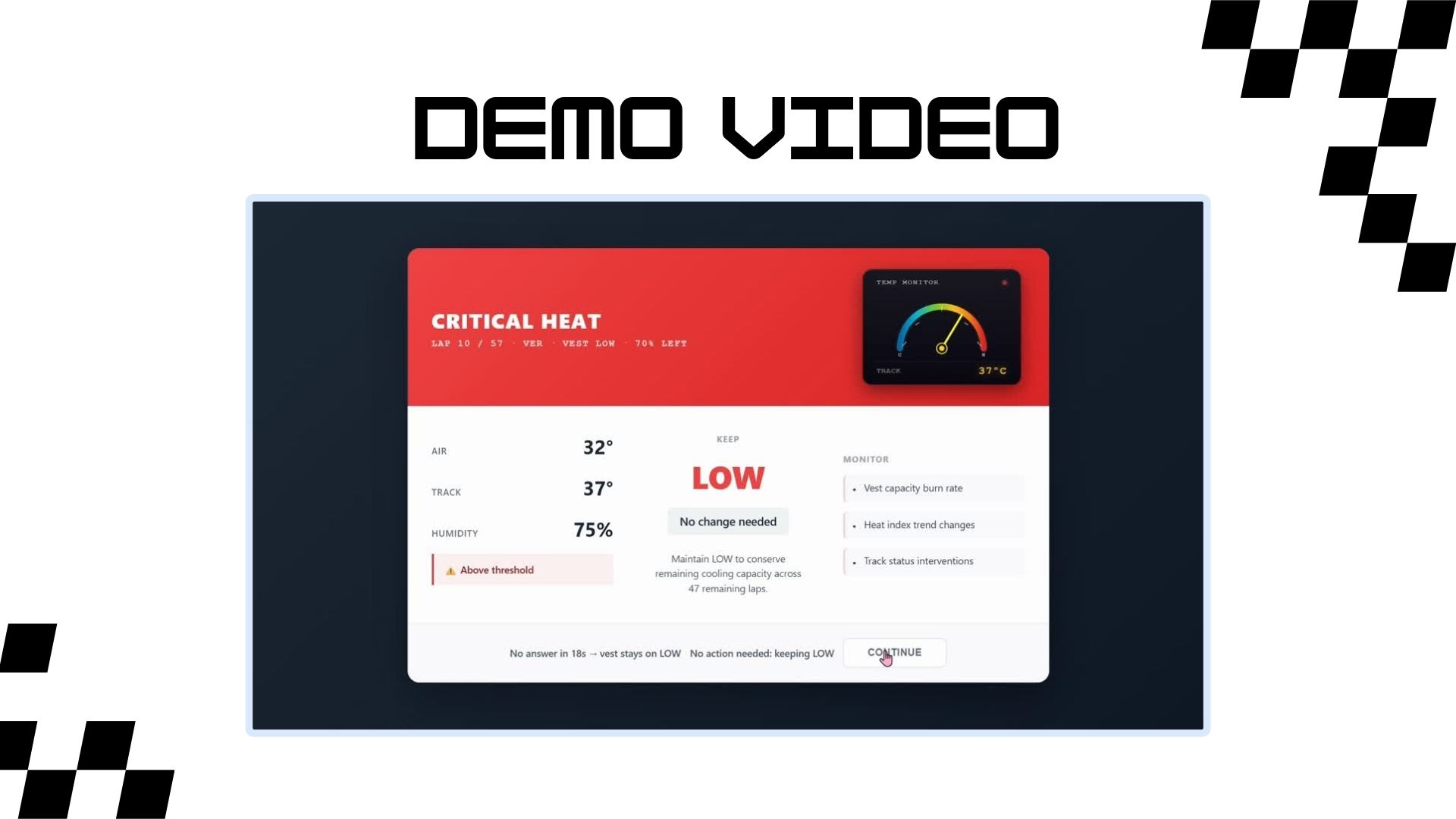
Rather than allowing AI to directly control the driver's equipment, the recommendation is sent to the pit wall for human approval. The pit team can approve or reject the recommendation, or choose not to respond. If there is no response within 30 seconds, the recommendation automatically expires.
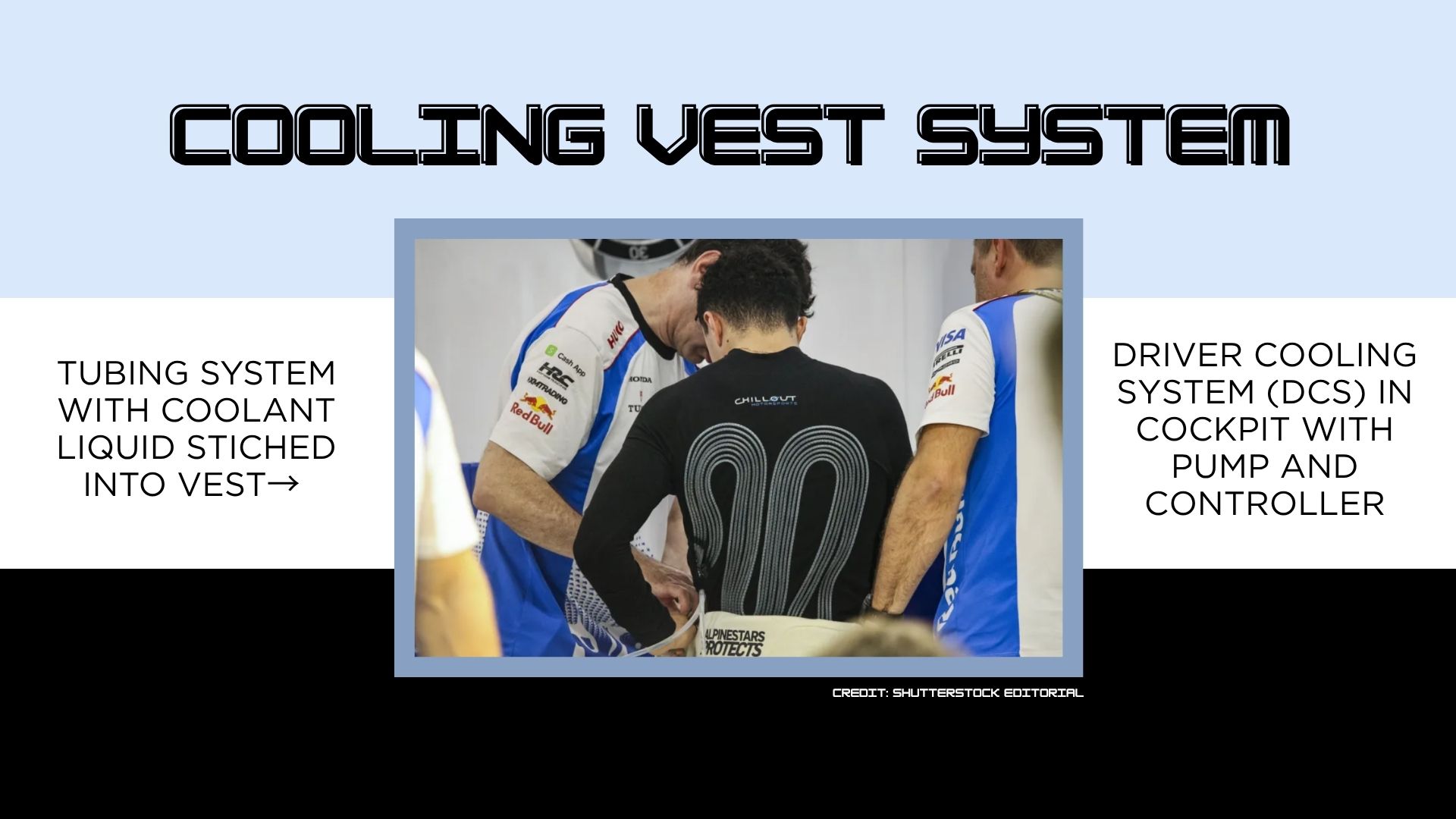
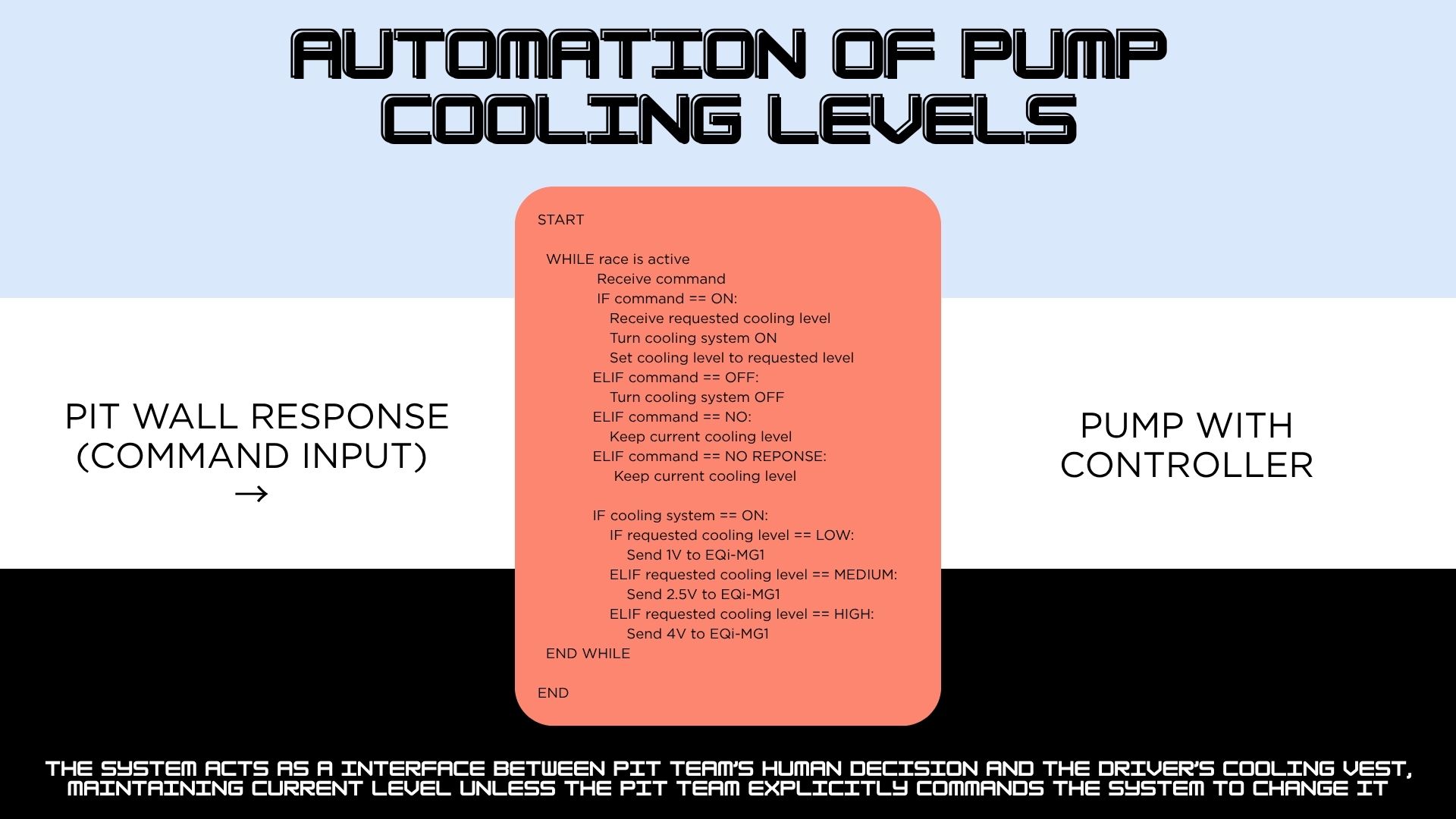
When approved, the command is translated into a pump-control instruction that adjusts the cooling system's setting. This creates a complete loop from live data --> AI analysis --> human decision --> physical pump control.
How we built it
We started with extensive research into F1 telemetry, driver biometrics, cooling systems, and the hardware required to control a cooling pump. We used FastF1 as our source for live race telemtry and designed our system around the possibility of incorporating biometric data alongside it.
Since we did not have access to real-time F1 biometric data or an actual F1 cooling system, we focused on building a proof of concept that demonstrates how these components would interact. We designed the AI-to-pit-wall workflow, created an interface showing the three possible human responses, and developed pseudocode for translating an approved cooling command into a pump setting.
The pump control component was designed around different cooling levels allowing an approved command to be translated into a corresponding pump speed/control signal.
Challenges we ran into
One of our biggest challenges was access to realistic, synchronized data. FastF1 provides valuable race telemetry, but real F1 driver biometric data is not publicly available in the same way. We explored simulated biometric datasets from Kaggle, but the datasets we found could not reliably be synchronized with FastF1 data or mapped to the same race conditions.
We also ran into limitations caused by proprietary F1 technology and systems. There is limited public information about exactly how teams collect and process driver biometrics and how their real cooling systems are integrated into the car.
These limitations forces us to continually distinguish between what we could realistically demonstrate and what would require access to real F1 hardware and data.
Accomplishments that we're proud of
We are proud of how much research and system-level understanding went into developing CoolPit. We began with a broad problem: driver safety in extreme conditions. Then we explored many possible approaches before narrowing our idea down to a specific, achievable system.
A major accomplishment was taking all of the different pieces we researched (F1 telemetry, biometrics, AI agents, cooling systems, and pump control) and synthesizing them into one coherent workflow.
We are also proud that we didn't stop at AI recommendation. We designed a human-in-the-loop architecture that connects the AI's analysis to an actual physical action while keeping the pit team responsible for approving the intervention.
What we learned
We learned that building a real-time AI system is about much more than the AI itself. The quality, availability, and synchronization of data can determine what is actually possible.
We also learned more about how F1 telemetry works, how driver biometerics could potentially be collected, how cooling systems operate, and how software decisions can ultimately be translated into physical hardware control.
Most importantly, we learned how to take a very broad problem and iteratively research, brainstorm, evaluate, and narrow it into a focused project that we could actually prototype within a hackathon.
What's next for CoolPit
The biggest next step for CoolPit is getting access to the real data needed to properly validate and develop the system. Unfortunately, real-time driver biometric data and dtailed information about F1 cooling systems are not publicly available, meaning that the next phase of CoolPit quite literally requires us to work in F1.
With access to real F1 data and hardware, we could validate our system with synchronized driver biometrics and race telemetry, test our cooling-control logic on real hardware, and determine how accurately our system can detect and respond to thermal stress in real race conditions.
Built With
- agent
- ai
- api
- promptengineering
- python
- research


Log in or sign up for Devpost to join the conversation.