-
-
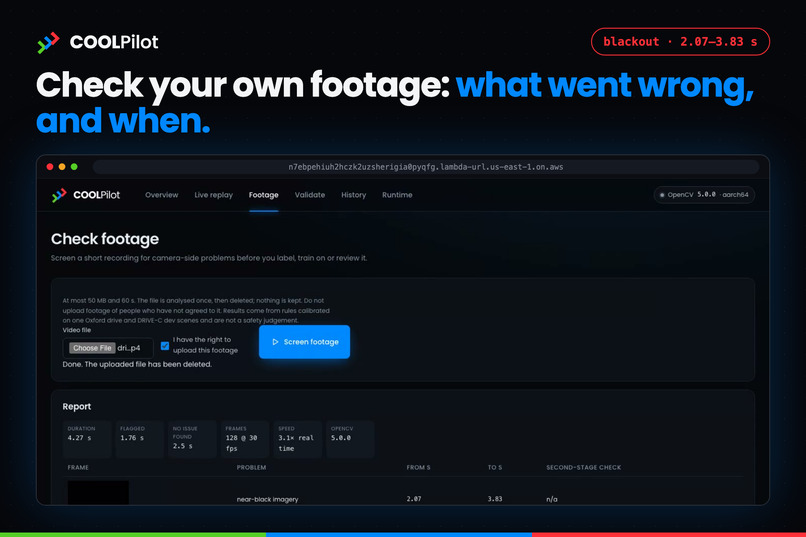
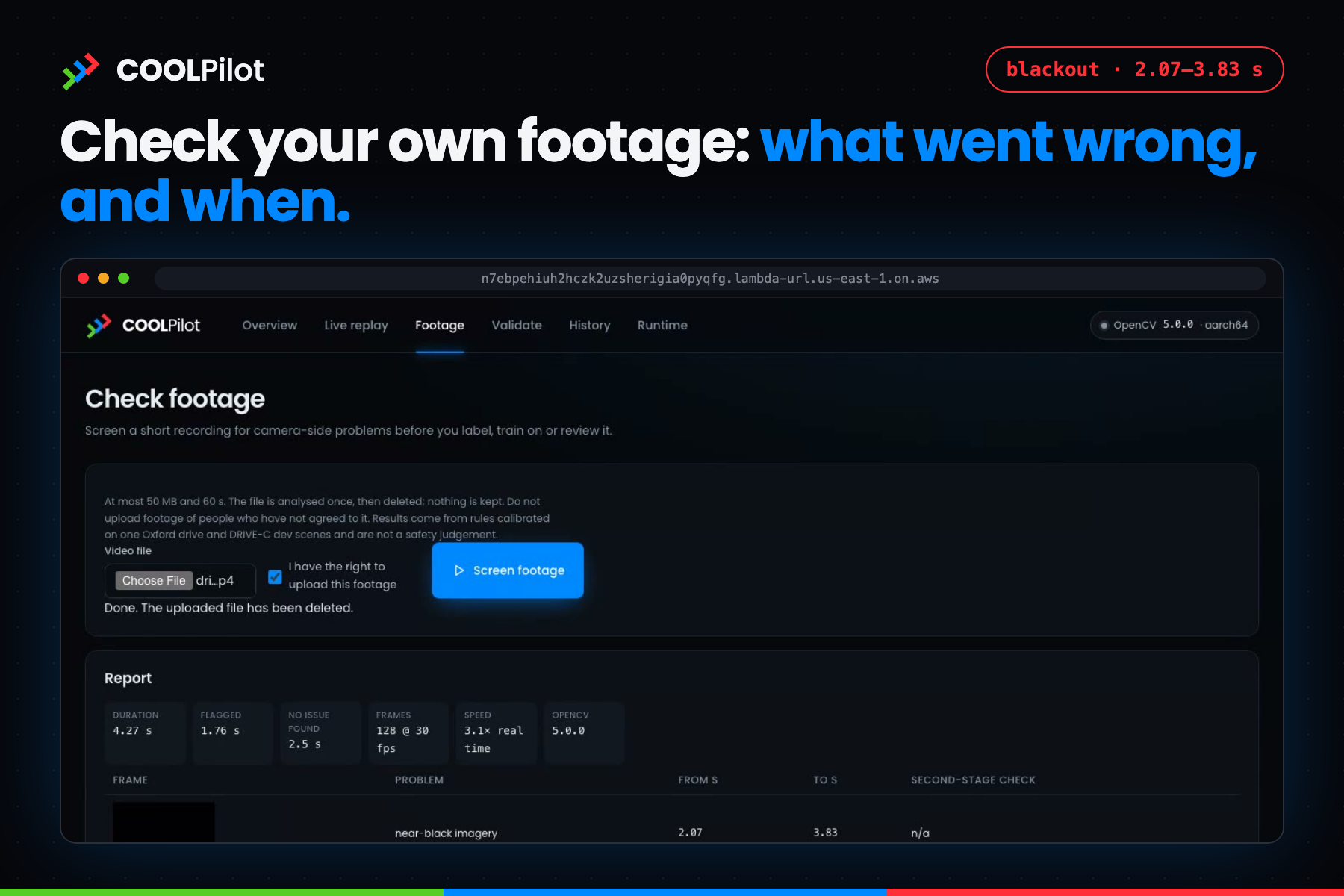
Check your own footage: what went wrong, and when.
-
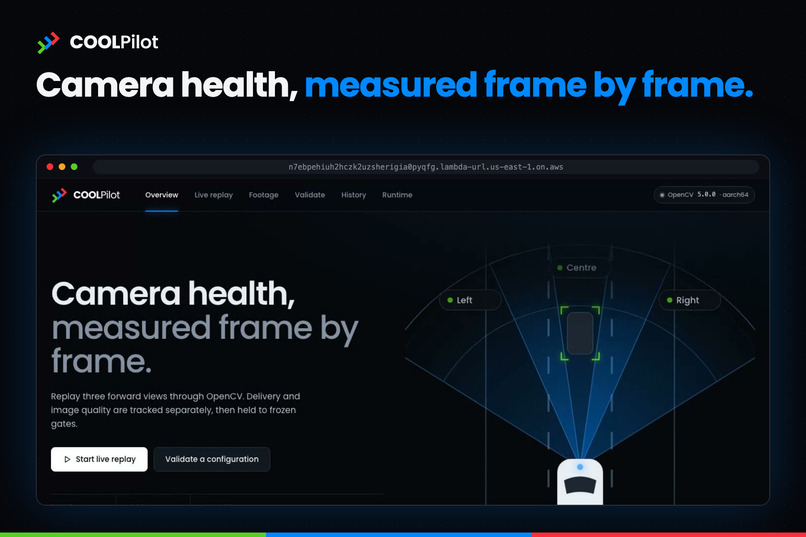
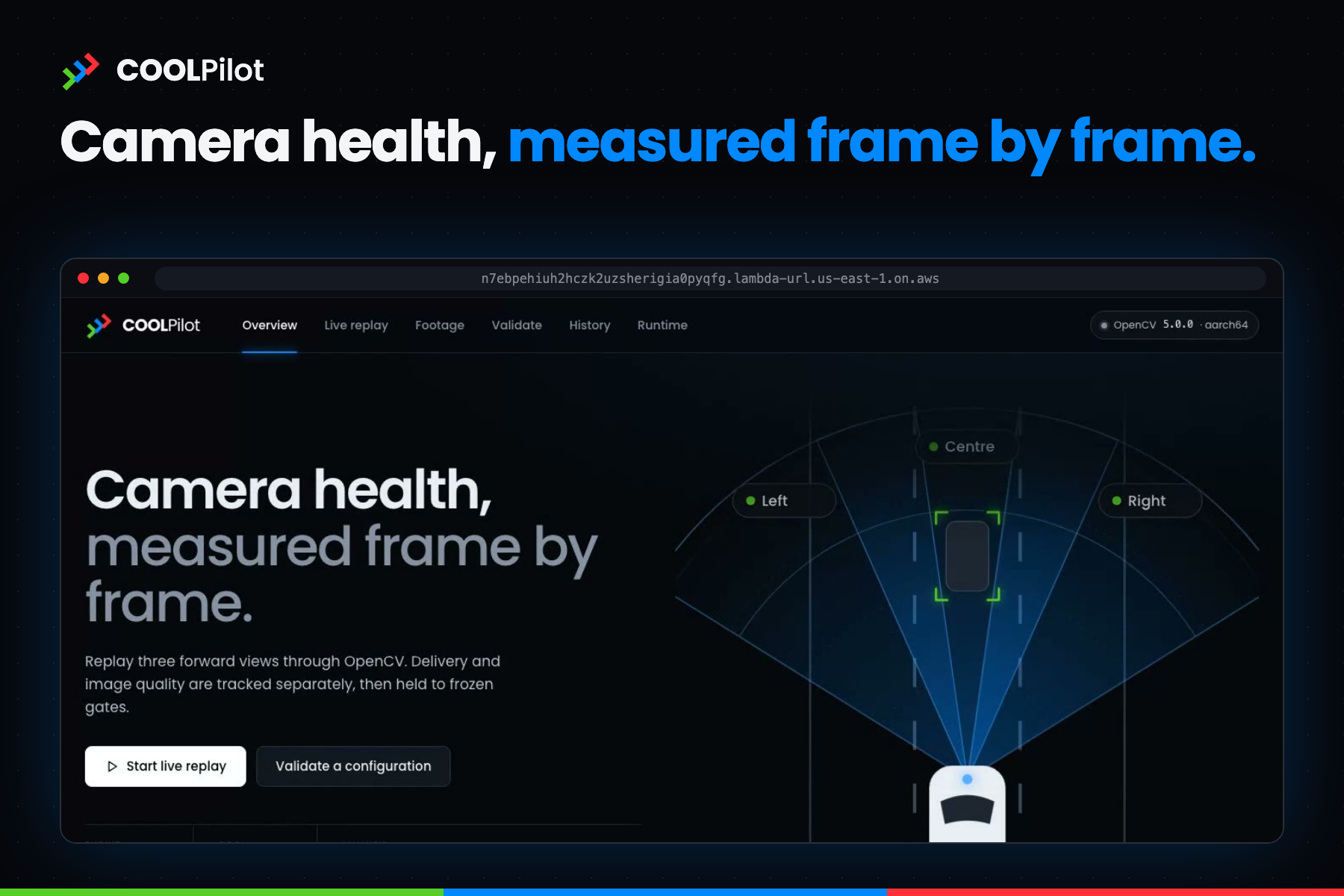
Camera health, measured frame by frame.
-
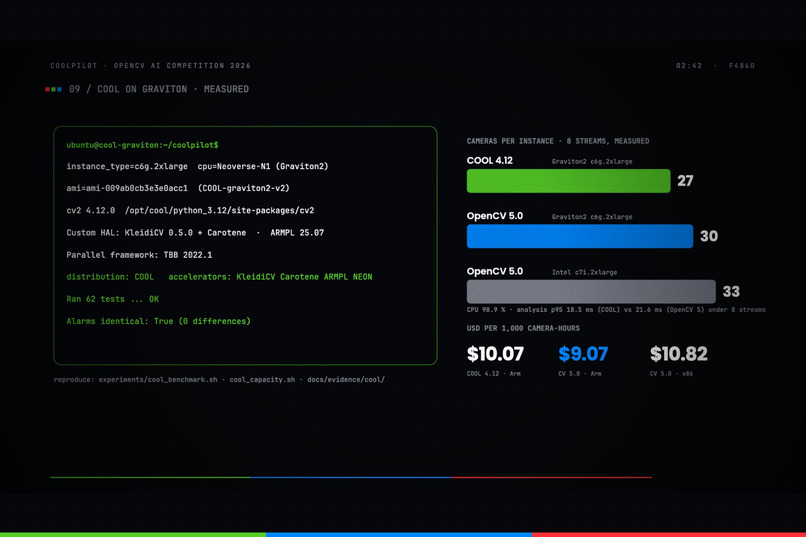
COOL terminal + capacity + cost
-
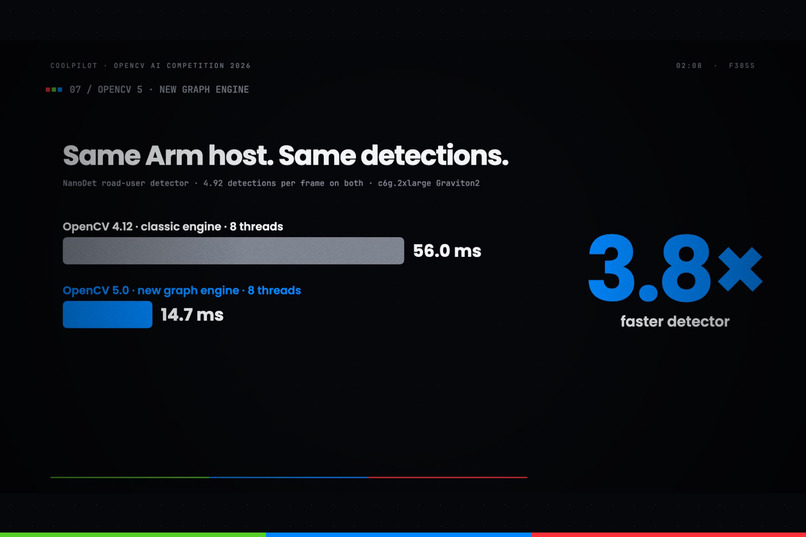
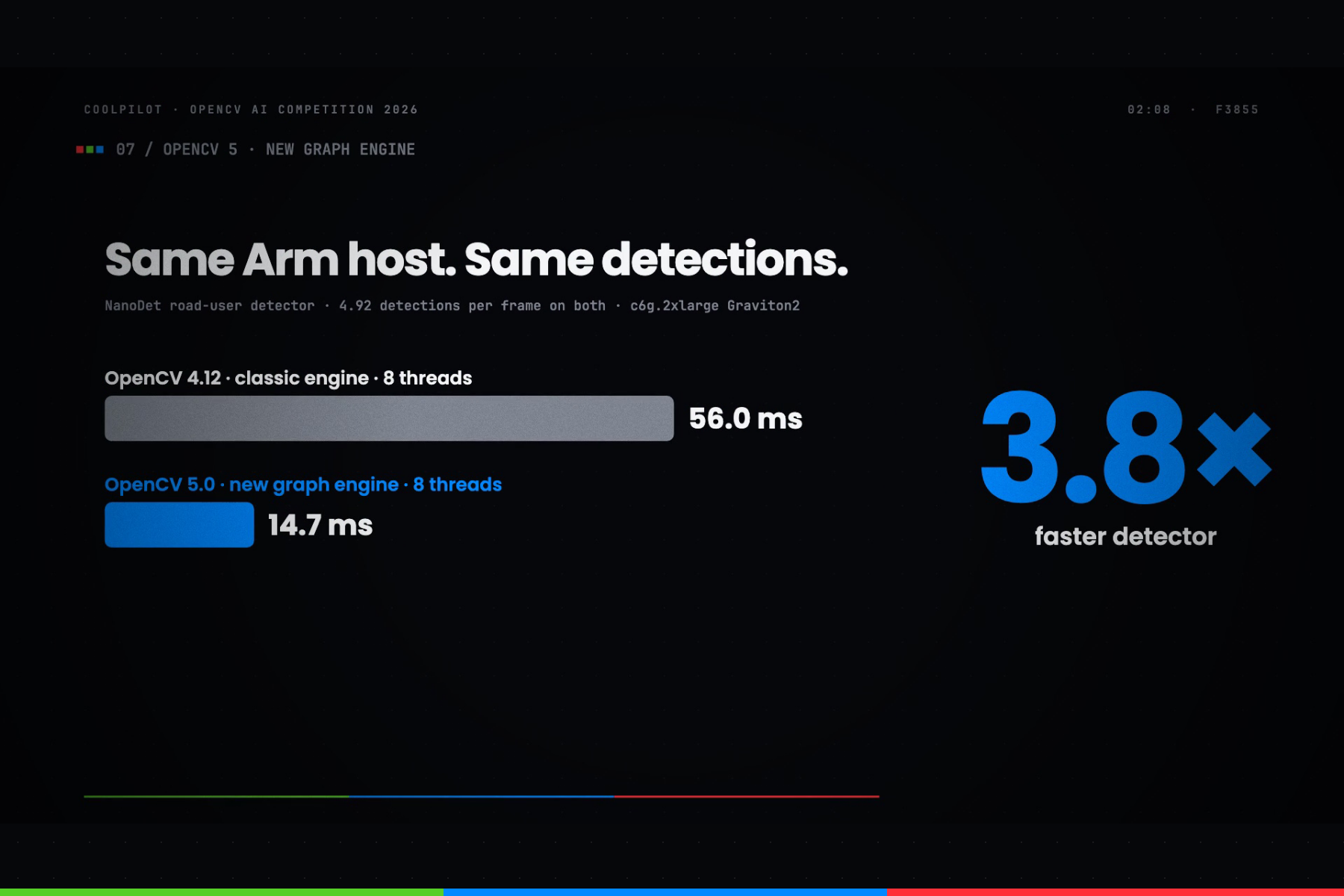
Same Arm host. Same detections. 3.8×
-
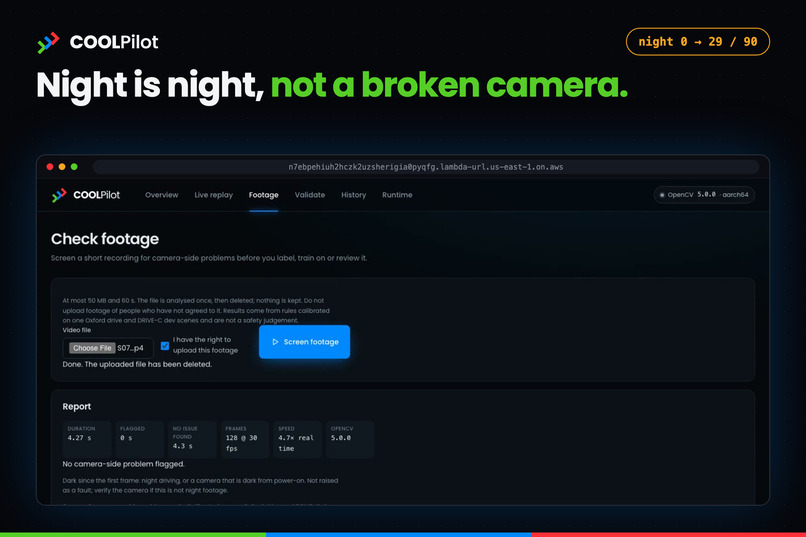
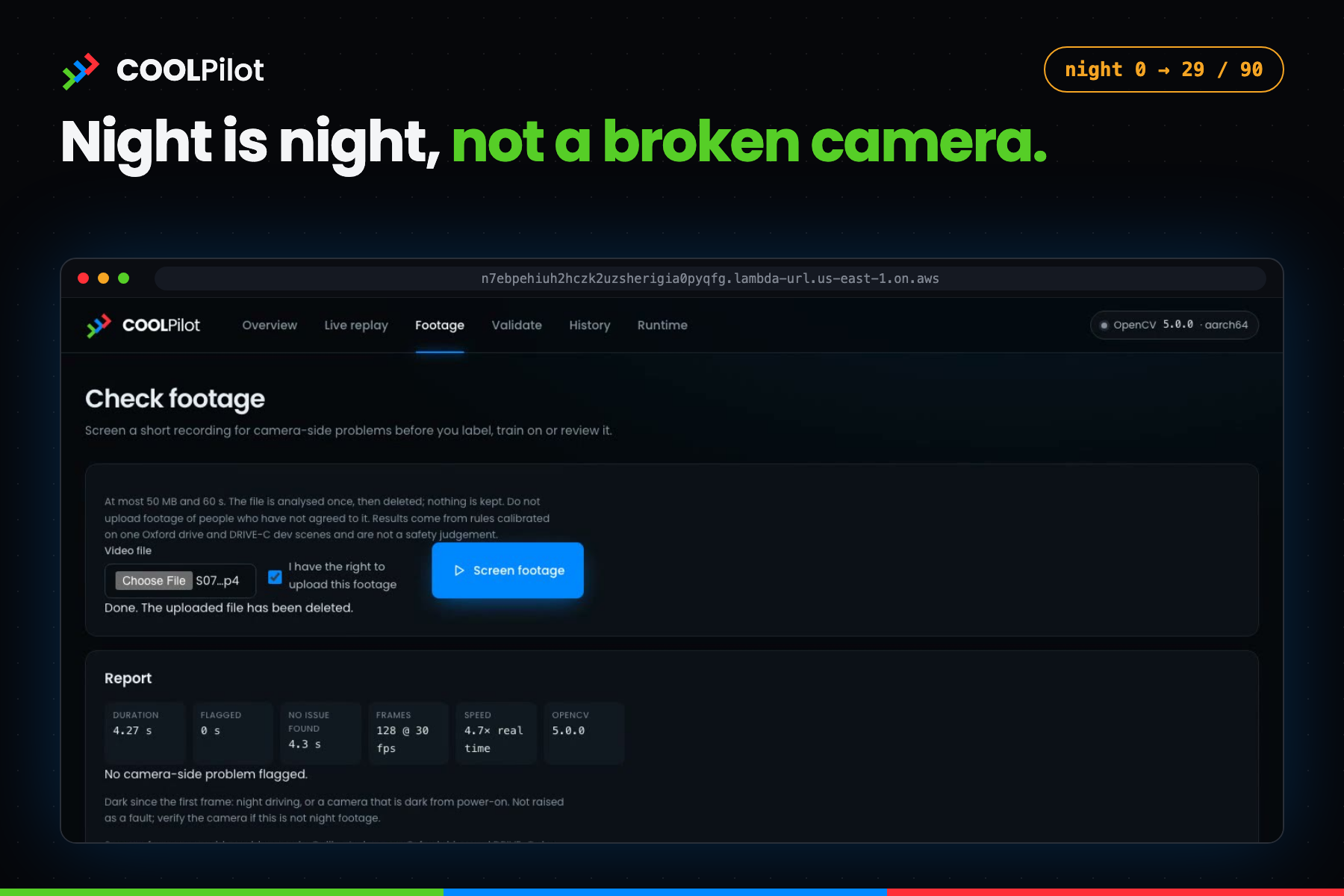
Night is night, not a broken camera.
-
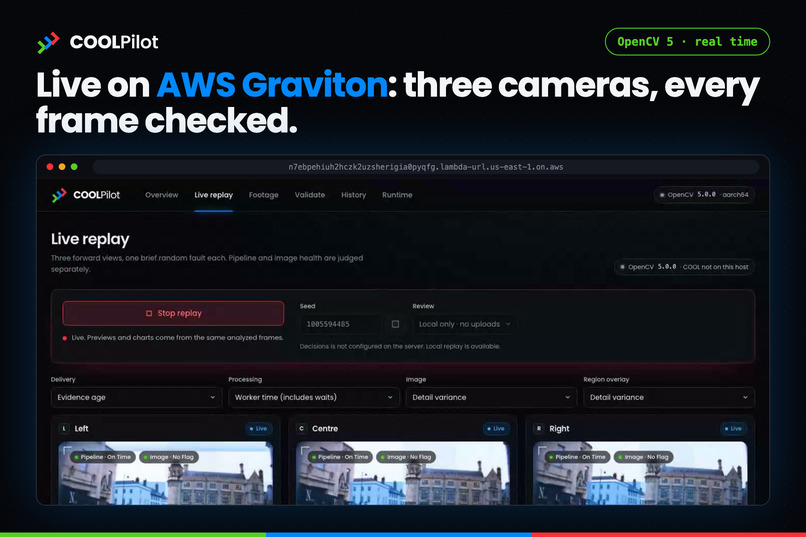
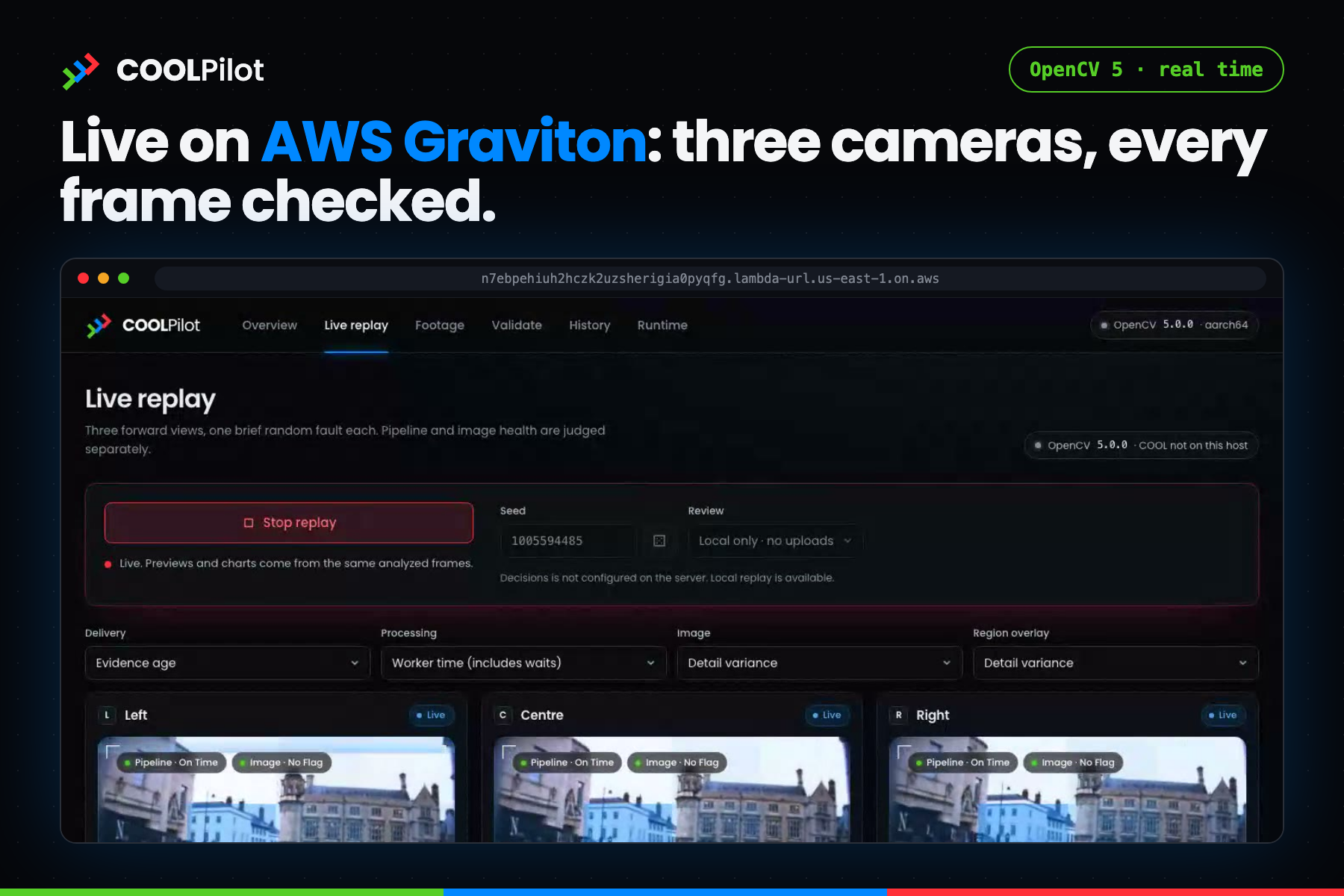
Live on AWS Graviton: three cameras, every frame checked.
-
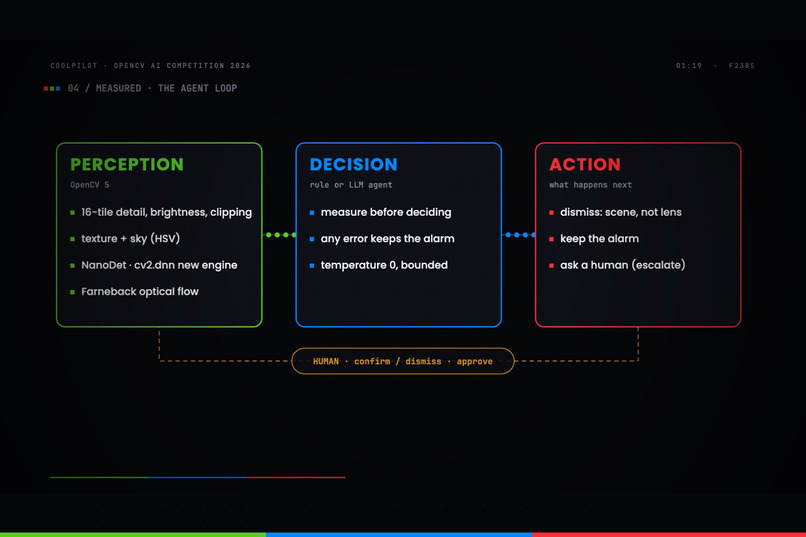
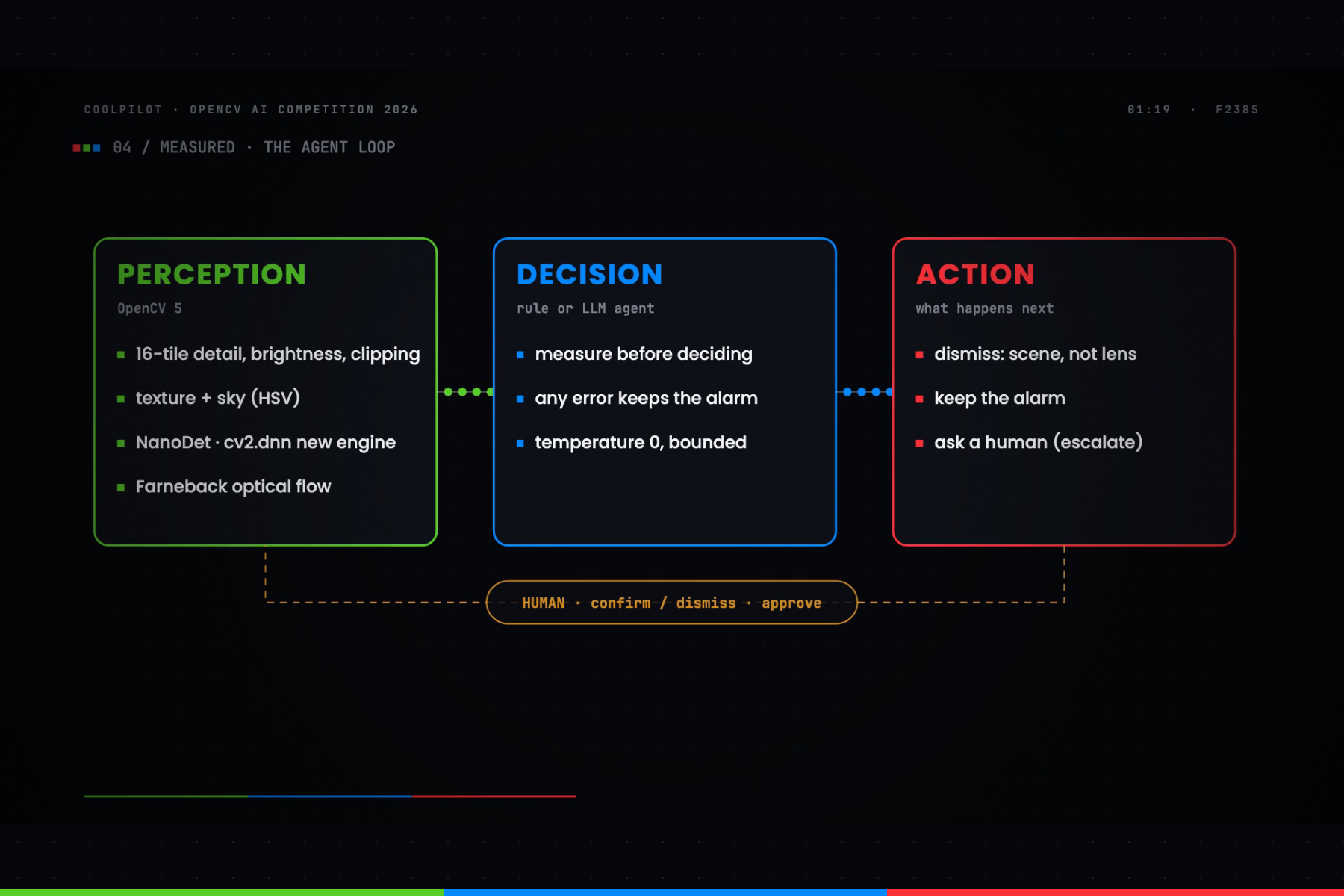
Perception → Decision → Action
-
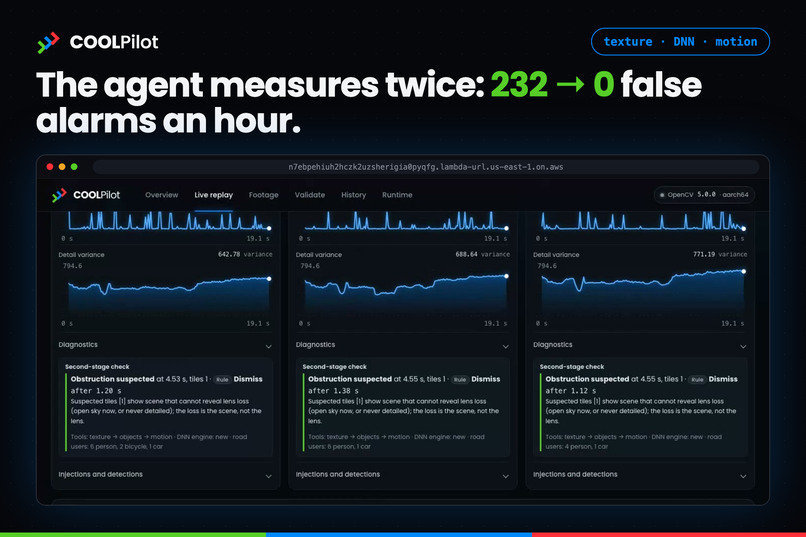
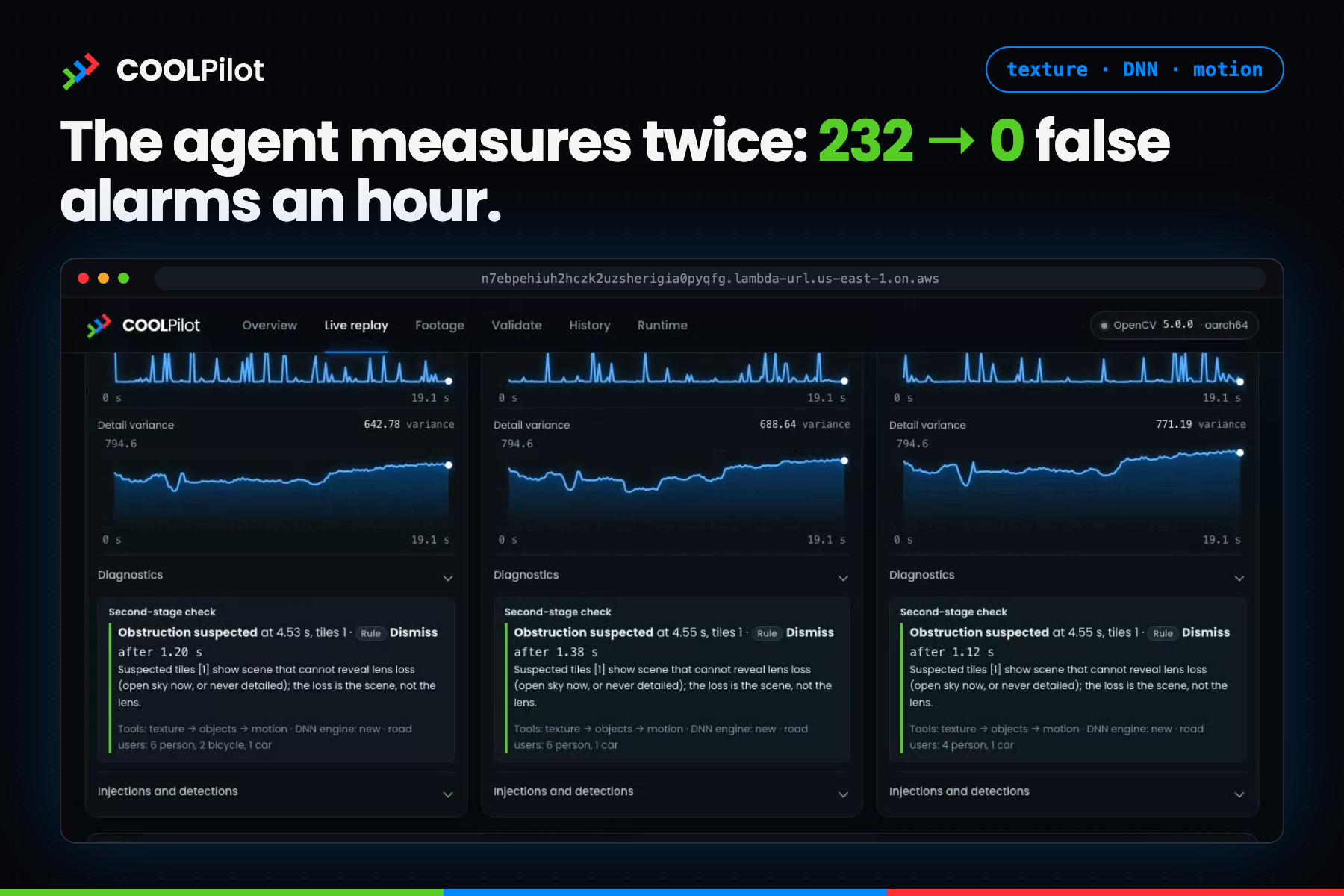
The agent measures twice: 232 → 0 false alarms an hour.

COOLPilot
A dirty lens doesn't crash. It quietly lies. COOLPilot catches it.
COOLPilot is camera health for ADAS fleets:
- OpenCV 5 checks every frame of every camera against that camera's own normal.
- An agent verifies each suspicion with more OpenCV 5 tools before an alarm stands.
- A diagnostic autopilot tunes the detector, and nothing it proposes ships without fresh evidence and a human.
It runs live on AWS Graviton. We also measured it on COOL, the Cloud-Optimized OpenCV Library, against standard OpenCV 5 and against x86.








Inspiration
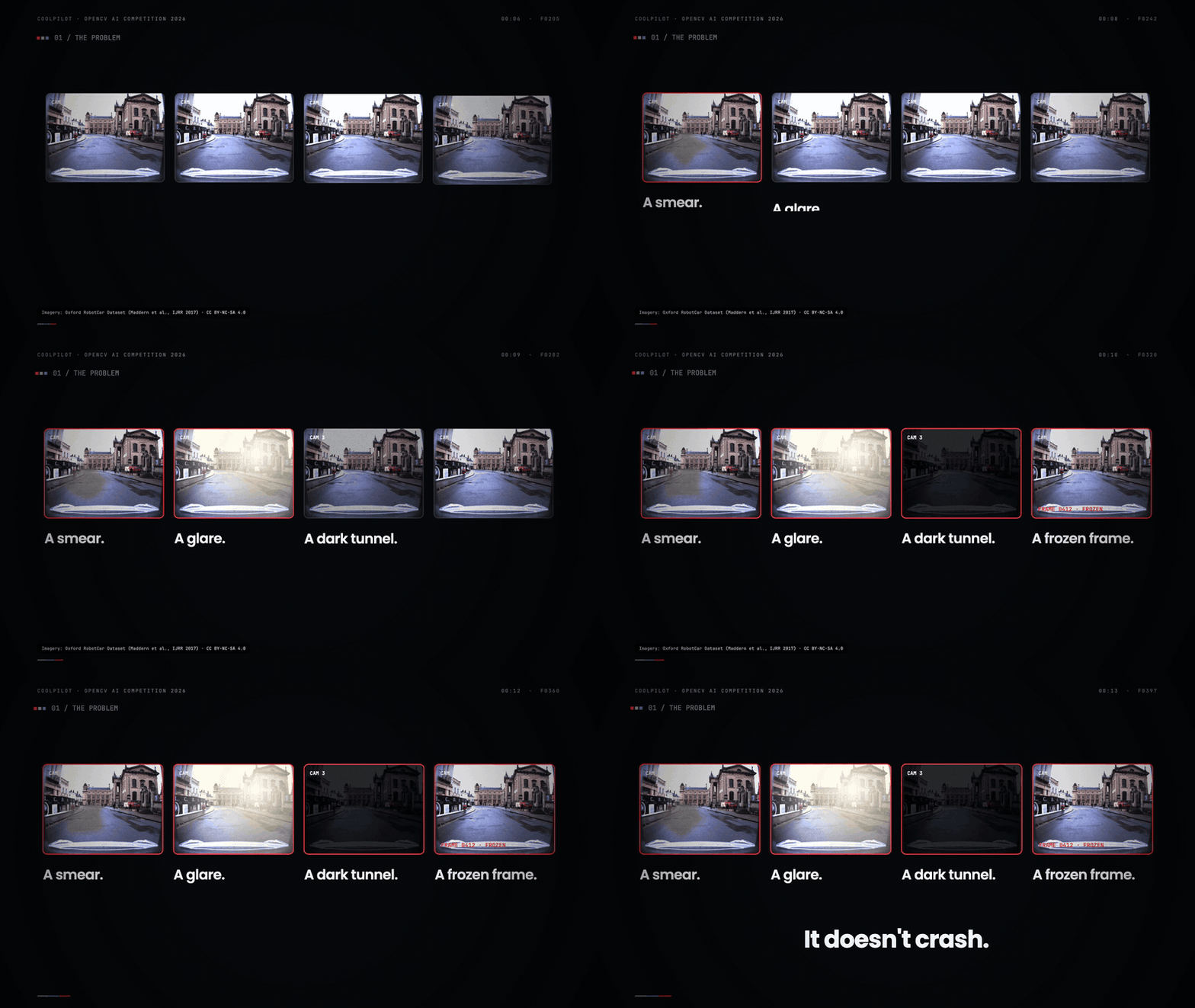
Cameras are how a car sees, and they fail quietly. Mud on the lens, sun glare, a tunnel or a frozen feed: the frames keep coming, so everything downstream keeps trusting them.
We tried the obvious fix first: fixed thresholds. It failed immediately on real roads:
- A bright sky is always "clipped", so our glare alarm fired all day.
- A building sliding past made the road look "obstructed".
Our own first version failed 15 of 53 checks at 1,332 false alarms an hour. An alarm nobody can trust is worse than no alarm.
So we asked a narrower question: can every camera be judged against its own normal, frame by frame, and can an alarm be trusted because something measured it twice?
What it does
| COOLPilot capability | What it does | Why it matters |
|---|---|---|
| 1 · Every camera vs its own normal | OpenCV 5 splits every frame into 16 tiles: detail, brightness, clipping and freeze. Each tile is compared with references learned while that camera looked healthy. | A bright sky stops being "glare". A sudden one is. |
| 2 · An agent measures twice | A suspected obstruction triggers OpenCV 5 tools: texture (HSV), road users (NanoDet on the new cv2.dnn graph engine) and motion (Farneback flow). It then dismisses, keeps, or asks a human. |
232 → 0 false alarms per hour on 42 never-inspected clips, with no real fault lost. |
| 3 · Live, on Graviton | Three cameras replayed at their real sensor timing on AWS Lambda arm64. Delivery health (late, missing) is judged separately from image health. | "Late" is not "broken". Result age ≤ 0.25 s. |
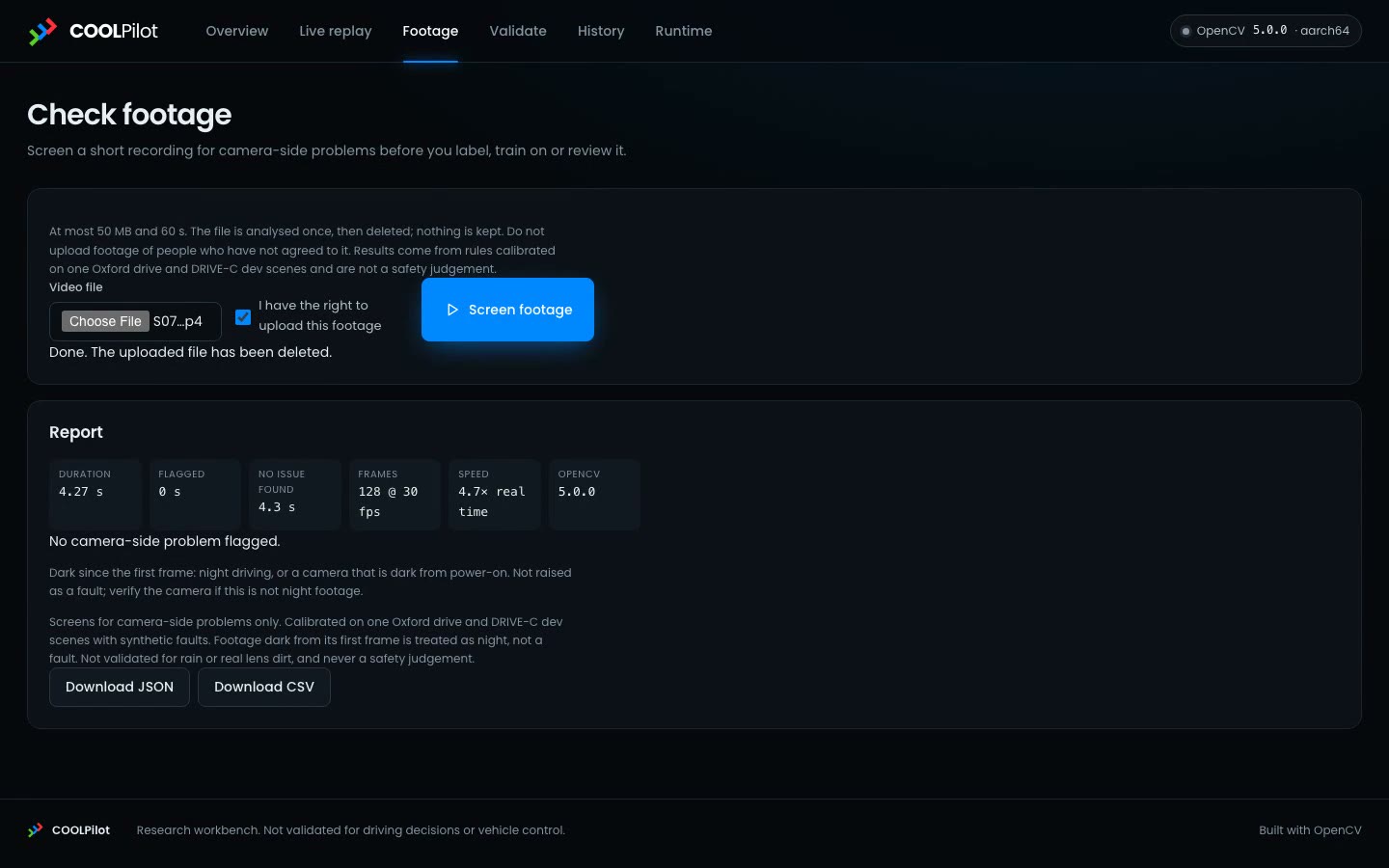
| 4 · Check your own footage | Upload a clip (presigned S3) and get a report of what went wrong and when. The file is deleted after analysis. Night footage is treated as night. | A camera-data quality gate before labelling or training. |
| 5 · A diagnostic autopilot | An LLM agent tunes the detector with OpenCV-measured tools, then proposes. A human approves, and validation on never-seen clips decides. | It found a "better" setting that failed unseen data, and the gate kept it out. |
| 6 · Measured on COOL vs OpenCV 5 vs x86 | The same workload on the COOL Graviton AMI, on standard OpenCV 5, and on Intel, at 8 parallel streams. | The pilot picks the cheapest safe stack: OpenCV 5 on Graviton, $9.07 per 1,000 camera-hours. |
Product walkthrough
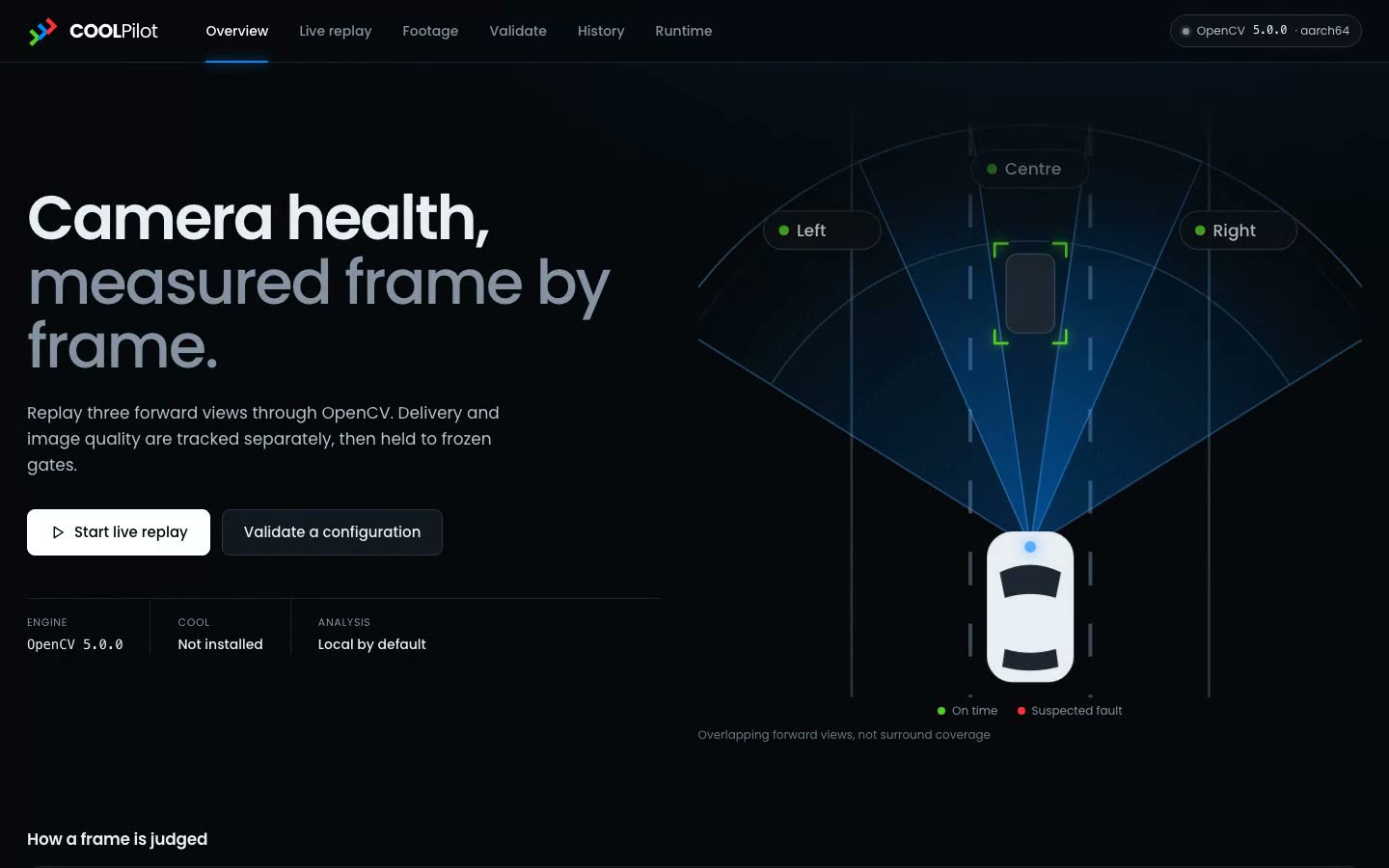
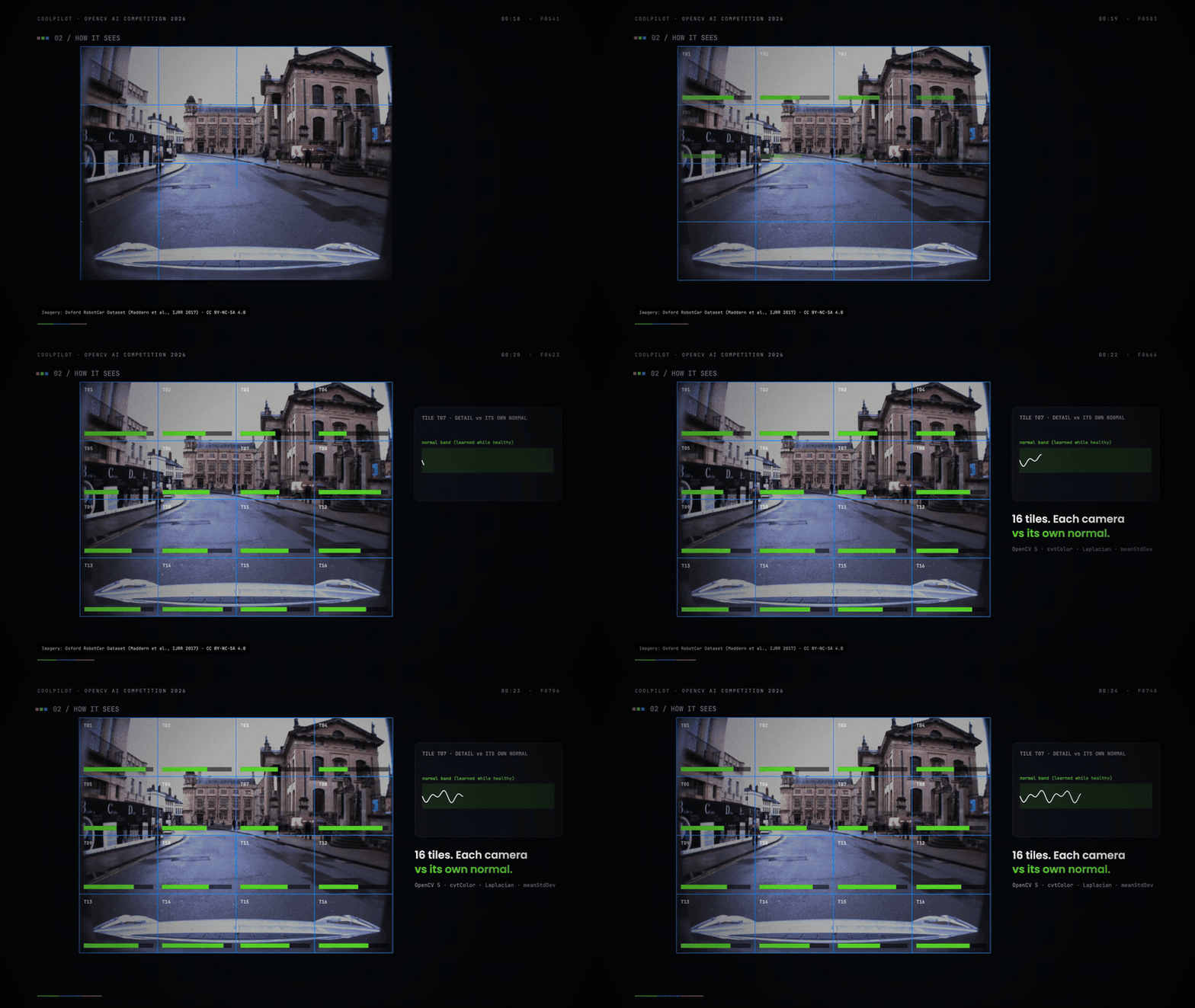 I · How it sees. 16 tiles, each against its own normal band. One drifts, and that's a suspicion, not yet an alarm. |
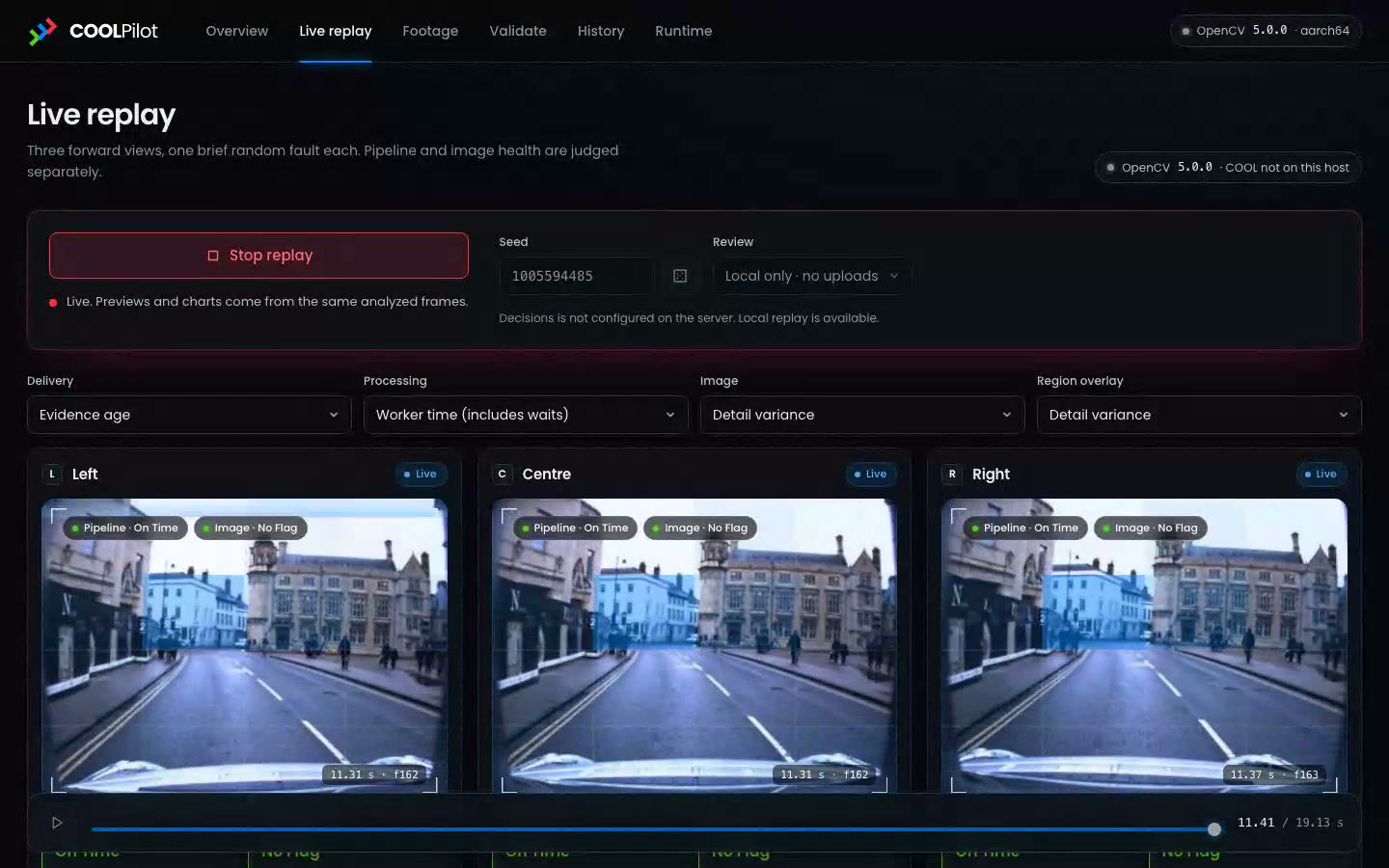
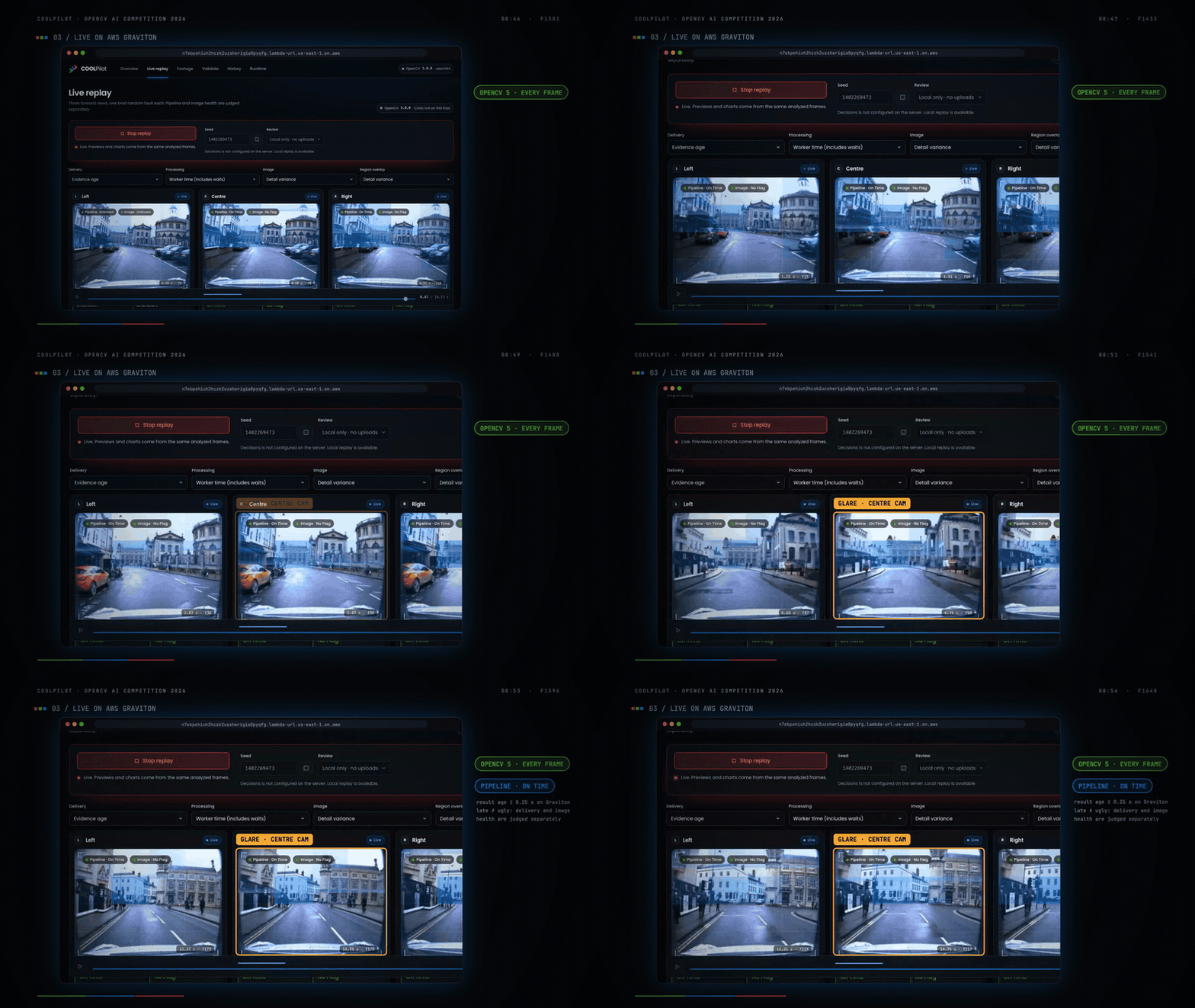 II · Live on AWS Graviton. The real deployed app: Start replay, three cameras streaming, glare caught on the centre one. |
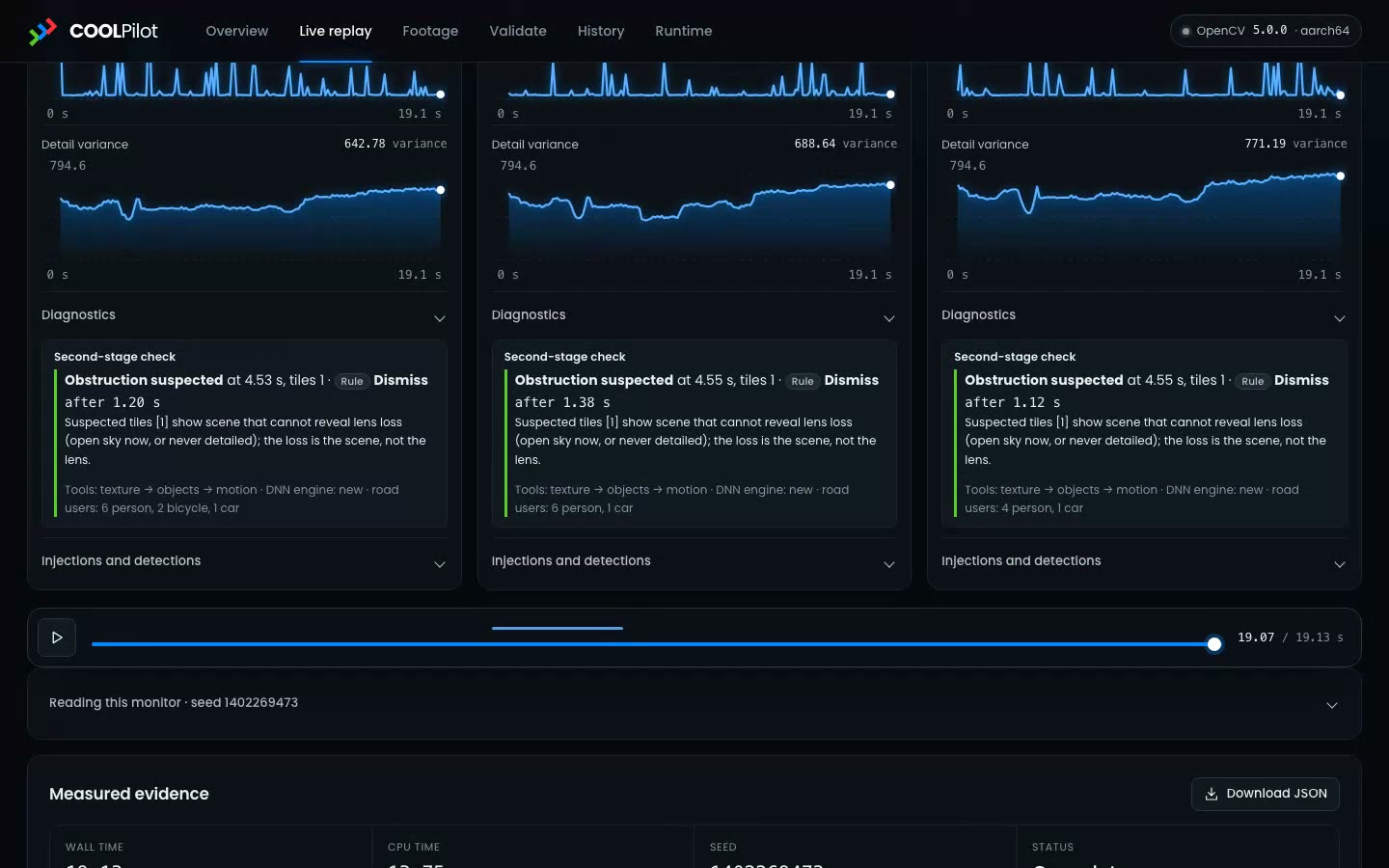
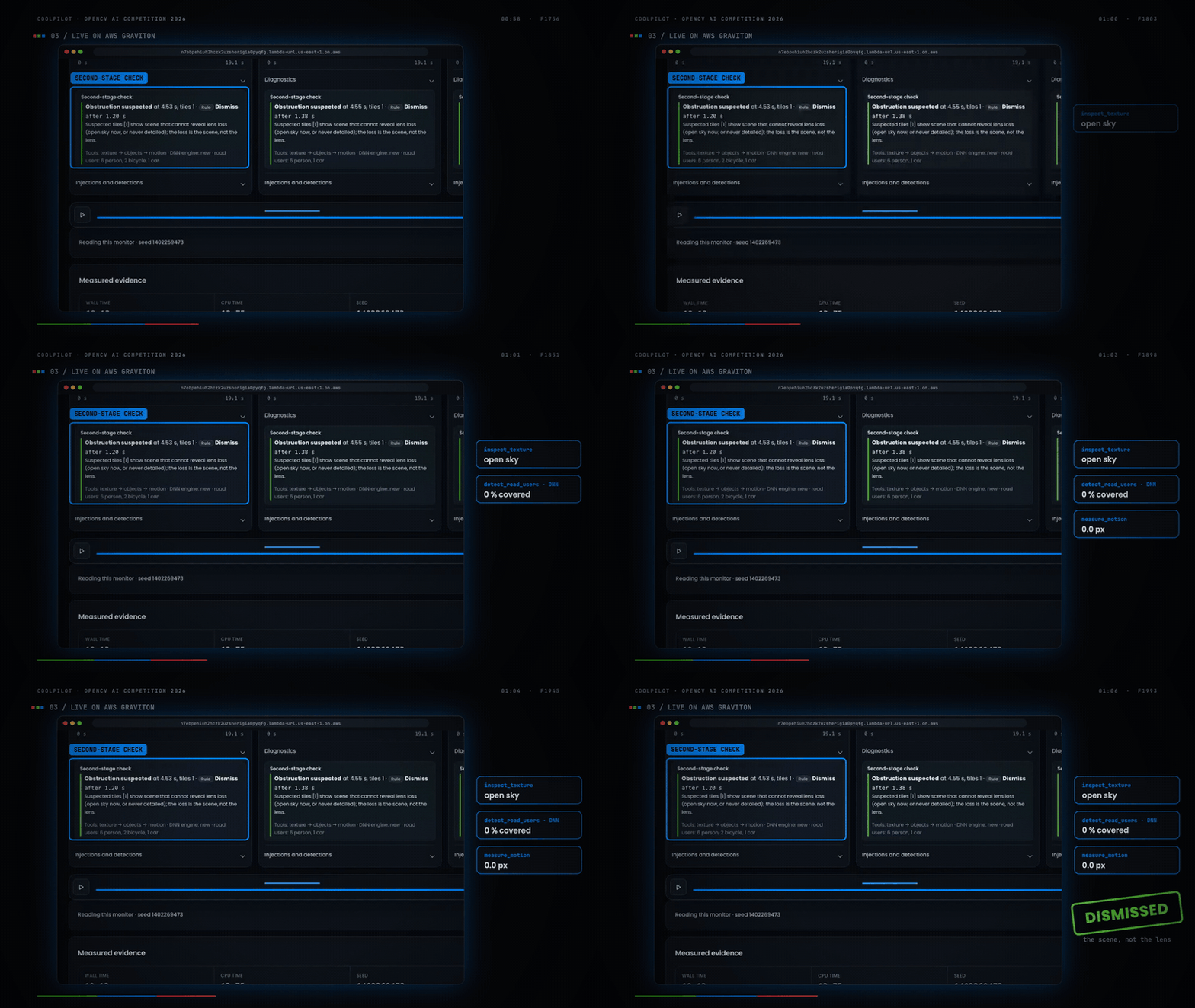 III · The agent measures before it decides. Open sky, 0% road users, 0.0 px motion: the scene, not the lens. Dismissed. |
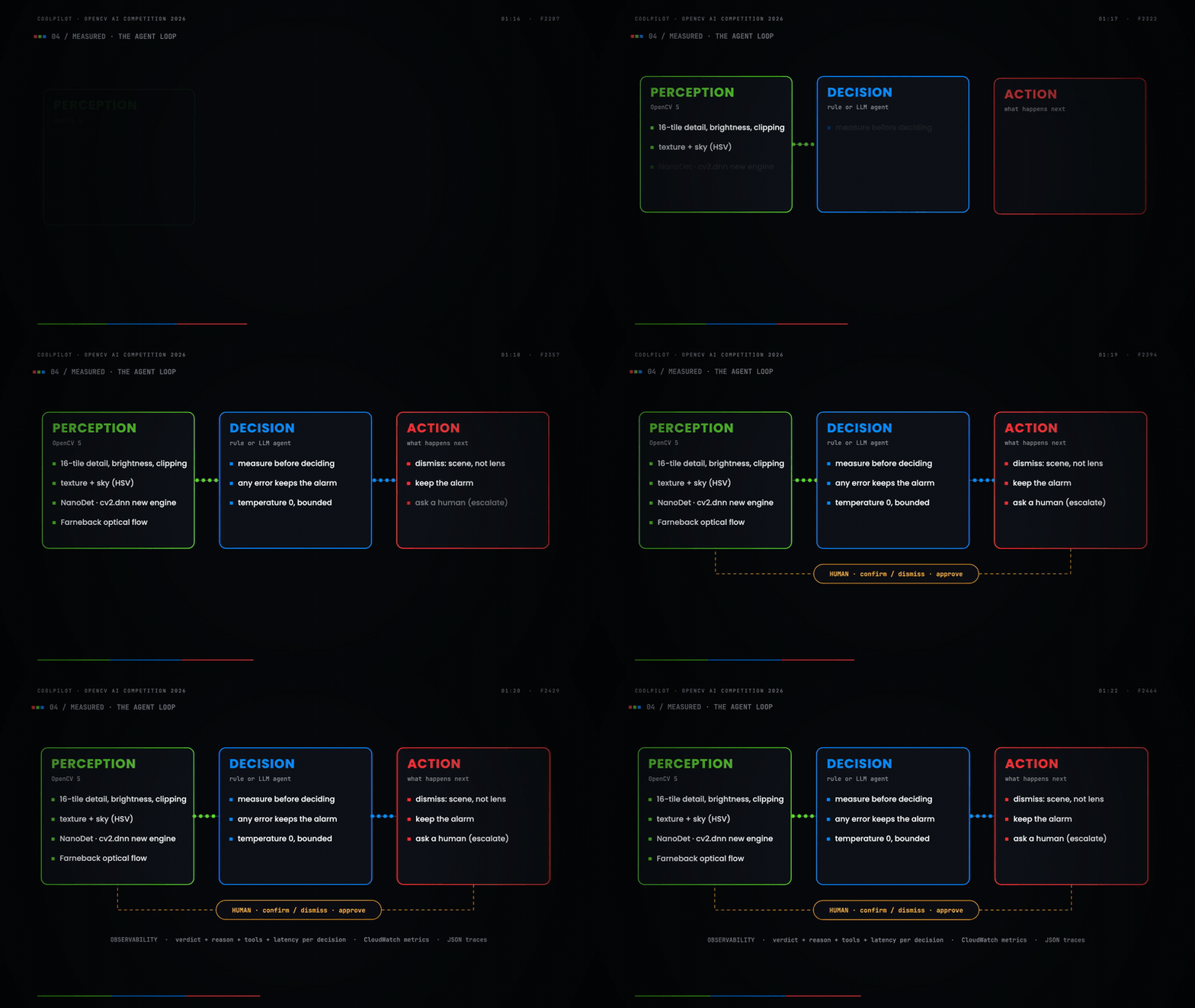 IV · The loop. Perception (OpenCV 5), decision (rule or LLM agent, fail-safe), action (dismiss, keep, ask a human), all observable. |
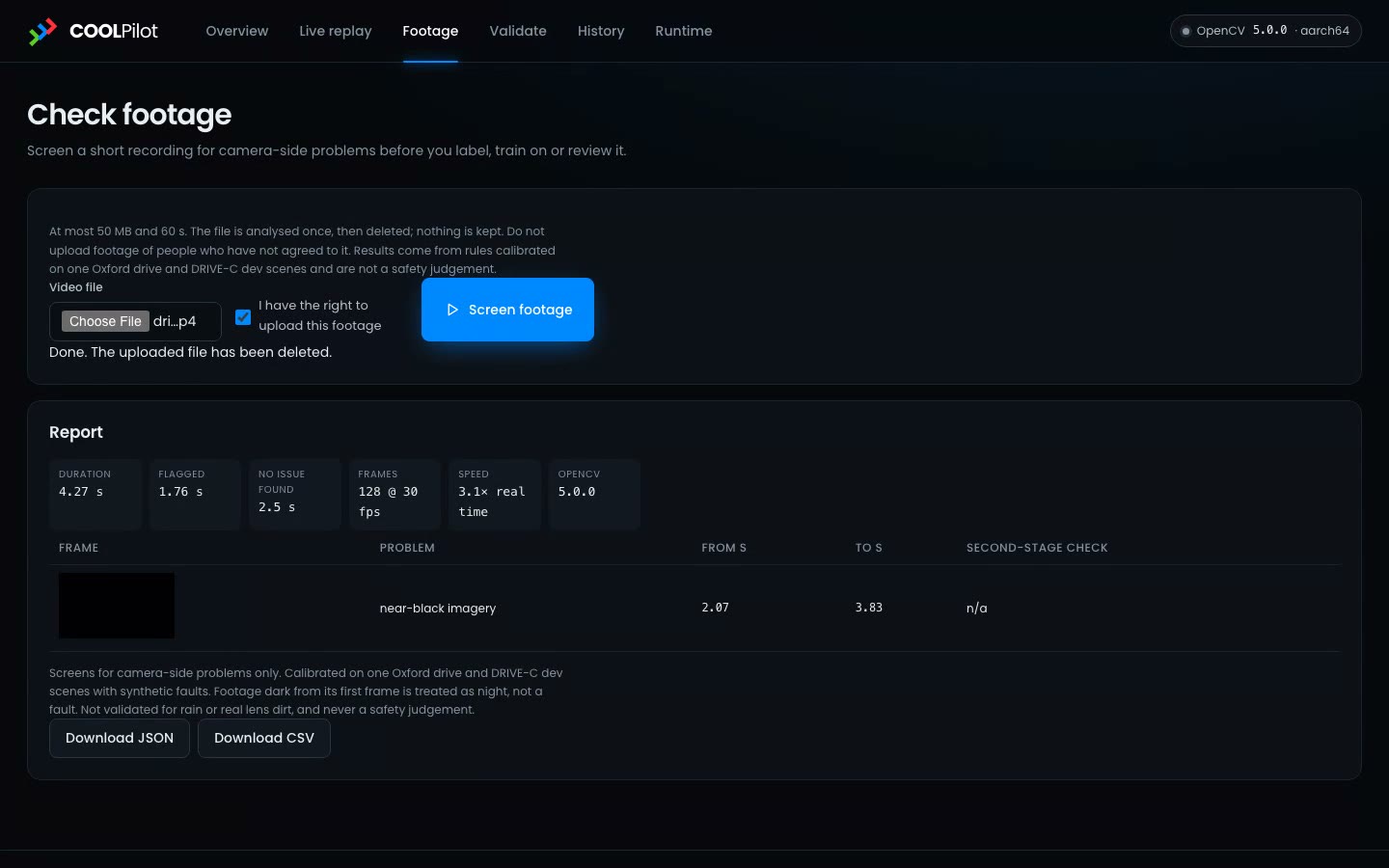
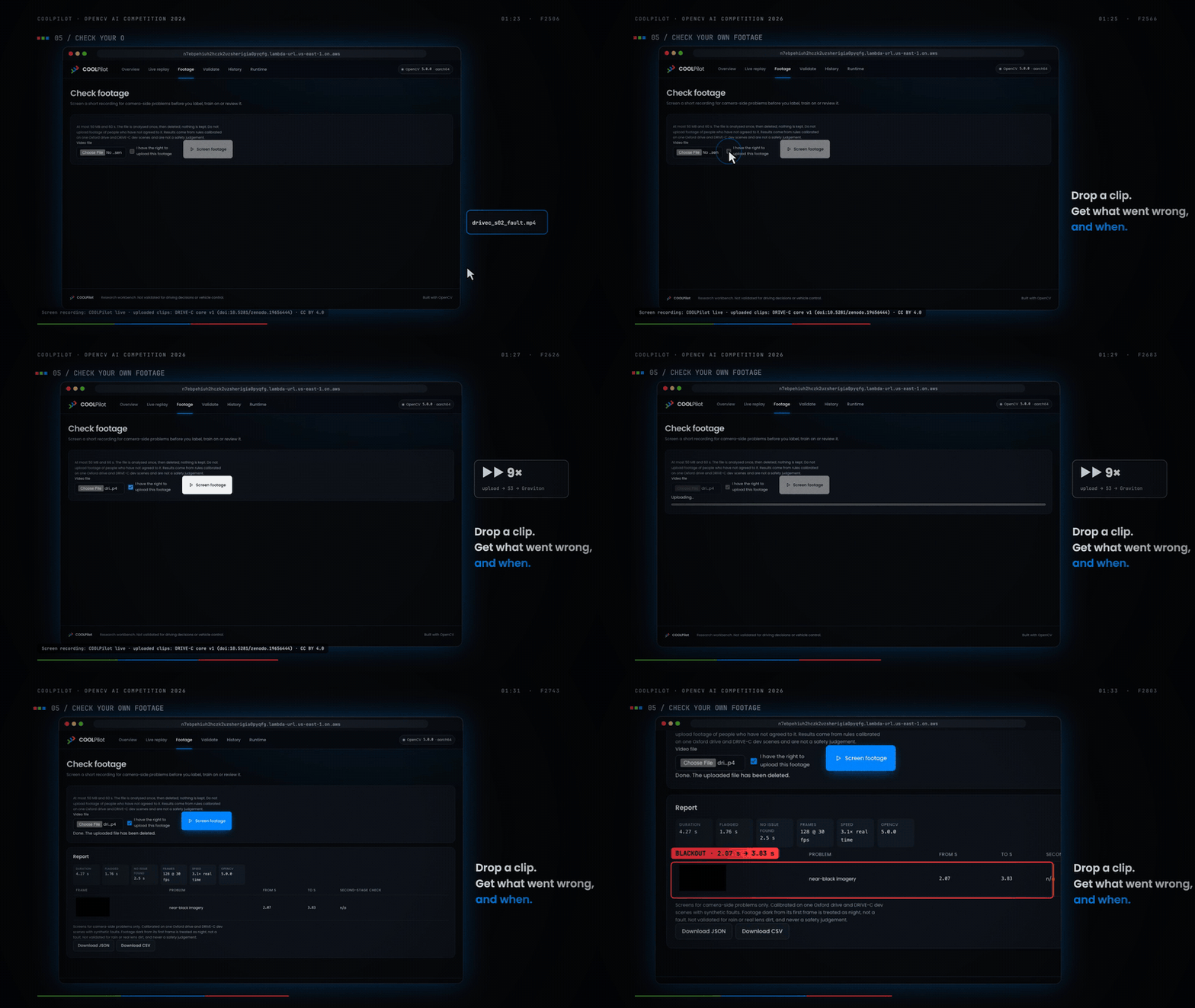 V · Check your own footage. Upload, screened on Graviton, blackout found at 2.07–3.83 s; night clip flagged "dark since the first frame". |
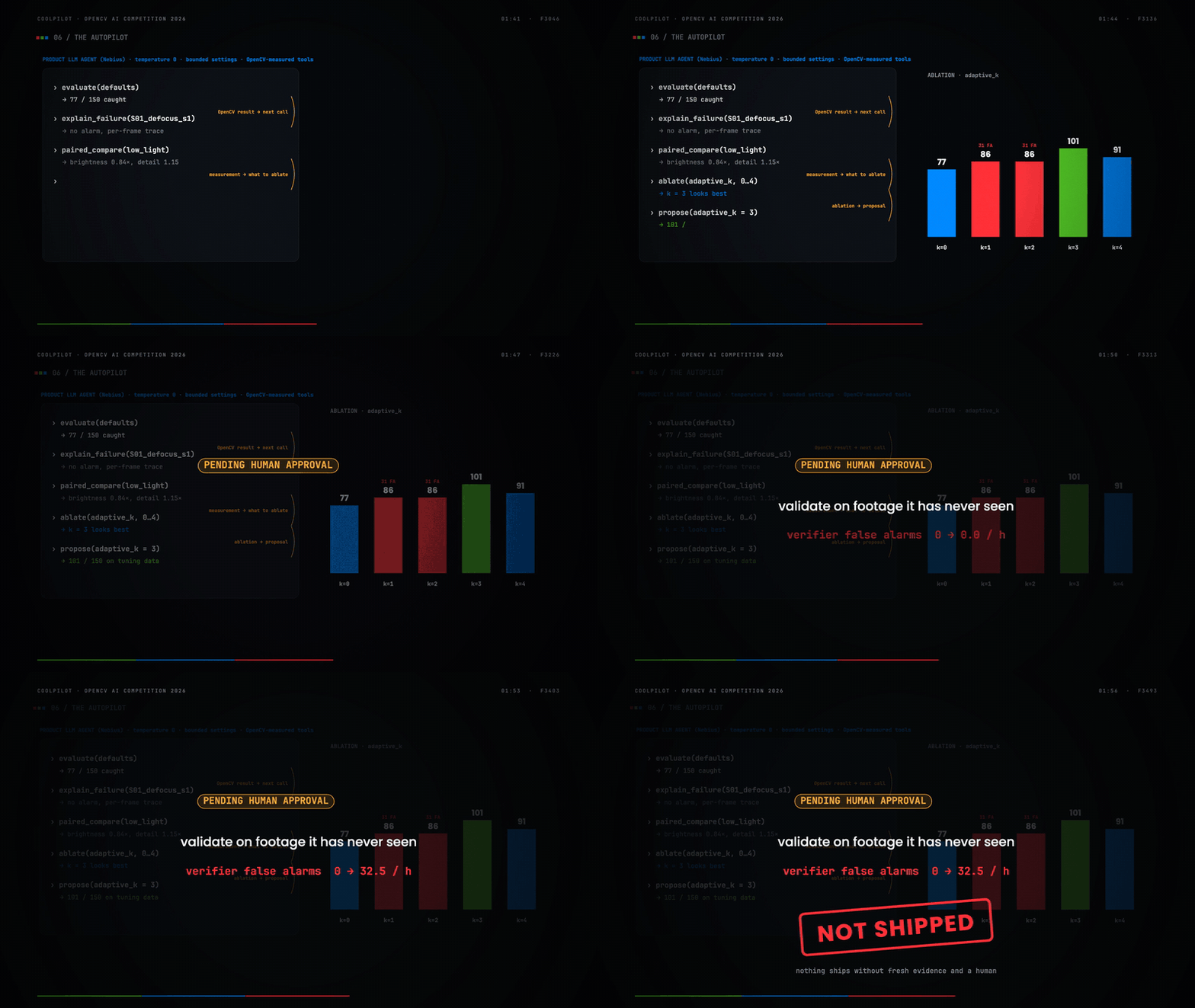 VI · Nothing ships without proof. Diagnose, ablate, propose, human approval, unseen validation, NOT SHIPPED. |
| Overview | Live replay | Verifier verdict |
|---|---|---|
 |
 |
 |
| Footage report | Night, not a fault | Runs measured on AWS |
|---|---|---|
 |
 |
 |
Screenshots and clips are recordings of the deployed app. Road imagery: Oxford RobotCar (CC BY-NC-SA 4.0). Uploaded clips: DRIVE-C core v1 (CC BY 4.0).
How we built it
OpenCV 5 is the workload, not a wrapper. Every stage is an OpenCV call:
| Stage | OpenCV 5 | Why this call |
|---|---|---|
| Test feeds from raw sensors | cvtColor(COLOR_BayerGBRG2BGR / BayerRGGB2BGR) |
Raw Oxford RobotCar Bayer frames, demosaiced, then given synthetic faults with frame-exact ground truth |
| Per-frame measurement | resize(INTER_AREA), cvtColor, Laplacian + meanStdDev, compare + countNonZero, absdiff |
Detail at 640 px (defocus is invisible at 320 px, measured), clipping, freeze |
| Verifier perception | cvtColor(BGR2HSV), dnn.readNetFromONNX(engine=ENGINE_NEW), dnn.blobFromImage, dnn.NMSBoxes, calcOpticalFlowFarneback |
Sky and texture, road users (NanoDet-Plus), static-tile motion |
| Video in and out | VideoCapture (files, RTSP or USB live sources), imencode |
Paced replay, live cameras, report thumbnails |
OpenCV 5's speed-up, measured on the same Arm host, with identical detections:
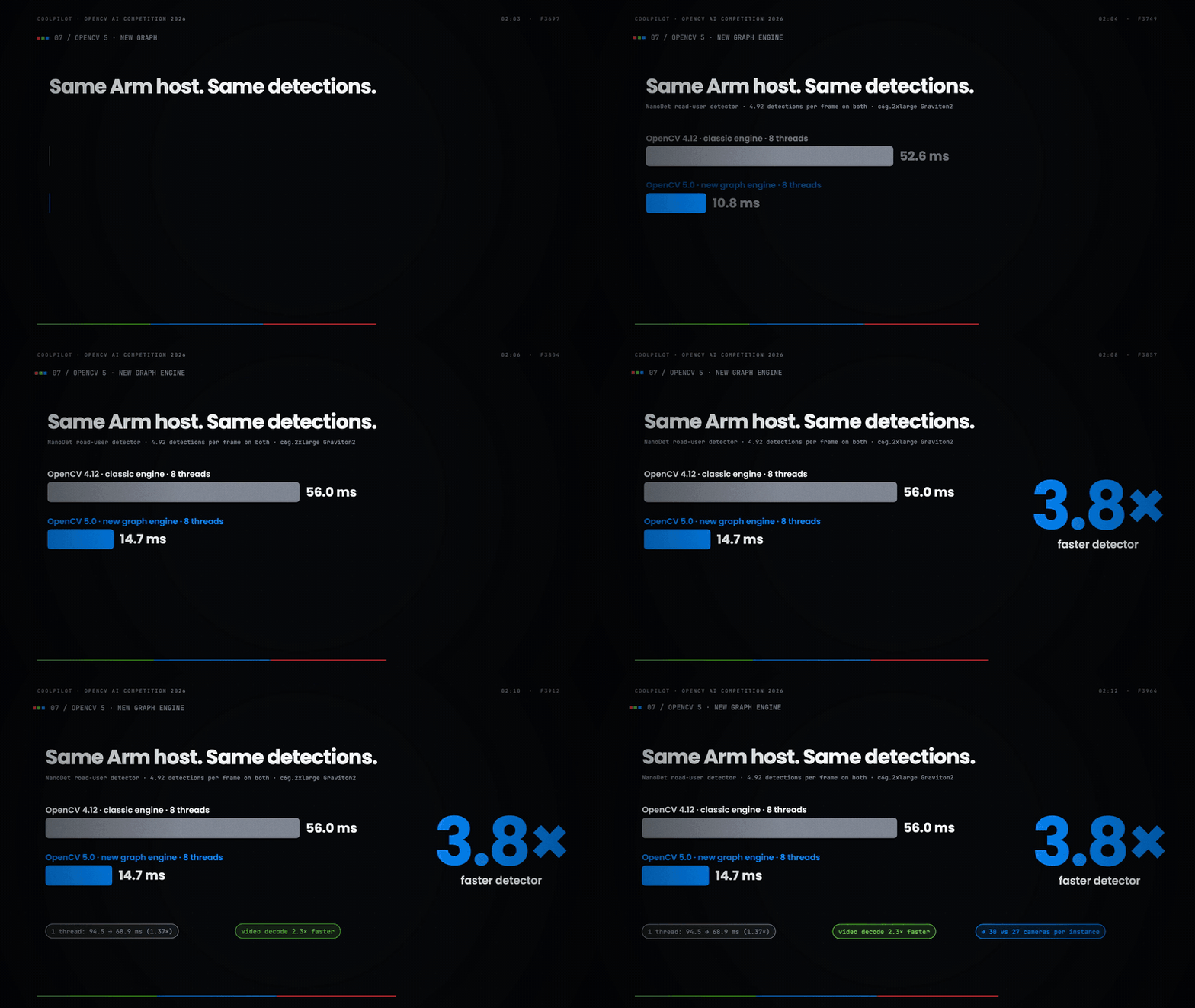
| c6g.2xlarge Graviton2 | OpenCV 4.12 | OpenCV 5.0 | Gain |
|---|---|---|---|
| NanoDet, 8 threads | 56.0 ms (classic) | 14.7 ms (new graph engine) | 3.8× |
| NanoDet, 1 thread | 94.5 ms | 68.9 ms | 1.37× |
| Video decode | 5.15 CPU-s | 2.20 CPU-s | 2.3× |
| Real-time cameras per instance | 27 | 30 | +11% |
The stack:
- Backend: Python 3.12, FastAPI, pinned
opencv-python-headless==5.0.0.93and NumPy 2.5.3. - UI: React + TypeScript (Vite).
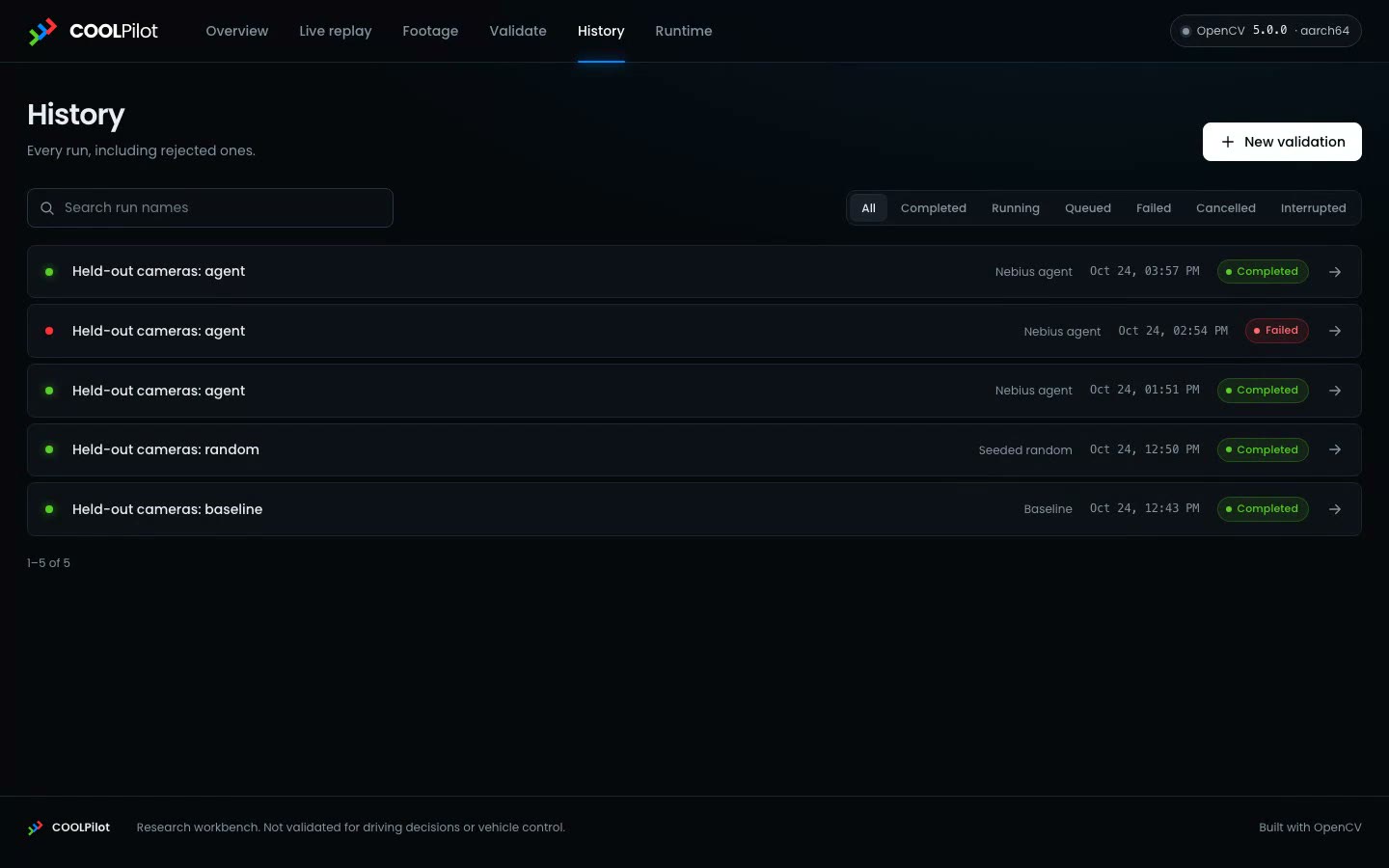
- AWS: Lambda arm64 behind a Function URL, S3 for recordings, History and presigned uploads, DynamoDB rate limiting, CloudWatch EMF metrics and a dashboard, EC2 Graviton for evaluation and the camera-fleet tier.
- LLM: Nebius at temperature 0, for the verifier agent and the autopilot.
- Detector model: NanoDet-Plus ONNX from the OpenCV model zoo.
flowchart LR
  UI["Browser · React UI"] -->|replay · footage · history| L["Lambda arm64 · FastAPI · OpenCV 5.0.0"]
  UI -->|presigned upload| S3["S3 · recordings · uploads (deleted after)"]
  L --> S3
  L --> CW["CloudWatch · metrics + dashboard"]
  EC2["EC2 Graviton · OpenCV 5 or COOL 4.12"] -.->|benchmarks · validation · autopilot| NB["Nebius LLM"]
  X86["EC2 x86 · baseline only"]
Agentic Vision: two loops where OpenCV 5 output changes what happens next
Loop A, the runtime verifier. OpenCV 5 tile statistics raise a suspicion. The agent calls OpenCV 5 tools, and their measurements decide the action: dismiss, keep, or escalate to a human.
It is fail-safe:
- Deciding before measuring is refused.
- Any error keeps the alarm.
- Reasons are capped at 600 characters.
- Every verdict is logged with its reason, tools and latency, and emitted to CloudWatch.
Loop B, the diagnostic autopilot. This is the product's LLM agent, not the coding assistant that helped write the repo.
- It reads OpenCV measurements to choose its next call. After
paired_compareshowed low light dims frames only to 0.84×, it ablatedadaptive_kand found that k = 3 caught 101 of 150 clips. - It proposed that setting, and the proposal waited for human approval.
- Validation on never-seen clips then rejected it (verifier false alarms 0 → 32.5 per hour), so it was never shipped. That is the failure handling working.
| Agentic evidence | Where |
|---|---|
| Workflow diagram (perception, decision, action, human, observability) | AGENT_WORKFLOW.md and the showreel |
| Step-by-step traces (autopilot run; one verifier moment judged by the rule and by the agent) | AGENT_WORKFLOW.md, docs/evidence/autopilot/ |
| Task success, failure handling, observability, human control | TECHNICAL_REPORT.md §4, §6 |
COOL: measured on AWS Graviton, decided by the numbers
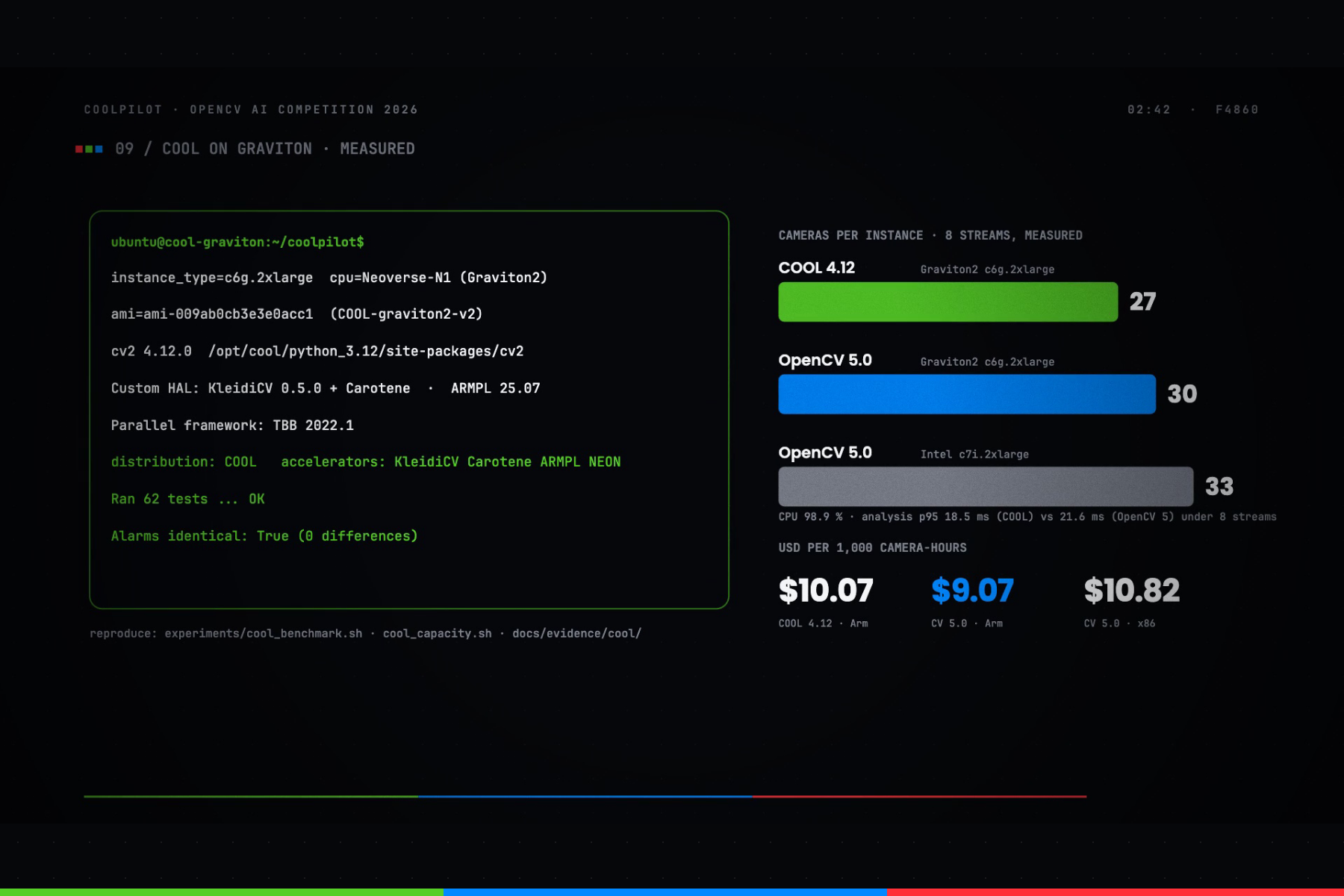
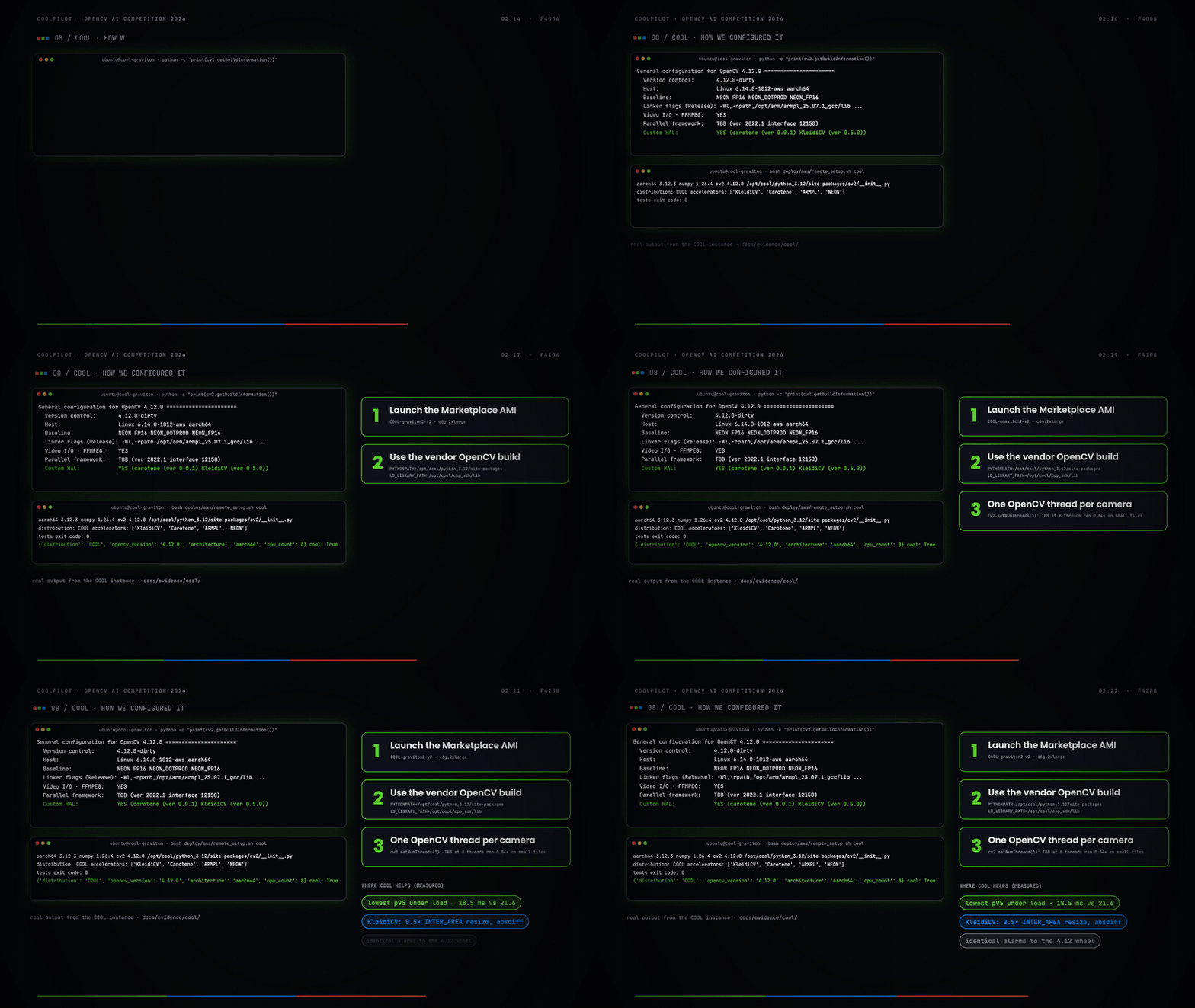 How we configured it. Real output from the COOL instance: OpenCV 4.12.0, KleidiCV 0.5.0 + Carotene, ARMPL 25.07, TBB, then distribution: COOL. |
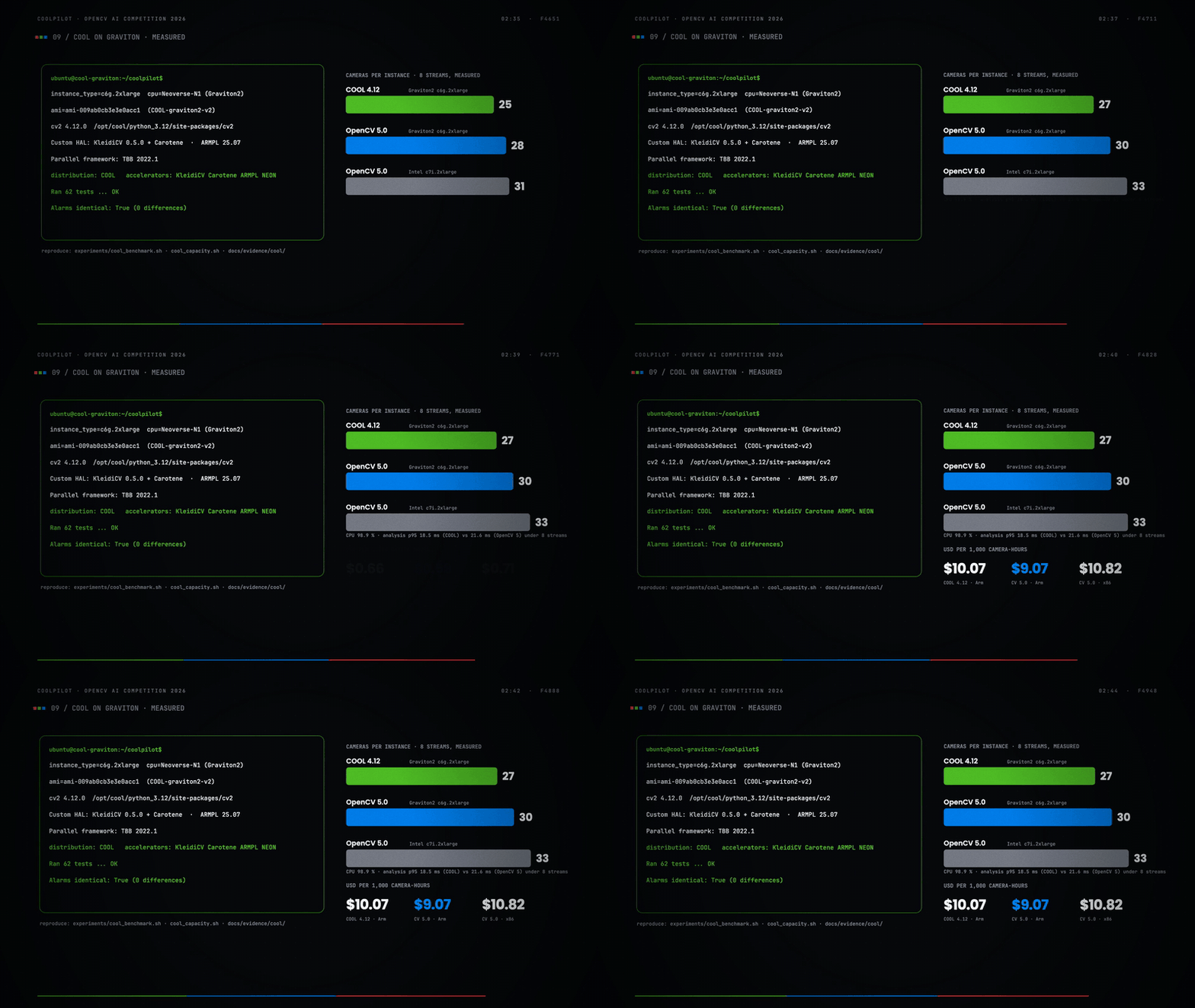 What it measured. 8 streams per instance; prices from the AWS Pricing API. |
Setup, in three steps:
- Launch
COOL-graviton2-v2(ami-009ab0cb3e3e0acc1) on a c6g.2xlarge (Neoverse-N1). - Run on the vendor build:
PYTHONPATH=/opt/cool/python_3.12/site-packages,LD_LIBRARY_PATH=/opt/cool/cpp_sdk/lib. - Use one OpenCV thread per camera stream. At 8 threads, COOL's TBB pool ran 0.84× on our small tiles.
COOL ran the whole workload: distribution: COOL, all 62 tests passing, and alarms identical to the standard 4.12 wheel.
| 8 parallel streams, measured | Real-time cameras | CPU | Analysis p95 | $ / 1,000 camera-hours |
|---|---|---|---|---|
| Graviton2, COOL 4.12 | 27 | 98.9% | 18.5 ms (steadiest) | 10.07 |
| Graviton2, OpenCV 5.0 | 30 | 98.8% | 21.6 ms | 9.07 |
| Intel c7i (x86), OpenCV 5.0 | 33 | 98.6% | 20.0 ms | 10.82 |
What the numbers say:
- Arm wins on cost: 16% cheaper per camera than x86.
- COOL gives the steadiest latency under load, but no throughput gain for this pipeline. Decode is outside its acceleration, and this AMI ships OpenCV 4.12, without the 5.0 DNN engine.
- So the pilot chooses standard OpenCV 5 on Graviton.
- Reproduce with
experiments/cool_benchmark.shandcool_capacity.sh. Evidence:docs/evidence/cool/.
Challenges we ran into
- Fixed thresholds lie on real roads. We moved to per-camera references that learn only while the view is healthy, and freeze while anything is pending.
- Defocus was invisible. Comparing each fault clip with its clean original, frame by frame, showed our 320 px analysis scale erased exactly the detail that defocus removes. Measuring at 640 px fixed it.
- Night looked like a broken camera. A camera dark from its first frame is now its own normal. The trade-off (a camera dark from power-on is not flagged) is stated in every report.
- COOL's real configuration was not in the obvious place: the vendor
cv2lives in/opt/cool/python_3.12/site-packages. We found it on the instance and fixed our setup script.
Accomplishments we're proud of
- 232 → 0 false alarms per hour on clips nobody had looked at, with no real fault lost, paced in real time on Graviton.
- 3.8× faster road-user detection from OpenCV 5's new graph engine on the same Arm host, with identical detections.
- An agentic system that says no to itself. The autopilot's best idea failed unseen validation, and the human gate kept it out.
- A real COOL measurement on AWS Graviton, with an x86 baseline and cost per camera-hour.
- Everything reproducible: 62 tests, pinned dependencies, content-hashed datasets, and evidence JSON for every number.
What we learned
- A trustworthy alarm needs a second look. Measuring twice, cheaply with OpenCV, beat any single smarter threshold.
- Five scenes are not a validation set. Fresh, never-inspected data is what tells you the truth.
- Choosing the stack is measurement too. The cheapest safe configuration was not the one with "optimized" in its name.
What's next
- Real soiled-lens data and a learned occlusion model. Lens dirt is the open problem.
- Exposure metadata from the camera ISP, for honest night handling.
- Wiring the autopilot's threads and streams search directly into COOL and Graviton deployments, so it picks the cheapest safe configuration per fleet.
Truth boundaries
- COOLPilot is a research workbench, not a safety system.
- All faults in the evidence are synthetic, except DRIVE-C's corruptions.
- Lens dirt is not solved, and night is 29/90.
- The LLM verifier is worse than the fixed rule, so the rule is the default.
- The autopilot did not beat random search.
- COOL brought no speedup for this pipeline.
Built with
OpenCV 5.0 (cv2.dnn new graph engine) · COOL (Cloud-Optimized OpenCV Library) · KleidiCV · Arm Performance Libraries · AWS Graviton · AWS Lambda (arm64) · Amazon EC2 · Amazon S3 · Amazon DynamoDB · Amazon CloudWatch · Python · FastAPI · NumPy · React · TypeScript · Vite · NanoDet-Plus (ONNX) · Nebius AI · Qwen3-TTS · Oxford RobotCar Dataset · DRIVE-C
Try it
- Live (read-only, AWS Lambda arm64): https://n7ebpehiuh2hczk2uzsherigia0pyqfg.lambda-url.us-east-1.on.aws/
- Code: https://github.com/azharizz/coolpilot
- Technical report: TECHNICAL_REPORT.md
- Showreel:
video/coolpilot_showreel_upload.mp4(3:10)
Built With
- amazon-ec2
- aws-graviton
- cool
- fastapi
- opencv
- python
- react

Log in or sign up for Devpost to join the conversation.