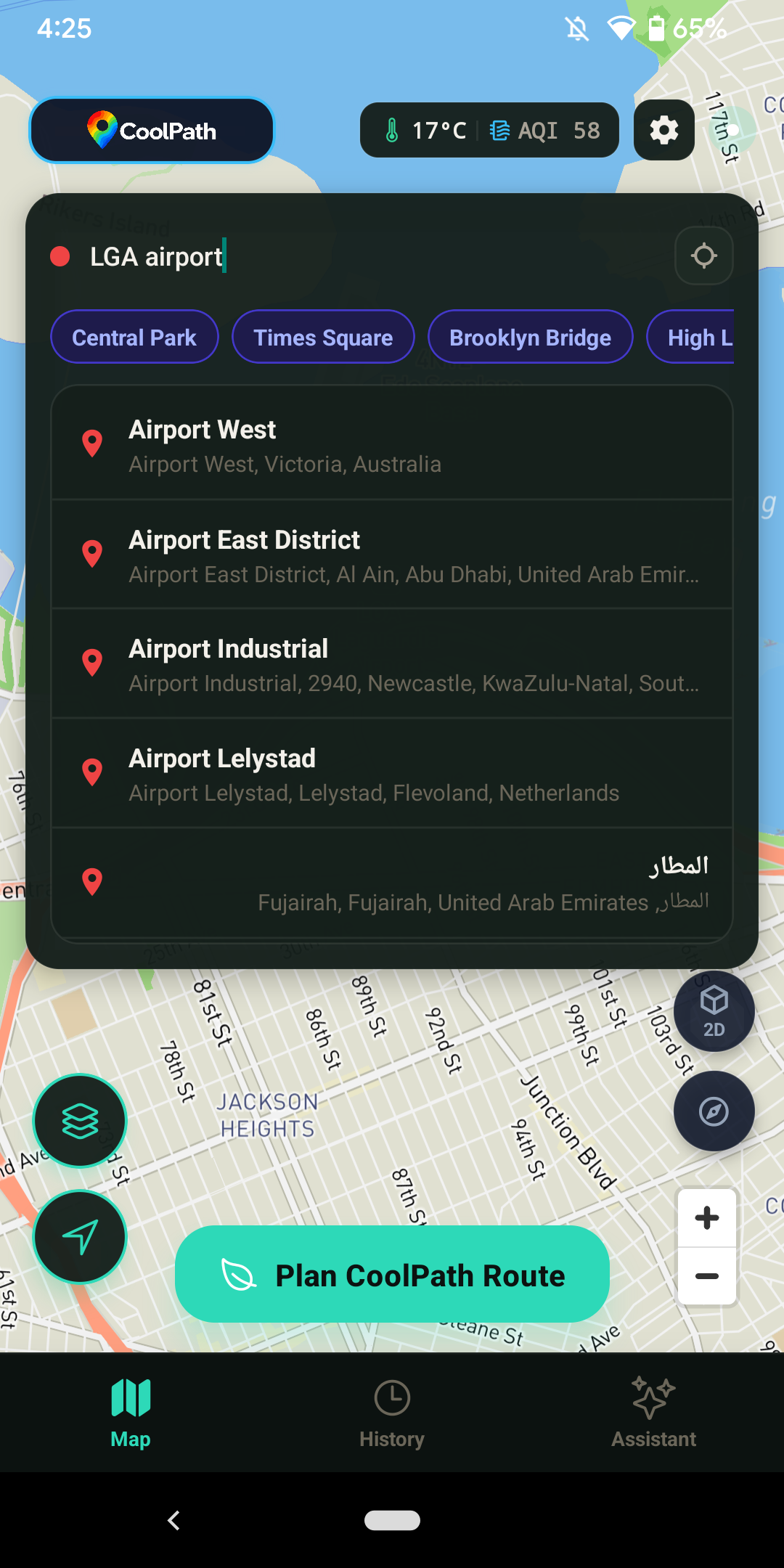
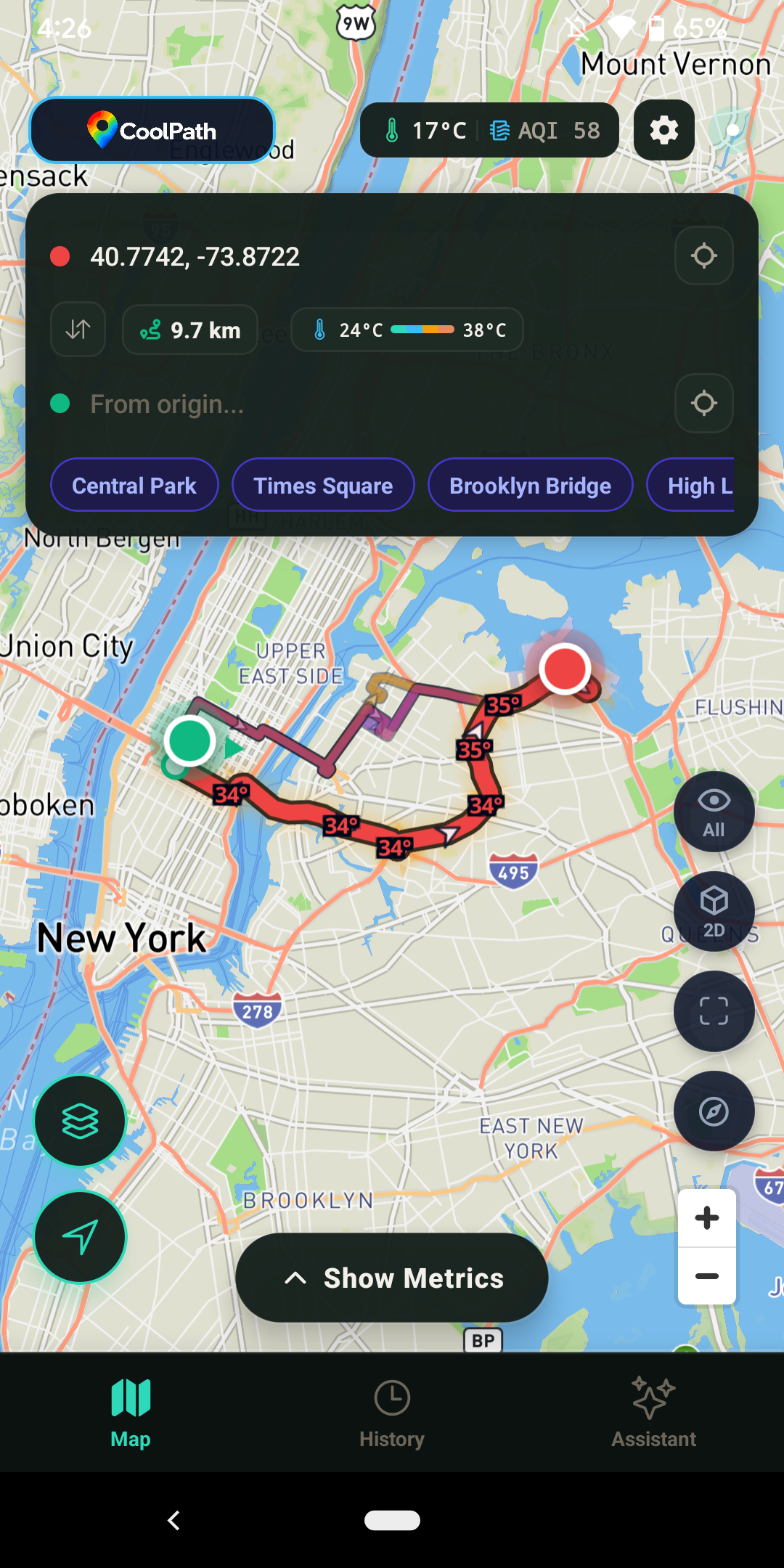
 # 🌡️ CoolPath: Climate-Resilient Navigation System
**AI-Powered Microclimate Routing for Extreme Urban Heat**
[](coolpath/backend)
[](coolpath/frontend)
[](coolpath/backend)
[](fortyguard)
Protecting pedestrians, runners, and cyclists from scorching sun-exposed asphalt by routing them into shade-rich, microclimate-cooled pathways.
✨ Why CoolPath?
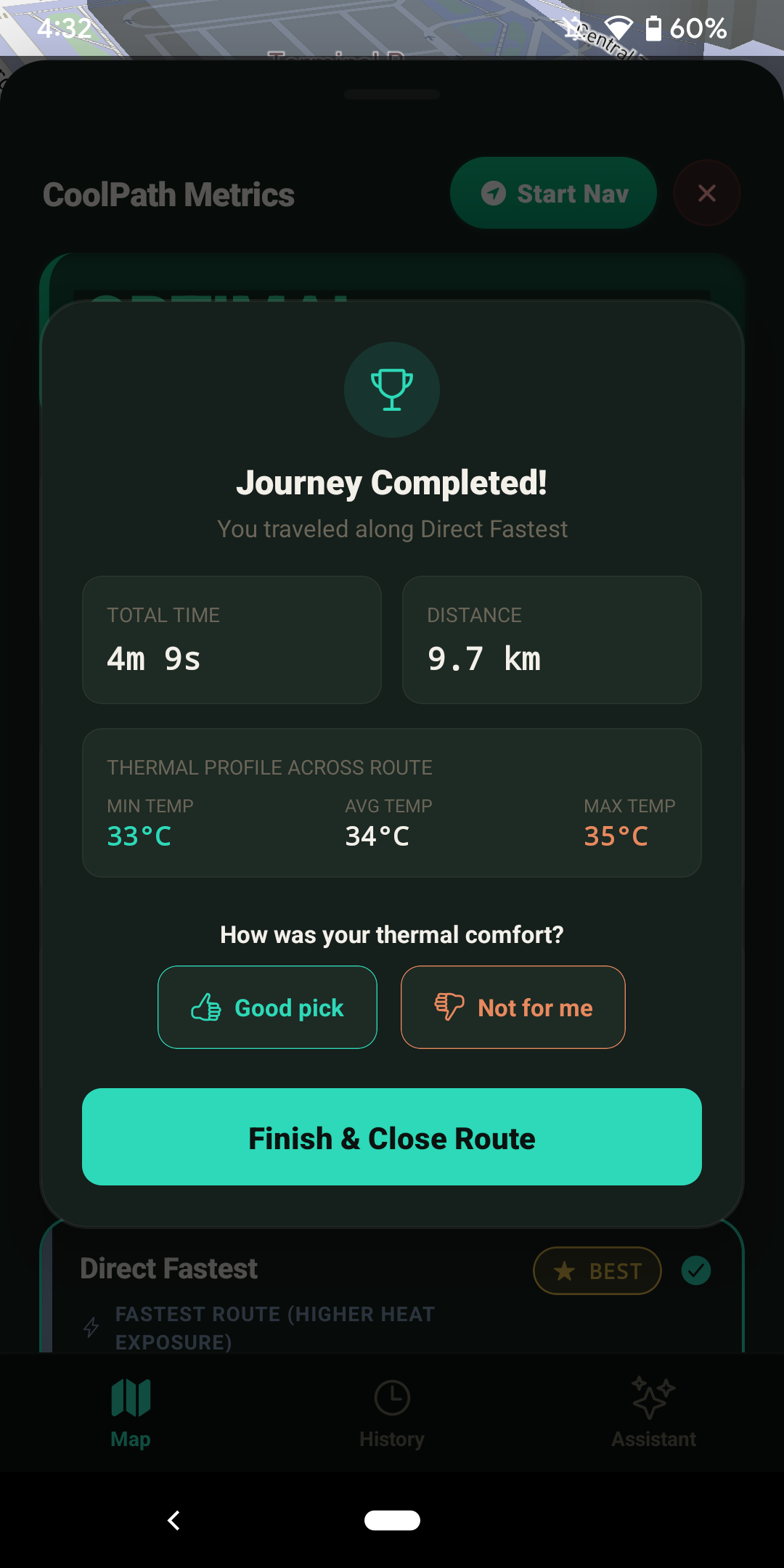
Urban heat islands are increasingly dangerous. CoolPath is a state-of-the-art, heat-aware microclimate navigation engine built for modern cities. Powered by high-resolution thermal rasters from FortyGuard, AI mission planning via Google Gemini 2.0, and human thermodynamic physiological modeling, CoolPath ensures that your journey is not just fast, but thermally safe.
🚀 Key Features
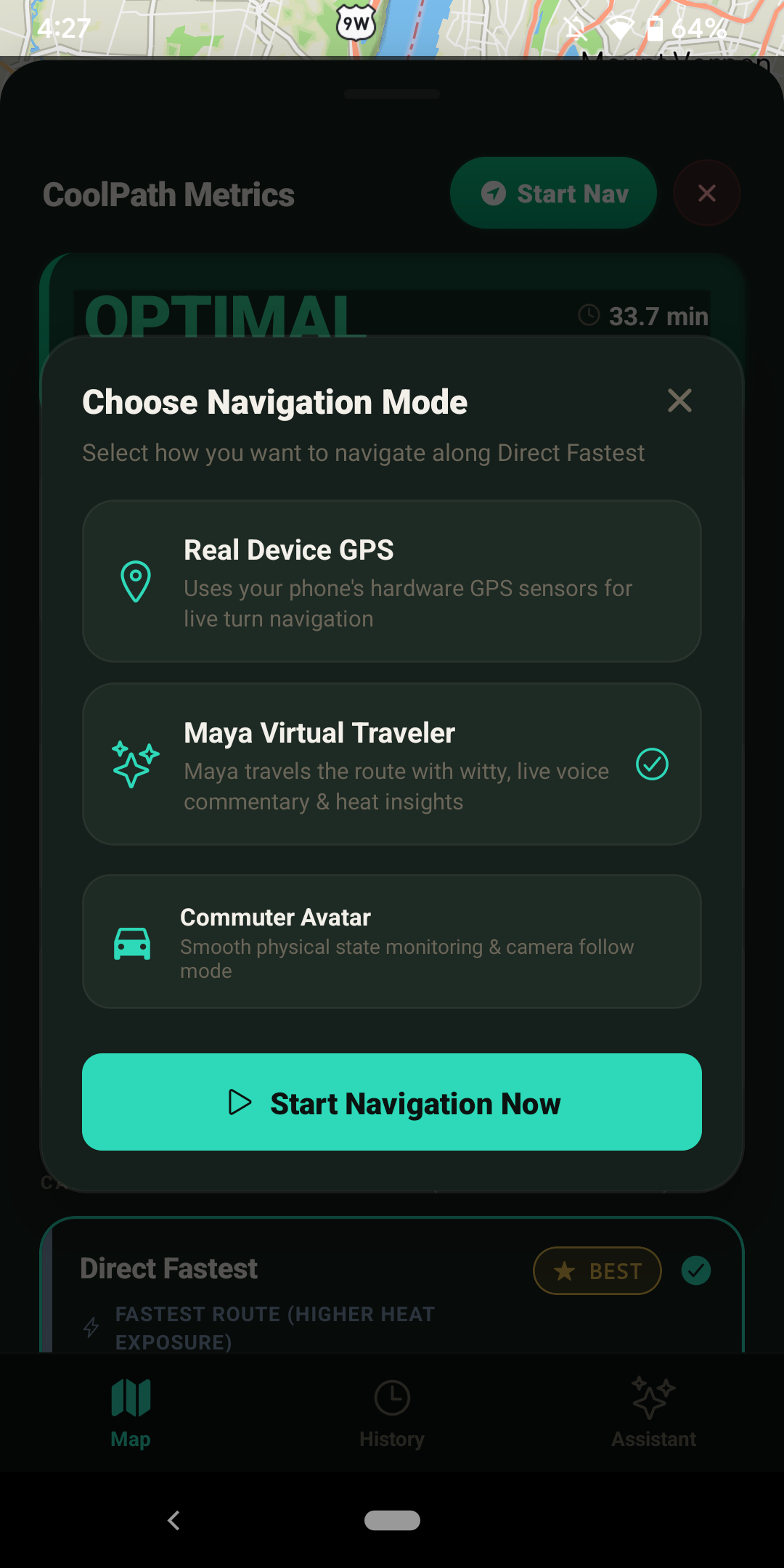
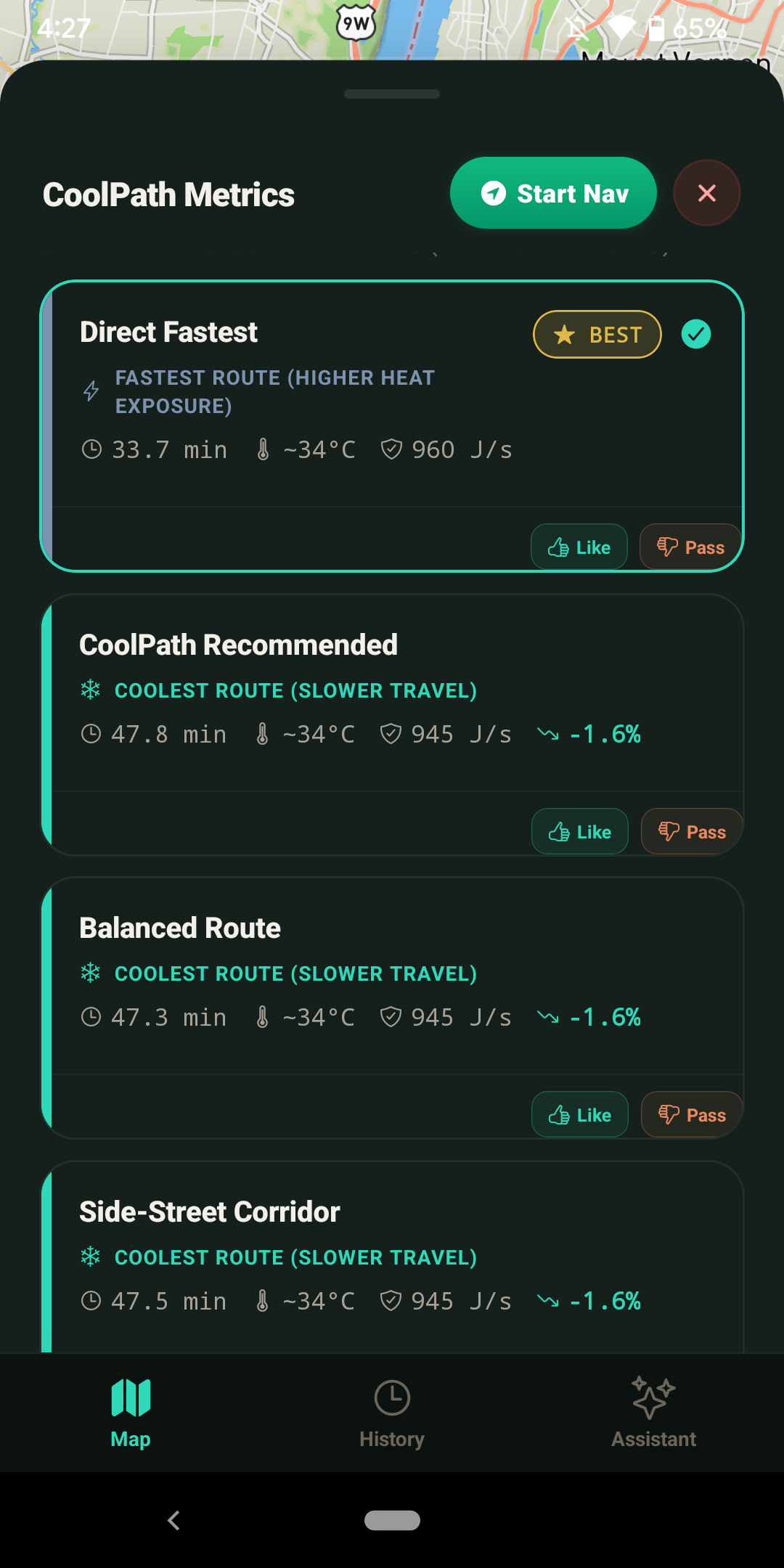
🌳 Multi-Objective Heat & Shade OptimizationMulti-objective Pareto routing solver (Fastest vs. Shaded vs. Balanced) combining OpenStreetMap topological street networks with FortyGuard spatial heat rasters. |
⚡ Sub-Millisecond Spatial IndexingUtilizes Shapely |
🧬 Human Thermodynamic ModelingReal-time simulation of traveler core body temperature, metabolic energy expenditure (METs), convective wind cooling, and humidity evaporative limits. |
🤖 AI Assistant & Voice BriefingsGemini 2.0 agent parses natural language intent ("Find me a shaded 5km running path") and generates audio briefings via AWS Polly. |
📈 Online Machine Learning FeedbackOnline |
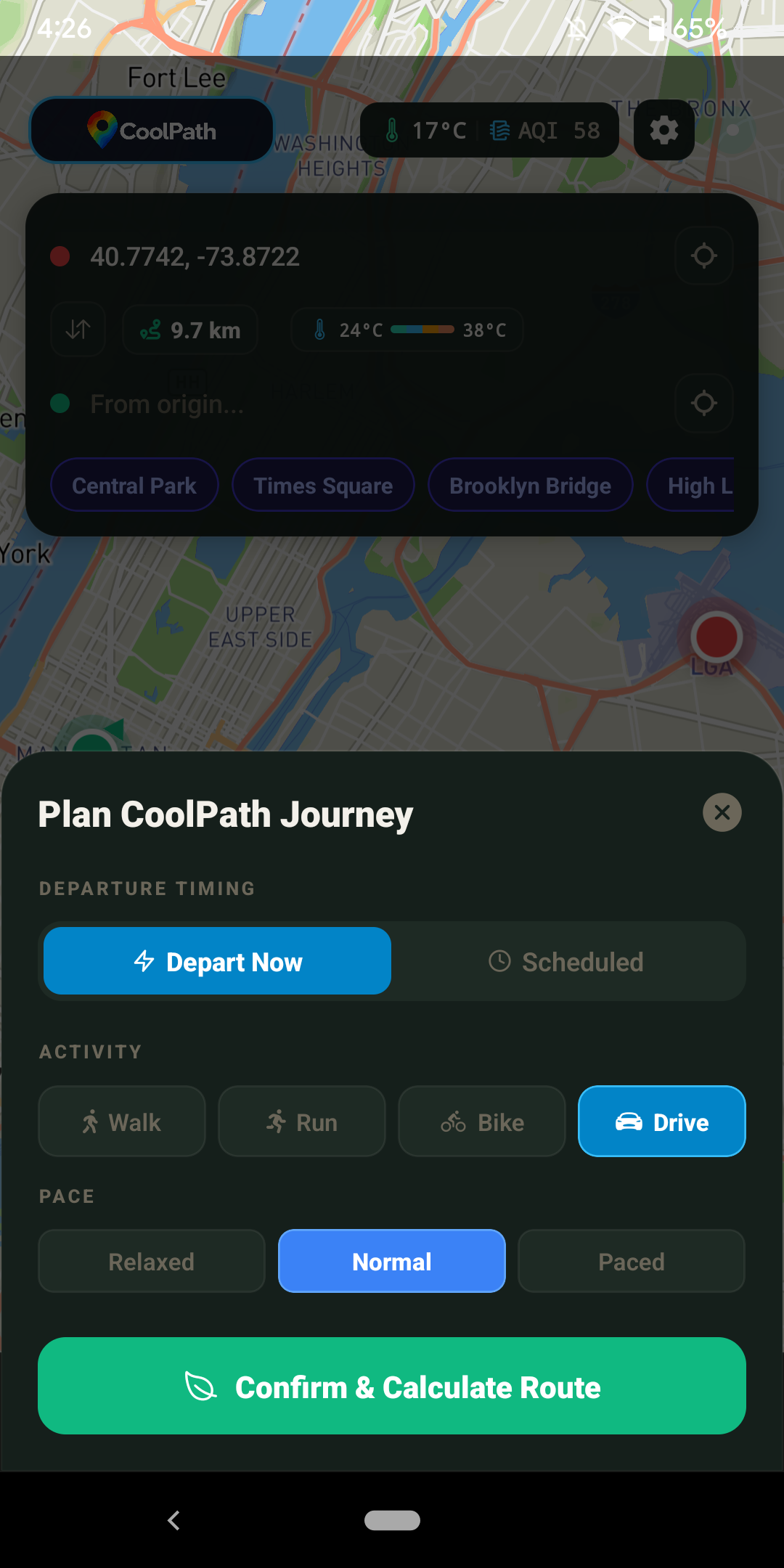
📱 Universal Frontend ArchitectureUnified Expo React Native architecture that seamlessly compiles to a highly responsive web application. |
🧠 System Architecture
We designed CoolPath to be highly scalable and decoupled, utilizing a lightweight Python backend and a blazing-fast universal frontend.
graph TD
    %% Styling
    classDef client fill:#000020,stroke:#fff,stroke-width:2px,color:#fff;
    classDef backend fill:#009688,stroke:#fff,stroke-width:2px,color:#fff;
    classDef ai fill:#8E75B2,stroke:#fff,stroke-width:2px,color:#fff;
    classDef external fill:#34D399,stroke:#fff,stroke-width:2px,color:#000;

    Client[📱 Universal Web Frontend<br/>React Native / Expo]:::client
    API[⚡ FastAPI Spatial Backend<br/>Routing & Logic]:::backend
    Gemini[🤖 Google Gemini 2.0<br/>Intent Parser]:::ai
    Polly[🗣️ AWS Polly<br/>Speech Synthesis]:::external
    FortyGuard[🌡️ FortyGuard API<br/>Thermal Rasters]:::external
    Weather[⛅ Open-Meteo API<br/>Live Weather]:::external

    Client -- "POST /api/mission" --> API
    API -- "Parse Intent" --> Gemini
    Gemini -- "JSON Parameters" --> API
    API -- "Fetch Microclimates" --> FortyGuard
    API -- "Fetch Conditions" --> Weather
    API -- "Generate Briefings" --> Polly
    API -- "Route + Audio" --> Client
🧮 Thermodynamic Physics Model
CoolPath computes core body temperature $T_{\text{core}}$ using the human stored thermal heat equation:
$$T_{\text{core}}(t+\Delta t) = T_{\text{core}}(t) + \frac{Q_{\text{stored}}}{m \cdot c} \Delta t$$
Where:
- $Q_{\text{stored}} = Q_{\text{metabolic}} - Q_{\text{work}} - Q_C - Q_R - Q_E$
- Metabolic Rate ($Q_{\text{metabolic}}$): $\text{MET} \times 58.15 \times A_{\text{DuBois}}$
- Stefan-Boltzmann Radiation ($Q_R$): Accounts for pavement $T^4$ thermal emission. Shade tree canopy routing cuts $Q_R$ direct solar flux by up to 85%.
- Convective Loss ($Q_C$): $h_c \cdot (T_{\text{skin}} - T_{\text{ambient}}) \cdot A_{\text{DuBois}}$ where $h_c = 8.3 \sqrt{v_{\text{wind}}}$.
📁 Repository Structure
temperature-api-quickstart/
├── coolpath/
│   ├── backend/                 # Python FastAPI Microclimate & AI Backend
│   │   ├── app/
│   │   │   ├── agent/           # Gemini 2.0 Intent Parser & Prompt Logic
│   │   │   ├── api/             # REST Endpoints (/api/mission)
│   │   │   ├── data/            # OSM Topology & Microclimate Cache
│   │   │   ├── ml/              # Online SGD Preference Learning Model
│   │   │   └── services/        # FortyGuard, NetworkX Solver, AWS Polly
│   │   ├── Dockerfile           # Docker container build specification
│   │   └── render.yaml          # Render 1-Click Infrastructure Blueprint
│   ├── frontend/                # Universal Expo Web Application
│   │   ├── src/                 # Web Map & Dashboard Components
│   │   ├── assets/              # App Icons, Fonts & Sounds
│   │   ├── app.json             # Expo App Manifest Configuration
│   │   └── package.json         # Frontend Dependencies
│   └── .gitignore               # Unified CoolPath Git Exclusion Rules
├── fortyguard/                  # SDK Client Package for FortyGuard tOS API
├── docs/                        # Engineering Specifications & Formulas
└── start.py                     # Universal 1-Command Developer Launcher
🛠️ Quickstart
1-Command Boot
To launch both the FastAPI Backend and the Expo Web Frontend automatically with port conflict resolution:
python start.py
Note: The launcher automatically detects available ports, boots Uvicorn, configures the frontend API endpoint, and opens the Expo web server.
Manual Setup
1. Backend Setup (FastAPI)```bash cd coolpath/backend python3 -m venv venv source venv/bin/activate # Windows: venv\Scripts\activate pip install -r requirements.txt ``` **Environment Variables (`coolpath/backend/.env`)**: ```env GEMINI_API_KEY=your_google_gemini_api_key FORTYGUARD_API_KEY=your_fortyguard_api_key AWS_ACCESS_KEY_ID=your_aws_key_optional AWS_SECRET_ACCESS_KEY=your_aws_secret_optional DEMO_MODE=False ``` **Run**: ```bash uvicorn app.main:app --host 0.0.0.0 --port 8000 --reload ``` 2. Frontend Setup (Expo Web)
The frontend is now a unified Expo universal app serving responsive web. ```bash cd coolpath/frontend npm install ``` **Environment Variables (`coolpath/frontend/.env.local`)**: ```env EXPO_PUBLIC_MAPBOX_TOKEN=your_mapbox_token EXPO_PUBLIC_NGROK_BACKEND_URL=http://localhost:8000 ``` **Run Web Server**: ```bash npx expo start --web ```
☁️ Deployment
Render (Backend)
- Push this repository to GitHub.
- Go to dashboard.render.com and click New + $\rightarrow$ Blueprint.
- Select your repository. Render will automatically process
coolpath/backend/render.yaml. - Enter your environment variables in the Render Dashboard and click Apply.
Built with ❤️ for a cooler, safer urban future.
Built With
- dockerfile
- html
- javascript
- kotlin
- procfile
- python
- typescript
