-
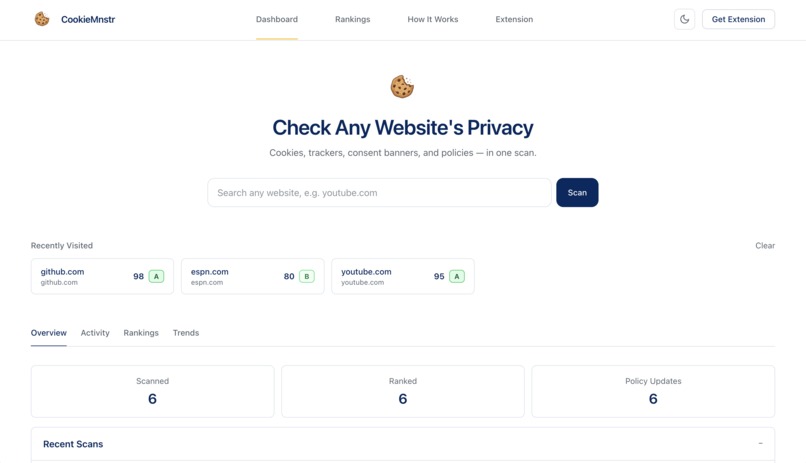
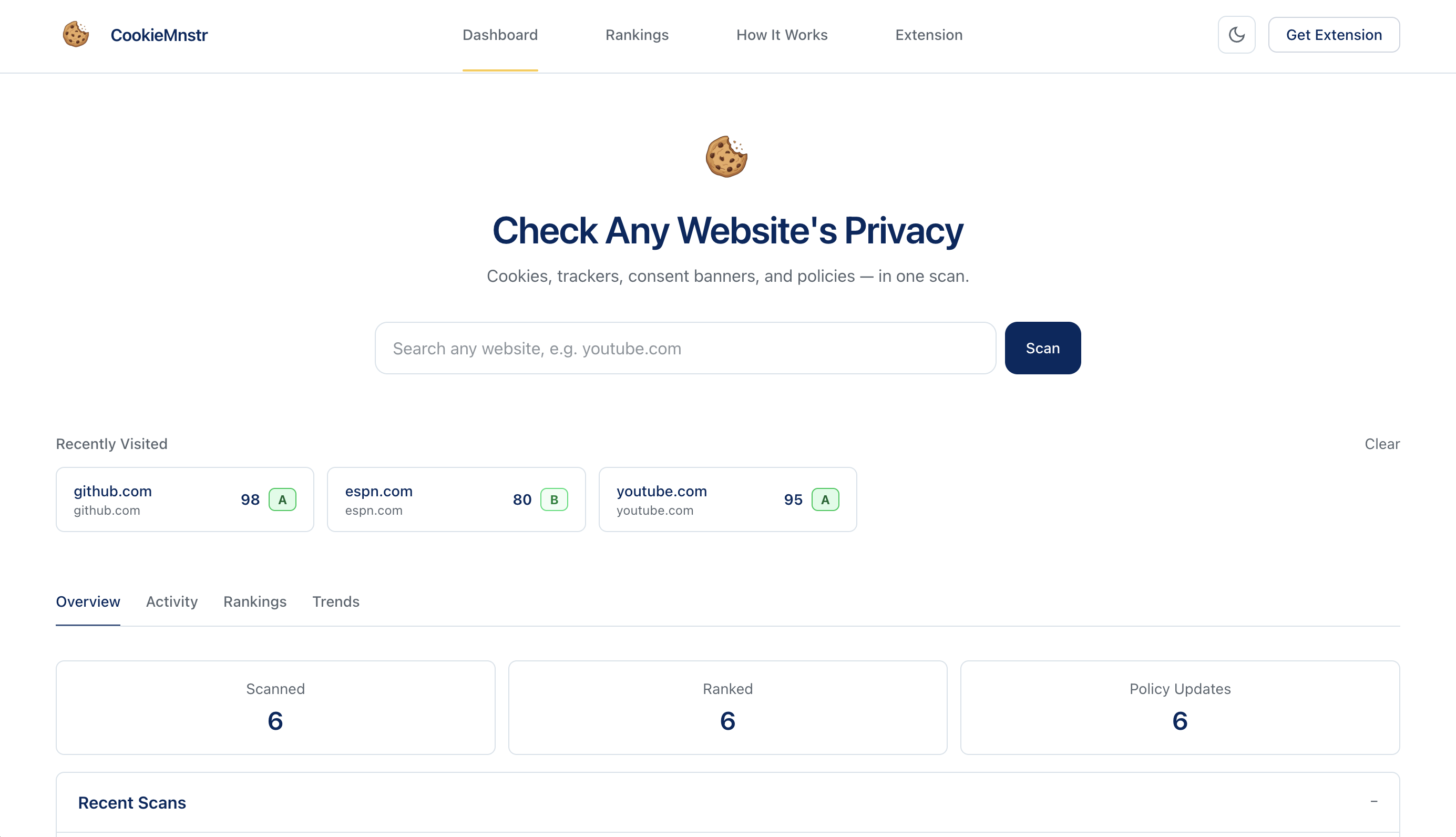
website
-
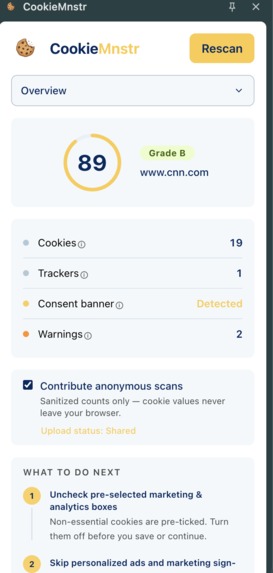
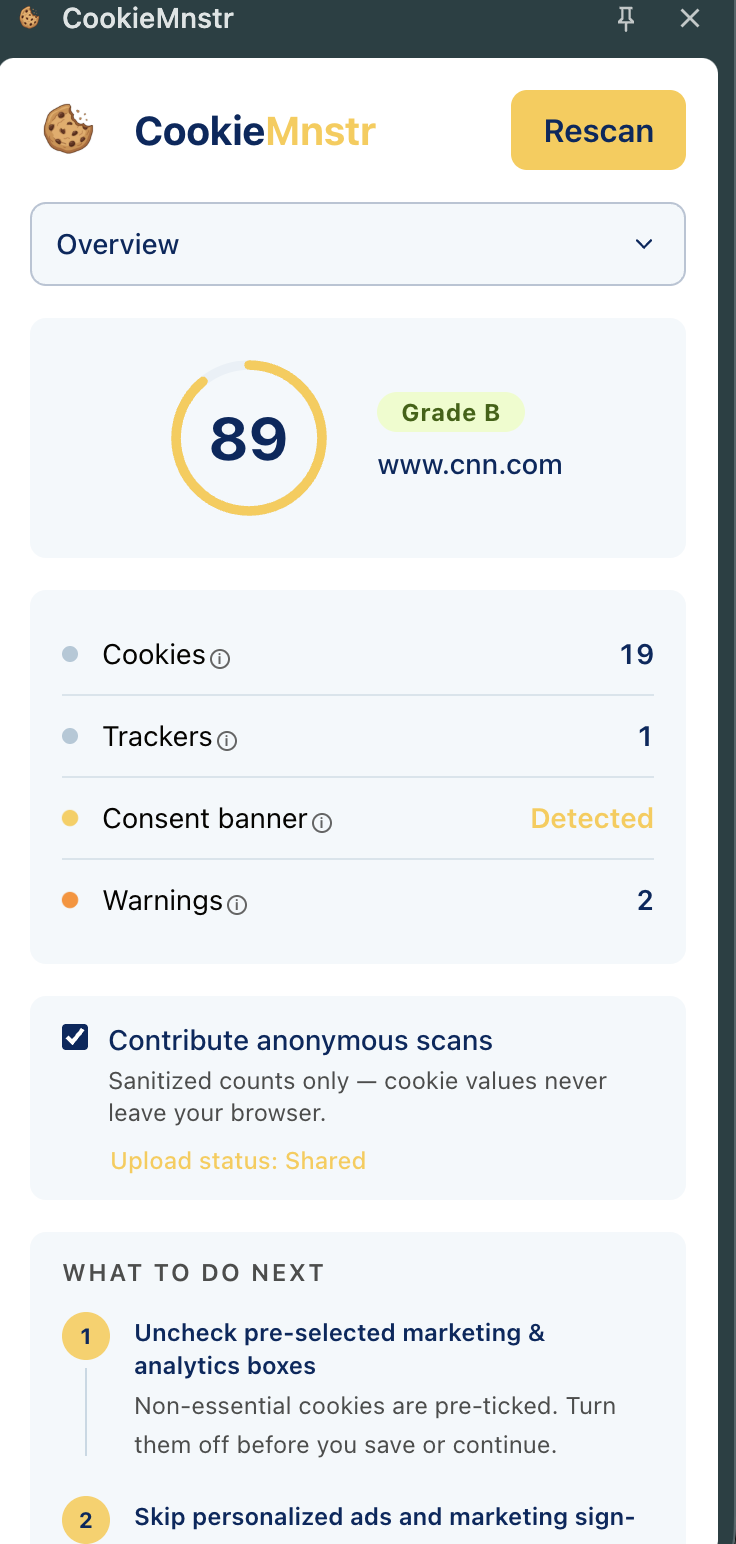
extension
Inspiration
Almost every website asks users to accept cookies, but very few people actually understand what they are accepting. Cookie banners are often designed to make “Accept All” the easiest option, while privacy policies are long, confusing, and difficult to compare with what the website is actually doing. We wanted to make online privacy more transparent without requiring users to read thousands of words or understand technical tracking terminology.
What it does
CookieMnstr is a privacy transparency platform made up of a Chrome extension, public website, and backend.
The extension scans the current website for cookies, trackers, privacy-policy links, terms links, and possible consent-banner dark patterns. It categorizes detected cookies, identifies common tracking services, and generates an explainable privacy score.
The public website turns sanitized scans into searchable website profiles, warnings, rankings, and privacy histories. CookieMnstr also compares what a website stores and loads with what its privacy policy says. This can reveal potential concerns, such as advertising trackers that are not clearly disclosed.
How we built it
We built the Chrome extension using React, TypeScript, Vite, Tailwind CSS, and Chrome Manifest V3. It uses Chrome APIs and content scripts to inspect cookies, trackers, consent banners, and legal links directly in the browser.
Our backend is built with FastAPI and PostgreSQL. It accepts sanitized scan results, stores website profiles and policy versions, and runs a deterministic scoring and comparison engine.
We use Playwright and Chromium for standardized automated website scans. OpenRouter is used only to convert long privacy policies into structured information. The main privacy score and warnings are still generated using rule-based logic instead of relying entirely on AI.
The public website is built with React and displays searchable profiles, score breakdowns, rankings, tracker summaries, warnings, and policy histories.
Challenges we ran into
One major challenge was detecting tracking behavior accurately. Websites load scripts in many different ways, and some trackers only appear after users interact with a consent banner.
Another challenge was categorizing cookies without collecting sensitive information. We designed CookieMnstr so that cookie values are never uploaded or stored. Only sanitized details, such as cookie names, domains, expiration types, and categories, are used.
Privacy policies were also difficult to analyze because every website formats them differently. Some are extremely long, dynamically rendered, or spread across several pages. We had to extract readable text and convert inconsistent policy language into a standardized structure.
We also had to avoid presenting uncertain findings as facts. Because CookieMnstr is not a legal tool, we focused on explainable evidence and neutral language rather than definitive accusations.
Accomplishments that we’re proud of
We are proud that CookieMnstr is more than a simple AI wrapper. The core scanning, categorization, scoring, and comparison systems work through deterministic browser analysis and rule-based logic.
We also built a full system connecting a Chrome extension, FastAPI backend, PostgreSQL database, automated browser scanning, and a public React website.
Another accomplishment is our privacy-first design. CookieMnstr helps users understand tracking without collecting the actual contents of their cookies.
Most importantly, the platform does not just list technical information. It transforms that information into understandable scores, evidence-backed warnings, and comparisons that normal internet users can use.
What we learned
We learned that browser privacy is much more complicated than simply counting cookies. Cookies can serve different purposes, trackers can load through multiple methods, and a website’s behavior can change depending on whether a user accepts or rejects consent.
We also learned how to build and connect a Chrome extension, backend API, database, automated browser system, and public website.
On the product side, we learned that transparency is more useful than making overly confident claims. Showing users the evidence and explaining how a score was calculated is more trustworthy than simply labeling a website as safe or unsafe.
What’s next for CookieMnstr
Next, we want to expand CookieMnstr’s tracker and cookie databases so it can recognize more technologies accurately.
We also want to add standardized scans across more websites, allowing users to compare companies by category and track how privacy scores change over time.
Future features could include notifications when a website changes its privacy policy, improved consent-banner dark-pattern detection, community-submitted scans, and detailed comparisons between similar services.
Our long-term goal is to make CookieMnstr a public transparency layer for the internet, where users can easily understand what websites collect, what they disclose, and how their privacy practices change.
Built With
- chromeextension
- chromium
- fastapi
- playwright
- postgresql
- react

Log in or sign up for Devpost to join the conversation.