-
-
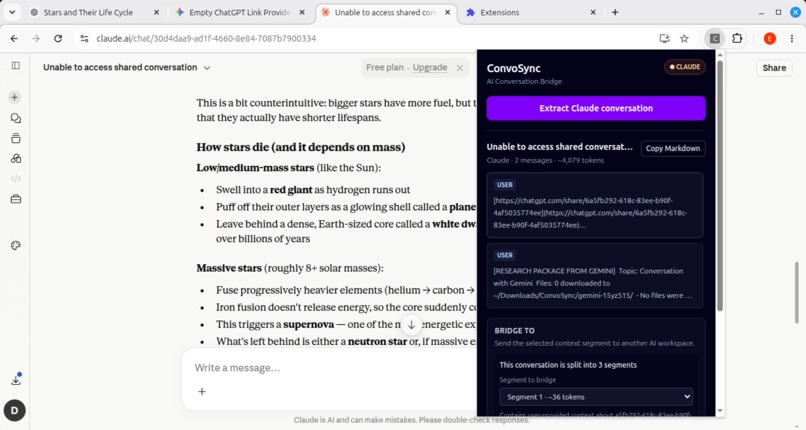
ConvoSync extension
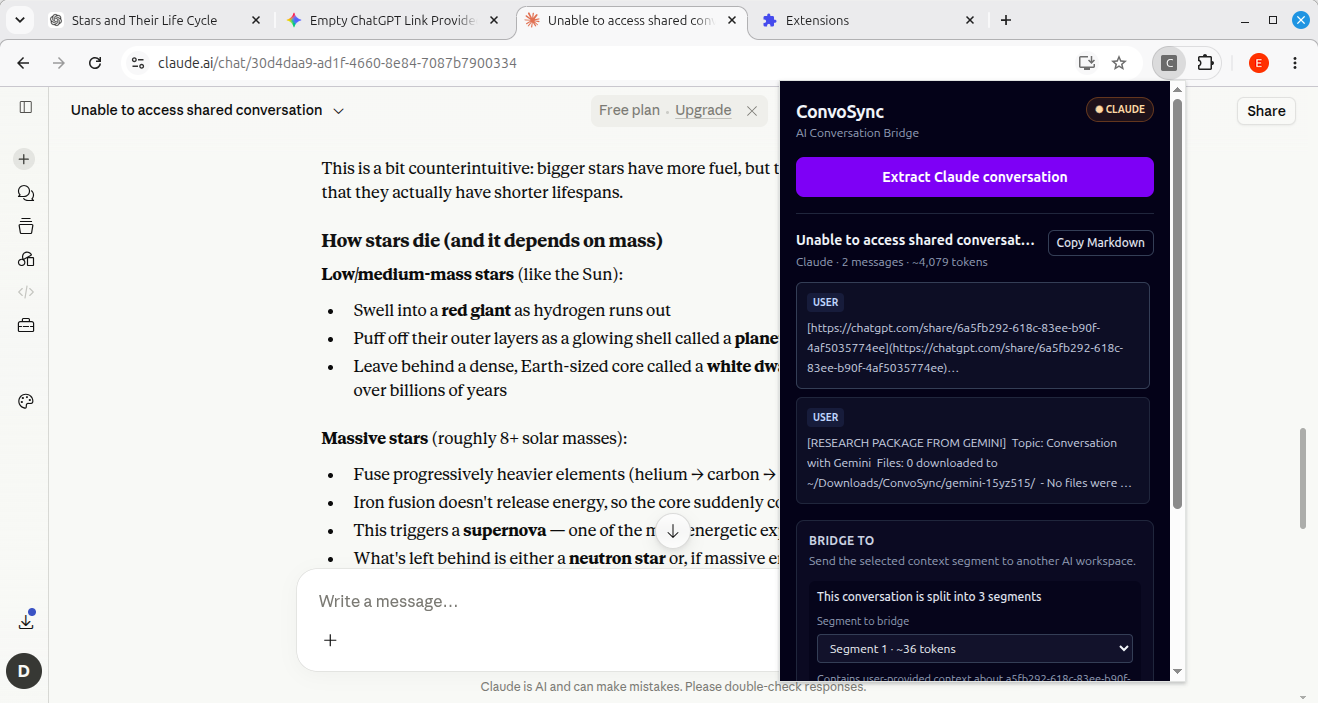
Inspiration
I use ChatGPT, Claude, and Gemini daily. Each has strengths — ChatGPT for coding, Claude for long-form analysis, Gemini for research. But my work gets trapped. A 2-hour research session in ChatGPT cannot move to Gemini. A Claude artifact cannot reach ChatGPT. The silos are real, and there is no bridge.
I built ConvoSync to break them.
What It Does
ConvoSync is a Chrome extension that extracts full AI conversations — with roles, code blocks, tables, file references, and context — then bridges them to any other AI platform.
- Extract from ChatGPT, Claude, Gemini, Perplexity, or Copilot
- Preserve context with smart semantic chunking that never splits a code block
- Bridge the conversation to Gemini or Claude with one click
- Export to NotebookLM as a structured research source
How I Built It
Architecture: Manifest V3 Chrome extension. React 18 popup UI. TypeScript strict mode. Pure client-side — no server, no data leaves the browser.
Core Engine:
- Multi-platform parsers — Each AI renders conversations differently (React hydration, shadow DOM, lazy loading). ConvoSync handles all of them.
- Smart chunking — Splits long conversations at message boundaries, preserves semantic flow, adds overlap context so the receiving AI understands continuity.
- Context preservation — System instructions, code blocks with language tags, tables, file attachments, and metadata are all preserved.
- Bridge injection — Uses Chrome's scripting API to inject formatted conversations directly into target AI text areas, with graceful clipboard fallback.
How Codex Accelerated This
I built the core architecture and UX flow. Codex handled the heavy technical lifting:
- DOM parsers — ChatGPT, Claude, and Gemini each use different DOM structures. Codex wrote the resilient extractors that handle dynamic content and lazy loading.
- Smart chunking algorithm — The semantic boundary detection, token-aware splitting, and code-block preservation logic.
- Bridge injection layer — Navigating MV3 restrictions, cross-tab messaging, and target platform text area detection.
- Context engine — System instruction extraction, topic detection, and platform-specific formatting (Claude loves XML, Gemini prefers markdown).
Codex turned architectural decisions into production code in hours, not days.
Challenges
The content script problem. MV3 content scripts must be self-contained IIFE bundles — no ES module imports. My initial build split chunks that Chrome could not load. I had to reconfigure Vite to inline everything into a single content.js.
File attachment detection. ChatGPT renders Excel files as rich React components, not simple <a> tags. My scanner initially found 5 false positives from spreadsheet cell content. I rebuilt the detection to distinguish file headers from data cells using parent context and icon proximity.
Cross-origin injection. Browser security prevents direct file transfer between AI platforms. I pivoted to a "Research Package" model — downloading files locally and guiding users to re-upload — which is honest about limitations while still delivering value.
What I Learned
- MV3 extension architecture in depth
- DOM parsing across React-hydrated, dynamically loaded pages
- Semantic text chunking without external tokenization libraries
- When to fight browser security and when to design around it
What's Next
- Direct file download-and-bridge using background fetch + blob handling
- Conversation diffing across AI versions
- Team workspace for shared research corpora
Built With
- chrome
- codex
- css
- extension
- gpt-5.6
- manifest-v3
- openai
- react
- tailwind
- typescript
- vite

Log in or sign up for Devpost to join the conversation.