Inspiration
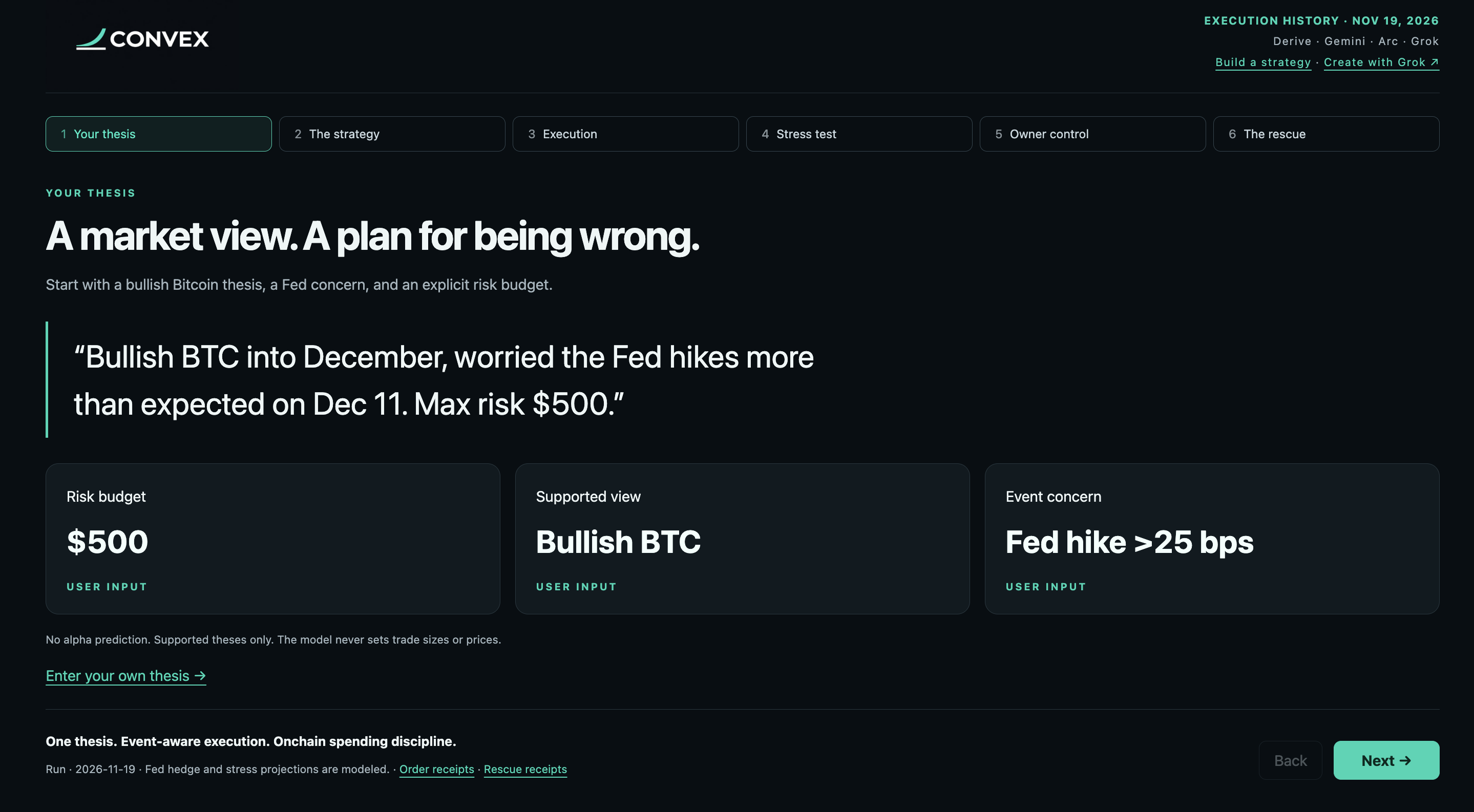
Having a market opinion is easy. Turning it into a position you understand, and knowing what happens when you’re wrong, is much harder.
An investor might say, “I’m bullish on Bitcoin, but I’m worried about the Fed.” Acting on that view means choosing instruments, sizing positions, pricing hedges, and managing margin across different platforms. New investors face a steep learning curve, while experienced traders spend time coordinating the same moving parts manually.
We built Convex to close that gap. You bring the thesis and risk budget; Convex handles the work of structuring, pricing, and coordinating the strategy.
What it does
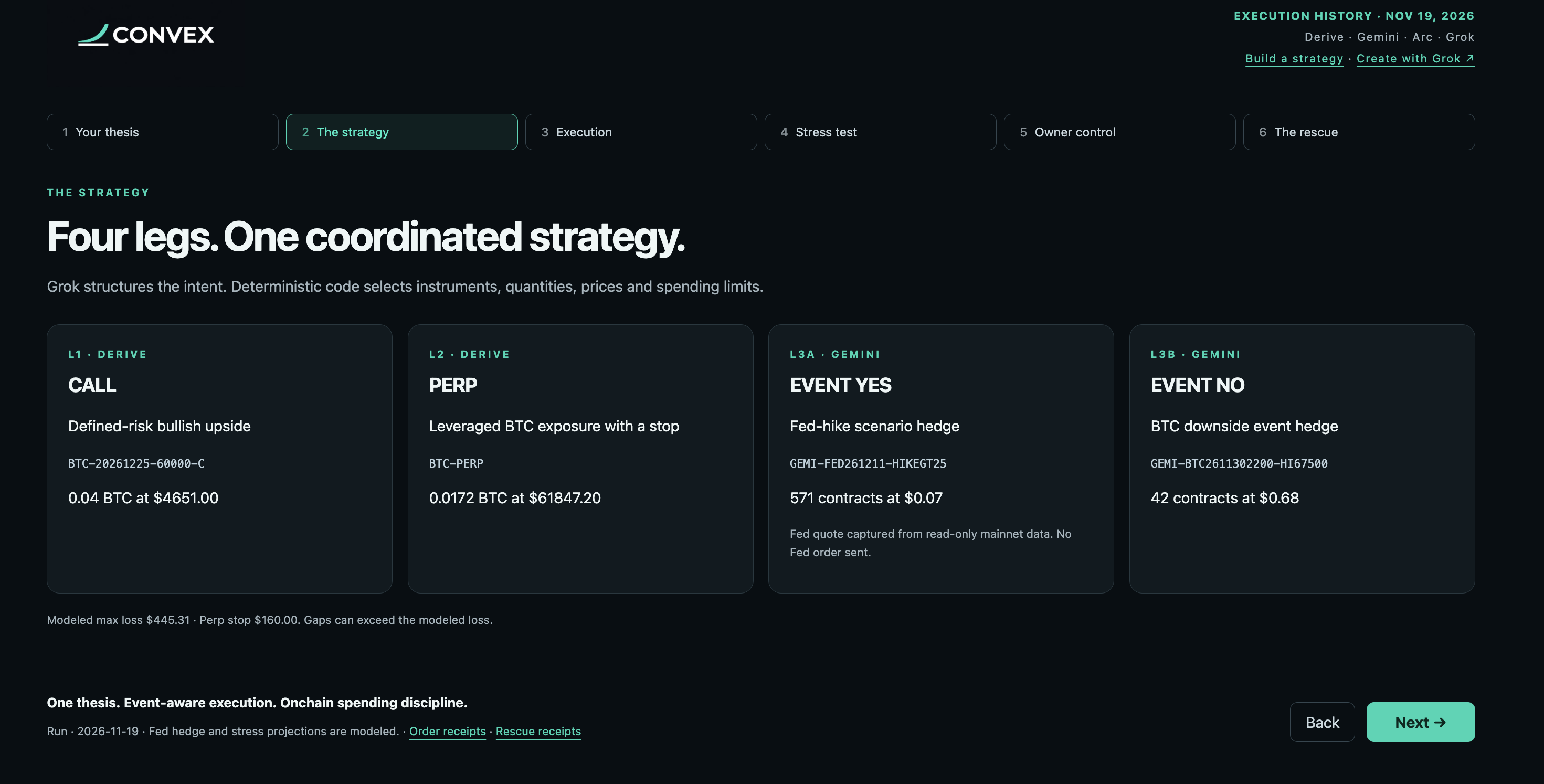
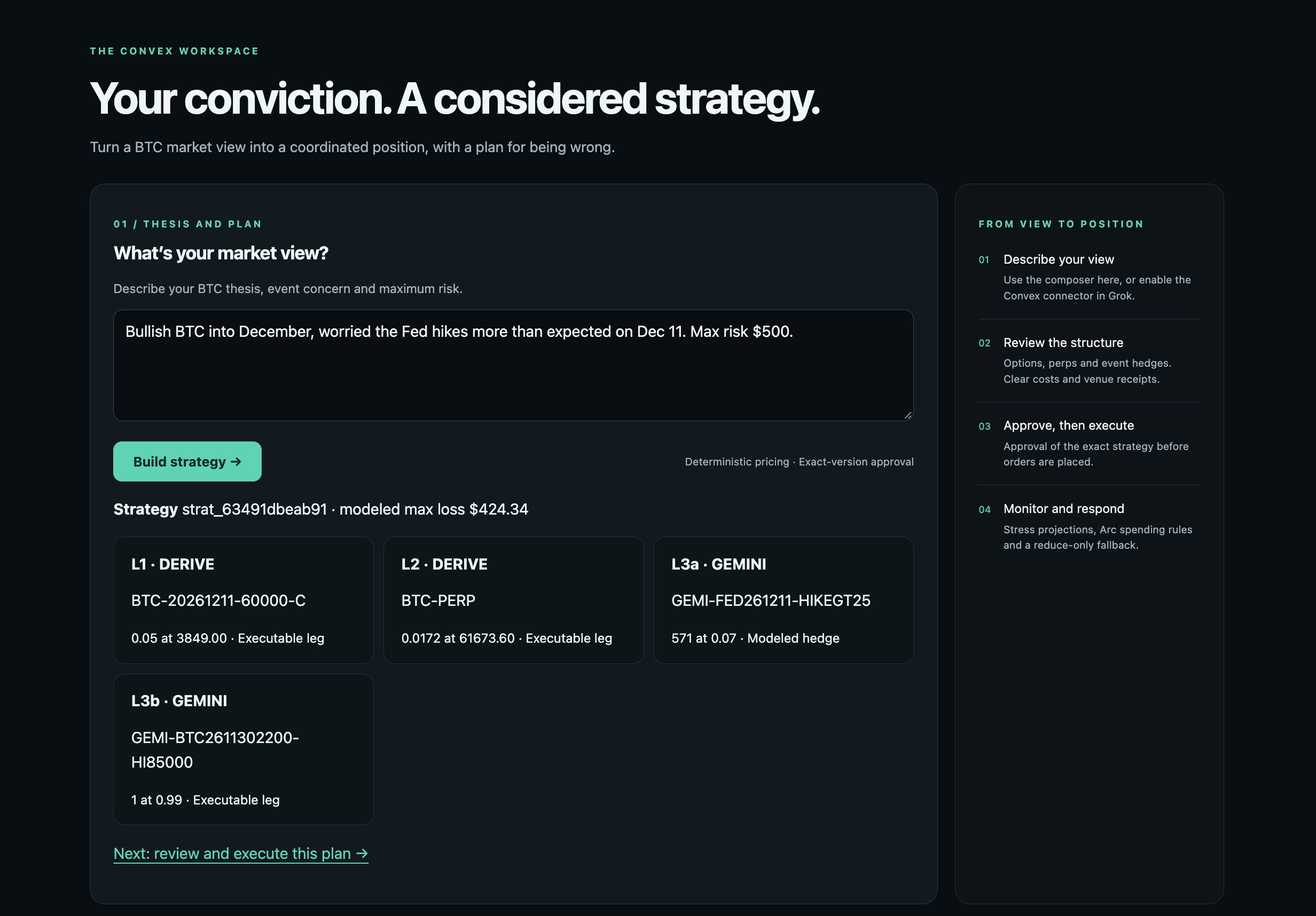
Convex turns a plain-English market view into a coordinated trading plan, starting with a supported Bitcoin strategy spanning options, perpetual futures, and prediction markets.
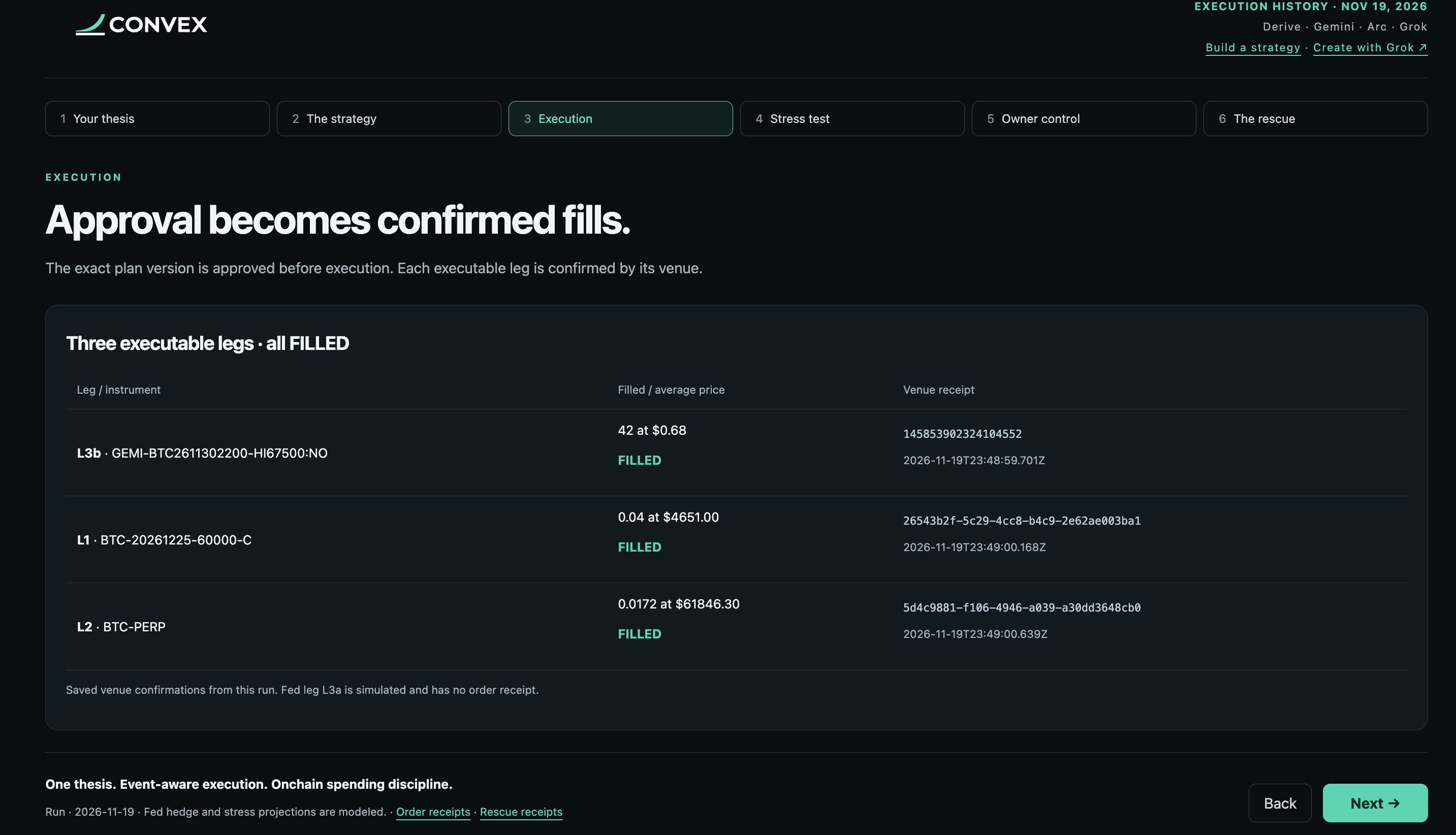
It assembles the legs, shows their costs and modeled payoffs, and checks that the plan fits the user’s stated risk budget. Users review and approve a specific version before execution.
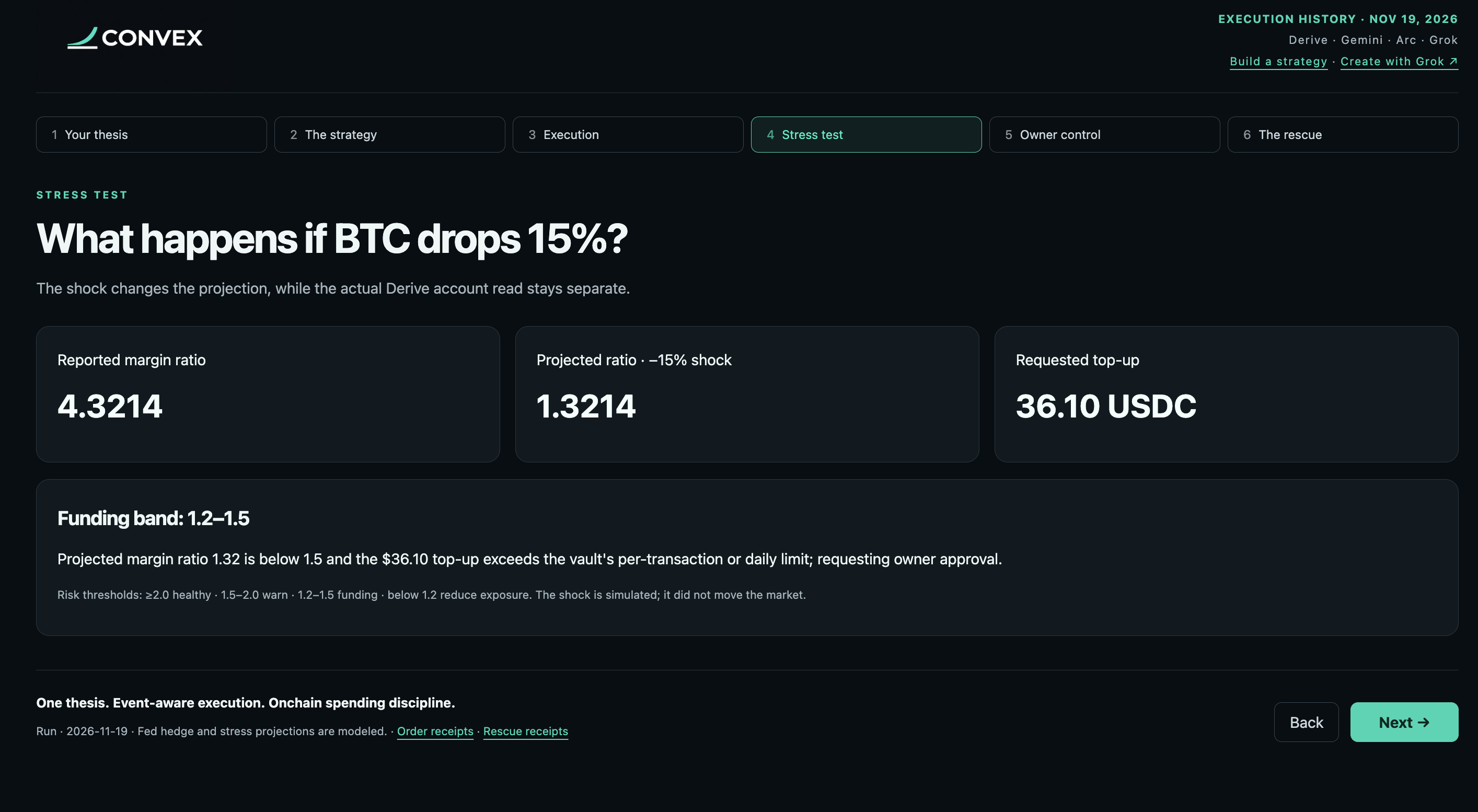
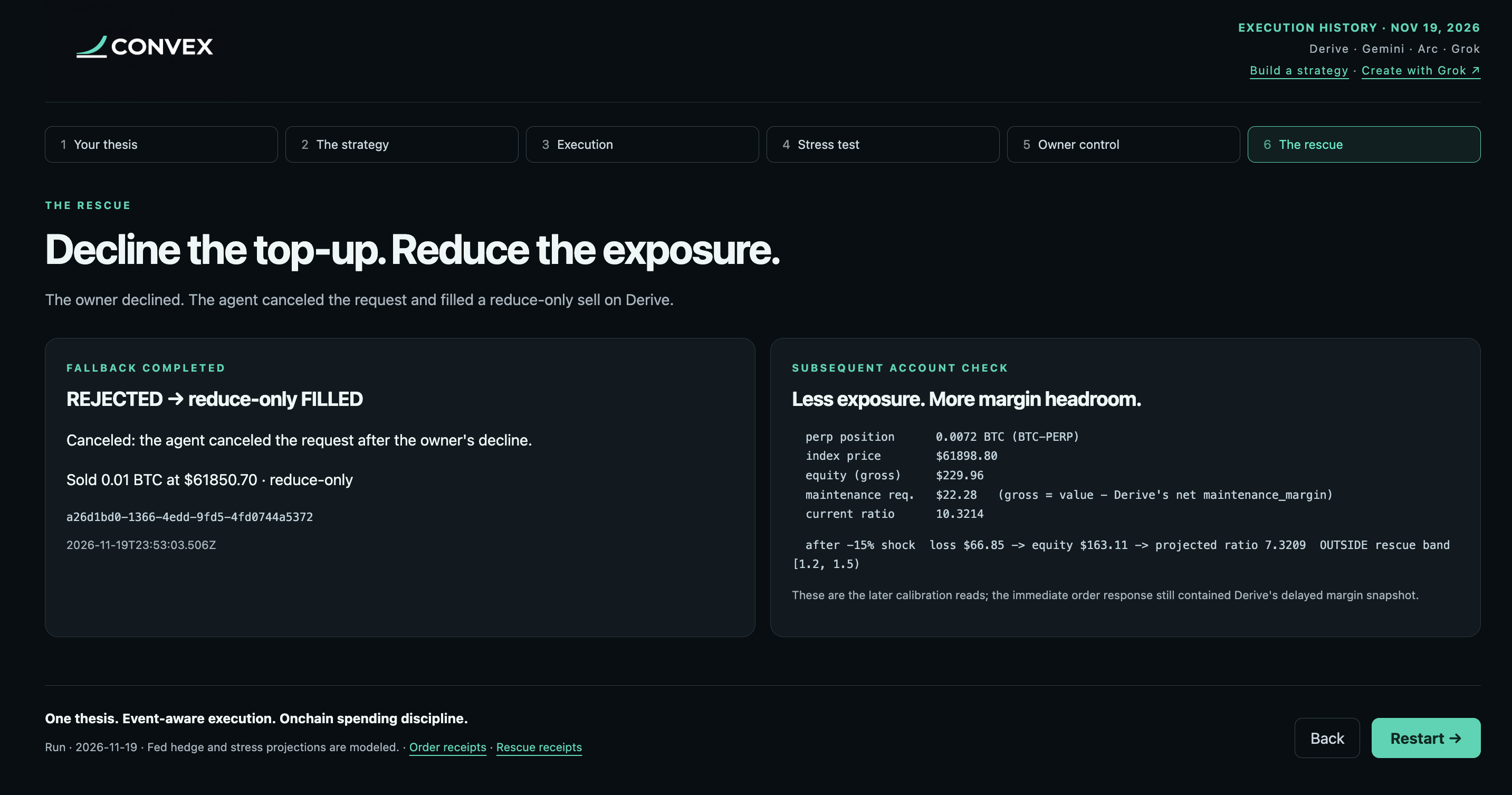
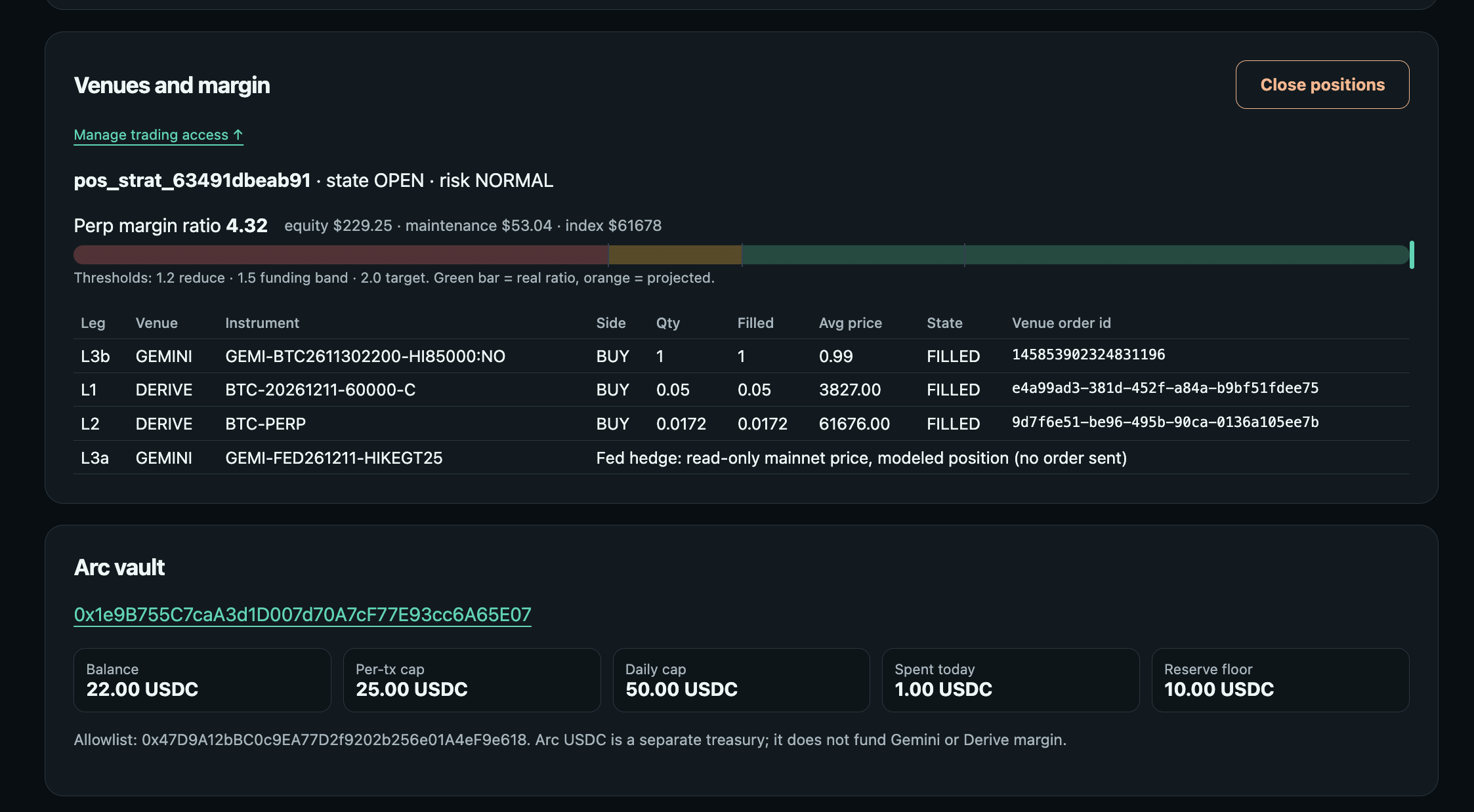
After execution, Convex monitors margin and evaluates how the position would behave under market stress. Its risk engine can request treasury support or reduce the perpetual position when the configured thresholds are crossed.
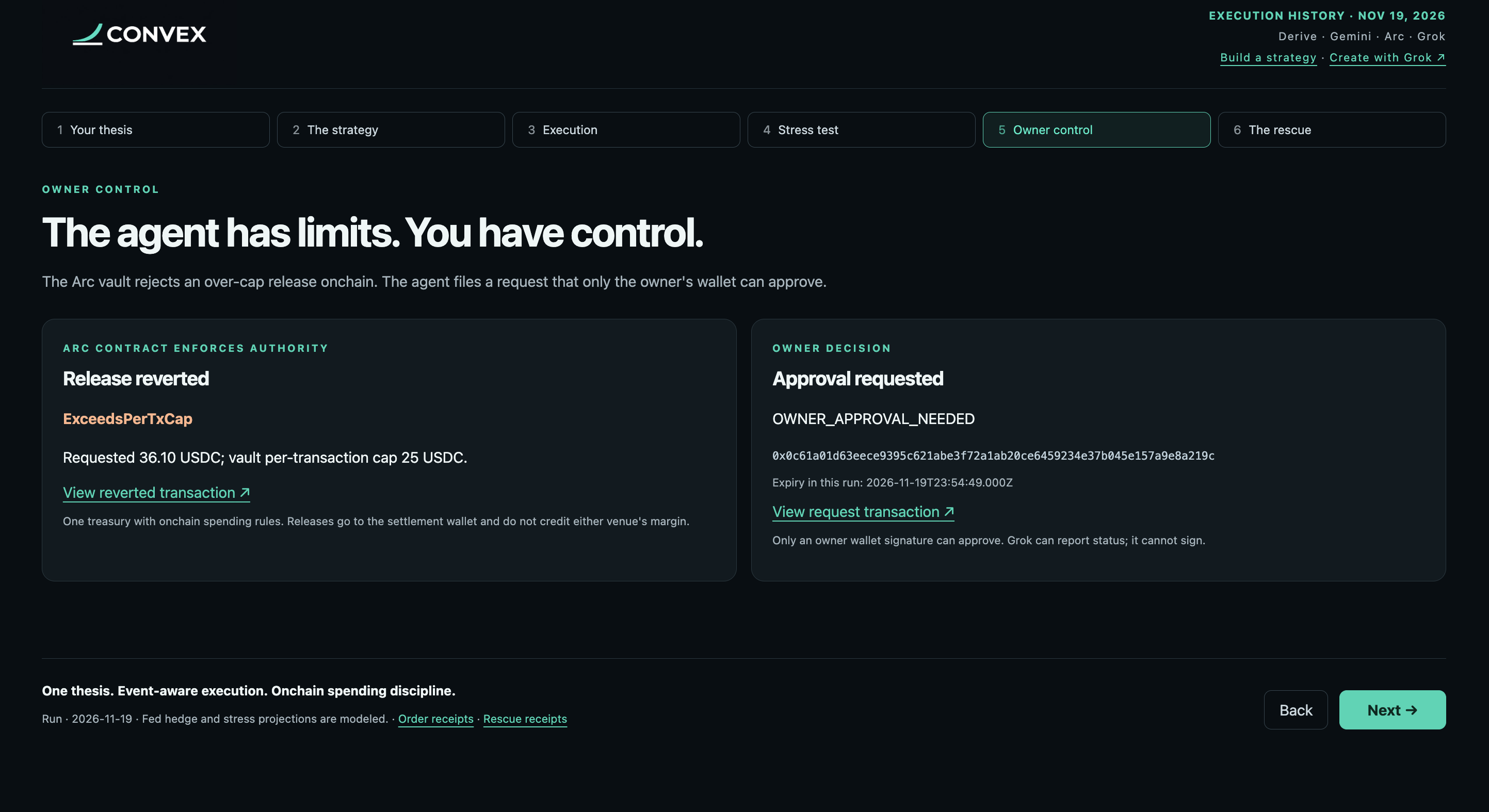
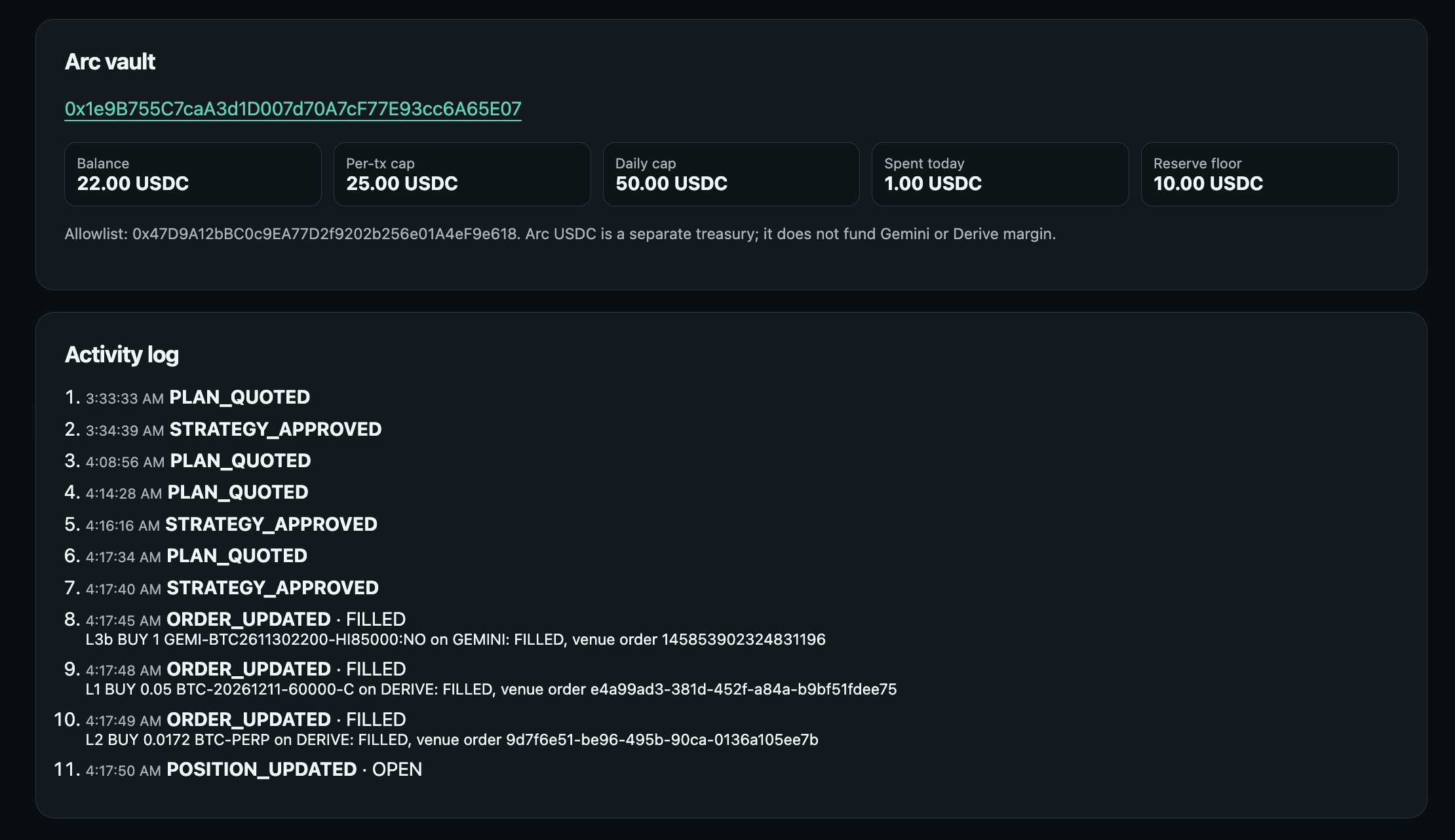
An Arc smart-contract vault enforces transfer limits and a reserve floor. Requests that exceed the agent’s authority require approval from the owner’s wallet.
The prototype operates on testnets and sandbox venues. Individual integrations have live transaction evidence; the complete coordinated workflow currently runs end to end with mocks.
How we built it
We divided development into three parallel lanes: treasury and risk, venues and strategy, and orchestration and interface. Shared TypeScript schemas gave every lane the same contracts for quotes, orders, positions, and risk decisions.
The strategy engine translates supported theses into deterministic plans. Venue adapters connect Derive testnet for options and perpetuals, and Gemini for prediction markets. Each price carries its source so users can distinguish sandbox, testnet, simulated, and read-only mainnet data.
On Arc testnet, we deployed a Solidity treasury vault with transaction, daily, and strategy spending caps, an allowlisted destination, and owner approval for larger requests.
A Fastify API coordinates the workflow, persists orders and activity in SQLite, and runs margin monitoring. The Next.js dashboard presents strategies, payoff scenarios, and a wallet-based owner approval page.
We also implemented an authenticated MCP transport so conversational clients such as Grok can call the same strategy and execution tools. Hosting and the final Grok connection remain part of our next integration step.
Challenges we ran into
Our original derivatives venue became unavailable to the team, so we moved to Derive. That required adapting instrument names, order signing, minimum sizes, and margin calculations.
The sandbox environments also exposed practical constraints. Gemini did not list the Fed event we wanted, and some Bitcoin contracts had very little liquidity. We separated the Fed leg’s read-only mainnet pricing from its simulated position and capped sandbox order sizes to available liquidity.
Reliable execution required careful handling of delayed order visibility and identifiers too large for JavaScript’s normal integer precision. We added lossless parsing, persisted order identifiers, and recovery checks to reduce the risk of duplicate submissions.
We also had to make the treasury’s role clear: an Arc release reaches a settlement wallet, while each venue maintains its own margin account. Simulated venue credit never changes the actual margin reading.
Accomplishments that we're proud of
We brought three independently developed lanes together into a working, tested workflow: thesis, quote, approval, execution, stress evaluation, treasury request, owner decision, and position reduction.
We deployed the Arc vault and collected real testnet evidence for allowed releases, over-limit reverts, owner-approved execution, and pause controls. The venue adapters also passed authenticated smoke tests on Derive testnet and Gemini sandbox.
Our automated checks cover strategy construction, risk thresholds, adapters, persistence, MCP tools, and the mock rescue flow. We’re particularly proud that spending authority is enforced by the vault contract, while the interface makes the distinction between real and simulated behavior visible.
What we learned
The hardest part of financial automation is coordinating systems with different assumptions about prices, balances, order states, and permissions.
A successful API response does not necessarily mean an order filled. A treasury transfer does not automatically improve venue margin. A modeled loss budget cannot account for every gap move.
Those lessons shaped Convex around explicit approvals, persistent records, source labels, and deterministic checks. We learned that a convincing agent needs clear boundaries around both its decisions and its authority.
What's next for Convex
Our immediate priorities are deploying the API and MCP endpoint, connecting Grok, completing local credential setup, and running a funded testnet rehearsal across all three lanes.
Next, we want to improve strategy explanations, add alerts, and make it easier to compare payoff scenarios before approving a trade. Broader instrument and strategy support will follow as we validate each integration.
Our goal is to make sophisticated execution accessible: a workflow where investors express their conviction, understand the tradeoffs, and approve a coordinated plan.
