Inspiration
We’ve all had that moment where a concept feels solid in our head, right up until someone asks us to explain it. That’s when the gaps start to show. Speaking out loud forces us to confront what we actually understand, not what we assume we understand, and that’s the core of the Feynman Technique. Feynman’s idea was simple: if you truly grasp something, you should be able to explain it in clear, everyday language, without relying on big terms or memorized lines. If you can walk through it as if you were talking to a 12-year-old, then you genuinely understand it.
What it does
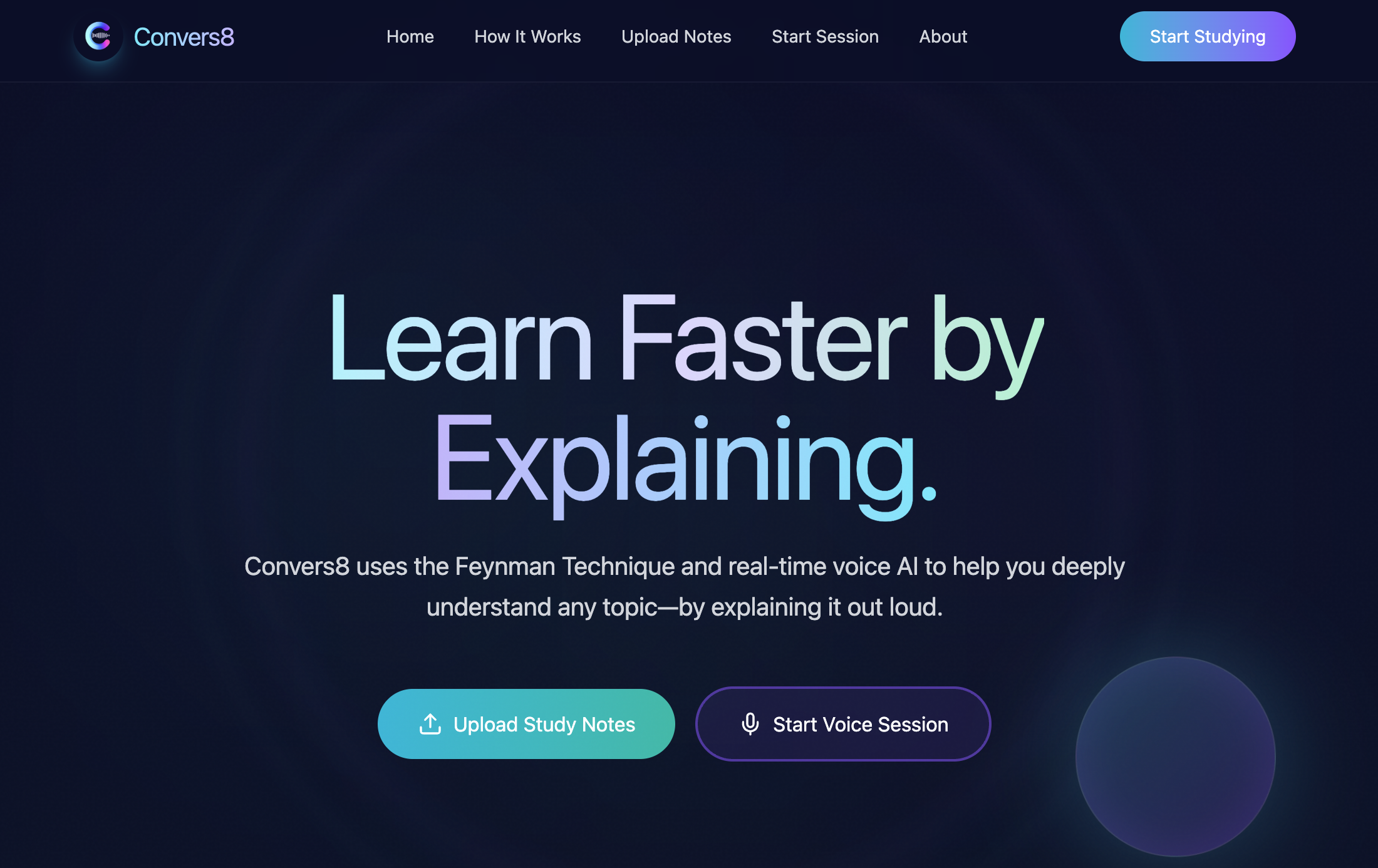
Convers8 is a voice-based Feynman learning companion that helps students understand concepts deeply by explaining them out loud. The brain remembers what it produces, not what it consumes.
You upload your notes → Convers8 extracts key ideas → it asks personalized teaching-style questions → you explain aloud → Convers8 evaluates clarity, correctness, and confidence → and asks smarter follow-ups where your understanding is weak.
How we built it
We built Convers8 by combining several systems into one seamless learning pipeline. On the frontend, React handles real-time microphone recording, animated voice feedback, and smooth UI interactions. Uploaded notes (PDF or text) are sent to the backend, where they’re parsed and summarized using Google’s Gemini model. Voice input is processed through a speech-to-text service, and the AI uses the transcript + notes summary to generate explanations or questions. Finally, responses are converted into natural spoken audio using ElevenLabs text-to-speech and are streamed back to the user. All of this runs through a FastAPI backend served with Uvicorn, connected to a modern, futuristic UI built in Next.js.
Challenges we ran into
We ran into a variety of challenges bringing Convers8 to life. Getting Gemini API versions to cooperate caused repeated 404 model errors, and PDF parsing produced inconsistent results depending on formatting. Real-time audio recording in the browser required careful handling to avoid lag, clipping, or empty submissions. Ensuring TTS playback synced smoothly with the UI meant handling base64 audio, WebM formats, and CORS issues. The biggest challenge was definitely making multiple AI systems like transcription, reasoning, summarization, and text-to-speech, all talk to each other reliably without huge delays.
Accomplishments that we're proud of
We’re super proud that Convers8 works end-to-end in a way that feels genuinely helpful. The system can accept a file, extract and summarize notes, listen to a user speak, understand what they said, generate contextual explanations, and speak back with a natural voice. Seeing the full loop function smoothly, especially the part where Convers8 asks real questions based on uploaded material, was a milestone for us. We’re also proud of how polished the UI feels, how accurate the speech recognition is, and how genuinely useful the tool feels for students who learn best by talking through concepts.
What we learned
Throughout this project we learned how much is involved in building a fluid multimodal AI experience. We gained experience with model prompting, note summarization, PDF extraction, LLM reasoning, real-time audio pipelines, and user-centered interaction design. We also discovered how sensitive AI systems are to prompt structure, how important speed is for user experience, and how explanation-based learning can reveal understanding gaps better than traditional studying. This project pushed us to think like engineers, designers, and educators all at once.
What's next for Convers8
Next, we want to transform Convers8 from a single-session learning tool into a long-term study companion that grows with each student. One of our biggest goals is to introduce Session History & Insights, allowing users to track their progress, clarity, and mastery over time. By saving explanations, summaries, and conversation patterns, Convers8 will be able to show what topics you’re improving on and which ones still need work. Along with this, we plan to build Knowledge Gap Detection—AI-powered analysis that identifies areas of confusion, highlights weak explanations, and automatically generates personalized follow-up questions or micro-lessons. We also want Convers8 to adapt more deeply by offering difficulty levels, confidence scoring, smarter question routing, and optional flashcard or quiz generation from your notes. Eventually, we hope to launch a mobile version for hands-free studying and provide dashboards that visualize understanding like a fitness app for your brain. The long-term vision is for Convers8 to become a truly intelligent learning partner—one that tracks you, supports you, and helps you grow every time you speak!


Log in or sign up for Devpost to join the conversation.