Project Story
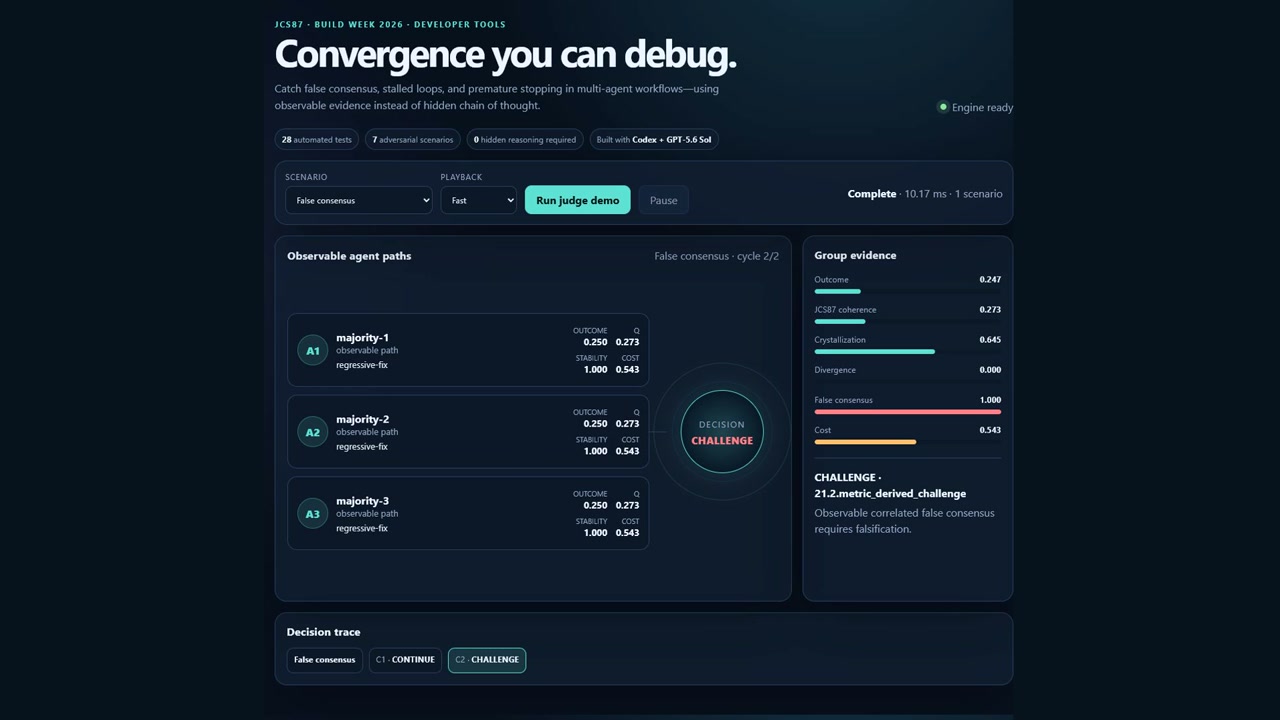
Multi-agent systems often treat agreement as evidence of correctness. But several agents can converge on the same wrong answer because they share assumptions, training patterns, tools, or failure modes. A stable consensus can therefore hide a systematic error.
JCS87 began before Build Week as a theoretical framework with preliminary exploratory observations. Its central question was: can convergence itself become observable, measurable, and debuggable?
During Build Week, I used Codex with GPT-5.6 Sol to transform that framework into an executable developer tool. I built a deterministic routing engine, observable agent adapters, an append-only event store, evaluation scenarios, ablation studies, automated tests, reports, and an interactive control room.
JCS87 does not request or reconstruct private chain of thought. It works with observable evidence such as proposed alternatives, test results, revisions, contradictions, costs, solution changes, and externally verified outcomes. From these signals, it decides whether agent paths should CONTINUE, BRANCH, CHALLENGE, MERGE, REJECT, or STOP.
The hardest part was turning the theory into operational rules without secretly encoding the expected answer inside each scenario. Routing signals therefore had to be derived from metrics and observable structures. Merge decisions required deterministic compatibility analysis, while STOP and REJECT needed explicit hard-test evidence.
The current prototype includes 28 automated tests and seven structured adversarial scenarios. These demonstrate false consensus, independently verified minority paths, premature stopping, unproductive loops, productive disagreement, stable-but-wrong outcomes, and confirmed regressions. The complete suite runs locally with Python 3.11 or newer, without an API key or third-party runtime packages.
JCS87 is currently a controlled engineering demonstration, not a claim of general scientific validation. The next step is to connect it to live multi-agent frameworks, collect repeated real-world traces, calibrate its thresholds, and compare its decisions through budget-matched blind evaluations.
The goal is simple: make convergence inspectable before consensus becomes failure.
JCS87 — Don’t trust consensus. Debug it.
Built With
- codex
- gpt-5.6

Log in or sign up for Devpost to join the conversation.