-
-
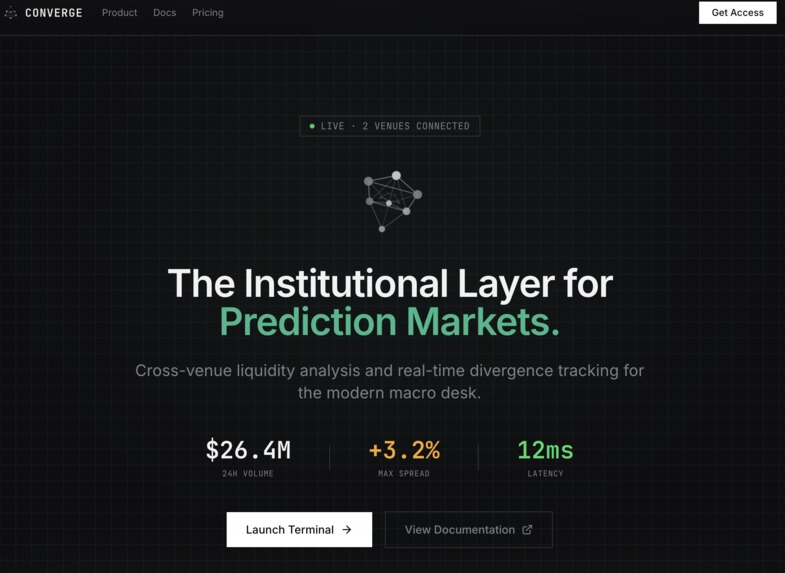
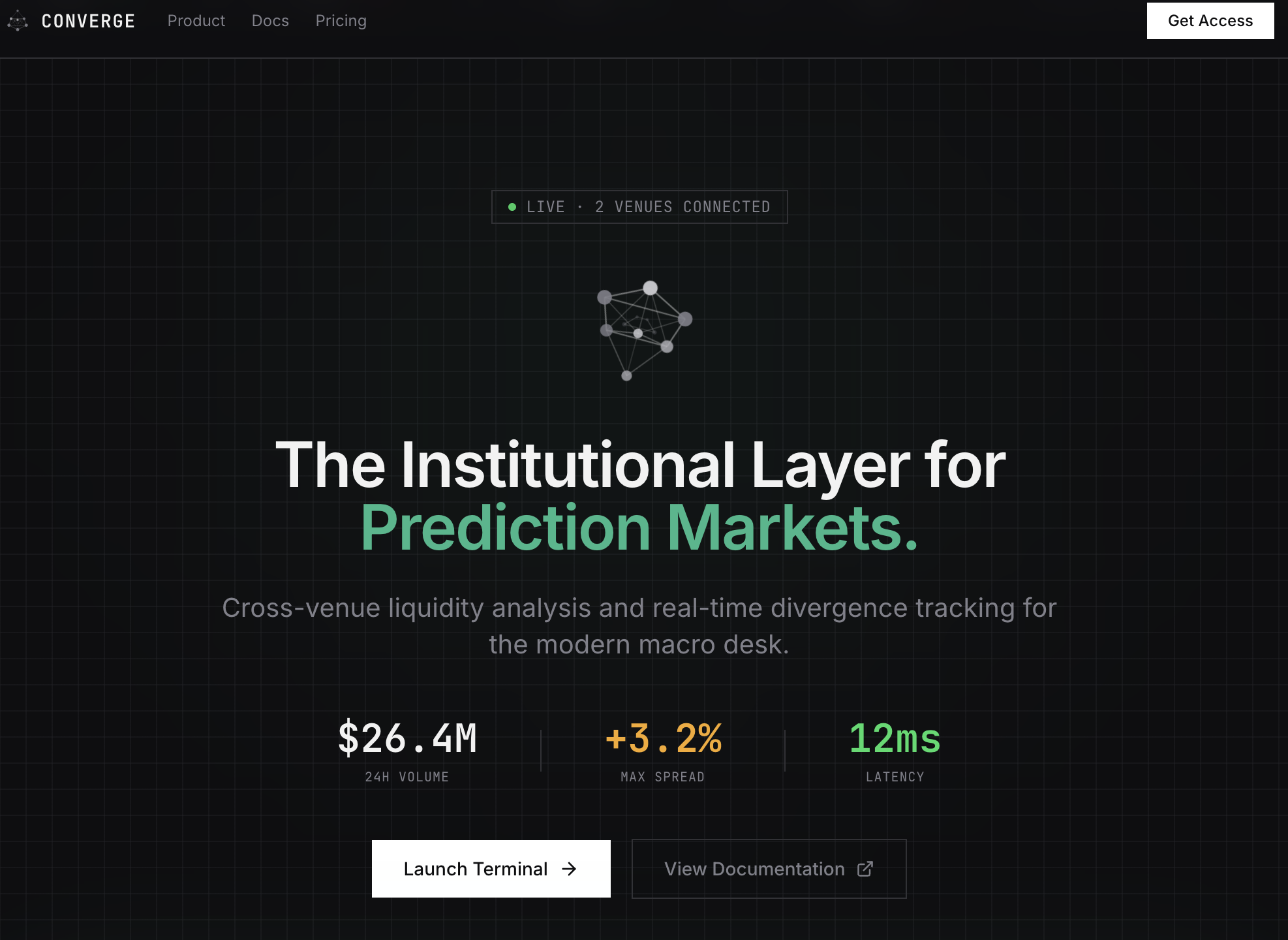
Landing page
-
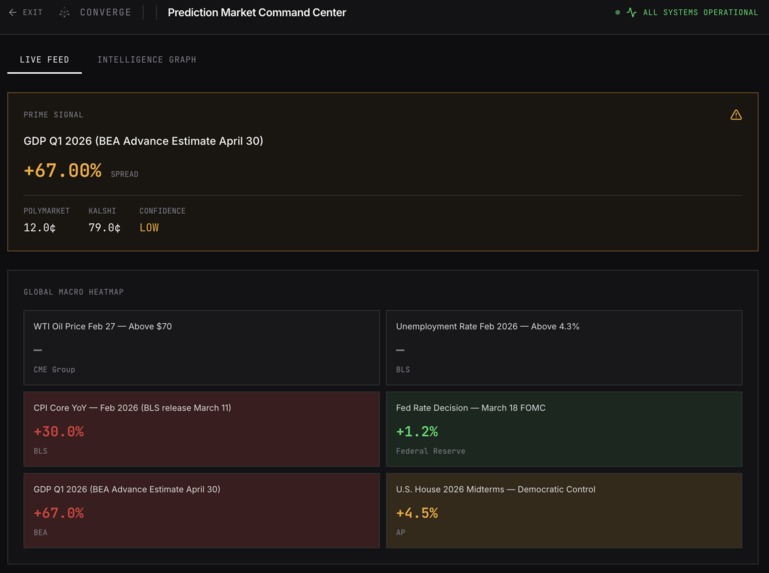
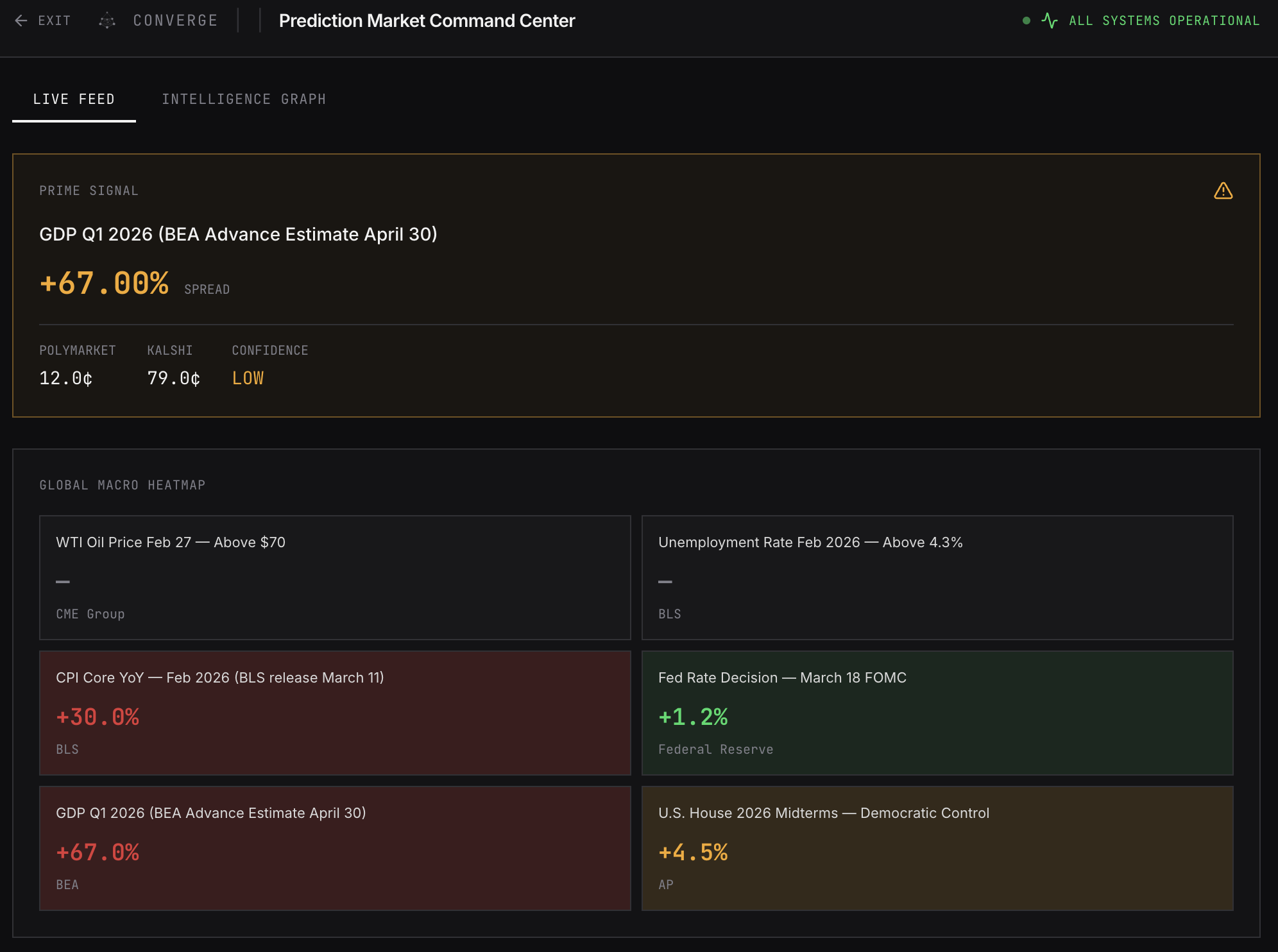
Live Feed 1
-
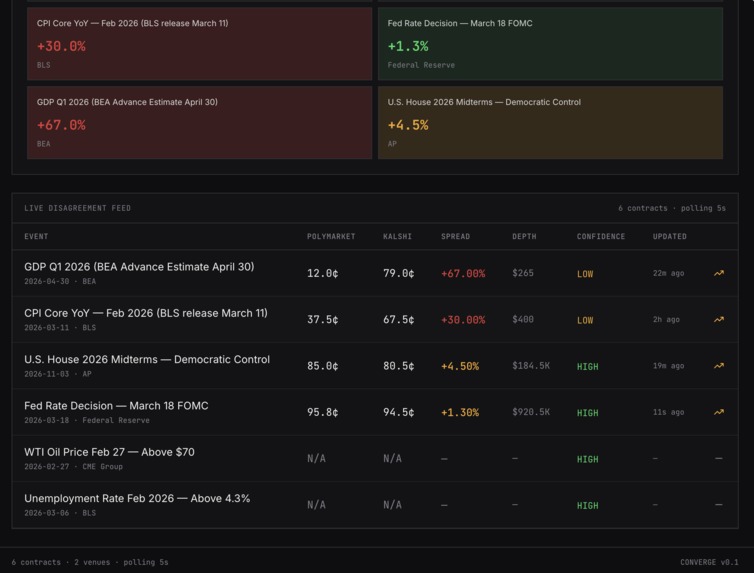
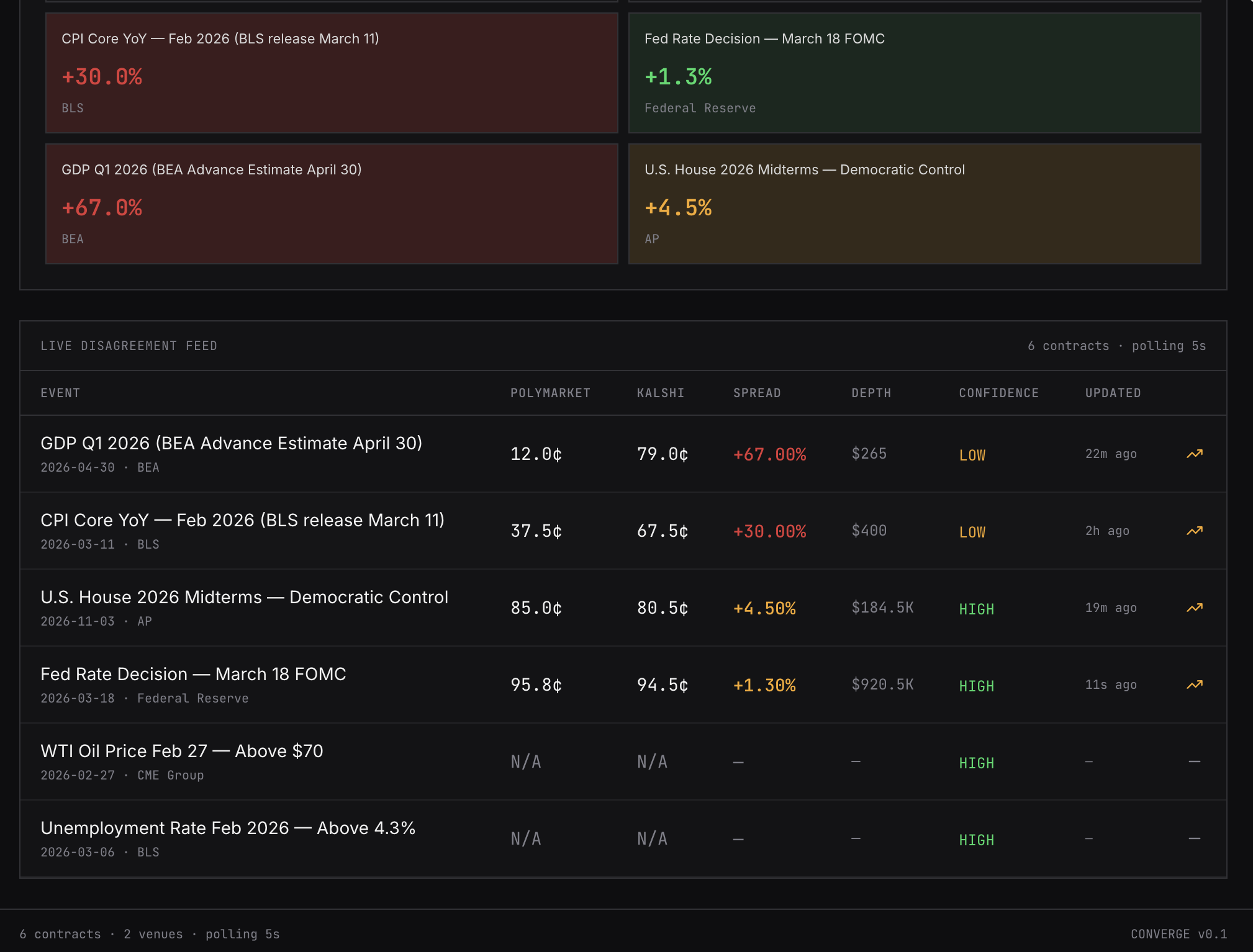
Live Feed 2
-
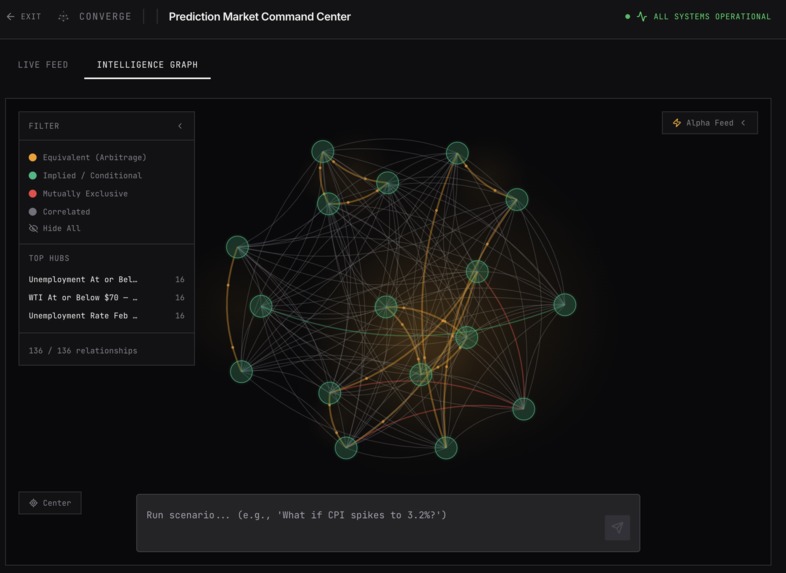
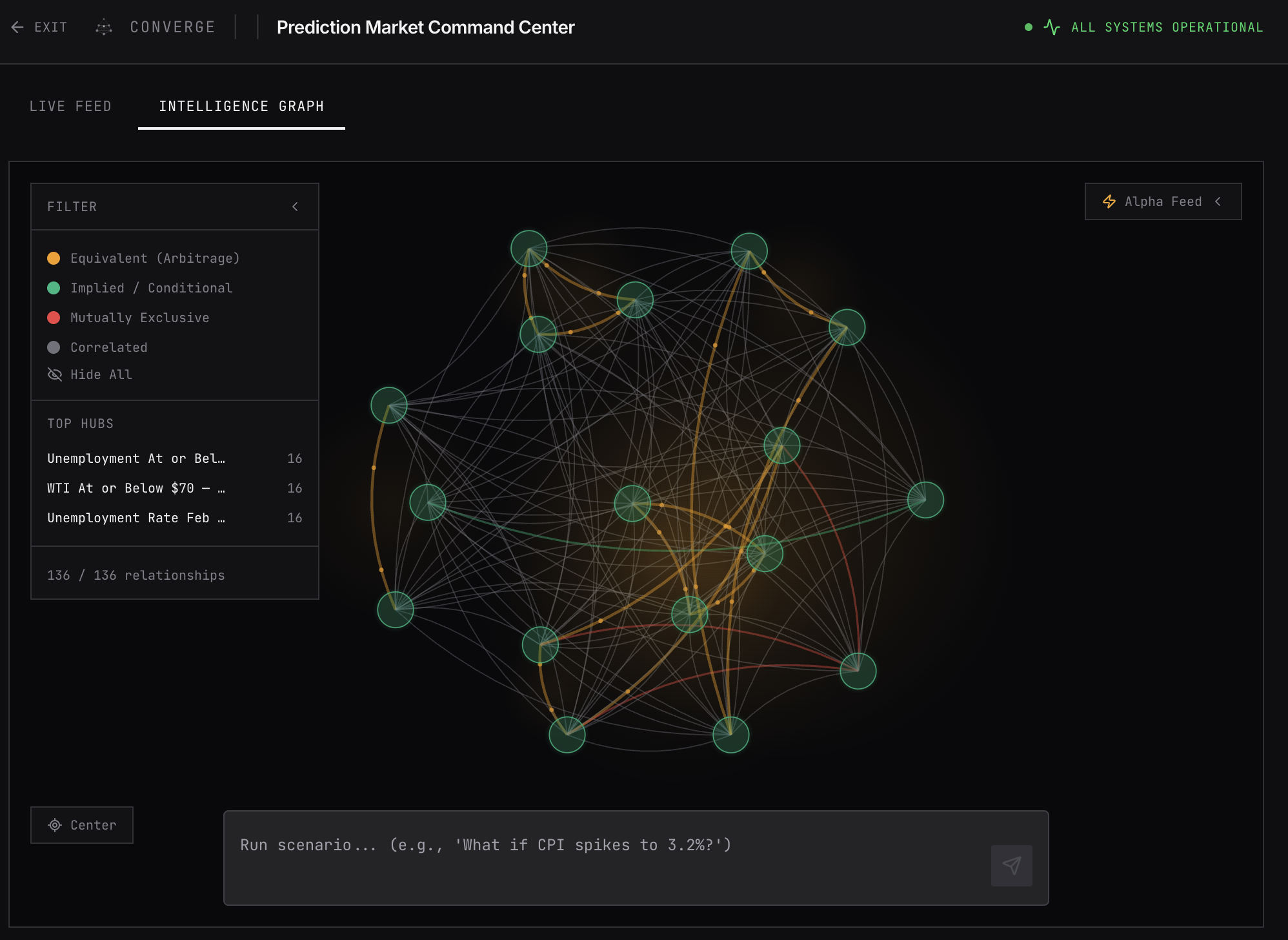
The Intelligence Graph
Inspiration
Prediction markets are powerful tools for aggregating collective beliefs, yet in practice they are highly fragmented. While exploring platforms like Polymarket and Kalshi, we noticed that many contracts describe the same real-world events using different wording, thresholds, or framing. Other markets are implicitly linked through economic or causal relationships, but these connections are invisible to users.
As a result, analysts and traders must manually monitor multiple platforms, reconcile overlapping questions, and interpret noisy signals under time pressure. We built Converge to address this gap by turning fragmented prediction markets into a unified intelligence layer that surfaces disagreement, liquidity, and hidden structure in real time.
What it does
Converge is a prediction market intelligence platform that aggregates live data from Polymarket and Kalshi into a single, real-time command center. It normalizes probabilities, liquidity, and volume across venues and highlights cross-platform disagreements where markets diverge on the same underlying event.
Beyond aggregation, Converge introduces market relationship detection, identifying when contracts are equivalent, mutually exclusive, implied, or correlated. The result is a professional terminal that transforms raw prediction market data into actionable insights for high-stakes decision making.
How we built it
- Backend: We built resilient Node.js WebSocket connectors for Polymarket and Kalshi, including authentication, heartbeat management, batching, and exponential backoff for reconnects.
- Data Layer: We used Supabase (Postgres + Realtime) to store a unified event stream, analytical views, and demo markets for relationship inference.
- Relationship Detection: A rules-first engine combines semantic similarity (via embeddings), regex-based threshold and negation detection, and macroeconomic heuristics to classify relationships between contracts.
- Frontend: A Bloomberg-style terminal UI built with Lovable, optimized for high-density information, real-time updates, and professional workflows.
- Deployment: The frontend is deployed on Vercel, while the backend runs independently as a persistent data ingestion service.
Challenges we ran into
One major challenge was handling real-time data sparsity and asynchrony. Kalshi markets often update infrequently, especially outside trading hours, which required careful handling of null values, stale data, and confidence indicators to avoid misleading users.
We also faced challenges in normalizing heterogeneous data sources. Polymarket and Kalshi expose different APIs, market structures, and liquidity metrics, requiring a carefully designed unified schema that preserved meaning across platforms.
Ensuring WebSocket reliability was another hurdle, including authentication quirks, heartbeat handling, and reconnect logic for long-running processes.
Finally, designing relationship detection that was both explainable and demo-ready required balancing sophistication with transparency. We intentionally prioritized interpretable rules and confidence scores over opaque models.
Accomplishments that we're proud of
- Building a fully functional real-time prediction market terminal from scratch
- Successfully aggregating and normalizing live data from two independent platforms
- Designing an intuitive UI that makes market disagreement immediately visible
- Implementing an explainable relationship detection system for fragmented contracts
- Deploying a production-ready frontend and backend within a hackathon timeframe
What we learned
We learned that prediction markets are not just trading venues, but rich information systems whose value is often hidden by fragmentation. Unlocking their potential requires infrastructure that treats probabilities as first-class data and emphasizes context, relationships, and trust.
We also gained hands-on experience building resilient real-time systems and learned how critical explainability is when working with probabilistic intelligence.
What's next for Converge: The Intelligence Layer for Prediction Markets
Next, we plan to expand relationship inference across all live markets, add alerting and APIs for institutional users, and incorporate agentic analysis to continuously interpret market movements. Longer term, Converge aims to become the standard intelligence layer for consuming and operationalizing prediction market data.

Log in or sign up for Devpost to join the conversation.