Converge AI — Project Story
Inspiration
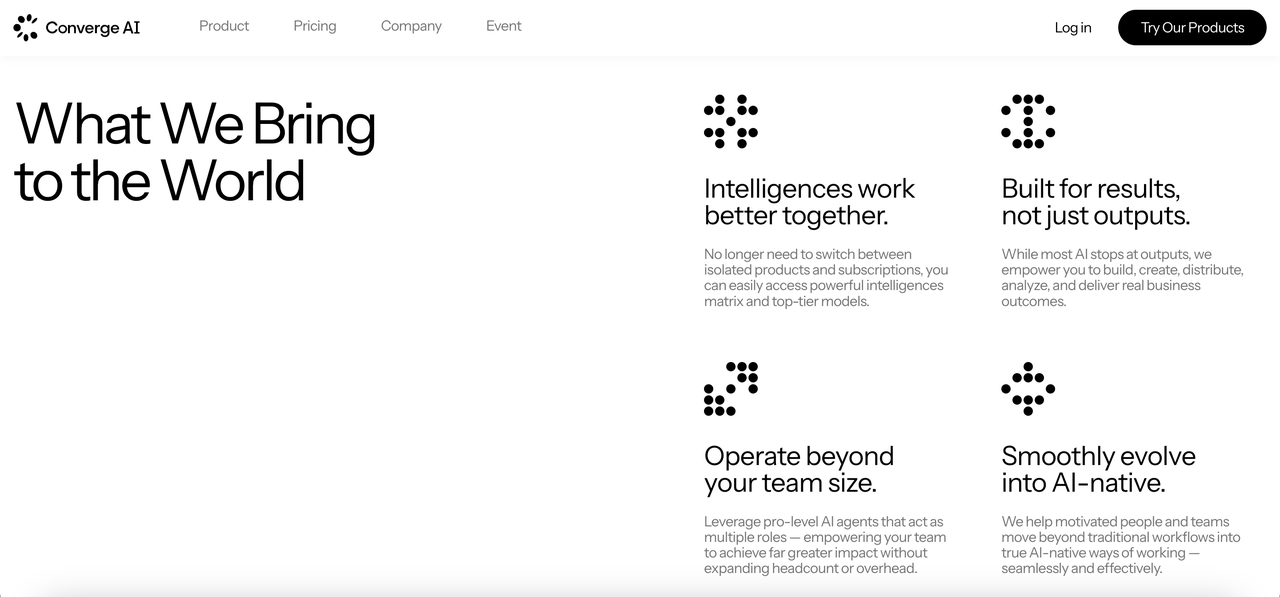
Converge AI was inspired by a simple but growing frustration: modern teams and builders rely on too many disconnected AI tools. Writing happens in one app, coding in another, design in a third, and automation somewhere else. This fragmentation slows down execution and creates context loss between tools.
We wanted to reimagine this experience as a single AI-native workspace, where different intelligent agents collaborate just like a real team—sharing the same understanding of business context.
What We Learned
During development, we learned that the real power of AI is not just in generating outputs, but in maintaining shared context across tasks.
We also discovered:
- Single-agent systems are limited when handling complex workflows
- Multi-agent collaboration introduces challenges in coordination and consistency
- Context management is more important than model selection in real-world applications
How We Built It
Converge AI was built as a modular AI agent system:
- Frontend: A real-time web interface designed for multi-workspace collaboration
- Backend: API-driven architecture for handling agent requests and orchestration
- AI Layer: Multiple specialized agents:
- General-purpose Agent (reasoning + coordination)
- Coding Agent (software generation and debugging)
- Design Agent (creative and visual generation)
- Context Engine: A shared memory layer that keeps all agents aligned on user goals and project state
- Infrastructure: Cloud-based deployment with scalable services to handle concurrent AI workloads
Each agent operates independently but communicates through a unified context system, allowing them to collaborate like a coordinated team.
Challenges We Faced
1. Context Consistency Across Agents
One of the hardest problems was ensuring that all agents interpret the same context correctly. Early versions suffered from inconsistencies where agents would produce conflicting outputs.
2. Multi-Agent Coordination
Orchestrating multiple AI agents introduced complexity in task delegation, sequencing, and dependency management.
3. Latency vs. Intelligence Tradeoff
More powerful reasoning required heavier computation, which sometimes impacted responsiveness. Balancing speed and quality was critical.
4. Designing for Simplicity
Although the system is complex under the hood, the user experience needed to remain simple. We iterated heavily to hide complexity behind a clean, intuitive interface.
Closing Thoughts
Converge AI is an attempt to move beyond isolated AI tools toward a true AI-native operating environment, where agents, humans, and context work together seamlessly.
We believe the future of work is not single AI assistants—but collaborative AI systems that act like teams.
Built With
- apis
- context
- fullstack

Log in or sign up for Devpost to join the conversation.