Inspiration When we started brainstorming ideas for OpenAI Build Week, we noticed that most AI assistants provide only one answer to a question. However, in real life, important decisions usually involve different opinions and trade-offs. Developers discuss architecture with teammates, founders evaluate ideas with investors and marketers, and students seek advice from professors and industry professionals before making decisions. This inspired us to build Convene, a platform where multiple AI experts work together instead of relying on a single response. Our goal was to make AI decision-making more transparent by allowing different AI personas to analyze a problem, challenge each other's reasoning, and reach a final consensus.
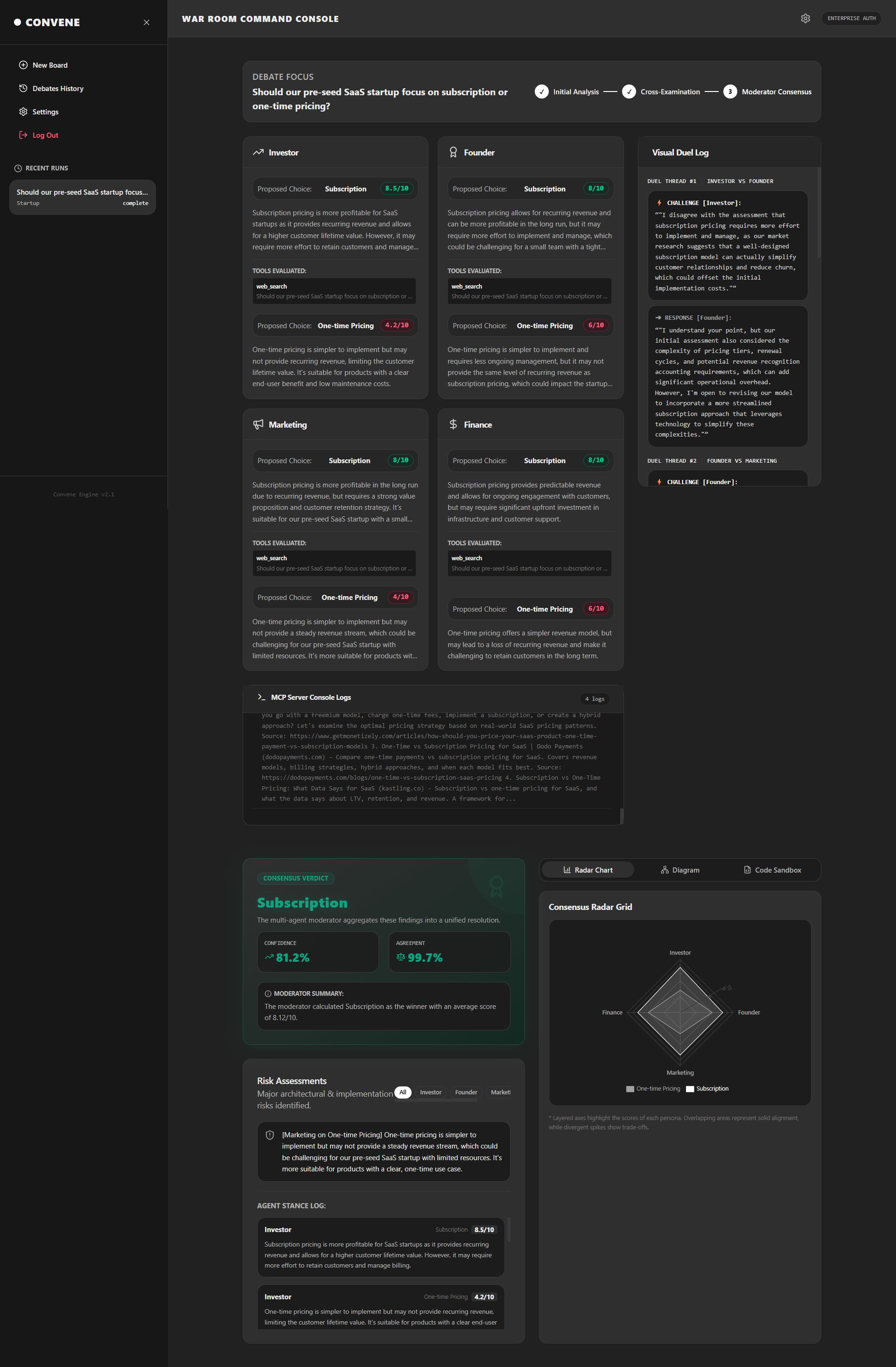
What it does Convene is an AI multi-agent decision engine that helps users make better decisions by simulating a discussion between multiple AI experts. The user starts by entering a problem, selecting a preset such as Developer, Education, or Startup, and providing the available options. Convene then creates a team of AI personas relevant to that domain. Each persona independently evaluates the options, gathers supporting information using external tools, and presents its reasoning. Instead of stopping there, the agents also participate in a cross-examination phase where they question each other's arguments before a moderator combines the strongest points into a final recommendation. The user can also view confidence scores, agreement levels, risk assessments, and the complete reasoning process behind the final decision.
How we built it We built Convene as a modular multi-agent system. The backend uses LangGraph to orchestrate the debate workflow while FastAPI provides the API layer and streaming support. Different AI personas are loaded dynamically through a shared registry, allowing the same orchestration engine to support multiple domains without changing the core logic. To make the discussions more reliable, we integrated MCP tools that allow agents to gather external information before making their arguments. After every agent finishes its analysis, a deterministic scoring system calculates the final consensus instead of relying on another language model to pick a winner. The frontend was designed as a "War Room Command Console" where users can follow the complete discussion, tool usage, cross-examination, and final consensus in a single interface. Throughout the project, we used OpenAI Codex and GPT-5 as development partners. They helped us review architecture, implement backend modules, generate tests, improve prompts, and speed up the overall development process.
Challenges we ran into One of the biggest challenges was coordinating multiple AI agents while keeping the architecture flexible enough to support different domains. We wanted the same orchestration engine to work for Developer, Education, and Startup presets without hardcoding any logic. Another challenge was integrating external tools into the debate while keeping the reasoning traceable and consistent. We also spent considerable time integrating independently developed backend modules and making sure every component worked together correctly. Automated testing and clear interfaces between modules helped us solve these problems.
Accomplishments that we're proud of We are proud that we built a complete multi-agent system instead of a traditional chatbot. The final platform supports multiple expert teams, structured debates, cross-examination, external research, and transparent consensus generation. We're also proud of the frontend experience. Instead of presenting AI responses as a simple chat interface, we created a dashboard where users can watch the debate unfold and understand why the final recommendation was made.
Finally, we successfully integrated the entire backend into a single working system and verified it through comprehensive testing before building the frontend.
What we learned This project taught us that building multi-agent systems is very different from building applications around a single language model. Good orchestration, modular design, and clear communication between components are just as important as prompt engineering. We also learned how valuable automated testing and well-defined interfaces become when several people are developing different parts of the same project simultaneously.
What's next for Convene We plan to expand Convene beyond the three presets included in this project. Future versions could support domains such as healthcare, finance, legal advice, and enterprise decision-making. We also want to make the debates more interactive by allowing users to ask follow-up questions during the discussion, customize their own expert teams, and integrate additional MCP tools for richer external research. Our long-term goal is to make Convene a platform where people can confidently explore complex decisions with the help of multiple AI experts rather than relying on a single AI response.
Built With
- auth
- fastapi
- langgraph
- lucide-icons
- next.js-15
- postgresql
- python-3.11+
- supabase
- tailwindcss
- typescript

Log in or sign up for Devpost to join the conversation.