Inspiration
In a world where social media has made it easier than ever to stay connected, meaningful connection can still feel surprisingly difficult to find. Many people have fewer close relationships than they want, with 18% of U.S. adults reporting that they have never had a close friend. Prolonged social isolation can negatively affect both physical and mental well-being.
The problem isn't always a lack of people. It's the friction between wanting to connect and actually making it happen. Meeting someone you genuinely click with requires several things to line up: shared interests, compatible schedules, location, and someone willing to take the initiative.
Convene was created to remove that friction. By helping people discover others they're likely to connect with and effortlessly find a time and activity that works for everyone, Convene turns potential connections into real-world experiences.
What it does
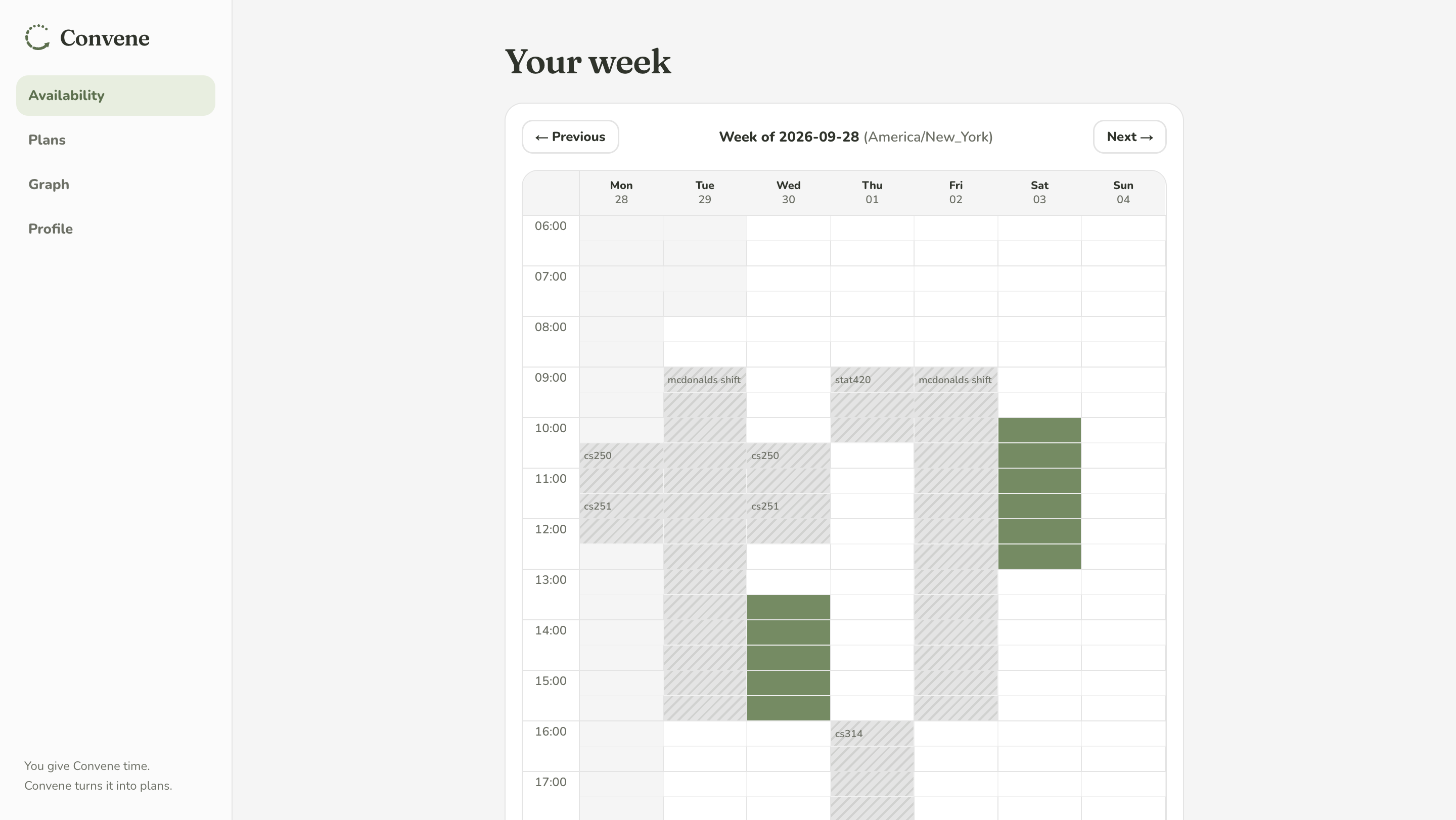
Convene turns your free time into small, real-life hangouts. You mark the hours you're free on a weekly grid and every night, Convene plans ahead and creates hangouts in your city. It picks:
- a group of 2 to 10 people who share your interests
- an activity you'd all enjoy
- a real venue
- the exact time, at least 48 hours ahead
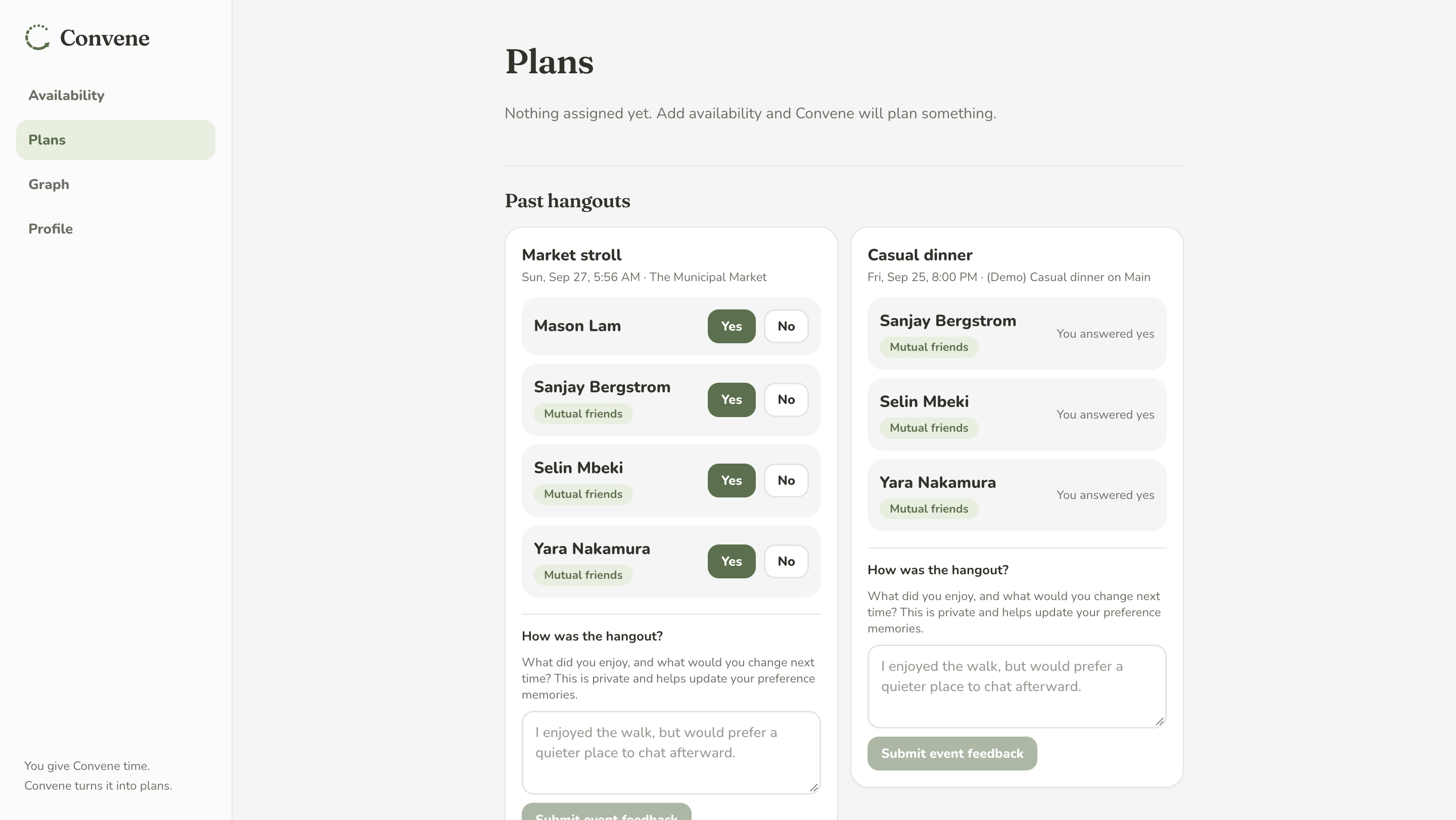
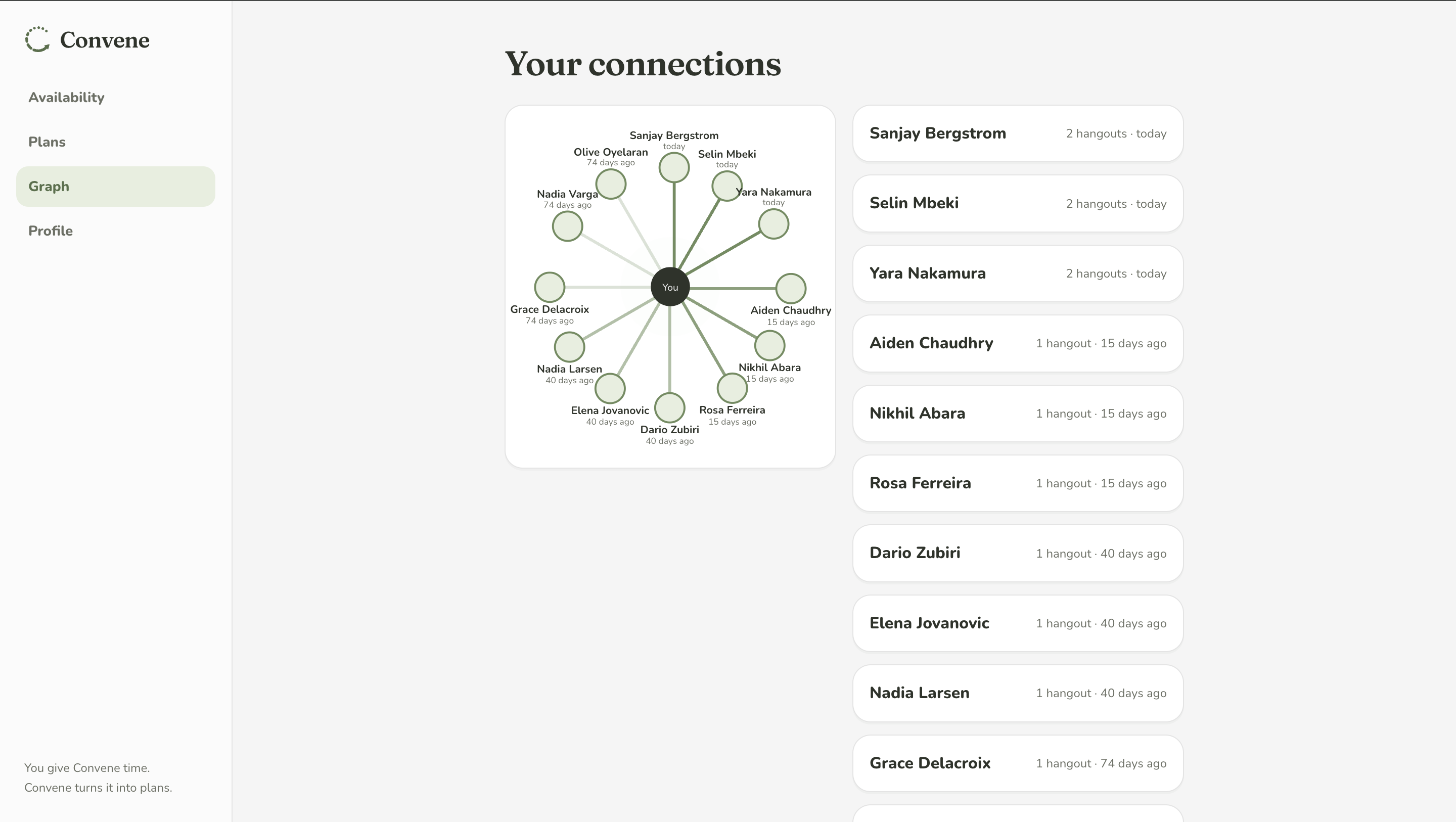
You get a push notification, Convene has created a plan for the group including the activity and venue, and you just show up. After each hangout, Convene will ask you for feedback including "would you meet them again?" When two people both say yes, they become friends. Convene will maintain these friendships by prioritizing creating plans that include friends who haven't connected on the app in a long time. Over time, users will continue to build large friends list and can visualize their friendships via Convene's connection graph.
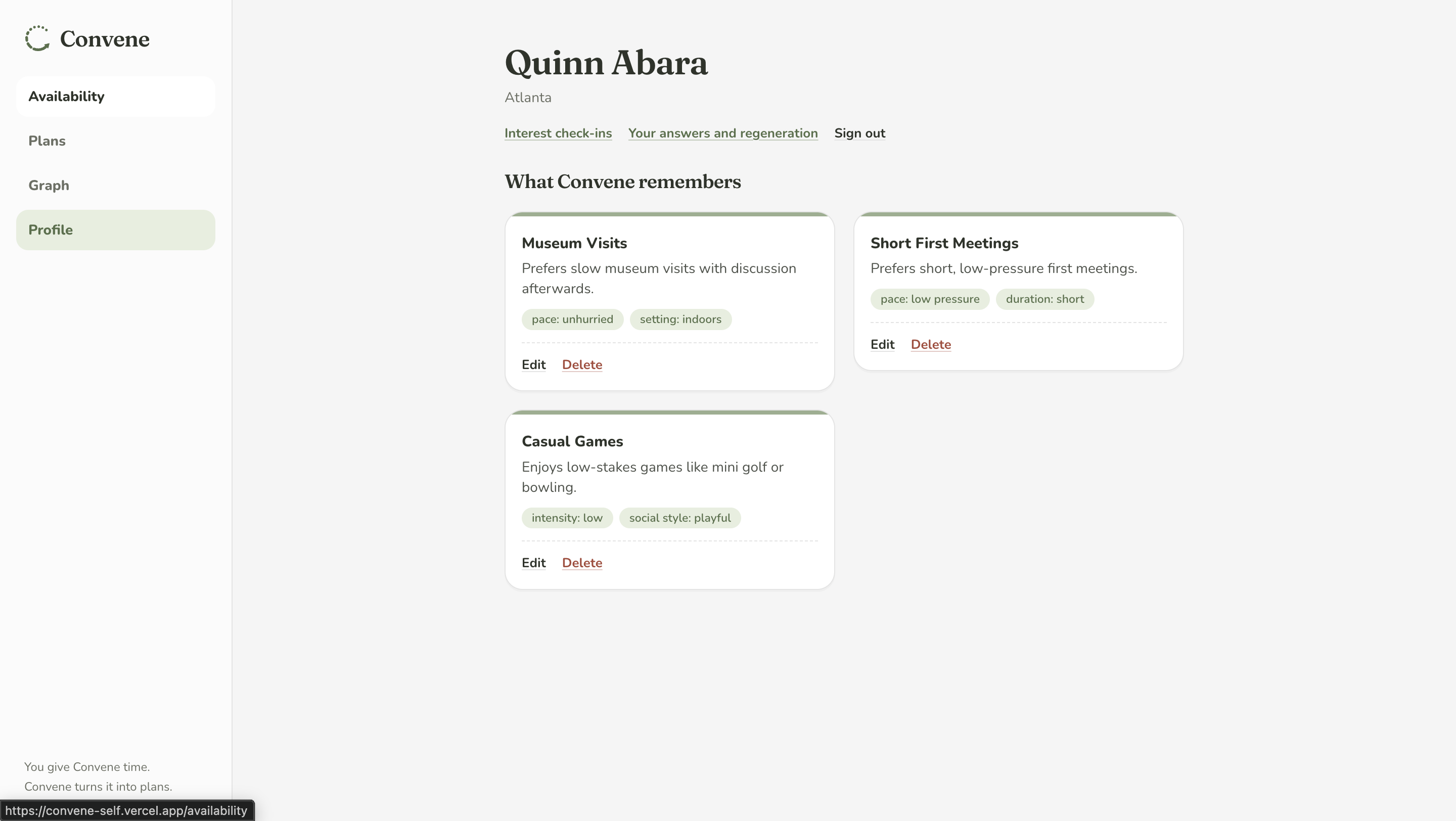
Users build their initial profile on Convene by first answering some surface level interests such as video games or sports. Then Convene asks the user more detailed open-ended questions. User responses to these questions are used to build their memory profile which is not fixed to specific categories instead being adaptable preventing important details from being lost. This memory profile is updated by user feedback on events they attend, and responses to interest notifications. Periodically Convene will search for relevant current or future local events and send notifications to users gauging their interest. User responses to these will continue to build and improve their memory profile.
How we built it
- App: Next.js 16 and React 19, built as a mobile-first installable web app, styled with Tailwind CSS. Data and sign-in: Supabase for Postgres and authentication, with pgvector for embeddings.
- AI: Meta Muse Spark turns your onboarding answers into editable "memories" and ranks activities. Gemini embeddings match people on shared interests.
- Integrations: Google Calendar for busy times and plan sync, Google Places for venues, and Web Push for notifications.
- Memory Profiles: Meta Muse Spark takes user onboarding answers, event feedback, and interest notification responses to generate adaptable memory schema avoiding the pigeonholing that comes with fixed attributes.
- Matching Pipeline: Gemini embeddings of each user's memory profile is used to select clusters of people with similar to interests to be paired for an activity.
- Activity Selection: Meta Muse Spark analyzes each person in the group's user profile using their memory profile and then selects an event that best fits.
- Location Selection: The Google Places API is then used to find a venue that can host the activity checking both business open and close times.
Challenges we ran into
- Grouping people fairly: splitting overlapping availability into fair groups of 2 to 10, without double-booking anyone.
- Time zones: keeping them correct across daylight-saving changes.
- Trusting AI output: treating everything the model returns as a suggestion to check against the activity catalog, never as the final answer.
Accomplishments that we're proud of
The whole loop works from end to end: you mark your free time, get matched, receive a notification, meet up, give feedback, and gain a friend. The memory profile continually updates through user feedback and interactive interest notifications.
What we learned
We learned that an LLM alone isn’t enough to build a reliable product. Muse Spark helps interpret preferences and suggest activities, but useful plans require real-world data from APIs like Google Places, scheduling constraints, and validation. Guardrails, grounded sources, and fallback logic turn a plausible AI suggestion into something people can actually use.
What's next for Convene
- Online meetup support
- Richer activity catalogs
- Smarter reconnection for friends who haven't met in a while
- Reservations at venues
Built With
- gemini
- google-gmail-oauth
- google-places
- meta-muse-spark
- mobile
- next
- pgvector
- postgresql
- pwa
- supabase
- svg
- tailwind
- vercel
- zod

Log in or sign up for Devpost to join the conversation.