
Inspiration
Long-horizon agents fail in one predictable way: they keep going. They retry until something gives, they double-execute under crashes, and when a step fails they narrate success anyway. Enterprises don't need a smarter agent as much as they need a control plane that makes those failure modes impossible.
What it does
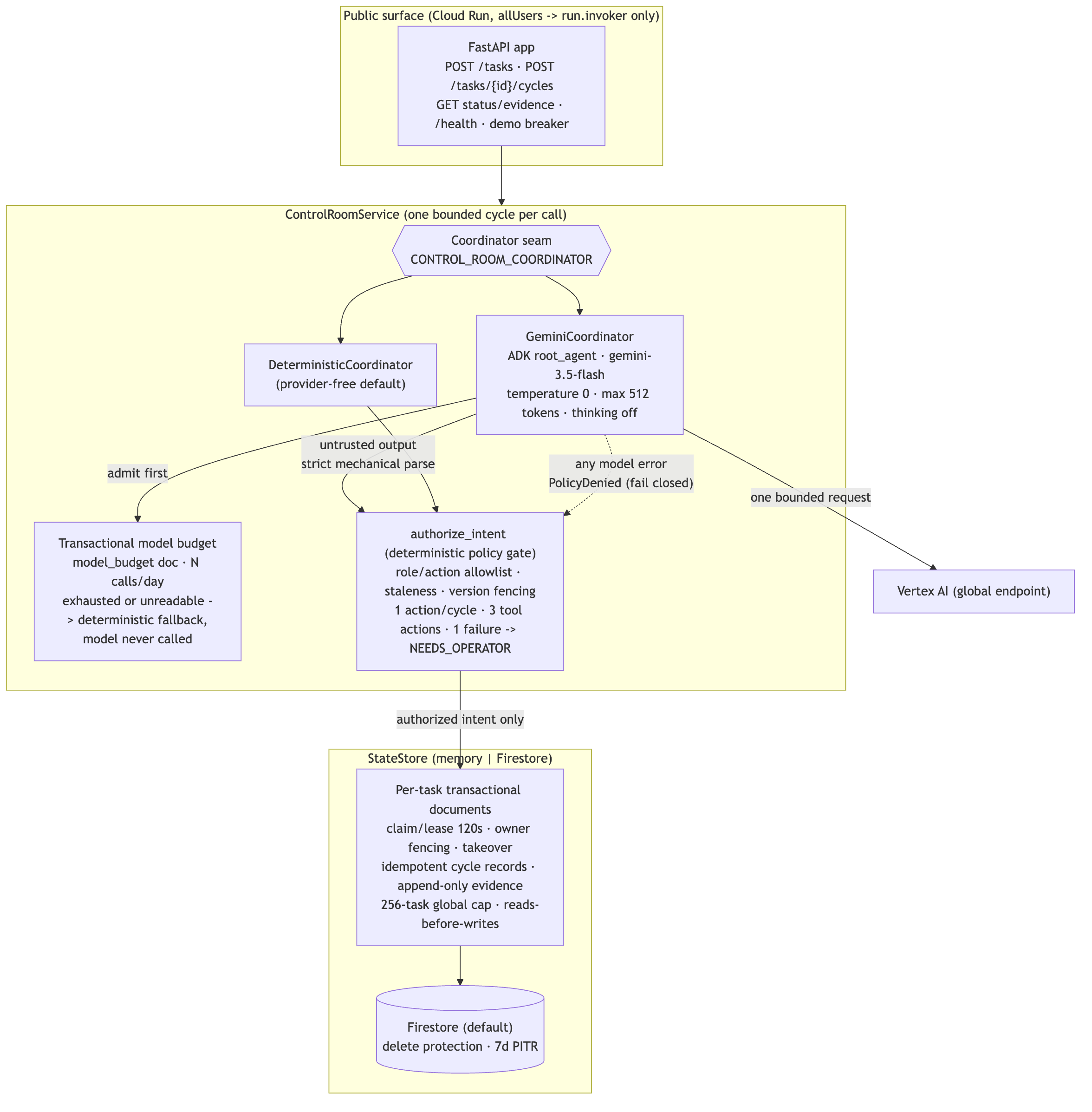
Control Room runs institutional agent work as bounded, policy-authorized, exactly-once cycles over durable state:
- A coordinator (Gemini 3.5 Flash via Google's ADK, behind a swappable seam with a provider-free deterministic default) proposes the next step for a task.
- A deterministic policy gate (
authorize_intent) is the only authority: role and action allowlists, staleness and version fencing, one action per cycle, three tool actions and one failure per task — then the task parks inNEEDS_OPERATORfor a human. - A transactional state layer (Firestore) makes each cycle exactly-once under real concurrency: claim documents with 120-second fenced leases, atomic takeover of expired claims, idempotent replay of a crashed worker's bound intent, append-only evidence, and a global task cap.
- Verification is separated from work: a
PASSrequires per-check verification evidence from a registered verifier distinct from the worker. - The public demo endpoint serves synthetic data only, by construction (store-level validation of provenance and titles).
How the fleet stays fortified (criteria mapping)
Innovation & operational utility (40%)
The novel piece is the cost-and-trust boundary around the model:
- Model output is treated as untrusted input end-to-end. The Gemini
coordinator strict-parses responses into a bounded choice, rebuilds every
infrastructure field locally, and still routes the result through the same
policy gate as deterministic proposals. A malformed or failed model response
can only produce
NEEDS_OPERATOR— never fabricated progress. - A transactional model-call budget document admits every model call before it happens (default 50/day). Budget exhausted or unreadable → the coordinator answers deterministically without calling Vertex. An anonymous public endpoint that structurally cannot amplify model spend removes a real operational blocker to exposing agents at all.
- Idempotency keys make client retries free: replays return the recorded result without re-invoking the model.
Architectural discipline & tech stack (30%)
- Python 3.12, FastAPI, Pydantic strict models everywhere; mypy
--strict, ruff, gitleaks, and 250 unit tests green; locked dependencies (uv.lock). - State machine semantics proven twice: against an in-memory fake for speed, and via an opt-in integration suite against the real Firestore emulator that replays the concurrency-critical paths (claim/lease/takeover/fencing/ idempotency/caps) — the real client also machine-enforces the all-reads-before-all-writes transaction discipline the fake cannot check.
- Decoupling: coordinator seam (deterministic ↔ Gemini), state seam (memory ↔ Firestore), transport seam (fake ↔ ADK/Vertex) — each swap is one environment variable, and every seam fails closed.
Demo & production readiness (30%)
- Live on Cloud Run (europe-west1), public invoker only,
maxScale 1, dedicated runtime service account with least-privilege roles. - Supply chain: images built by Cloud Build with SLSA provenance
(
requestedVerifyOption: VERIFIED); the provenance's source-material SHA-256 matches the submittedgit archivehash; Artifact Registry vulnerability scanning enabled; deploys are by digest only with prior revisions kept ready as instant rollbacks. - Observability:
severity>=ERRORlog alert emailing the owner; billing export dataset in BigQuery; alert-only budget on the project. - Reproducibility: the README spin-up was re-run from a fresh clone before submission (install → tests → lint → typecheck → live normal + breaker smokes). An audit ledger outside the repo records every cloud mutation and the metadata of every bounded model request (never response bodies).
Technologies
Google ADK (google-adk), Gemini 3.5 Flash on Vertex AI (global endpoint),
Cloud Run, Firestore (native mode, delete protection + 7-day PITR), Cloud
Build + Artifact Registry (SLSA provenance, vulnerability scanning), Cloud
Monitoring/Logging, BigQuery, FastAPI, Pydantic, uv, pytest, mypy, ruff,
gitleaks.
Data sources
Synthetic data only. Task titles are store-validated to a synthetic_*
pattern; evidence references are metadata-only opaque tokens. No real
institutional data touches the system.
Prior-work disclosure (required reading for judges)
Control Room is a new standalone repository created during the contest
window. It deliberately builds on design concepts from the author's earlier
private project hermes-operator-controls — specifically metadata-only
telemetry, bounded tool/failure budgets, and typed verification evidence.
Those ideas were reimplemented from scratch here; no code was copied from
the prior repository. All Gemini usage, cloud spend, and deployments during
development were bounded by a written authorization contract and recorded in
an audit ledger.
What we learned
- The emulator-backed suite caught what no fake could: real Firestore rejects reads placed after writes in a transaction, and real commits abort under contention — retry-purity is a design constraint, not a nicety.
gemini-3.5-flashis not served from every Vertex region; model access belongs on theglobalendpoint while data and compute stay regional.- A "one bounded canary request" discipline (retries=0, temperature 0, thinking disabled, metadata-only recording) turns model integration from a leap of faith into an auditable step.
What's next
Multi-tenant actor registries, verifier pools with quorum policies, and a
first-class operator console for the NEEDS_OPERATOR queue.

Log in or sign up for Devpost to join the conversation.