-
-
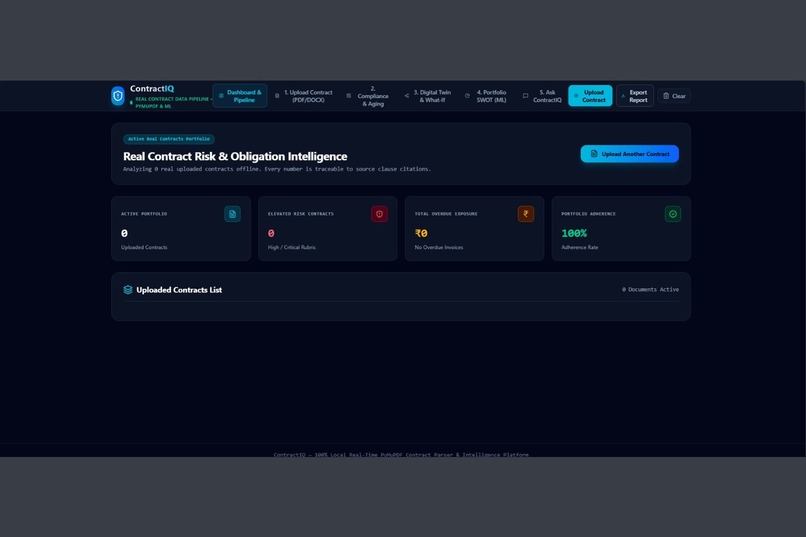
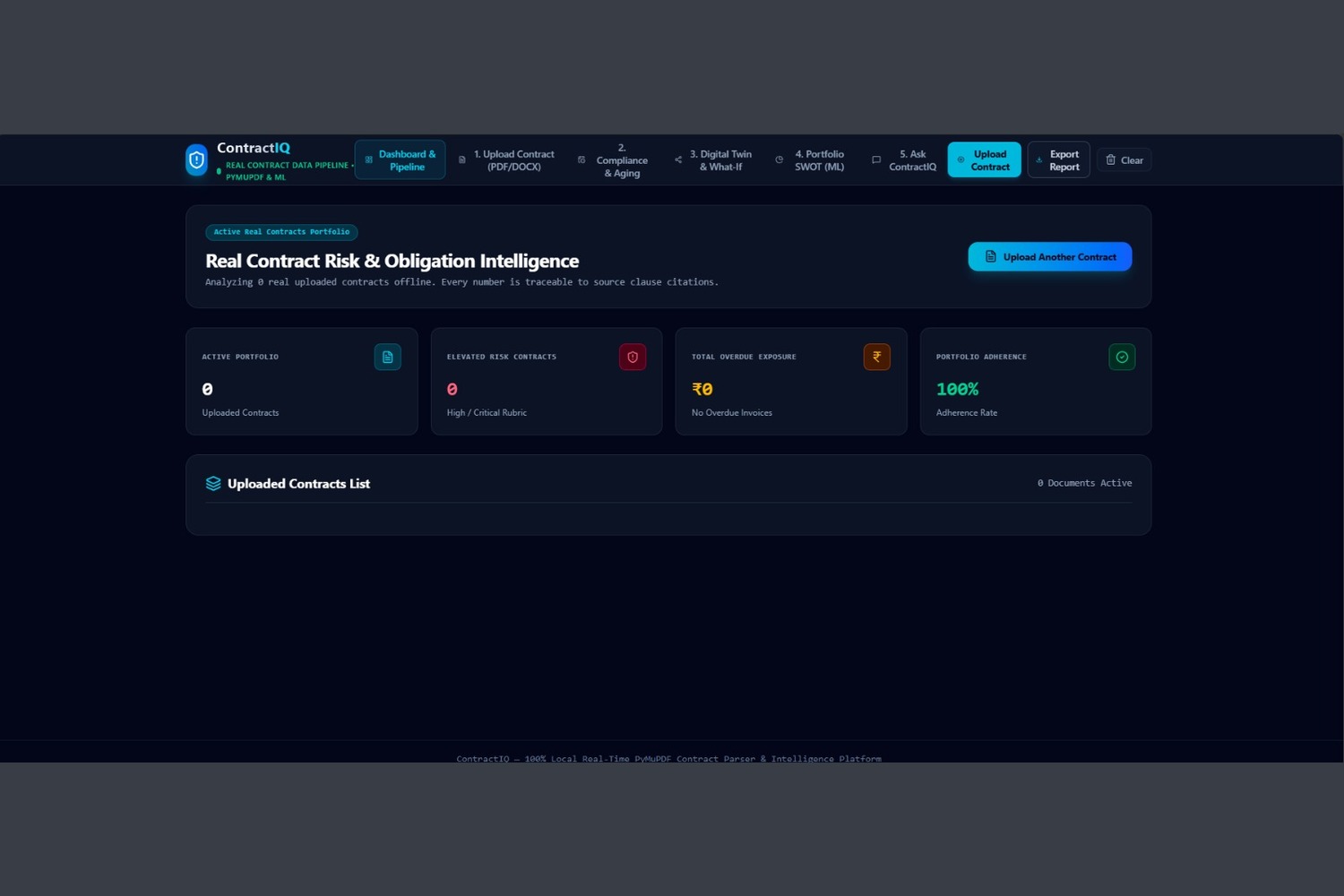
ContractIQ Dashboard — Real-Time Contract Risk Overview
-
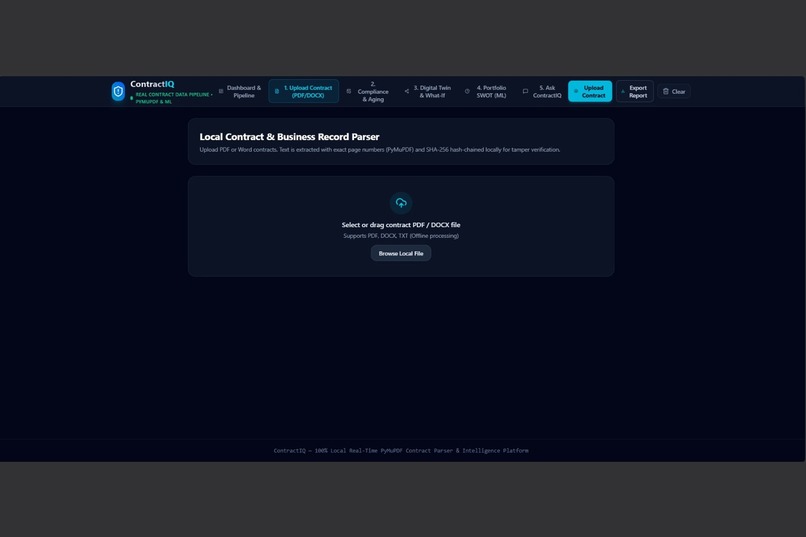
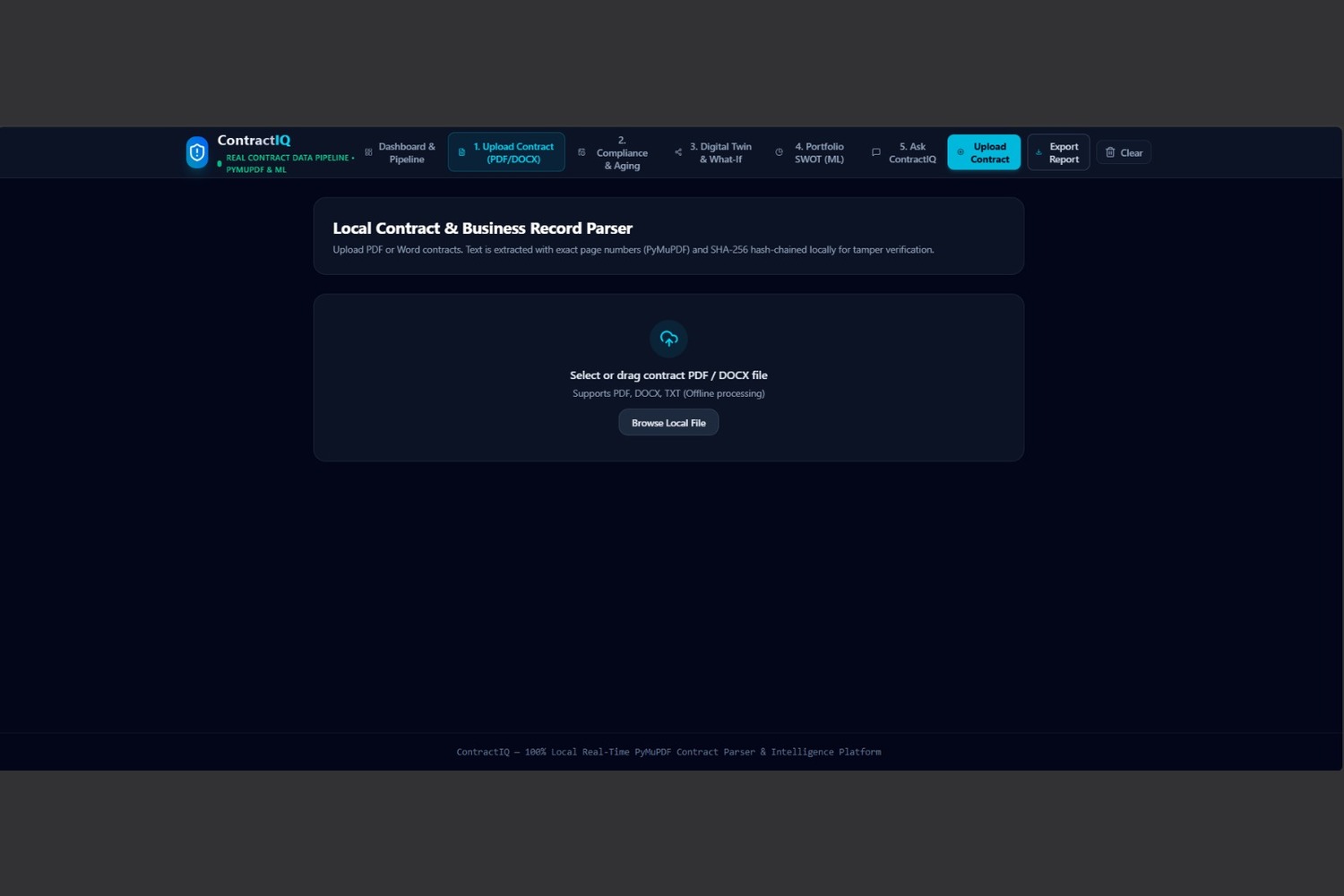
Contract Upload Screen – Upload PDF or DOCX contracts for local AI analysis.
-
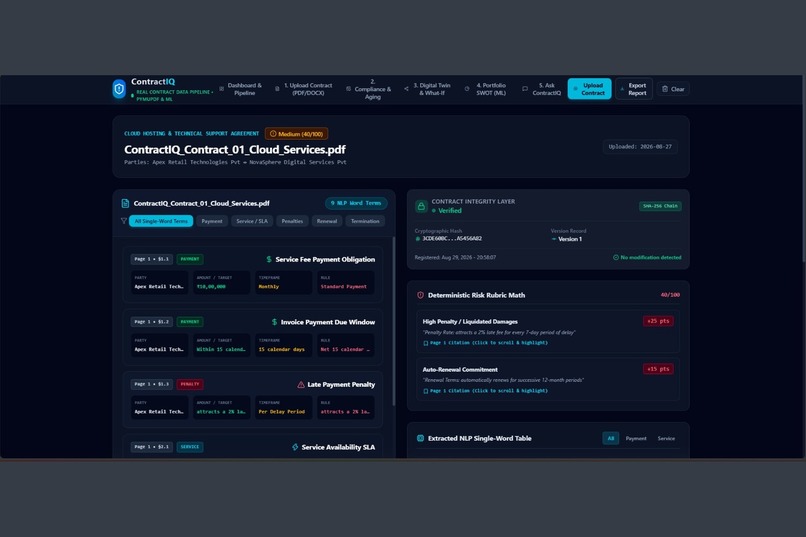
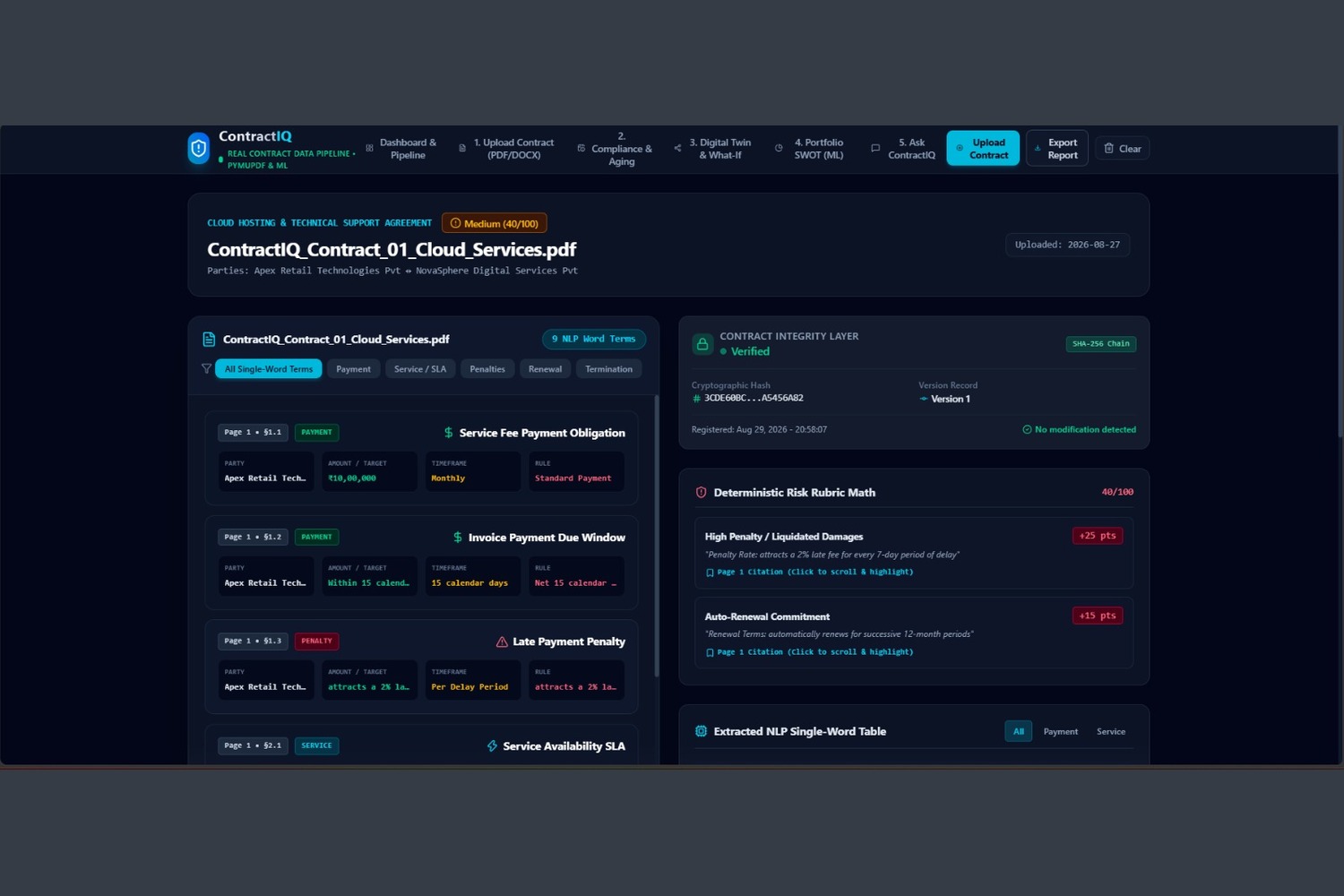
Contract Analysis Dashboard – Extracted clauses, obligations, NLP insights, integrity verification, and explainable risk scoring.
-
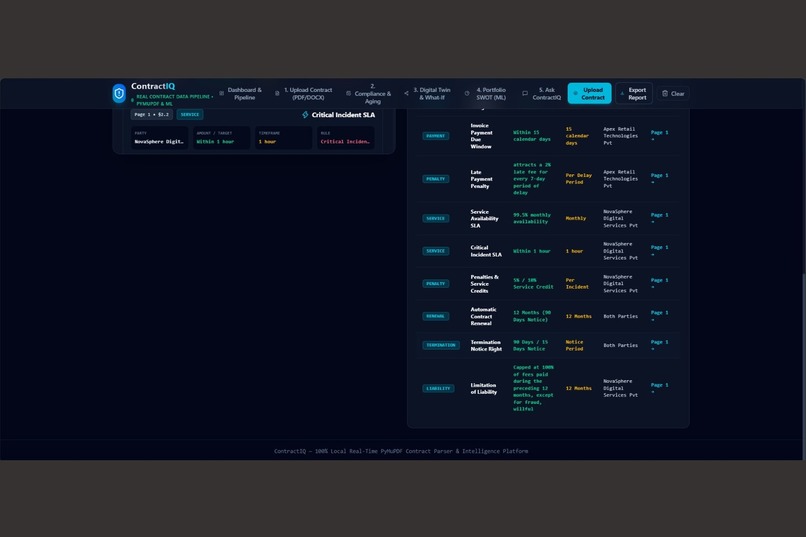
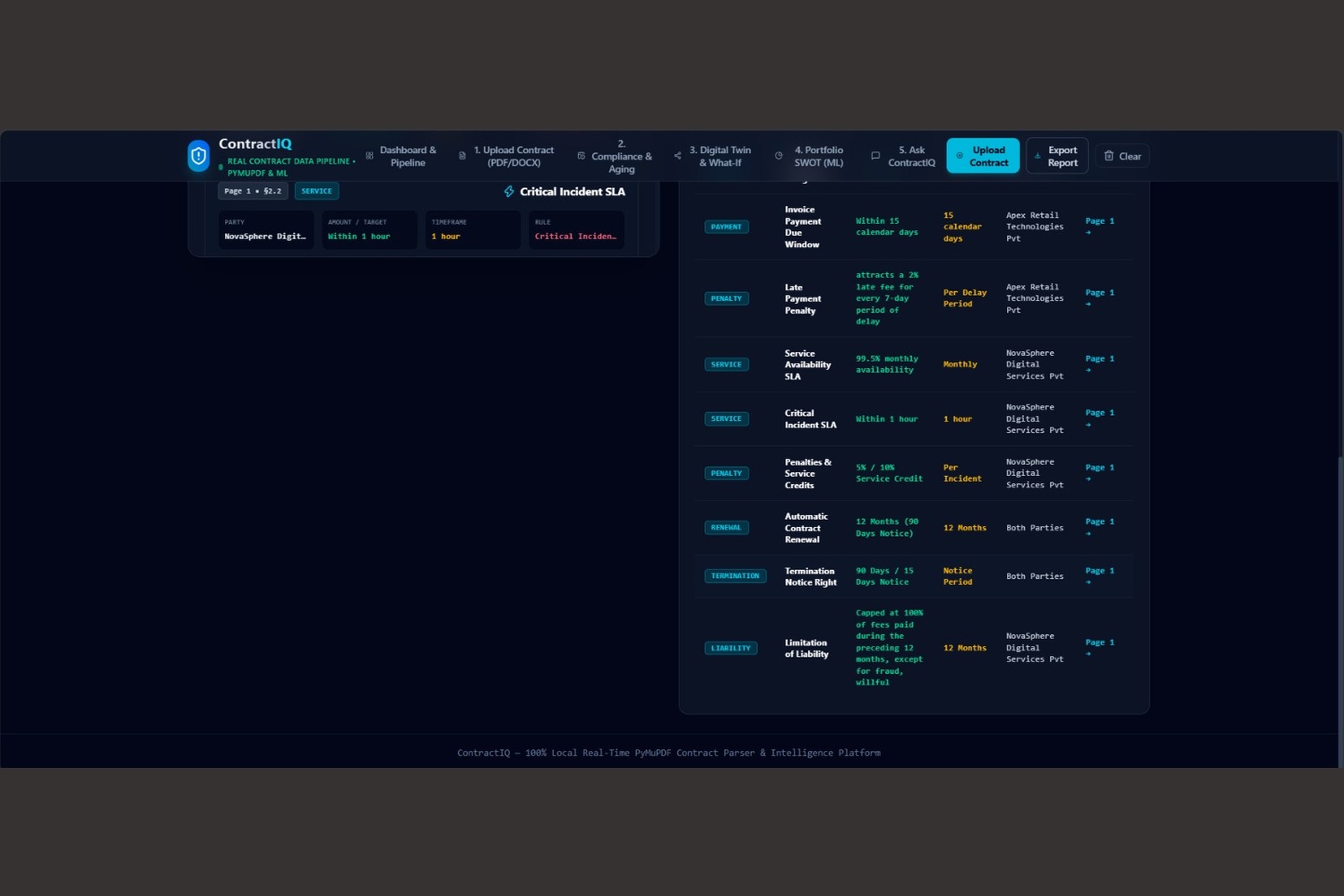
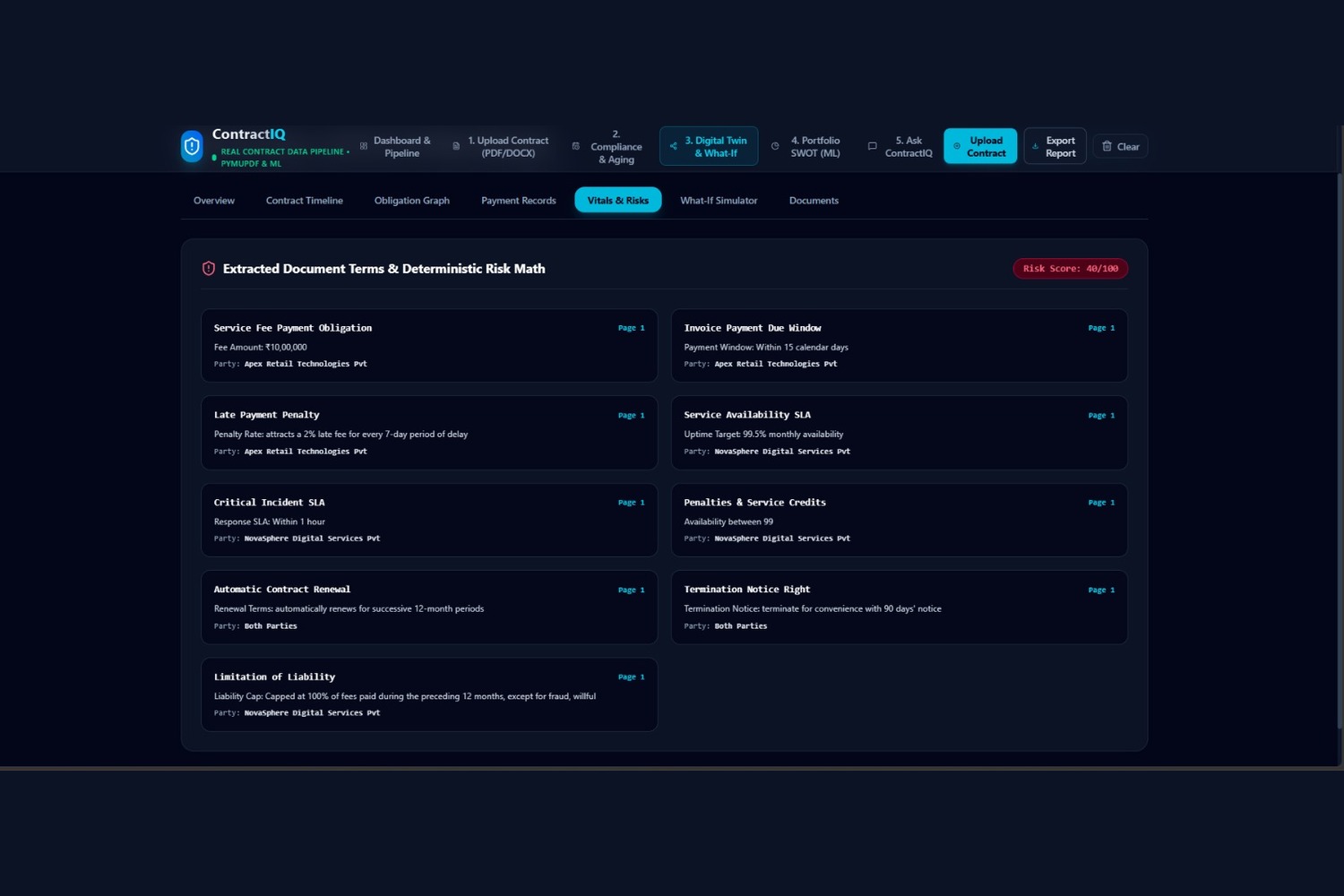
Extracted NLP Terms Table – Structured view of payment, service, penalty, renewal, termination, and liability clauses.
-
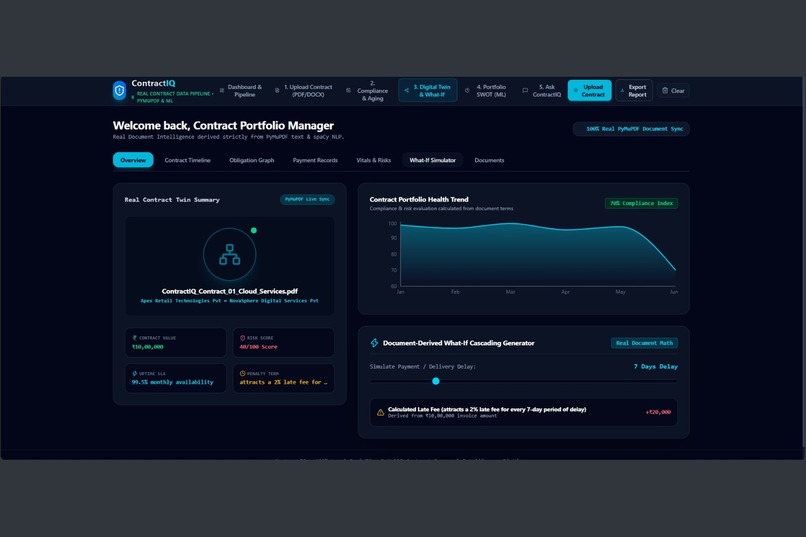
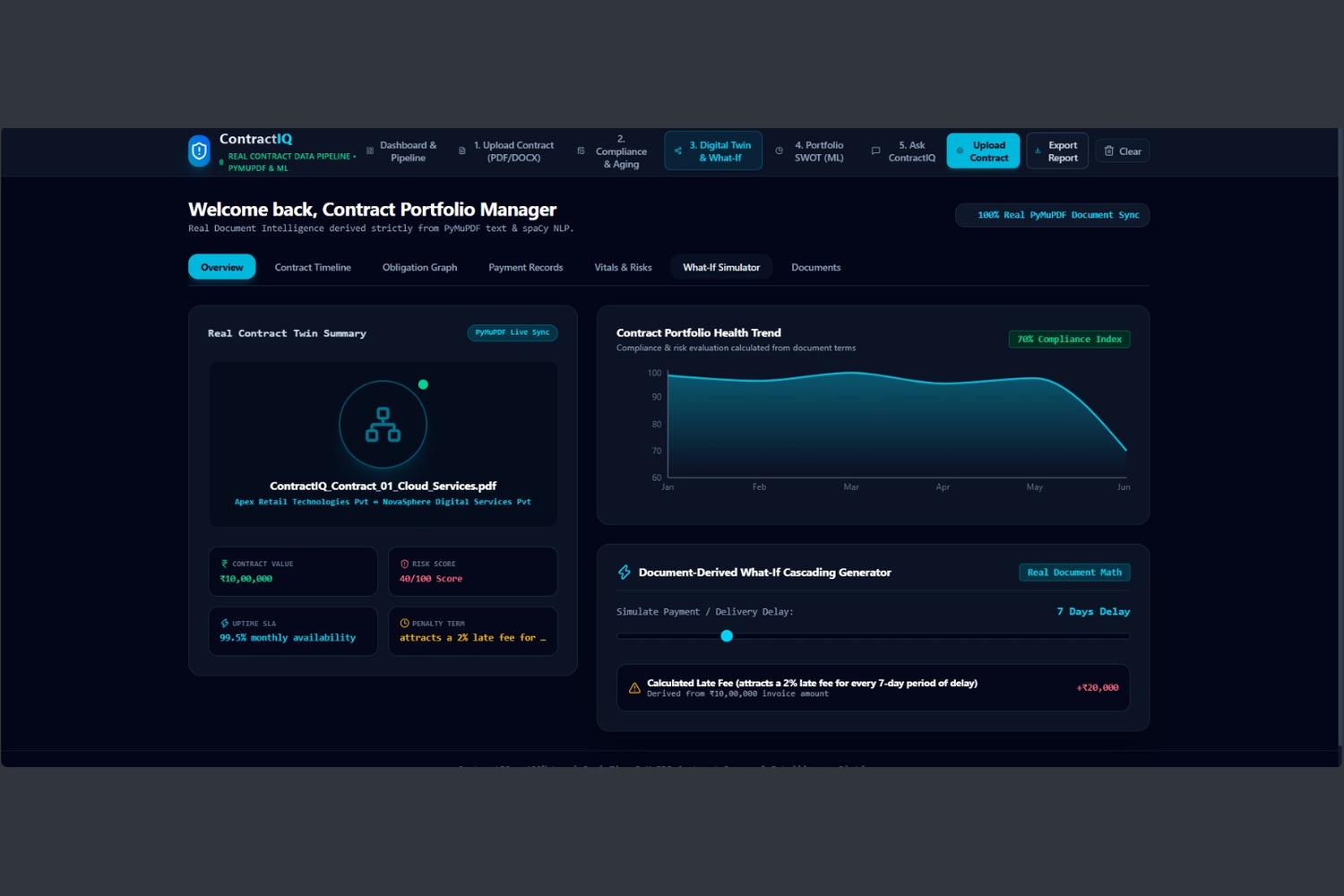
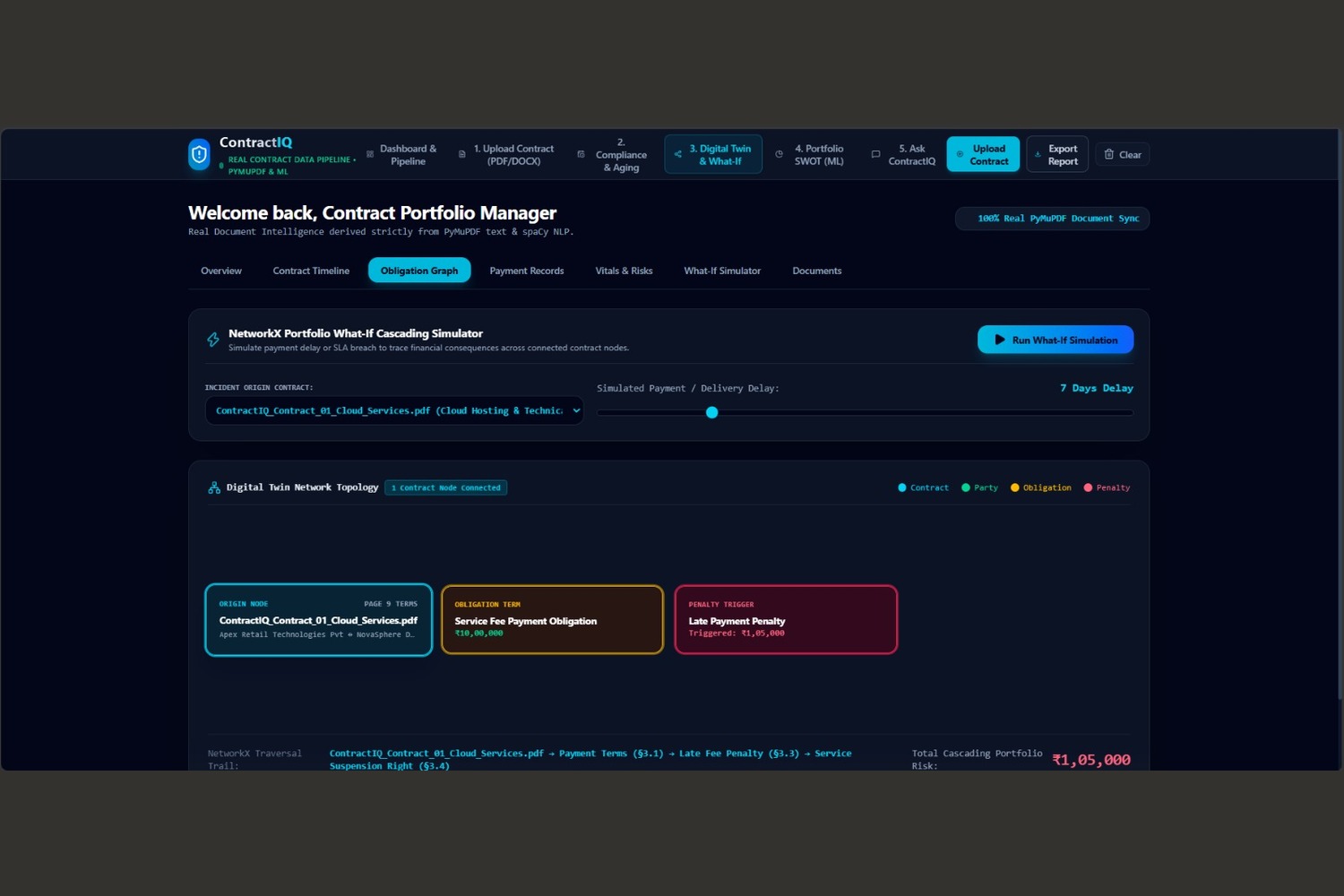
Digital Twin & What-If Simulator – Simulates contract delays, risks, cascading impact, and financial exposure.
-
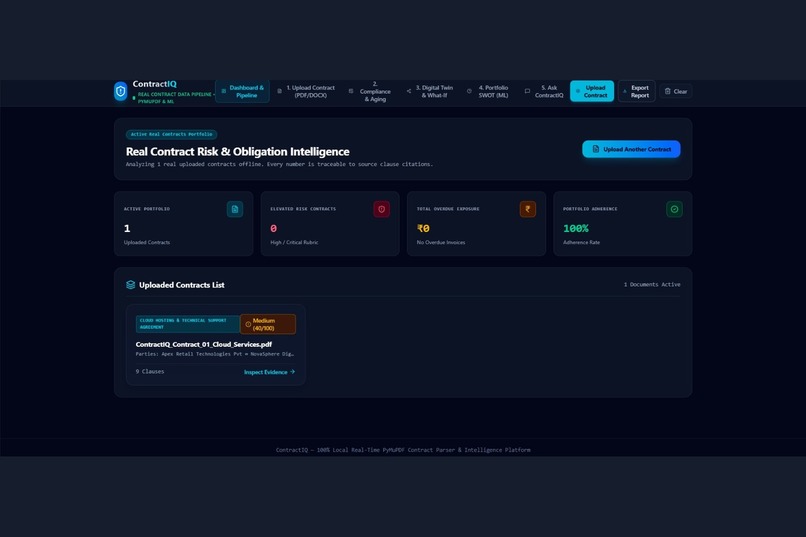
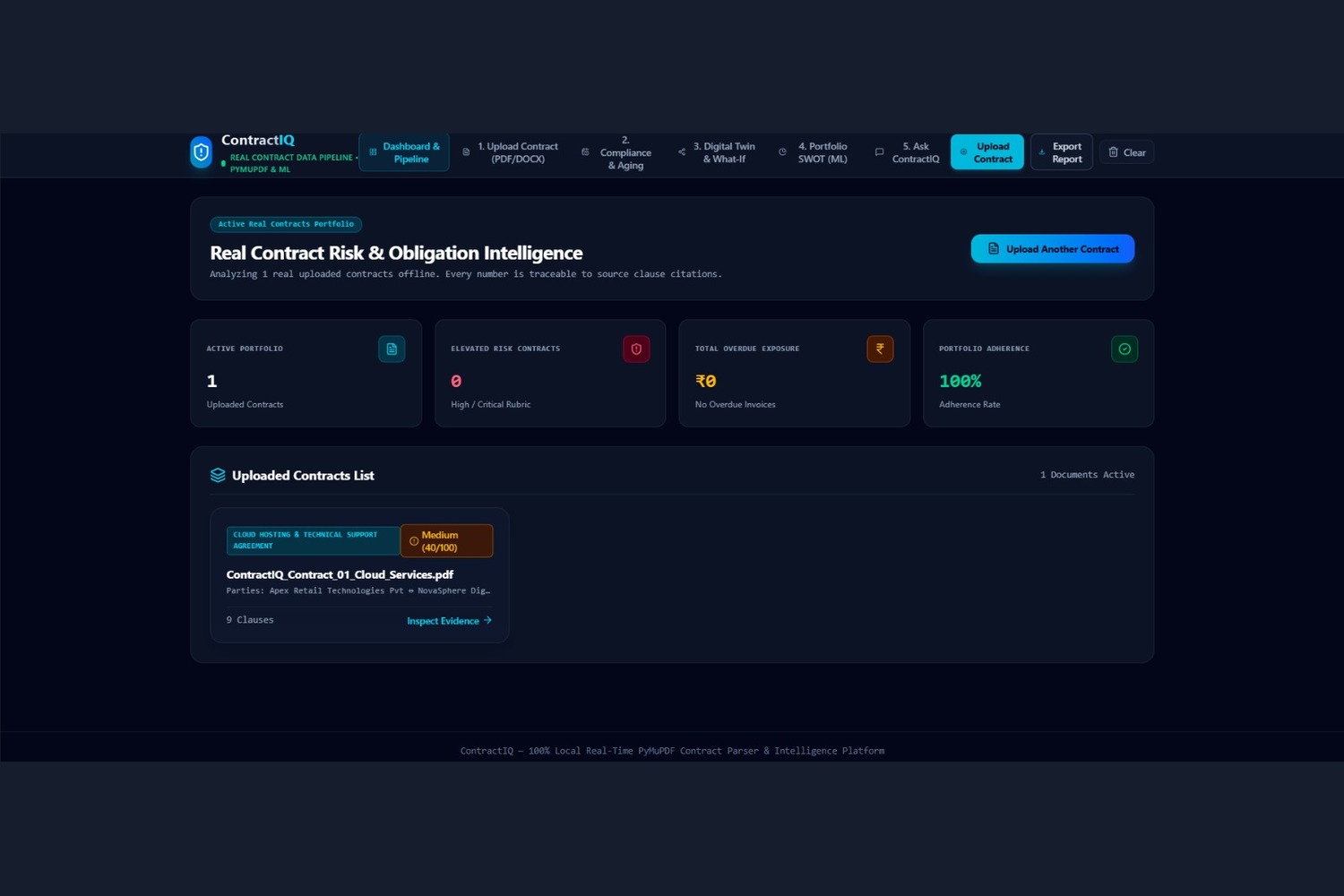
ContractIQ Portfolio Dashboard – Overview of contracts, risks, exposure, and compliance status.
-
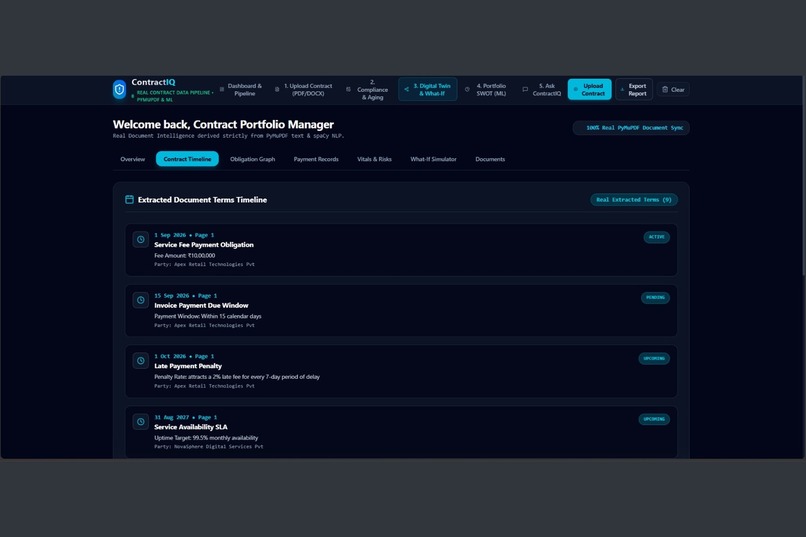
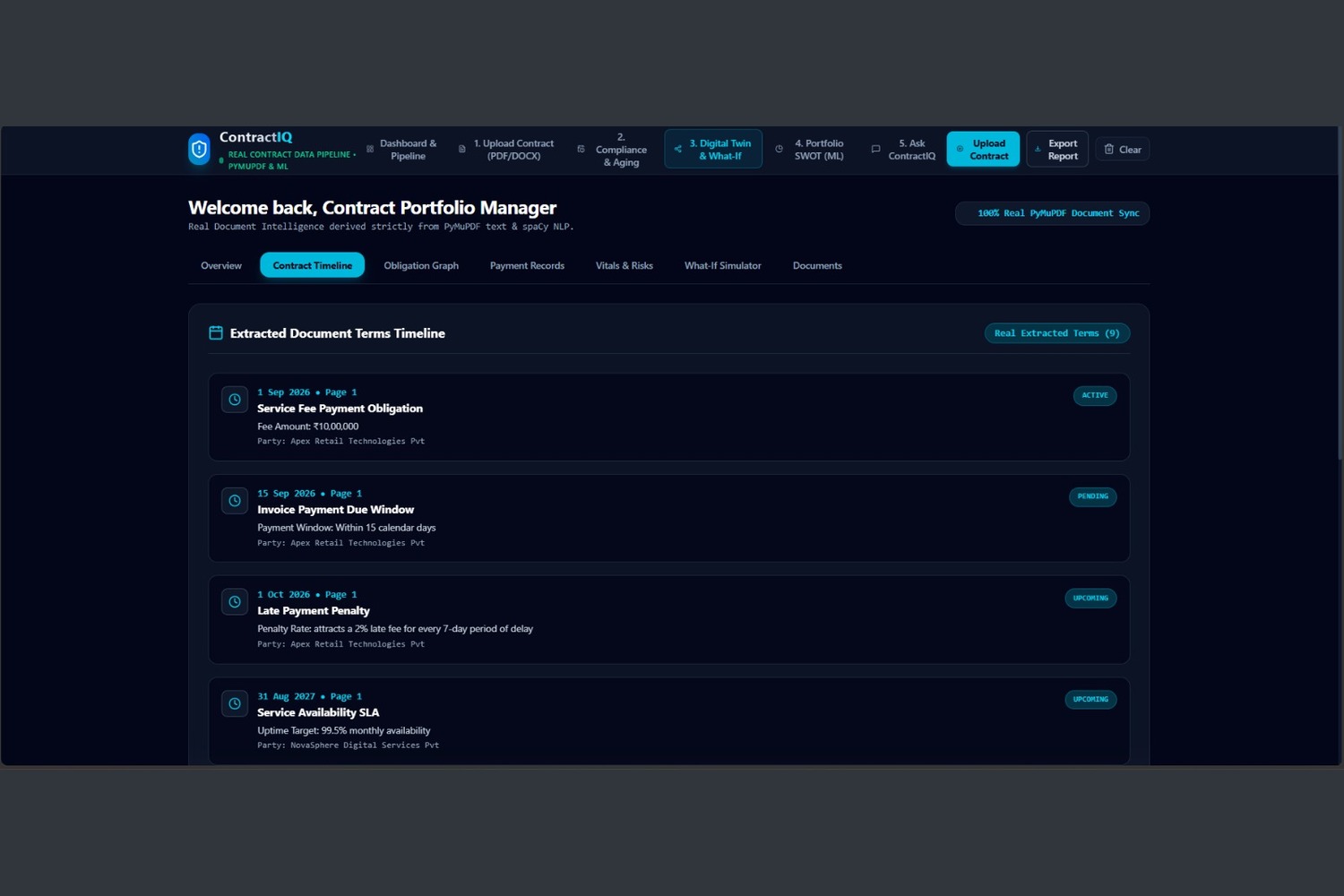
Extracted contract terms displayed in a clear timeline with payment dates, penalties, and SLA obligations.
-
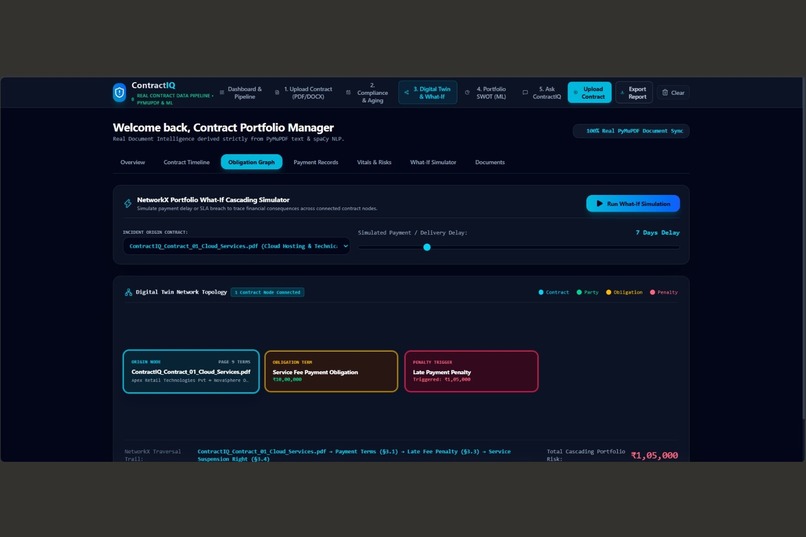
Digital Twin obligation graph simulating cascading risks and financial impact from contract delays.
-
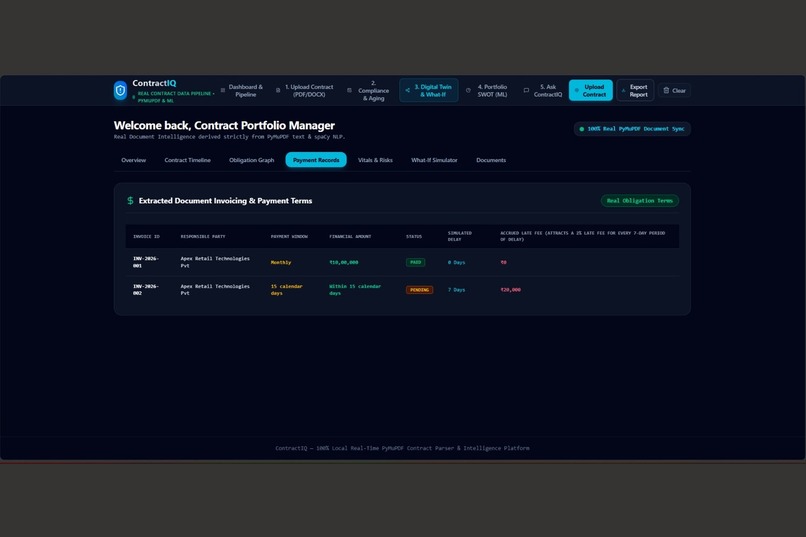
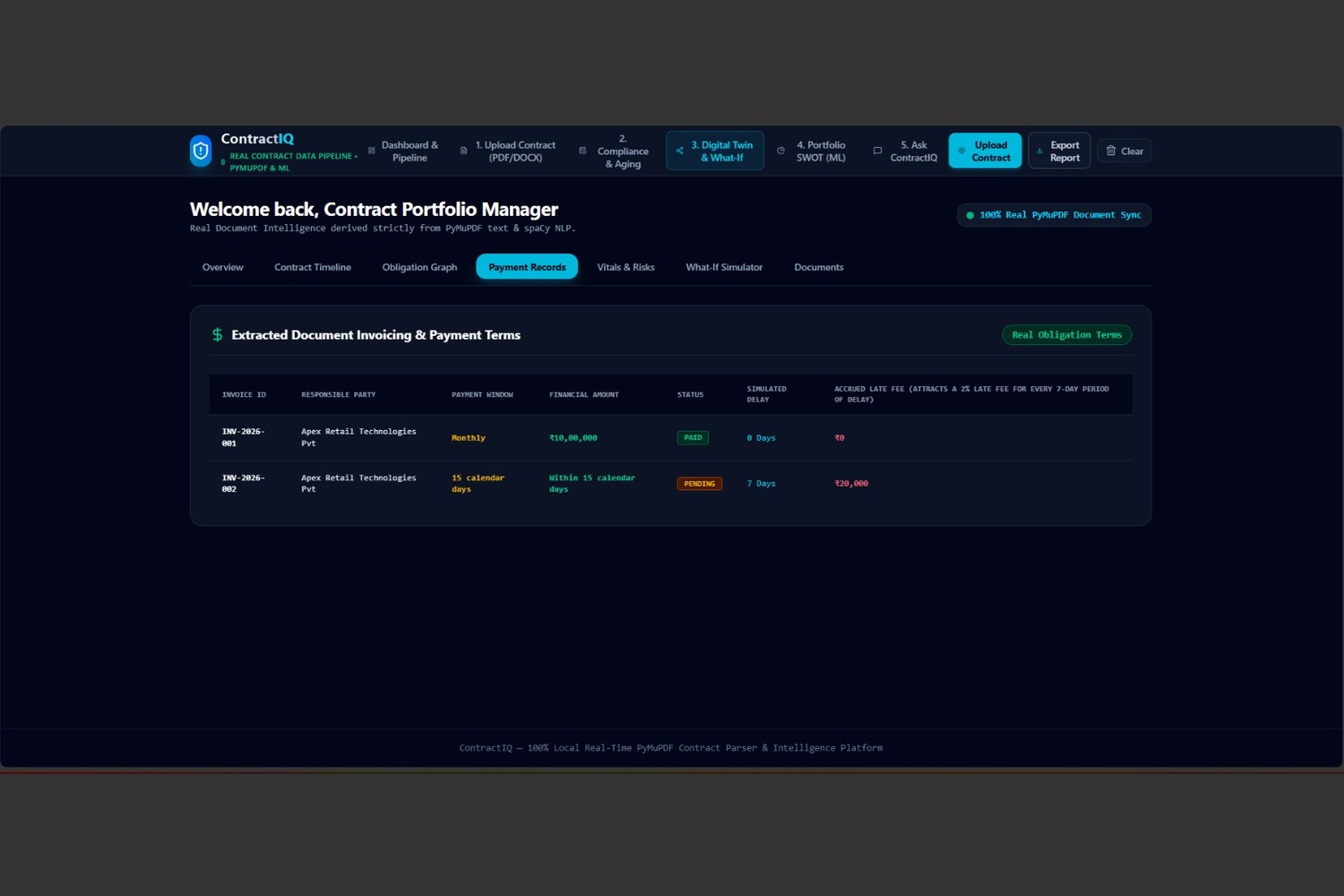
Extracted invoice and payment records showing payment status, delays, and accrued late fees.
-
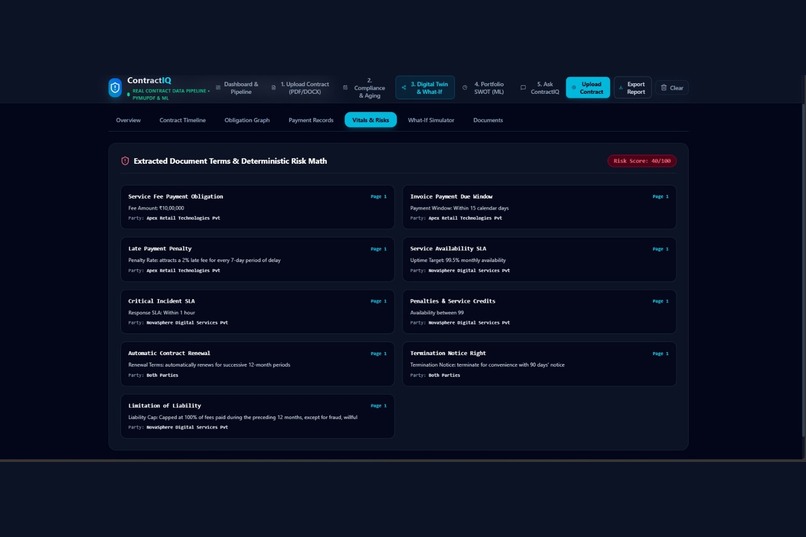
Extracted contract clauses with deterministic risk scoring for clear risk identification.
-
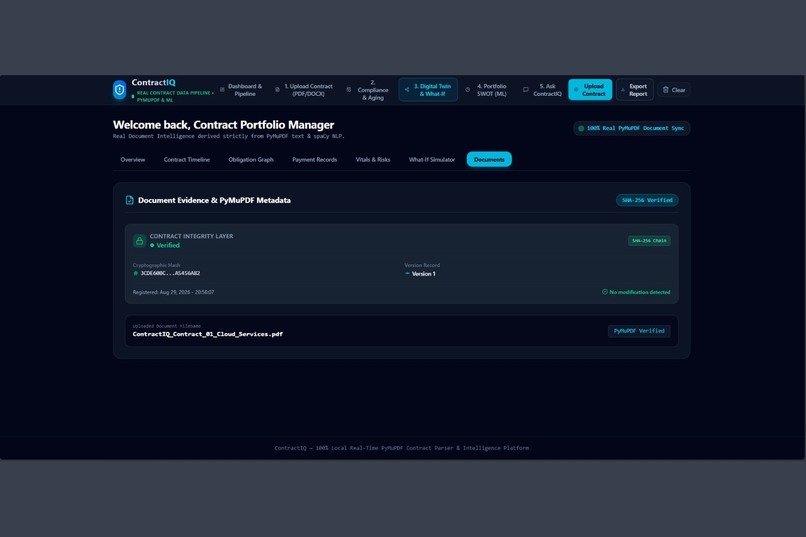
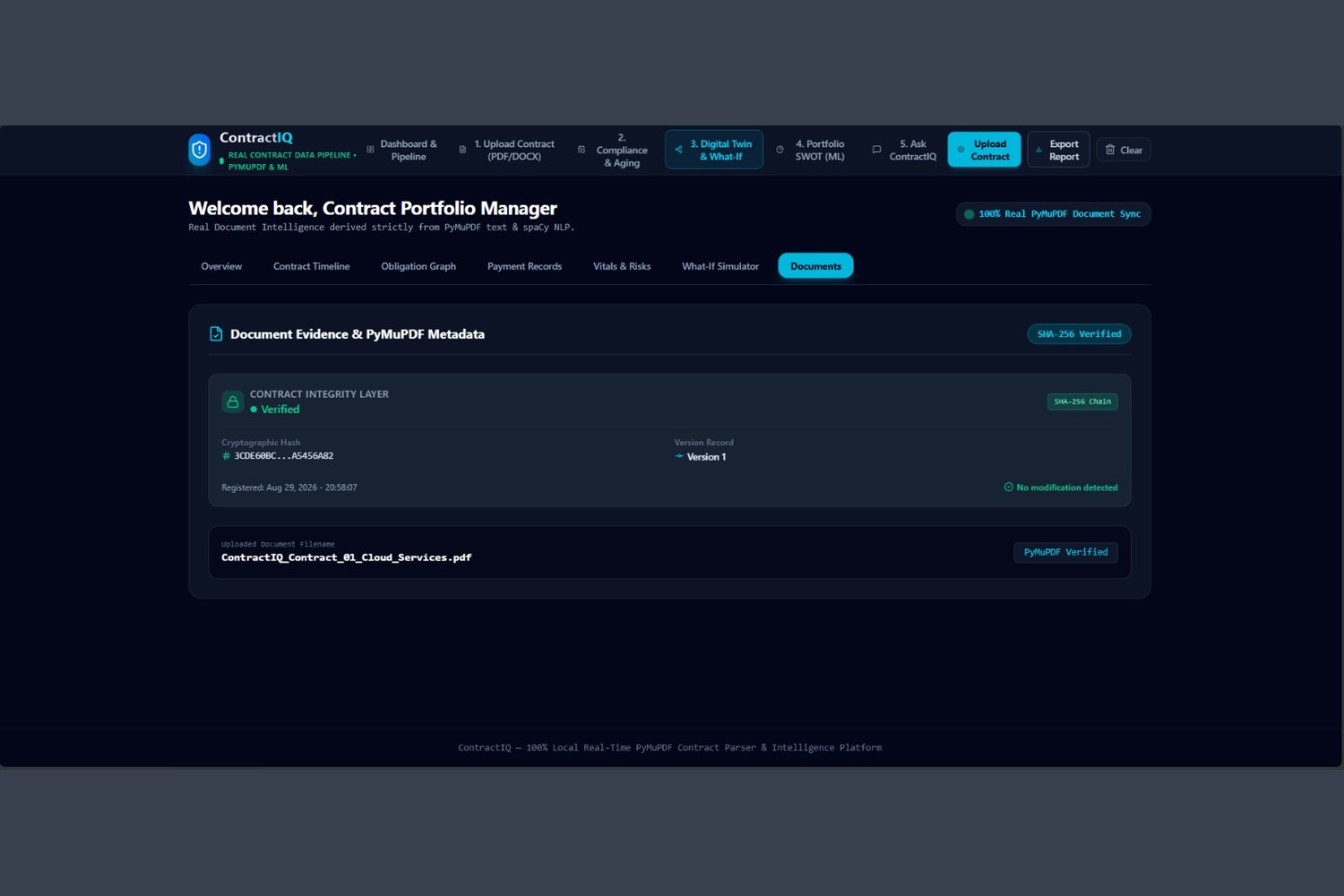
Document integrity verification using SHA-256 hashing to ensure the uploaded contract has not been modified.
-
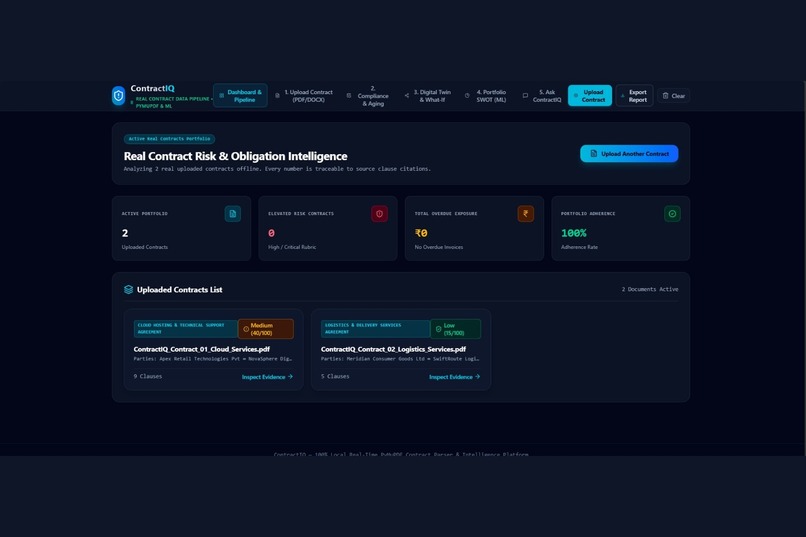
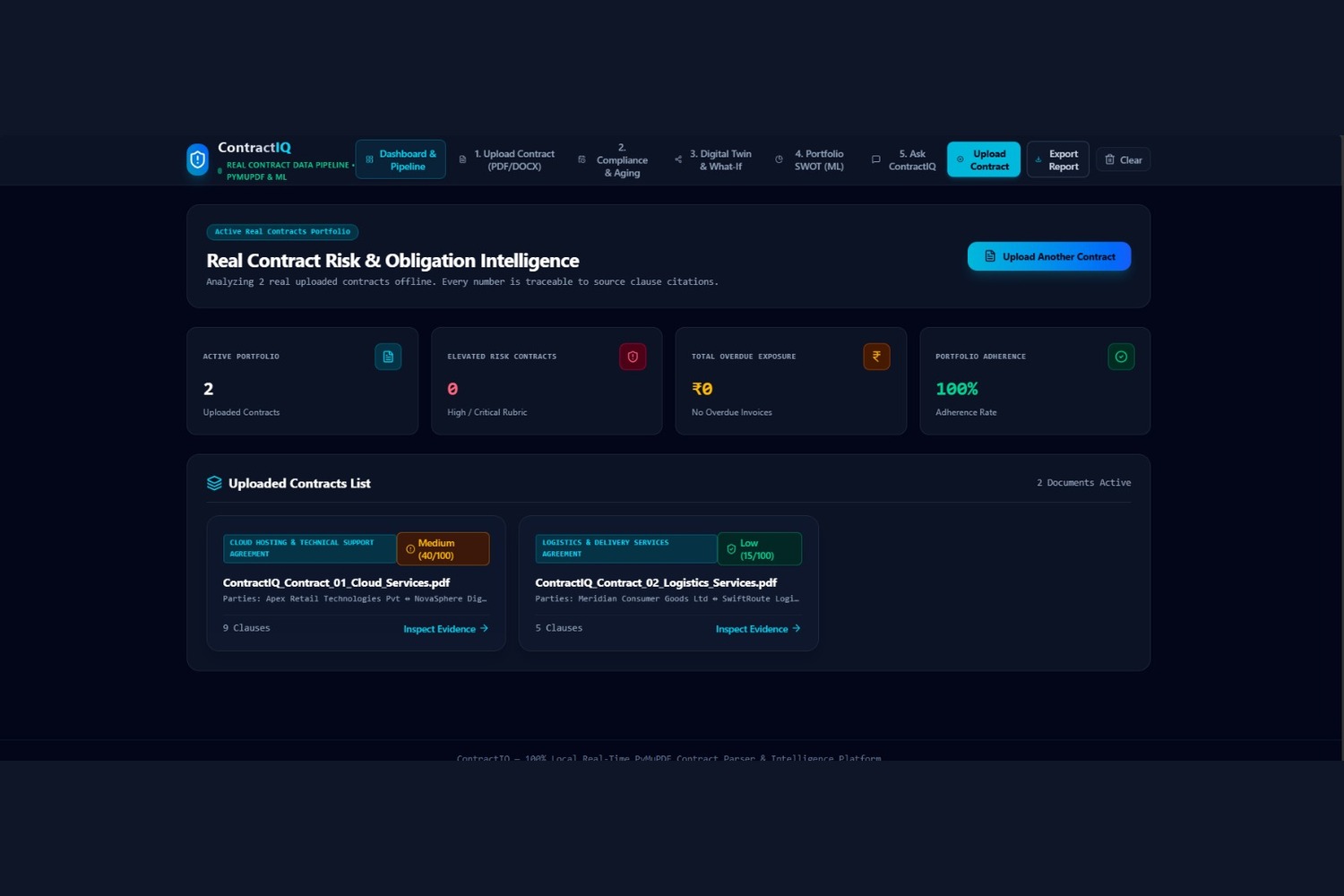
ContractIQ Portfolio Dashboard – Centralized view of contracts, risk scores, clauses, and portfolio intelligence.**
-
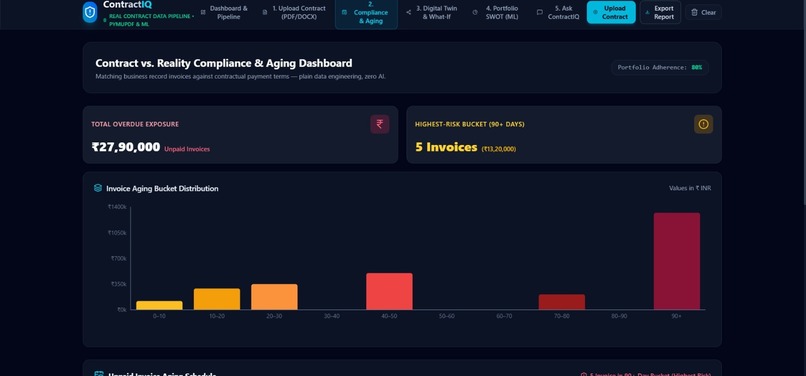
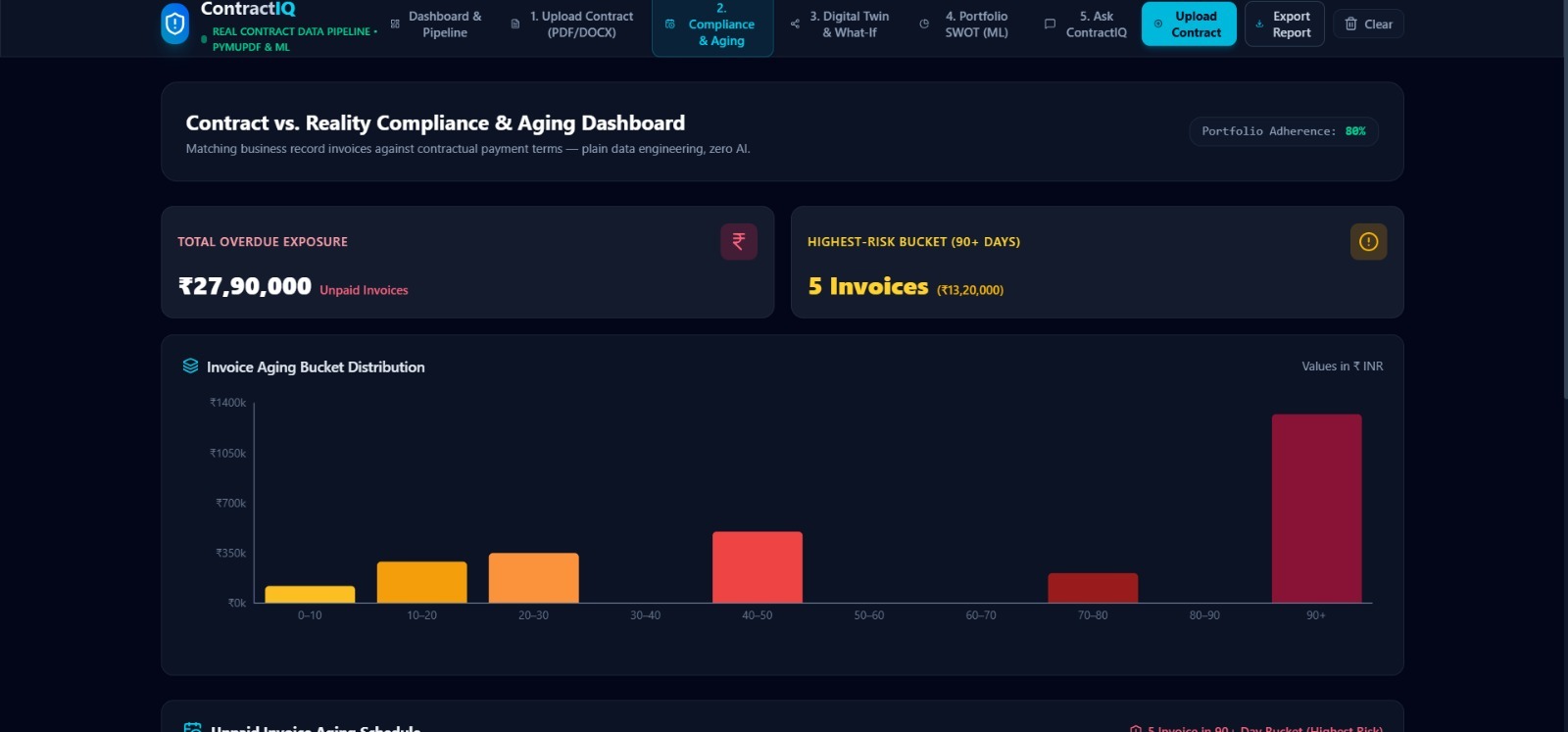
ContractIQ Compliance & Aging Dashboard – Tracks overdue invoices, aging risks, and portfolio adherence.**
-
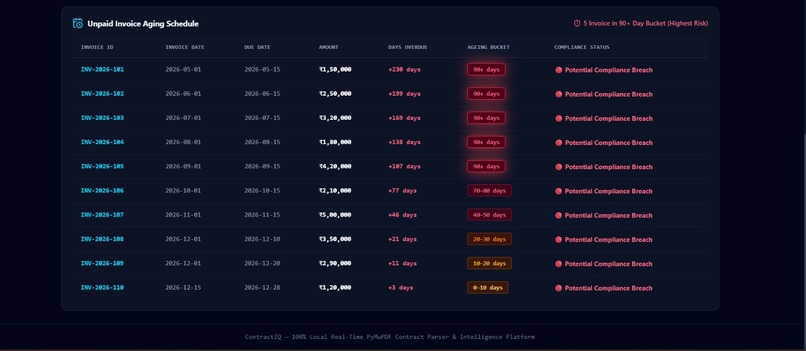
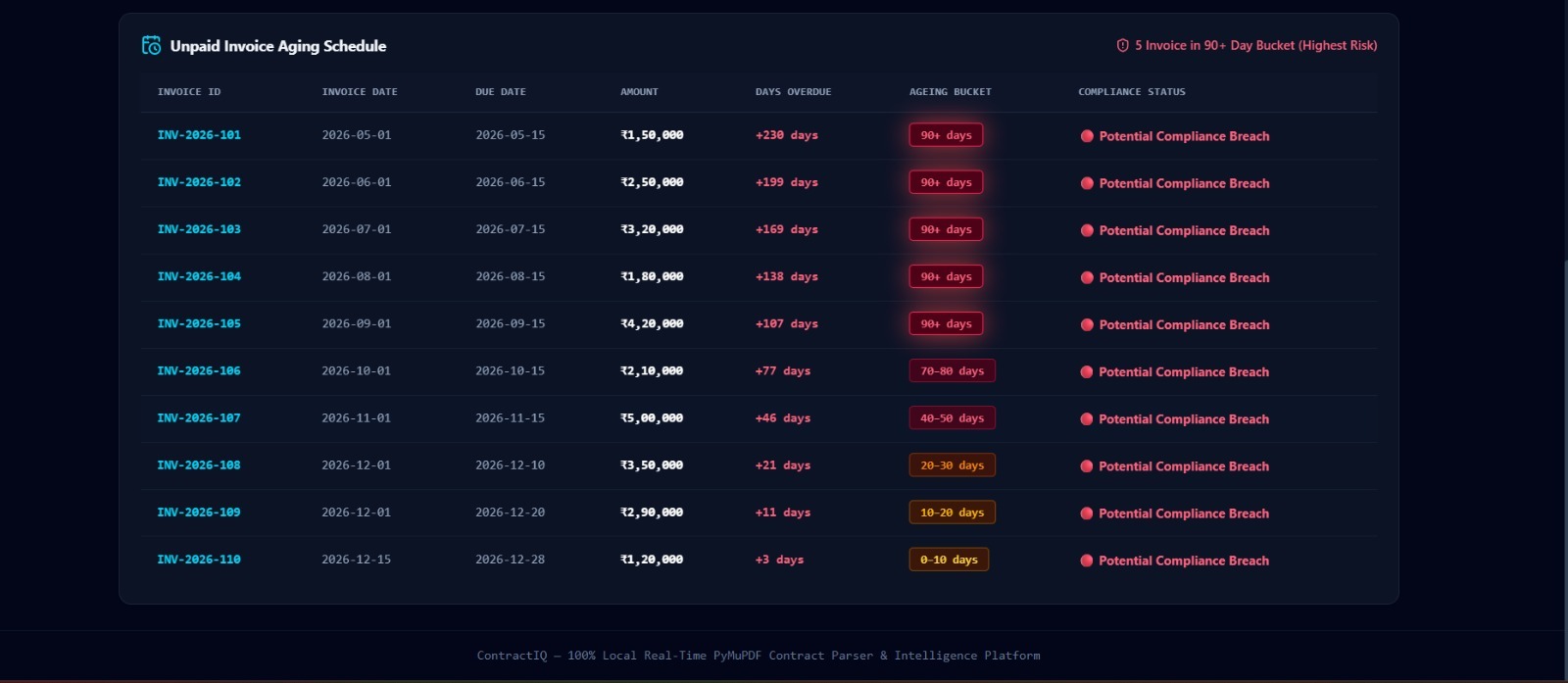
**ContractIQ Unpaid Invoice Aging Schedule – Tracks overdue invoices, aging buckets, and potential compliance breaches.**
About the Project
Inspiration
The idea for ContractIQ came from a simple observation: businesses deal with many contracts, but important details are often buried inside long and complex documents. Payment deadlines, service commitments, renewal dates, penalties, and termination conditions can easily be missed when contracts are reviewed manually.
We felt that simply summarizing a contract was not enough. Even if a company knows what a contract says, there is still an important question: Are the obligations actually being followed in real life?
This led us to build ContractIQ—a platform that not only understands contracts but also helps check compliance, identify risks, and understand the possible consequences when an obligation is missed.
What We Built
ContractIQ is an AI-powered platform for analyzing contracts and extracting useful information from them.
The system can identify important clauses, payment and service obligations, renewal and expiry dates, penalties, termination conditions, and other risky clauses. It also generates a risk score and explains why a particular clause or contract is considered risky.
One of the main features of our project is Contract vs. Reality Compliance Monitoring. After extracting obligations from a contract, the system can compare them with actual business records such as invoices and payment data. This helps identify late payments, overdue amounts, compliance issues, and ageing buckets.
For example, if a contract requires payment within 5 days but the actual payment was made after 9 days, ContractIQ can identify this deviation and flag it as a potential compliance issue.
We also included a What-If Simulator to help users understand the possible financial impact of missing or delaying an obligation. Along with this, clause-level evidence helps users trace important findings back to the original contract text instead of blindly trusting an AI-generated result.
How We Built It
We built the frontend using React and Tailwind CSS and used Python with FastAPI for the backend.
For document processing, we used PDF text extraction and OCR where required. We used NLP techniques, including spaCy and rule-based pattern matching, to identify important information such as dates, money, organizations, and contractual obligations.
For clause classification and summarization, we designed the system around locally available open-source models. The risk score itself is calculated using a rule-based approach so that the user can clearly understand how the score was generated.
We also used structured databases to store extracted contract information and business records, allowing the system to compare contractual obligations with actual business activity.
What We Learned
Working on ContractIQ taught us that analyzing contracts is much more challenging than simply extracting text from a PDF. The same obligation can be written in many different ways, so identifying useful information requires a combination of NLP, pattern matching, and business rules.
We also learned the importance of explainability. If a system says that a contract is risky, the user should be able to understand why. That is why linking risks and obligations back to the original clause became an important part of our project.
Another major learning was understanding how unstructured documents can be connected with structured business data. Comparing contract requirements with actual payment records showed us how AI can move beyond document summarization and provide practical business intelligence.
Challenges We Faced
One of the biggest challenges was dealing with different styles of contract language. The same payment or service obligation can be expressed in many ways, which makes accurate extraction difficult.
Another challenge was matching business records with the correct contractual obligations. We had to carefully distinguish between payments that were overdue, payments that were made late, and payments that were simply not due yet. Calculating overdue amounts and assigning the correct ageing buckets also required careful date handling.
We also had to balance our ideas with the limited time available during the hackathon. Instead of trying to build too many unrelated features, we focused on creating a clear end-to-end workflow:
Upload Contract → Extract Clauses and Obligations → Identify Risks → Show Evidence → Compare with Actual Business Data → Detect Compliance Issues → Simulate Possible Consequences
What's Next?
Our goal with ContractIQ is to move beyond answering just one question:
"What does this contract say?"
We want to help businesses answer more useful questions:
"What does this contract require? Are we following it? What risks do we have? And what could happen if something goes wrong?"
That is the idea behind ContractIQ—turning complex contracts into actionable and understandable business intelligence.
Built With
- artificial-intelligence
- faiss
- fastapi
- hugging-face-transformers
- local
- machine-learning
- natural-language-processing
- networkx
- ocr
- pdf-processing
- pymupdf
- python
- react
- rule-based-system
- sentence-transformers
- spacy
- sqlite
- tailwind-css
- tesseract-ocr

Log in or sign up for Devpost to join the conversation.