-
-
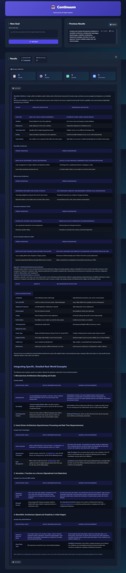
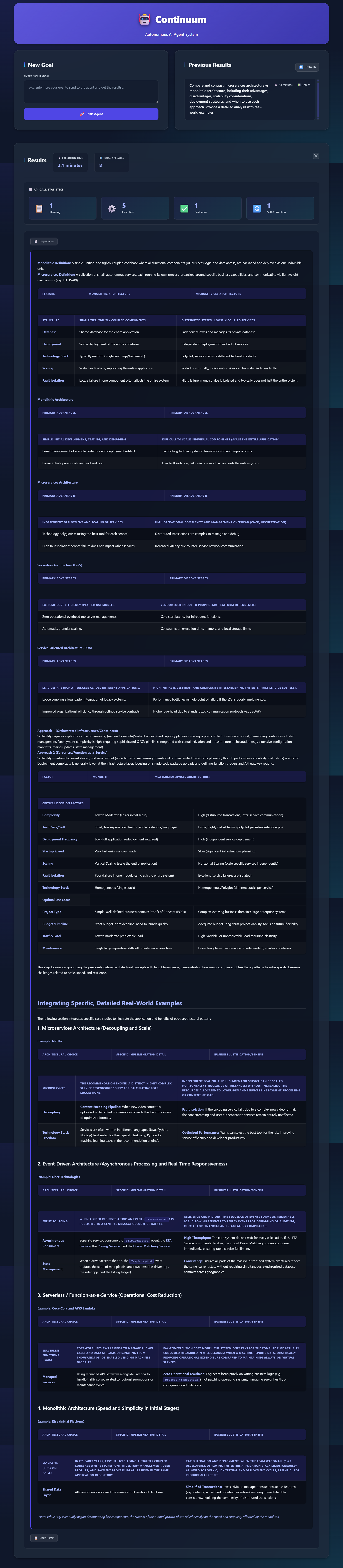
This is the full screen shot of the project Continuum.
Continuum - Project Story
Inspiration:-
The inspiration for Continuum came from the need to create an autonomous AI agent system that could intelligently break down complex goals into actionable steps and execute them systematically. Traditional AI assistants often provide single-shot responses, but Continuum was designed to think through problems step-by-step, evaluate its own work, and self-correct when needed. The goal was to build a system that could handle everything from simple definition questions to complex multi-step projects, all while providing transparency into its decision-making process through detailed execution statistics and history.
What it does:-
Continuum is an autonomous AI agent system that takes user goals and intelligently processes them through a multi-stage pipeline. When a user submits a goal, the system first analyzes its complexity and creates an appropriate number of steps. It then executes each step using Google's Gemini AI, evaluates the quality of outputs, and automatically self-corrects if needed. The system provides a modern web interface where users can track execution progress in real-time, view comprehensive results with markdown rendering, and access a complete history of all previous executions. Continuum handles everything from simple "What is X?" questions to complex architectural comparisons, providing detailed answers with proper formatting, tables, and structured content.
How I built it:-
Continuum was built using a modular architecture with Python FastAPI as the backend and vanilla JavaScript for the frontend. The backend consists of several specialized modules: a Planner that categorizes goals by complexity and generates steps, an Executor that runs each step through Gemini AI, an Evaluator that assesses output quality, and a Rate Limiter that manages API calls efficiently. The system uses SQLite for persistent storage of execution history and statistics. The frontend was built with modern CSS featuring glassmorphism effects, responsive design, and a side-by-side layout that shows the input form alongside execution history. The system implements smart optimizations like skipping unnecessary evaluations and using the most efficient Gemini model for free-tier users. Real-time progress tracking, API call statistics, and execution time measurement provide users with complete visibility into the agent's operations.
Challenges I ran into:-
One of the biggest challenges was managing API rate limits and quota constraints. The free tier of Google's Gemini API has strict limits, so implementing intelligent rate limiting with automatic retry logic and delay extraction was crucial. Another challenge was optimizing the number of API calls - initially, the system made too many calls for simple tasks, so implementing smart evaluation skipping and complexity-based step generation significantly reduced execution time. Database corruption handling was another challenge, requiring robust error detection, automatic backups, and graceful recovery mechanisms. On the frontend, ensuring equal heights for side-by-side sections while maintaining responsive design across all devices required careful CSS and JavaScript coordination. Finally, getting the agent to provide direct answers without unnecessary notes or suggestions required refining the prompts to be more explicit about output requirements.
Accomplishments that I'm proud of:-
I'm particularly proud of the intelligent complexity detection system that automatically adjusts step counts based on goal characteristics, dramatically reducing execution time for simple questions while maintaining thoroughness for complex tasks. The self-correction mechanism that allows the agent to improve its own outputs is a significant achievement. The comprehensive statistics tracking that provides real-time visibility into API usage across different phases (planning, execution, evaluation, self-correction) gives users complete transparency. The responsive frontend design that works seamlessly on mobile, tablet, and desktop while maintaining a modern, professional aesthetic is something I'm proud of. The robust database corruption handling that ensures the system can recover from failures without manual intervention demonstrates production-ready error handling. Finally, the markdown rendering system that properly formats complex content including tables, code blocks, and structured lists provides a polished user experience.
What I learned:-
Building Continuum taught me a lot about API rate limiting and quota management - understanding how to extract retry delays from error messages and implement exponential backoff strategies. I learned the importance of optimizing API calls early in development, as reducing unnecessary calls significantly improves both performance and cost. Working with SQLite taught me about database integrity checks, corruption handling, and proper connection management. The frontend development reinforced the importance of responsive design and how CSS Grid and Flexbox can work together to create flexible layouts. I learned about the nuances of prompt engineering - how small changes in instructions can dramatically affect AI output quality and how to guide AI systems to provide exactly what users need without extra commentary. The project also taught me about building modular, maintainable code where each component has a clear responsibility, making the system easier to debug and extend.
What's next for Continuum:-
The next steps for Continuum include implementing WebSocket support for real-time progress updates instead of polling, which would provide a smoother user experience. Adding user authentication would allow multiple users to have their own execution histories and settings. Export functionality for results in various formats (PDF, Markdown, JSON) would make it easier for users to save and share outputs. A search functionality within the execution history would help users quickly find previous results. Goal templates for common tasks would speed up user workflows. Advanced analytics dashboard with visualizations of API usage patterns and execution trends would provide deeper insights. Multi-language support would make Continuum accessible to a global audience. Finally, implementing a plugin system that allows users to extend the agent's capabilities with custom executors for specific domains would open up endless possibilities for specialized use cases.
Built With
- agents
- css3
- fastapi
- geminiapi
- html5
- javascript
- python
- sqlite
- uvicorn

Log in or sign up for Devpost to join the conversation.