Inspiration
The promise of digital assets to be your own bank is overshadowed by a crisis of confidence rooted in three deeply financially devastating risks. These aren't edge cases, they are fundamental flaws that create a constant state of anxiety for users and actively prevent mainstream adoption.
- The Digital Abyss: Where Generational Wealth Goes to Die
What happens to your assets when you're gone? For the vast majority of crypto holders, the answer is terrifying: they are lost forever. A 2020 study from crypto research firm Cane Island Alternative Advisors, cited by outlets like Forbes, estimated that up to 4 million Bitcoin (worth over $140 billion at the time) were already permanently lost, with a significant portion due to the death of the owner. This number grows daily with every user who passes away or becomes incapacitated without a succession plan. Every crypto wallet is a ticking time bomb, threatening to lock away generational wealth and undermining the very concept of digital property rights. This isn't just a security risk, it's a human tragedy unfolding on the blockchain.
- The Governance Gap (The Organizational Crisis) Crypto-native companies manage billions in assets but are forced to operate with dangerously primitive tools for governance. This creates two systemic vulnerabilities that have already cost users hundreds of millions of dollars:
Broken Promises in Funding: The lack of trustless vesting mechanisms erodes trust between builders and investors. In 2023 alone, blockchain analytics firm Chainalysis reported that over $200 million was lost to "rug pulls" a form of fraud where founders receive funding and then disappear. This makes legitimate milestone-based investment incredibly risky without on-chain enforcement, stifling innovation and capital deployment across the ecosystem.
- The "One-Click Catastrophe": The Terror of Irreversible Error Every cryptobro's has felt that heart-stopping moment of triple checking a wallet address before hitting 'send' button. A single mistyped character can dispatch a user's life savings into a digital void, with absolutely no recourse. But this isn't just about accidental typos anymore. Sophisticated scams like "Address Poisoning" are now actively weaponizing your wallet against you. Hackers send tiny "dust" transactions from wallet addresses designed to look identical to your trusted contacts.
What it does
Continuum is the seamless flow of assets from one state or person to another — a new paradigm for how we manage and transfer wealth in the digital age.. The mass adoption of crypto is critically stalled by a profound lack of a psychological safety net. This manifests in three primal fears: the "Digital Abyss", where hundreds of billions in assets are permanently lost upon an owner's death or incapacitation, the "Governance Gap" crippling businesses, and the "One-Click Catastrophe", where sophisticated scams like address poisoning and simple typos lead to irreversible loss.
Our platform introduces a new paradigm for DAO and corporate treasury management by leveraging the unique capabilities of the Hedera Consensus Service (HCS). By utilizing HCS as our core engine, we unlock two critical features previously out of reach for many platforms: fully automated, scheduled payment streams and a radically lower fee structure. This allows us to offer a solution that is not only more powerful but also significantly more cost-effective and transparent than any smart contract-based alternative.
We solve this through a three-pronged solution built on the high-performance Hedera network:
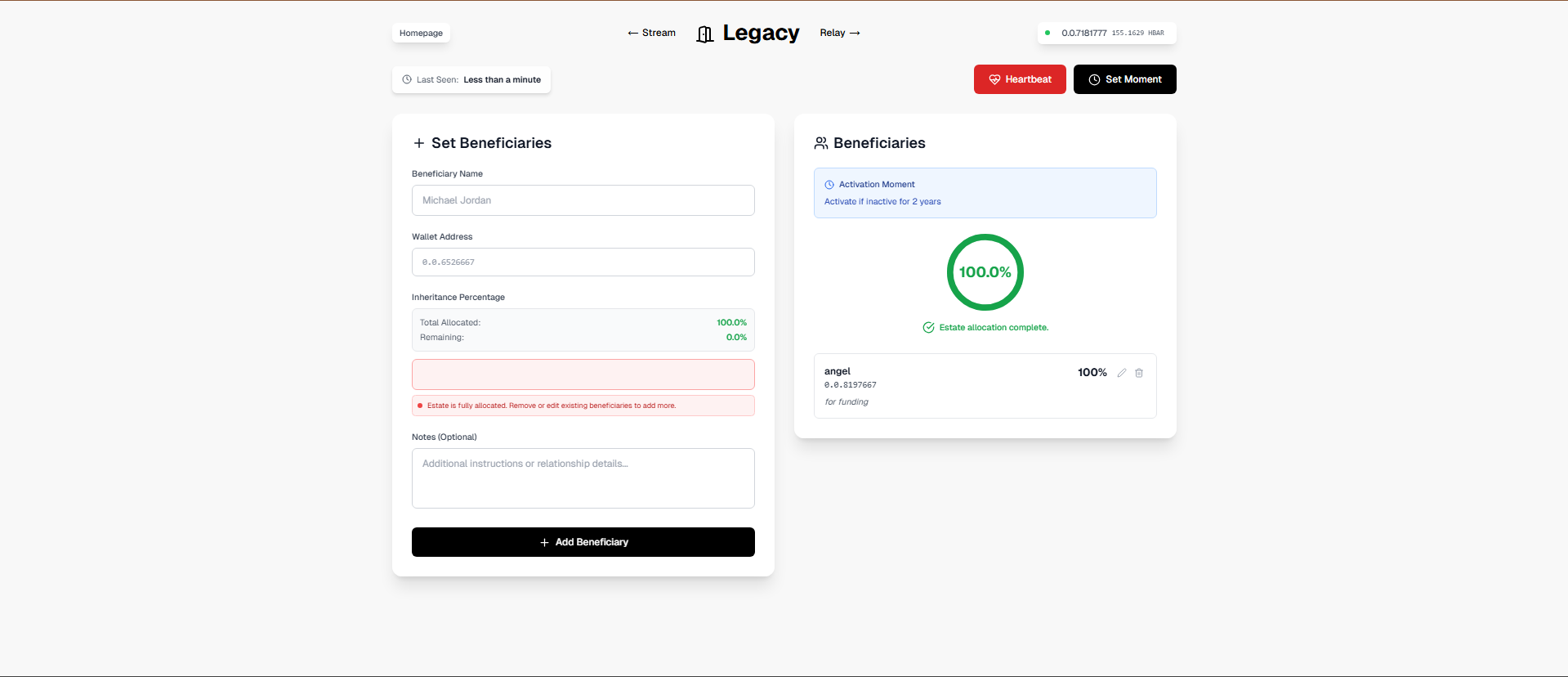
1.) Legacy Feature: The Legacy protocol acts as your trustless "Digital Will," automatically distributing your assets to designated beneficiaries with multi-party oversight only after a period of on-chain inactivity is confirmed via our "Heartbeat" check.
2.) Stream Feature: Our Stream protocol is an on-chain engine for governed finance, allowing you to automate complex payments like payroll or VC funding that are only released after receiving on-chain.
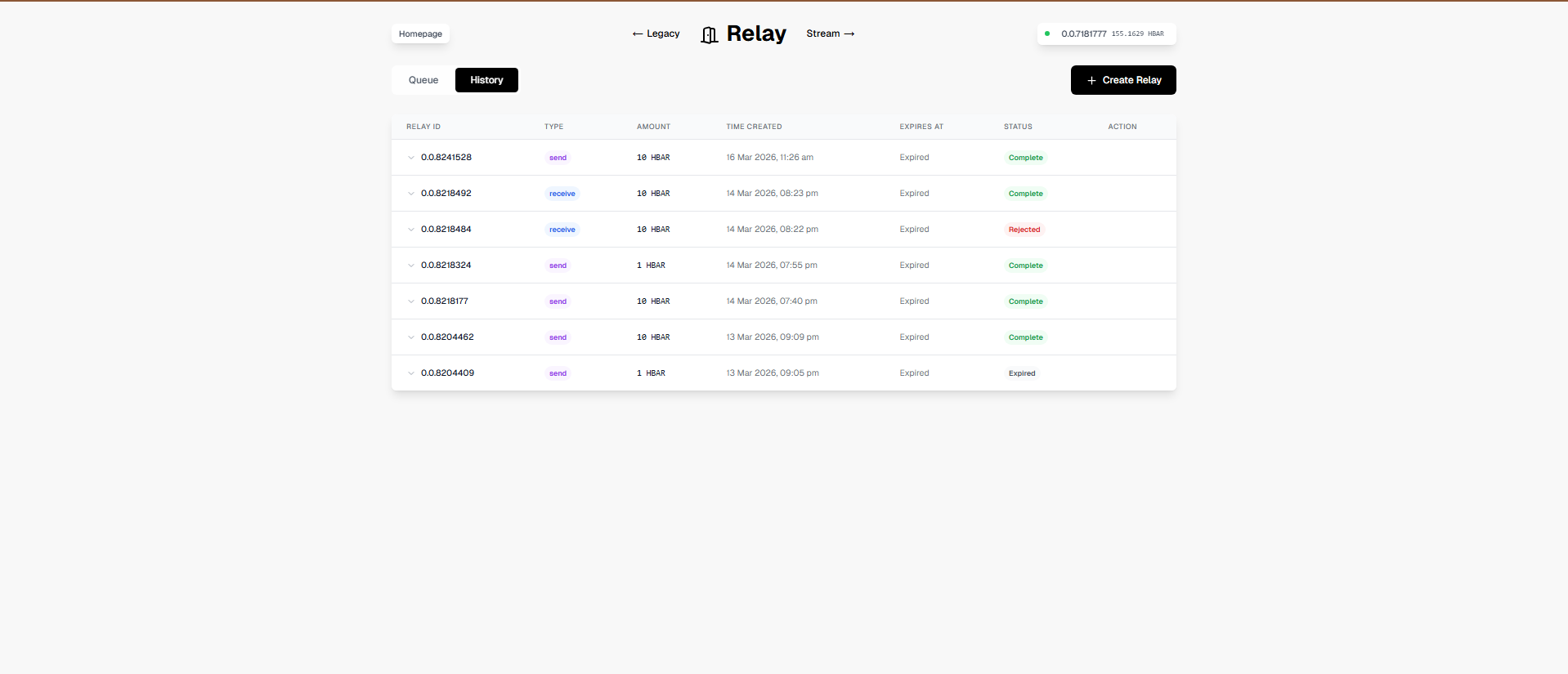
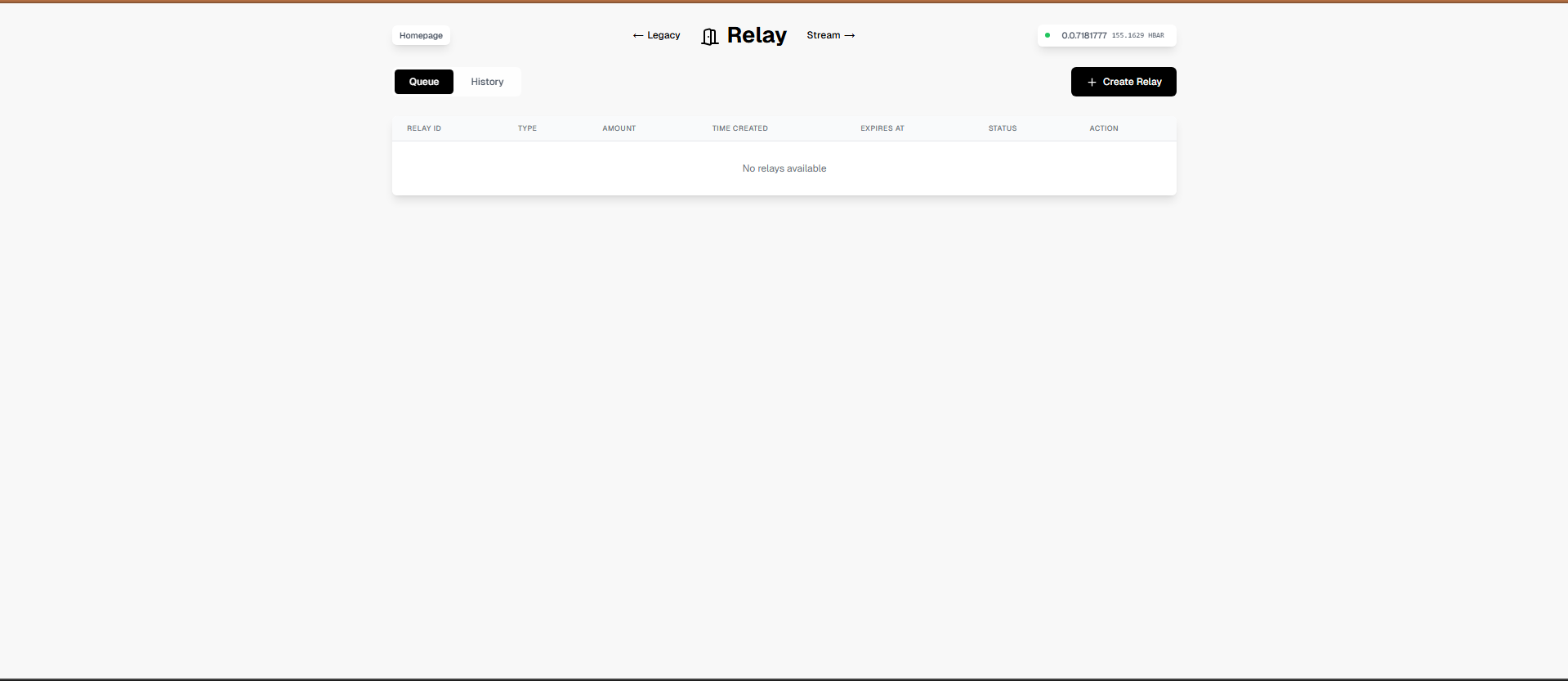
3.) Relay Protocol: An error-proof transfer mechanism requiring mutual consent, eliminating the risk of sending assets to the wrong address and protects users from malicious address attacks
Our target market is twofold. For B2C, we are targeting every active crypto holder, from DeFi traders to NFT collectors. For B2B, we are targeting digital platforms that require trusted transactions, including P2P marketplaces, Web3 freelance platforms, and DAOs managing their treasuries.
Our business model is built on direct value creation: a simple, flat $1.00 fee per B2C transaction and a competitive 0.15% fee for businesses using our Escrow-as-a-Service API. This dual approach ensures diversified and scalable revenue streams.
Continuum is not just a utility; it is foundational infrastructure designed to instill the confidence needed for the next wave of crypto adoption.
The Solution, Product, & Architecture Diagram
Our vision is simple yet profound: to give you absolute sovereignty over your digital assets. We believe that for crypto to achieve its potential, it must feel as intuitive and secure as modern banking, but without the centralized points of failure. Continuum achieves this by delivering total control over who receives your assets, when they receive them, and what happens in any eventuality.
We accomplish this through a platform built around a core governance engine, supported by a foundational security protocol.
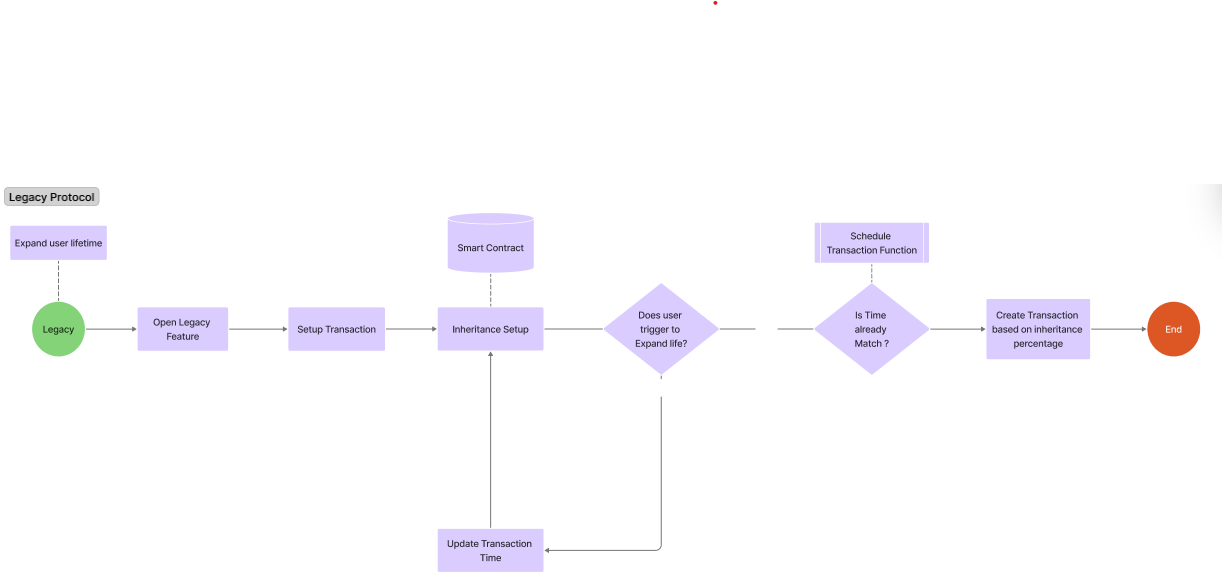
- The Legacy Protocol (Continuum Governance Engine) Continuum Legacy Protocol
The Legacy Protocol is a revolutionary "digital will" designed to ensure your assets are passed to family and friends exactly as you intend when you're no longer able to manage them. It functions as an intelligent "dead man's switch" that provides total peace of mind without sacrificing control.
The most critical feature is that your funds are never locked in a smart contract. You retain full custody and can use your assets freely at any time. The protocol simply monitors a "Heartbeat Signal" that you periodically reset. If this signal stops, it initiates a secure, pre-planned process to distribute your legacy.
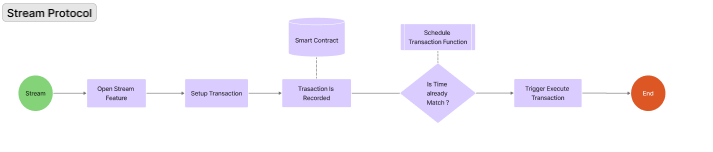
- The Stream Protocol Continuum Stream Protocol This is the core of our platform, where we move beyond simple security and into true on-chain governance and financial automation. We use time-based fund streaming to create a new framework for managing digital assets, transforming a simple automated payment into a fully governed financial agreement.
Our platform provides full auditability for all DAO members by using the Hedera Consensus Service (HCS) to create an immutable public log.
The process is simple yet powerful: First, a proposal for any action, like a payment stream, is submitted to HCS, creating a permanent, timestamped record. Then, the final on-chain transaction from the DAO's wallet includes a memo that directly references this HCS record.
This creates an unbreakable link between the publicly logged proposal and the financial action, allowing any DAO member to easily verify that every transaction was properly authorized. This transparent foundation enables high-trust applications:
1.) DAO & Corporate Treasury Management: Automate payroll and expenses with complete transparency for all stakeholders.
2.) Milestone-Based Funding: Trigger funding releases that are cryptographically tied to publicly verified project milestones.
- The Relay Protocol (The Foundation of Trust) Continuum Relay Protocol This protocol eradicates transfer errors. By requiring mutual, on-chain consent from both sender and receiver before any assets are moved from our secure smart contract, we transform anxiety-ridden transactions into a simple, verifiable Relay. It is the seatbelt for every digital transaction, a fundamental safety standard that should have always existed.
Advanced P2P Escrow: Facilitate high-value trades where funds are only released upon approval from the Buyer And Seller
In essence, Continuum provides a complete suite of tools for managing a digital life with confidence, transforming crypto from a high-risk asset class into a robust platform for everyday finance and long-term wealth management.
Business Model & Financial Projections
Our business model is designed for simplicity, scalability, and alignment with our users' success.
Per-Transaction Protocol Fees We will charge a predictable, flat fee for every transaction secured by our protocol. This model is transparent and easy for users to understand, directly tying our revenue to the value we provide.
- Relay Protocol Fee: Every successful, mutually-approved transfer will incur a flat fee.
- Legacy Protocol Fee: Every executed scheduled payment or "Digital Will" distribution will incur a flat fee.
Pricing: A flat fee of $1.00 USD (or its equivalent in the network token) per transaction. This is a negligible cost compared to the potential loss from a single error or the complexity of alternatives, making it an easy choice for users seeking peace of mind.
Escrow-as-a-Service API (B2B) We will offer an open API for other businesses to integrate the Continuum security features directly into their platforms. This allows us to act as a trusted, third-party escrow provider for a wide range of B2B use cases.
- Use Cases: P2P marketplaces for high-value goods (e.g., watches, digital art), Web3 freelance platforms, NFT OTC (Over-The-Counter) desks, and gaming platforms facilitating player-to-player trades.
- Pricing: We will charge a competitive, volume-based fee of 0.15% on the total transaction value that passes through our API. For high-volume enterprise partners, we can negotiate custom rates and potentially a monthly platform access fee. This model allows us to scale our revenue alongside the growth of our partners.
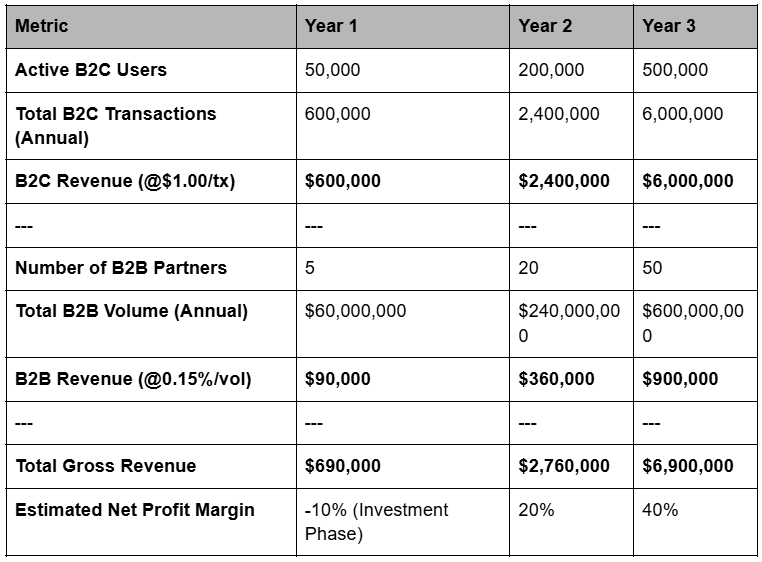
Financial Projections These projections are based on our new transaction-based model and stated user acquisition goals.
Key Assumptions:
- The average B2C user performs 1 secure transaction per month via our platform.
- The average B2B partner processes $1,000,000 in transaction volume per month through our API.
Financial Projections For Continuum
How we built it
The Continuum is built upon a modern, robust, and scalable technology stack. Our architectural philosophy prioritizes security, developer efficiency, and a seamless user experience. Every component has been deliberately chosen to serve the long-term vision of the protocol.
Core Language & Development Tooling
- TypeScript: The entire codebase is written in TypeScript. This provides end-to-end type safety, which is non-negotiable for a protocol handling user assets. It drastically reduces runtime errors, improves code quality, and enhances long-term maintainability.
- Vite: We use Vite as our build tool for its incredibly fast development environment and optimized production bundles, allowing our team to iterate and ship features efficiently.
Frontend & User Experience
- React: The user interface is built with React, the industry standard for creating dynamic and responsive web applications.
- Styling & State Management: We leverage Tailwind CSS for rapid and consistent UI development. For managing the complex state of a dApp, we use TanStack Query (React Query), which provides a powerful and efficient mechanism for data fetching, caching, and synchronization.
Web3 & Blockchain Core This is the heart of our protocol, where security and innovation converge.
- Hedera Network: Our protocol is built on the Hedera network to leverage its institutional-grade security (aBFT), high throughput, and, most importantly, its ultra-low, predictable fees.
- Smart Contract & EVM Integration: We use Wagmi and Viem as our primary tools for interacting with the Hedera EVM. These modern libraries provide a type-safe, reliable, and performant connection between our frontend and our smart contracts deployed via Remix IDE.
- Key Innovations: Our core features are powered by two critical standards:
- EIP-712: Used for typed, human-readable signatures. This ensures users know exactly what they are approving, protecting them from phishing and scams.
- Hedera Scheduler Transactions : This is our "secret weapon." We use Hedera’s native scheduling capabilities to power our Legacy Protocol, allowing for trustless, automated execution of future transfers without relying on centralized servers or keepers.
Backend Infrastructure & Database
- Supabase: We utilize Supabase, an open-source Firebase alternative, for our backend needs. It provides a robust and scalable PostgreSQL database for application data and handles our user authentication. This BaaS (Backend-as-a-Service) approach allows us to focus on our core protocol logic while relying on a trusted provider for infrastructure management.
Wallet Integration
- To ensure broad accessibility, we use Web3Modal to manage wallet connections. This provides a seamless experience for users connecting with a wide range of wallets, including MetaMask and mobile wallets via the WalletConnect protocol, all configured for the Hedera network.
Challenges we ran into
The challenge that I build this project is when I make sure that the table & data are synchronize with supabase and sometime I faced the problem in supabase about RLS policy that should be enabled especially when we want to insert & update the data for the users. This takes a day for me to solve the problem and thanks to GOD that the project that I build can be run smoothly without any bug / error agaun.
Accomplishments that we're proud of
Our development philosophy is to build and secure the most critical components first. For the Hackathon, we have successfully developed a fully functional Minimum Viable Product (MVP) that demonstrates the core, end-to-end functionality of both the Relay and Legacy protocols, establishing a complete foundation for the Continuum ecosystem.
1.) The Legacy Feature The Legacy protocol is the definitive solution to the "Digital Abyss," ensuring your assets are a gift to your loved ones, not a permanent digital mystery. It allows you to build a sophisticated, trustless estate plan that activates when the time is right.
At its core is the "Heartbeat" check—a simple, periodic on-chain interaction that proves you are still active. If the Heartbeat stops for a pre-defined period, the protocol automatically initiates your final wishes.
- Scheduled & Legacy Transfers: Users can successfully create transactions scheduled for a future date and time using Hedera's native scheduling service.
- Automated Execution: Our system correctly identifies and triggers the execution of these scheduled transactions once their time has come.
- Liveness check: User can trigger function by clicking button "Refresh Heartbeat" on our platform expand their liveness and automatically update the legacy transaction time
- Current Asset Support: Like the Relay protocol, the Legacy protocol MVP currently supports HBAR tokens.
2.) The Relay Feature The complete secure transfer flow is operational on the Hedera Testnet.
- End-to-End Flow: Users can initiate a transfer, have assets secured in our smart contract escrow, and the transaction is only completed upon the on-chain mutual consent of the receiver.
- Current Asset Support: The protocol currently supports transfers of HBAR tokens
3.)The Stream Feature
The Stream feature transforms how organizations and individuals manage and distribute funds. It's not just about scheduling payments; it's about creating enforceable, on-chain agreements that eliminate the need for manual trust.
We achieve this by using time-based asset streaming
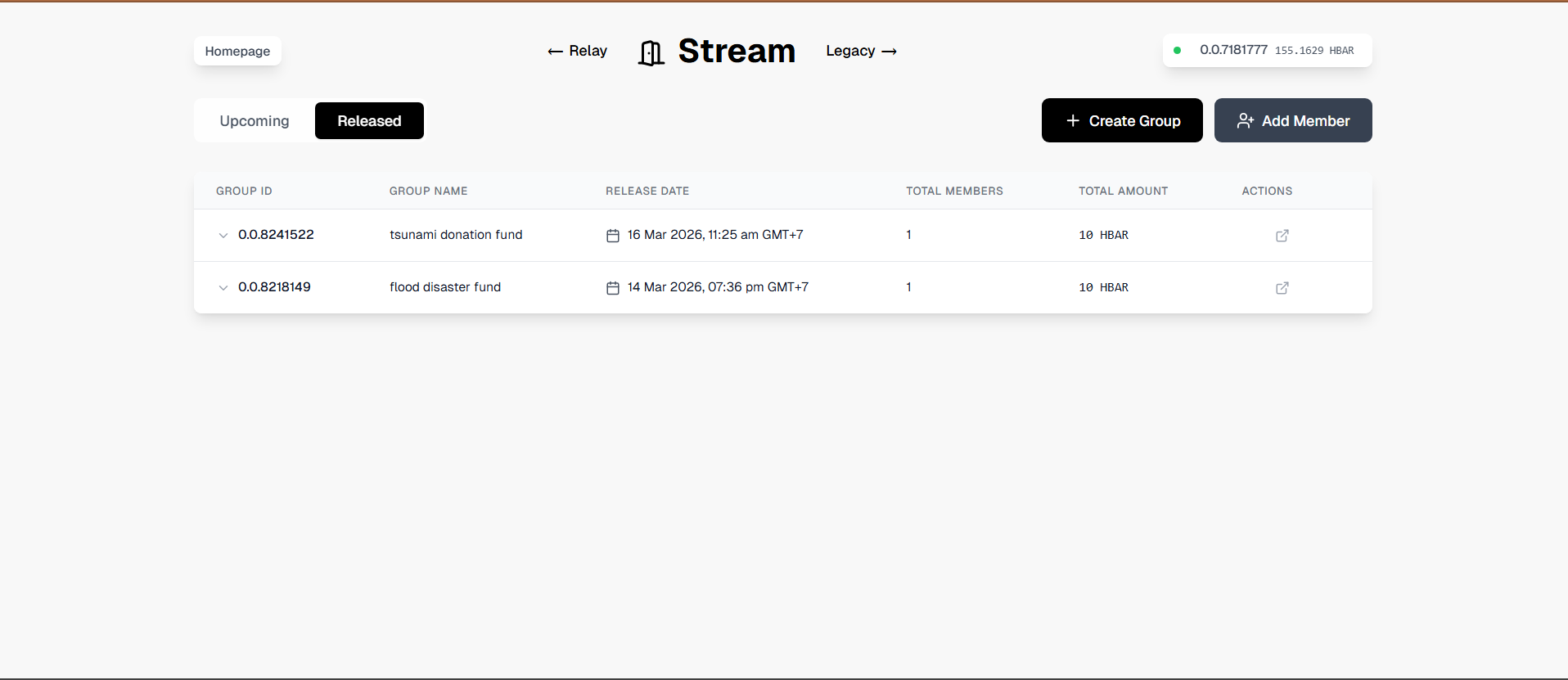
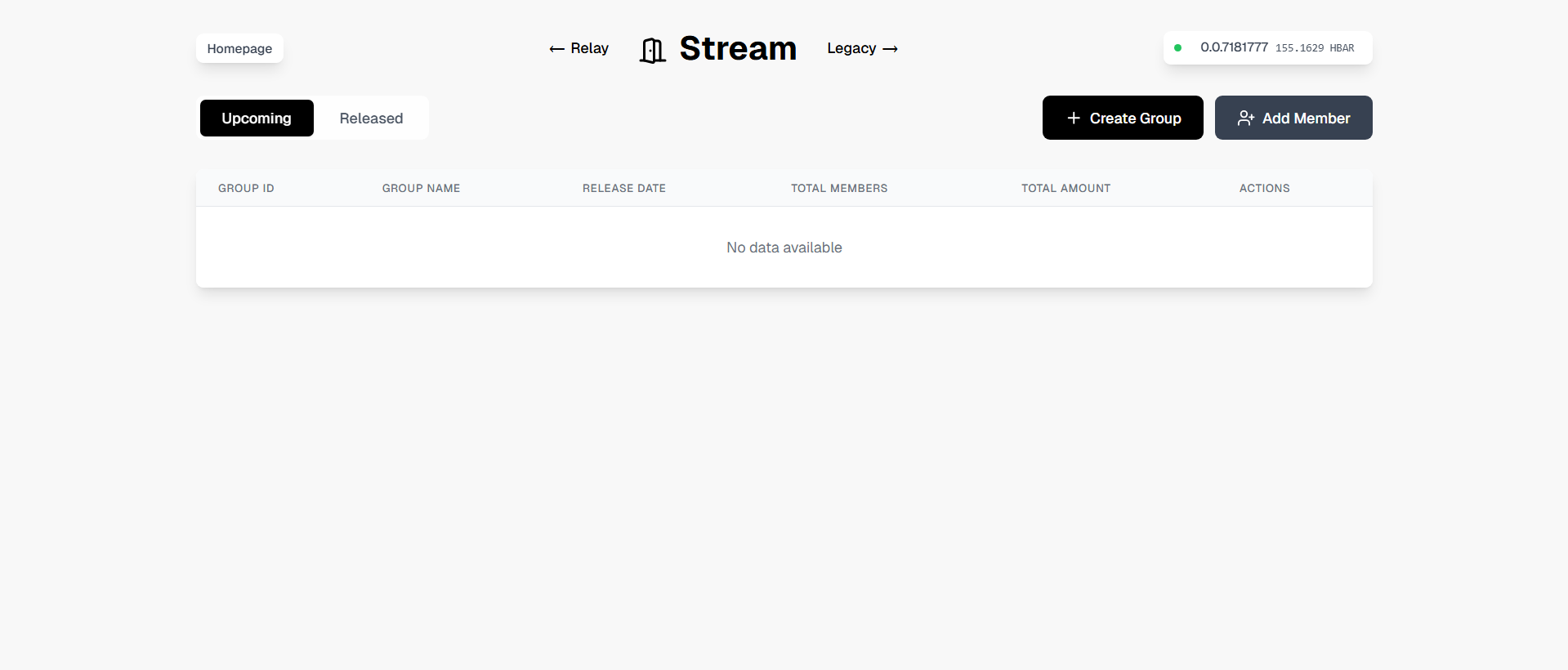
- Scheduled Batch Payments: Users can successfully create and fund payment "Groups" scheduled for a future release date, powered by Hedera's native scheduling service.
Current Limitations & Immediate Next Steps Transparency is key to our development process. The current limitations of the MVP define our immediate post-hackathon roadmap.
- B2B API: The core logic for B2B escrow is complete and functional internally. Our immediate next step is to build and publish the public-facing Open API documentation required to begin seamless partner integration.
- Expanded Token Support: Our next development sprint will focus on expanding asset support to include a wider range of popular wrapped assets from other ecosystems.
This MVP robustly proves our team's ability to execute on complex smart contract logic and deliver a complete, user-facing product on the Hedera network.
What we learned
In essence, Continuum provides a complete suite of tools for managing a digital life with confidence, transforming crypto from a high-risk asset class into a robust platform for everyday finance and long-term wealth management.
What's next for Continuum
Our launch strategy is a multi-phased approach focused on building a strong foundation within a core community before expanding.
Phase 1: Foundation (First 6 Months):
- Community First: Target the Hedera ecosystem, where we can gain early traction and feedback. Hackathons & Grants: Leverage our origin story to build credibility and secure non-dilutive funding.
- Strategic Partnerships: Integrate Continuum with leading Hedera wallets, DeFi platforms, and NFT marketplaces to offer our services directly where users already are.
Phase 2: Growth (Months 6-18):
- Content & Education: Launch a marketing campaign focused on the "Digital Will," educating the market on the importance of crypto inheritance.
- B2B Onboarding: Actively partner with other dApps to adopt our Sponsored Transaction API, creating a viral loop where their users are exposed to the Aegis brand.
- Influencer Marketing: Collaborate with trusted voices in the DeFi and NFT space to review and promote the protocol.
Phase 3: Expansion (Months 18+):
- DAO & Enterprise Solutions: Develop a dedicated offering for DAOs and crypto businesses to manage their treasuries with multi-signature Relays and scheduled payroll/vesting.
Built With
- hedera
- react
- supabase
- tailwind-css
- typescript
- vite
- wagmi
- web3modal


Log in or sign up for Devpost to join the conversation.