Inspiration
Healthcare is the only industry where "the system was down" can directly cost lives. When a patient arrives at an ER unconscious, with no history, no allergy list, and no medication record, clinicians make decisions with incomplete information. The average medical error rate in emergency settings is alarmingly high, and a significant portion traces back to fragmented patient memory across systems.
We asked: what if an AI agent could remember every patient interaction, not just today's visit but the full longitudinal record, and make that memory available globally, instantly, even in an emergency? Not a chatbot that summarizes notes, but a persistent, agentic memory layer that lives in a distributed database, survives region failures, and speaks the same language as production infrastructure.
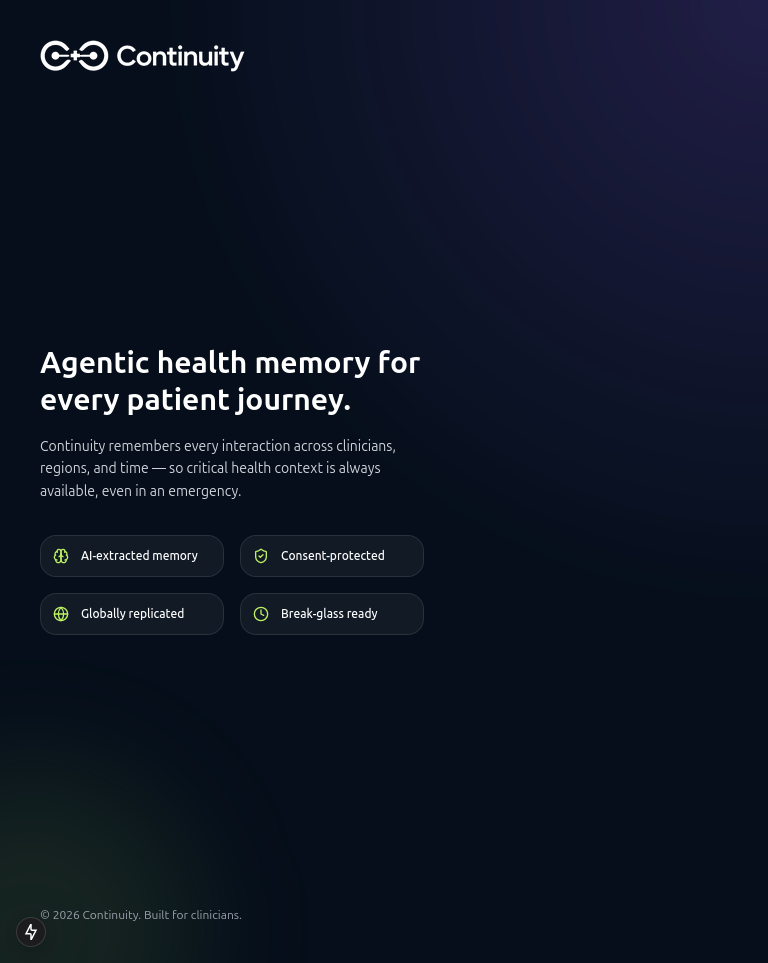
Continuity is that agent. It stores, retrieves, and reasons over patient memory using CockroachDB as its persistent backbone, with Amazon Bedrock models powering the intelligence. The name says everything: in healthcare, continuity of memory is continuity of care.
What it does
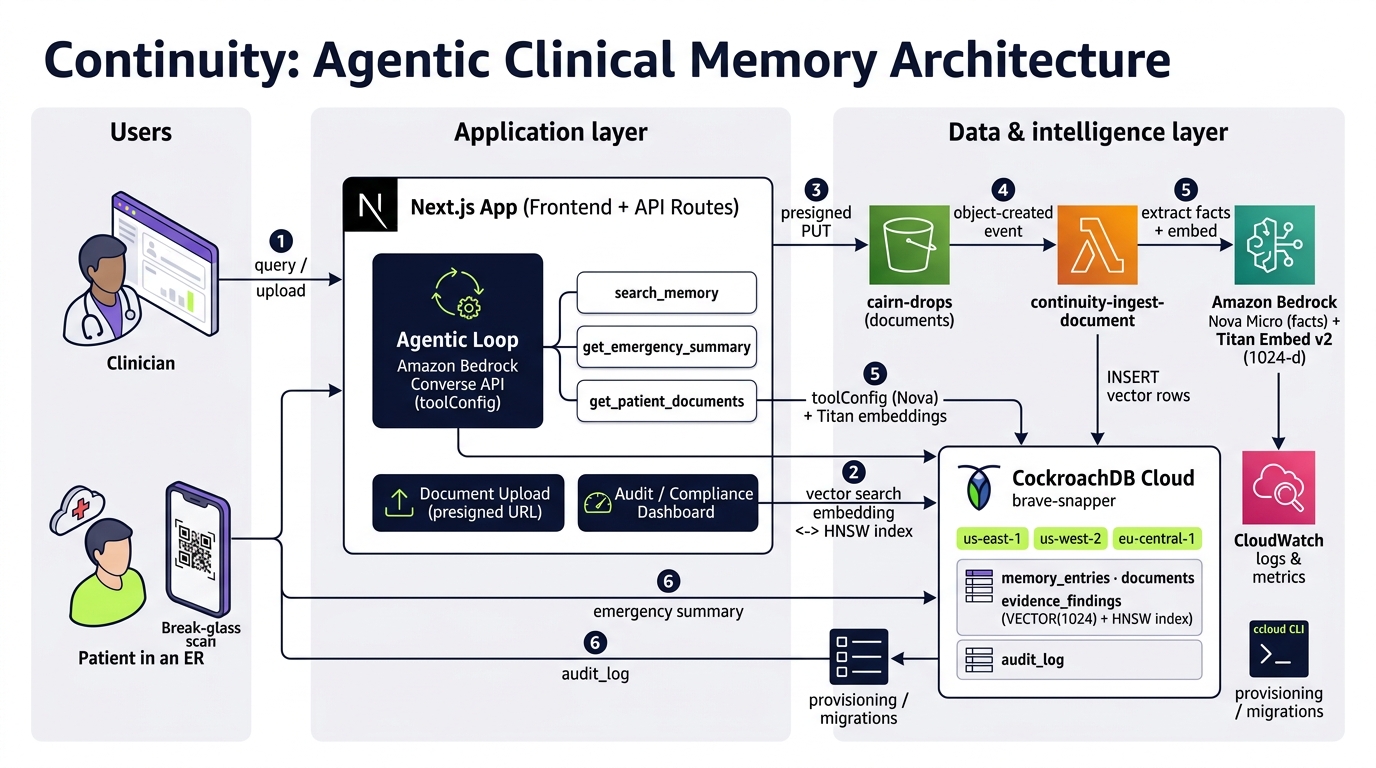
Continuity turns fragmented health records into a persistent, agentic memory layer. In a chat interface, clinicians ask questions, and the agent reasons over that memory using a Bedrock-powered tool-call loop — deciding which tools to invoke, executing them against CockroachDB, and synthesizing a sourced answer.
1. Agentic Memory Retrieval. A clinician asks "Show me Lucas's key medical history and all active allergies." The agent doesn't just search a database — it reasons. Using a Bedrock-powered tool-call loop, it decides which tools to invoke (memory search, emergency summary, document lookup), executes them against CockroachDB, synthesizes the results, and returns a structured answer with sourced facts and confidence scores.
2. Document Ingestion Pipeline. Clinicians upload clinical documents (charts, notes, labs) directly to S3 via presigned URLs. An S3-triggered Lambda reads the document, sends it to Bedrock Nova Micro for medical fact extraction, embeds each fact via Bedrock Titan, and stores the structured memory entries in CockroachDB with HNSW vector indexes. The pipeline is fully serverless and event-driven.
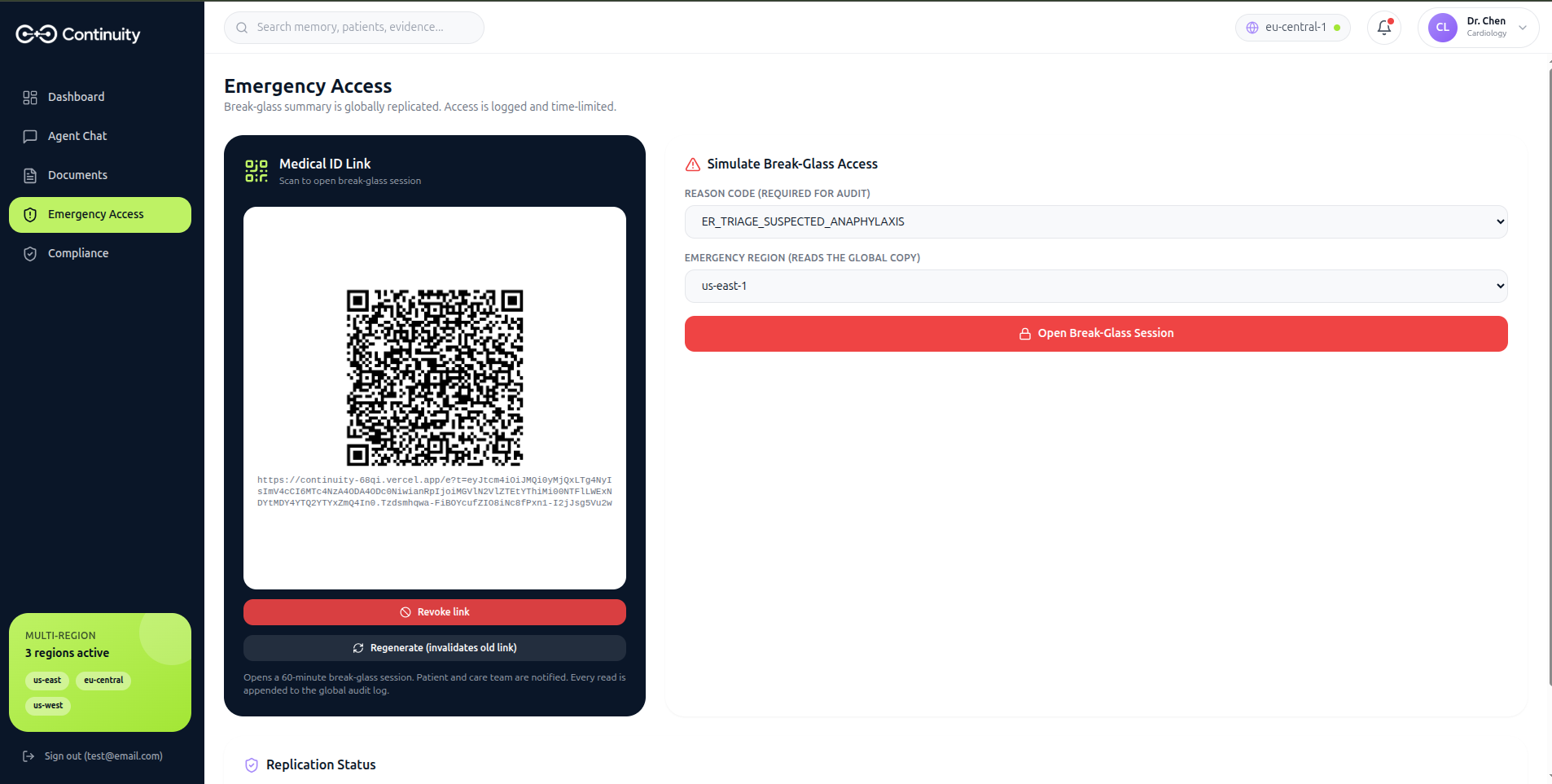
3. Emergency Break-Glass Access. For situations where a patient can't provide history, the system generates signed, 60-minute capability URLs with QR codes. An ER clinician scans the code, enters a reason code (mandatory for audit), and gets immediate access to the emergency summary: allergies, medications, conditions, emergency contacts. Every access is logged to a global audit trail. Links can be revoked before expiry.
4. Multi-Region Memory. The patient record lives across three CockroachDB regions (us-east-1, us-west-2, eu-central-1). When a patient arrives at an ER on a different continent, the agent reads from a memory that was written hours ago on another continent, with zero data loss and no manual replication.
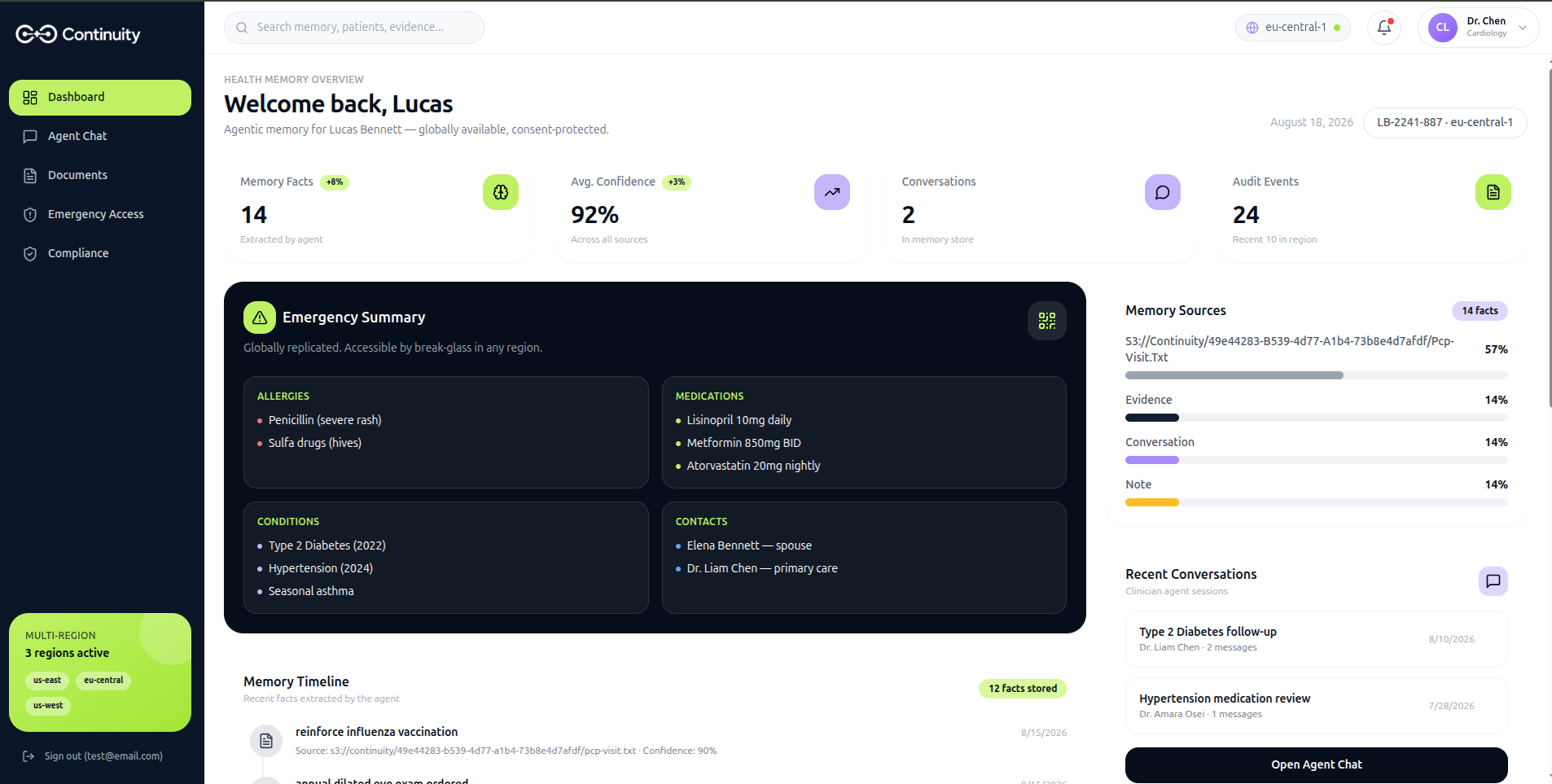
5. Compliance Dashboard. Every memory access, agent query, document upload, and break-glass event is recorded in an audit log. The compliance view shows access success rates, denied requests, and a full event timeline with actor attribution, region, and reason codes.
How we built it
The architecture layers CockroachDB's distributed SQL and vector capabilities under an agentic Bedrock-powered application. Here's the full stack:
The Memory Layer (CockroachDB)
The memory_entries table stores extracted medical facts with a VECTOR(1024) column, HNSW-indexed for approximate nearest-neighbor search. This is the core of the agent's retrieval: when a clinician asks a question, the query is embedded via Bedrock Titan and searched against this index using CockroachDB's <-> vector distance operator.
The documents table tracks source documents with their own embeddings. The emergency_summary table holds the critical-care snapshot. The audit_log table records every access event with timestamp, actor, action, region, and outcome. All tables use CockroachDB's multi-region features with home_region columns for data locality.
The PostgreSQL wire protocol means standard pg drivers work natively; no custom connector needed. The Lambda connects directly via pg.Pool with SSL.
The Agent Loop (Bedrock + CockroachDB)
The agent uses Bedrock's Converse API with Nova Micro in a tool-call loop (max 3 steps). Three tools are registered:
search_memory. Hybrid retrieval: Titan embeds the query, vector search runs against CockroachDB's HNSW index, and if no vector hits, falls back to keyword search with tokenizedLIKEqueries. Returns facts with category, confidence, and source attribution.get_emergency_summary. Reads the emergency summary from CockroachDB for urgent care context.get_patient_documents. Lists uploaded source documents with extracted text snippets.
The loop injects initial memory context before the first tool call, so the model has grounding even before it decides which tools to invoke.
The Ingestion Pipeline (S3 + Lambda + Bedrock + CockroachDB)
- Browser uploads directly to S3 via a presigned URL (no server-side proxy)
- S3 event triggers the Lambda (
continuity-ingest-document) - Lambda reads the document, sends text to Nova Micro with a medical fact extraction prompt
- Nova returns a JSON array of categorized facts (allergy, medication, condition, etc.)
- Each fact is embedded via Titan and inserted into
memory_entrieswith its vector - The document's own text is embedded and stored in the
documentstable
The Lambda uses CloudWatch for observability. The entire pipeline is serverless; no containers to manage.
The Emergency System (CockroachDB + Auth + HMAC)
The break-glass system has two paths: a direct API call (for clinicians in the app) and signed capability URLs (for external devices). The signed tokens use HMAC-SHA256 with a 60-minute TTL, and can be revoked before expiry. Every break-glass access requires a reason code and creates both an emergency_access_events row in CockroachDB and an audit_log entry. The /e public portal verifies tokens and checks revocation status before granting access.

The Frontend (Next.js 15)
The dashboard renders real-time counts from CockroachDB via the overview API. The agent chat returns structured widget cards (patient profile, memory hits with confidence bars, allergies, medications, sources) rendered inline with the conversation. The documents page shows upload status, file types, and ingestion progress. The compliance page displays the full audit trail.
Challenges we ran into
1. Vector search fallback design. HNSW indexes require embeddings to exist, but what about facts inserted before Bedrock was configured, or when the embedding model is temporarily unavailable? We built a hybrid retrieval path: vector search first, keyword fallback with tokenized LIKE queries and stemming (handling plurals, "ies" → "y") when vectors are missing. This means the agent degrades gracefully instead of returning empty results.
2. Self-fetch race in RSC. Next.js server components that fetch their own API routes (/api/overview) can fail during dev hot-reload when the server is mid-compile. The self-fetch hits the same busy process, causing RSC streaming errors. Fixed by switching to same-origin relative fetches with try/catch fallback, so the dashboard now degrades to seed data on transient failures instead of crashing.
3. Bedrock tool-use schema friction. The Bedrock Converse API's tool input schemas use a json union type that doesn't map cleanly to TypeScript. The chatWithTools function needed explicit type assertions (as never) to satisfy the TypeScript compiler while preserving runtime correctness.
4. Emergency link persistence across environments. On localhost, break-glass links are stateless HMAC tokens, which is fine for dev. On deployed environments, revocation requires a persistence layer. We added a conditional storage path: when the request host isn't localhost, links are persisted with token hashes (never raw tokens) and can be revoked before TTL expiry.
Accomplishments that we're proud of
The agent actually reasons. It's not a thin wrapper around a language model. The tool-call loop means Nova Micro reads the question, decides which CockroachDB tables to query, executes the tools, and synthesizes results, all in a single request. The initial memory retrieval provides grounding, and the model chooses whether to go deeper.
Hybrid vector + keyword retrieval. CockroachDB's HNSW index powers semantic search, but the keyword fallback means the system works even without embeddings. This is production thinking: things break, models go down, and the agent should still return something useful.
The ingestion pipeline is fully serverless and event-driven. Upload to S3 → Lambda fires → Nova extracts facts → Titan embeds → CockroachDB stores. No polling, no queues to manage, no containers. CloudWatch handles observability.
Real audit trail, not decoration. Every agent query, document upload, and break-glass access creates an audit log entry with actor attribution, region, and outcome. The compliance dashboard shows real data, not hardcoded mockups.
Emergency access works cross-region. The break-glass system is designed for the scenario where a patient arrives unconscious in a different country. The agent reads from CockroachDB's multi-region cluster and returns the emergency summary with zero manual intervention.
What we learned
Agentic memory is fundamentally different from application memory. Traditional apps read and write rows. Agents spawn autonomously, write constantly, and need memory that persists across regions, failures, and scale, with zero data loss. CockroachDB's distributed SQL model fits this perfectly: the same cluster handles vector embeddings, transactional writes, and cross-region reads without a separate vector store.
Tool-use changes everything about retrieval. A chatbot with RAG just retrieves and generates. An agent with tools decides what to retrieve, when to go deeper, and when the initial context is enough. The difference is night and day for clinical accuracy: the model can refuse to answer if the memory doesn't support it, rather than hallucinating.
Graceful degradation is non-negotiable. The hybrid vector/keyword retrieval, the fallback chat modes when Bedrock is unconfigured, the try/catch around self-fetches, all of these exist because production systems fail in unexpected ways. The agent should degrade, not crash.
What's next for Continuity
Consent-aware memory filtering. The schema already has consent_grants and consent_state columns. The next step is making the agent's retrieval respect consent boundaries: if a patient hasn't consented to share mental health records, the agent filters them out before the model even sees them.
Real-time streaming. Bedrock supports response streams. The agent's tool-call loop could stream intermediate results ("Searching memory... found 12 facts... querying emergency summary...") to give clinicians progressive feedback during longer queries.
Multi-patient context. Emergency departments handle multiple patients simultaneously. The agent could maintain session-scoped context across patients, allowing clinicians to switch between patient records without re-querying.
Federated memory. Using CockroachDB's multi-region capabilities to support memory federation across hospital networks, where each hospital maintains its own data locality while the agent queries across the federation with appropriate access controls.
PDF and DOCX ingestion. The Lambda currently supports text-based formats. Adding Bedrock-powered OCR and document parsing would unlock the full range of clinical document types.
Built With
- aws-bedrock
- aws-lambda
- cockroach-db
- nextjs

Log in or sign up for Devpost to join the conversation.