-
-
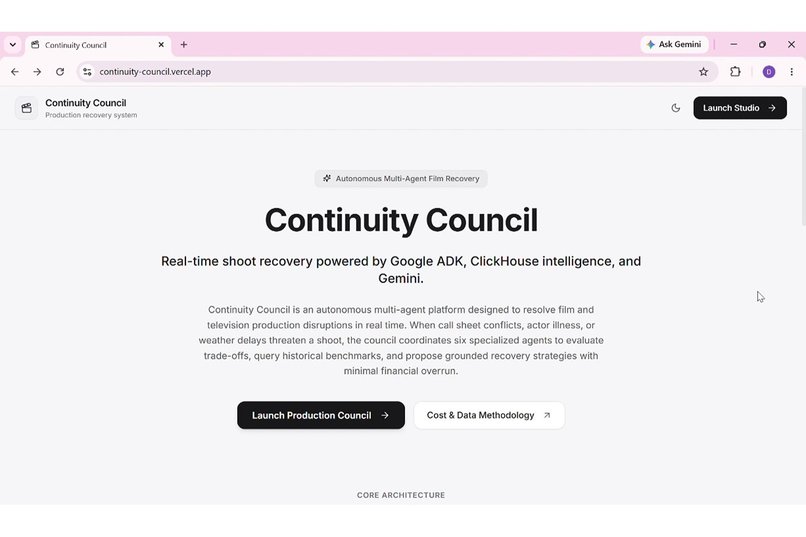
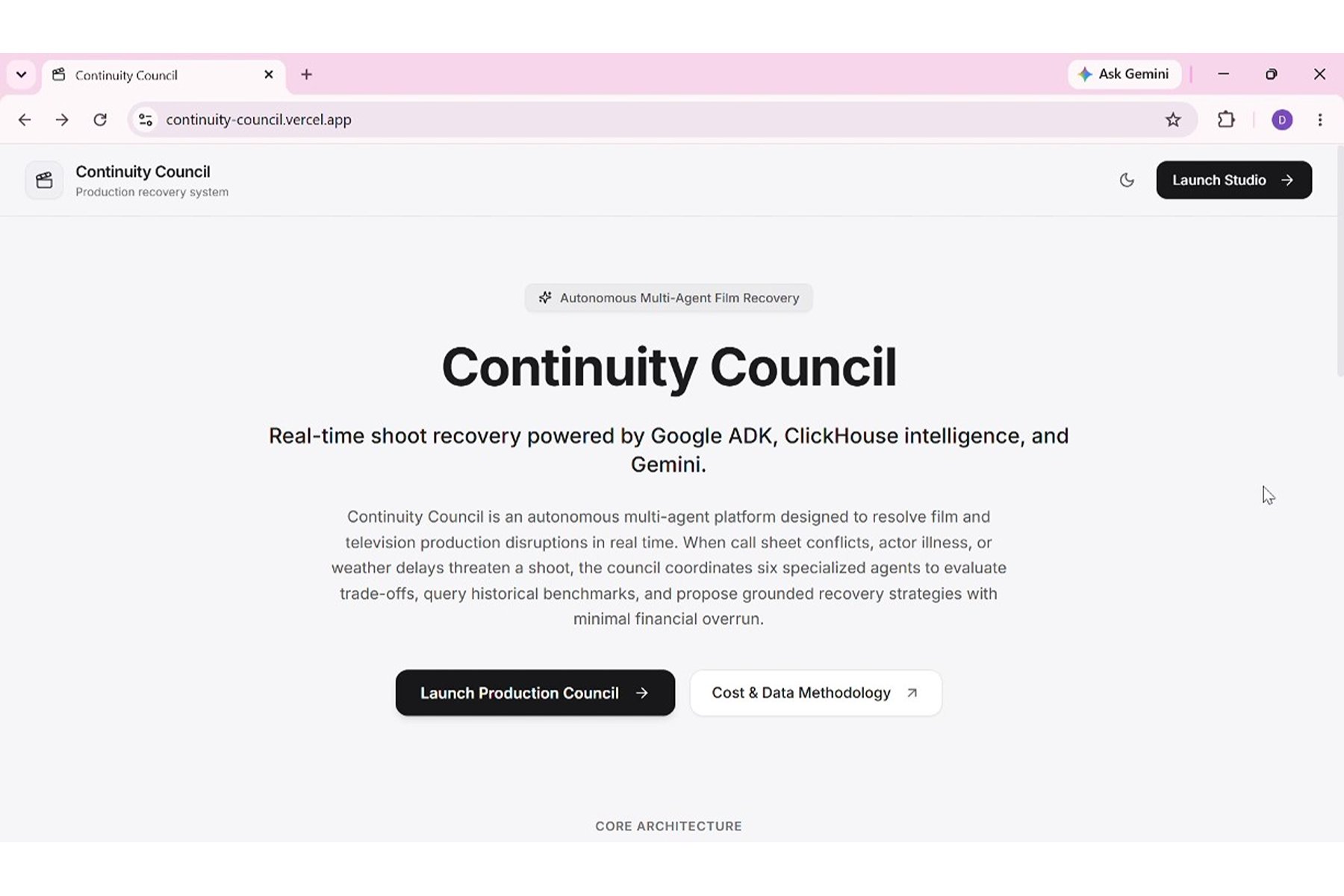
Autonomous Recovery: AI agents turn film disruptions into fast, data-backed recovery plans.
-
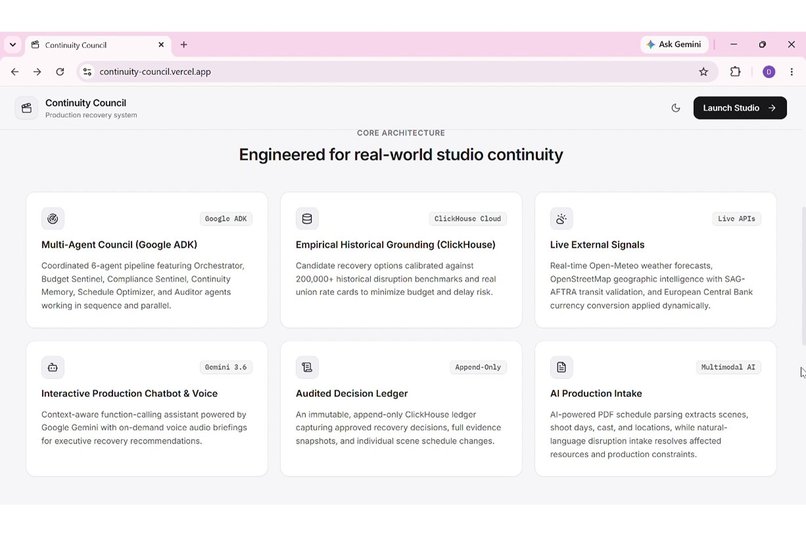
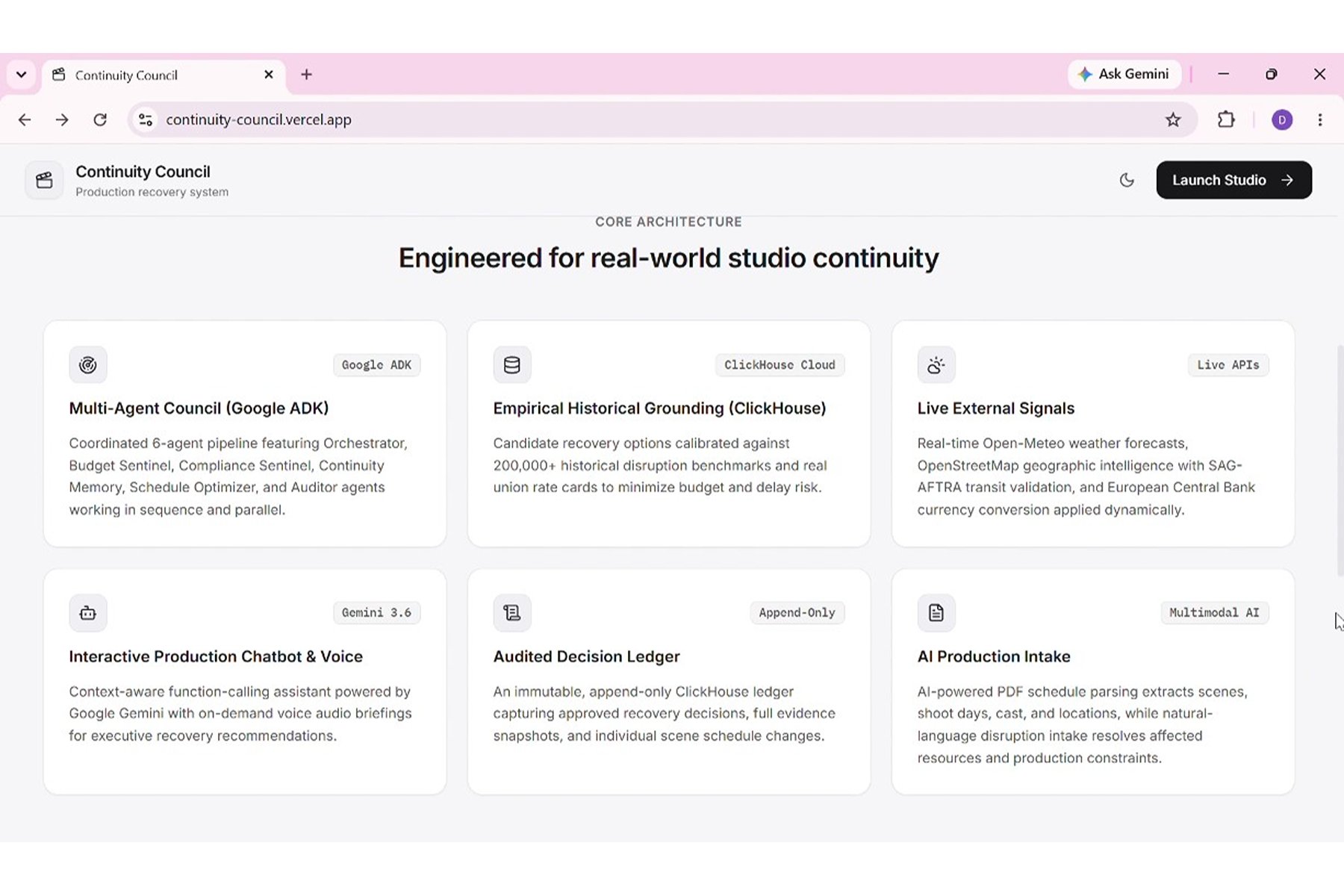
Core Architecture: Six AI agents collaborate to solve complex production disruptions.
-
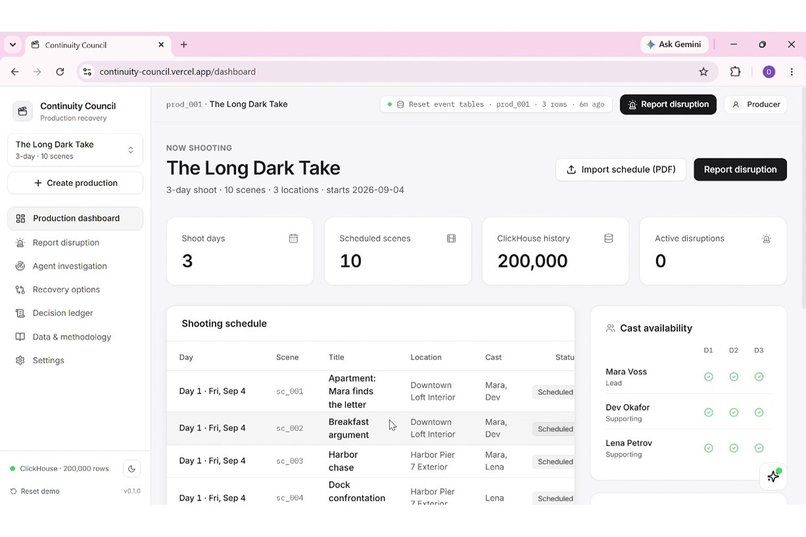
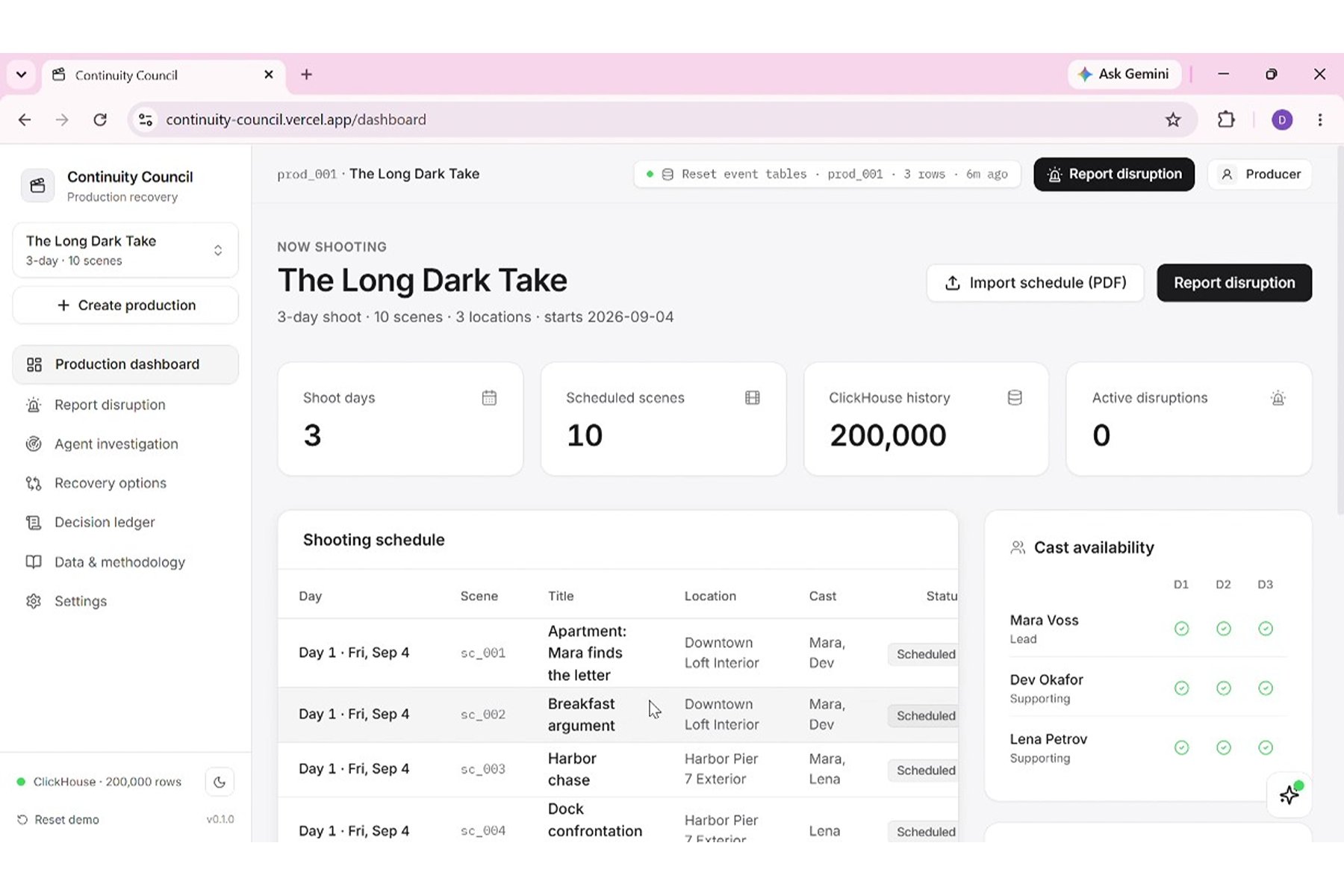
Production Dashboard: One view for schedules, scenes, cast, locations, and disruptions.
-
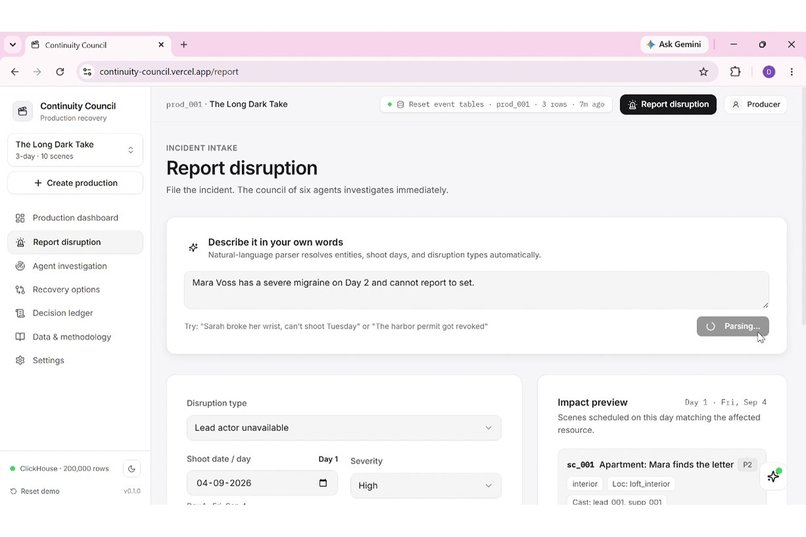
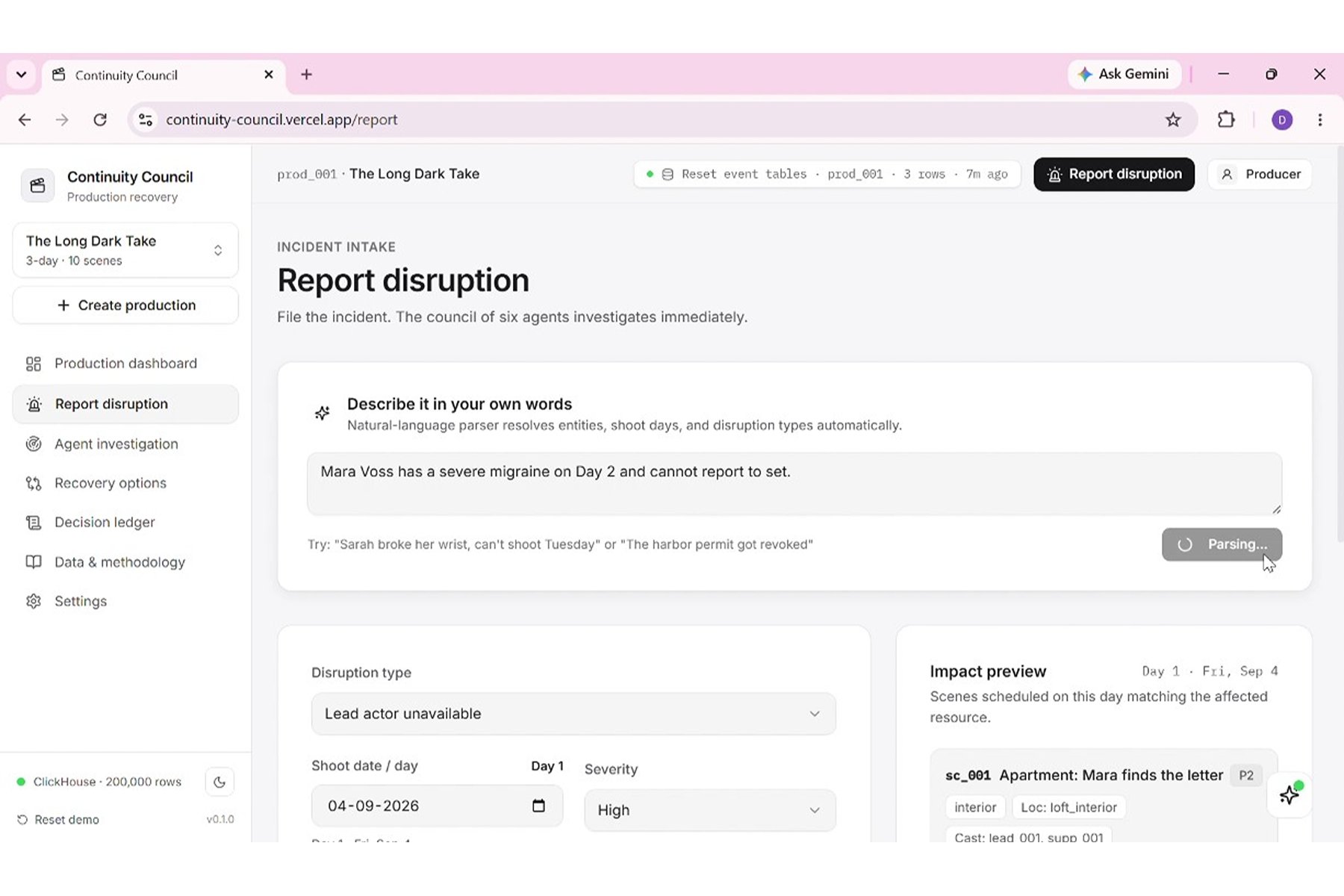
Natural Language Intake: Describe a disruption in plain English and AI structures the details.
-
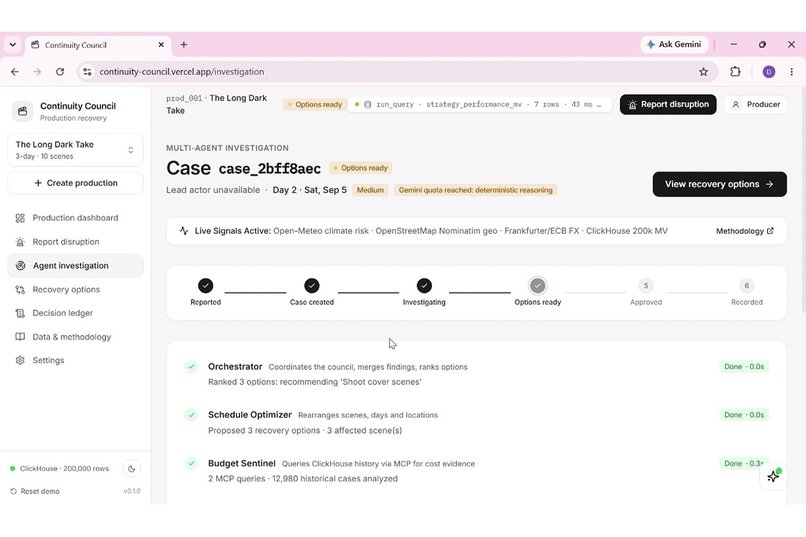
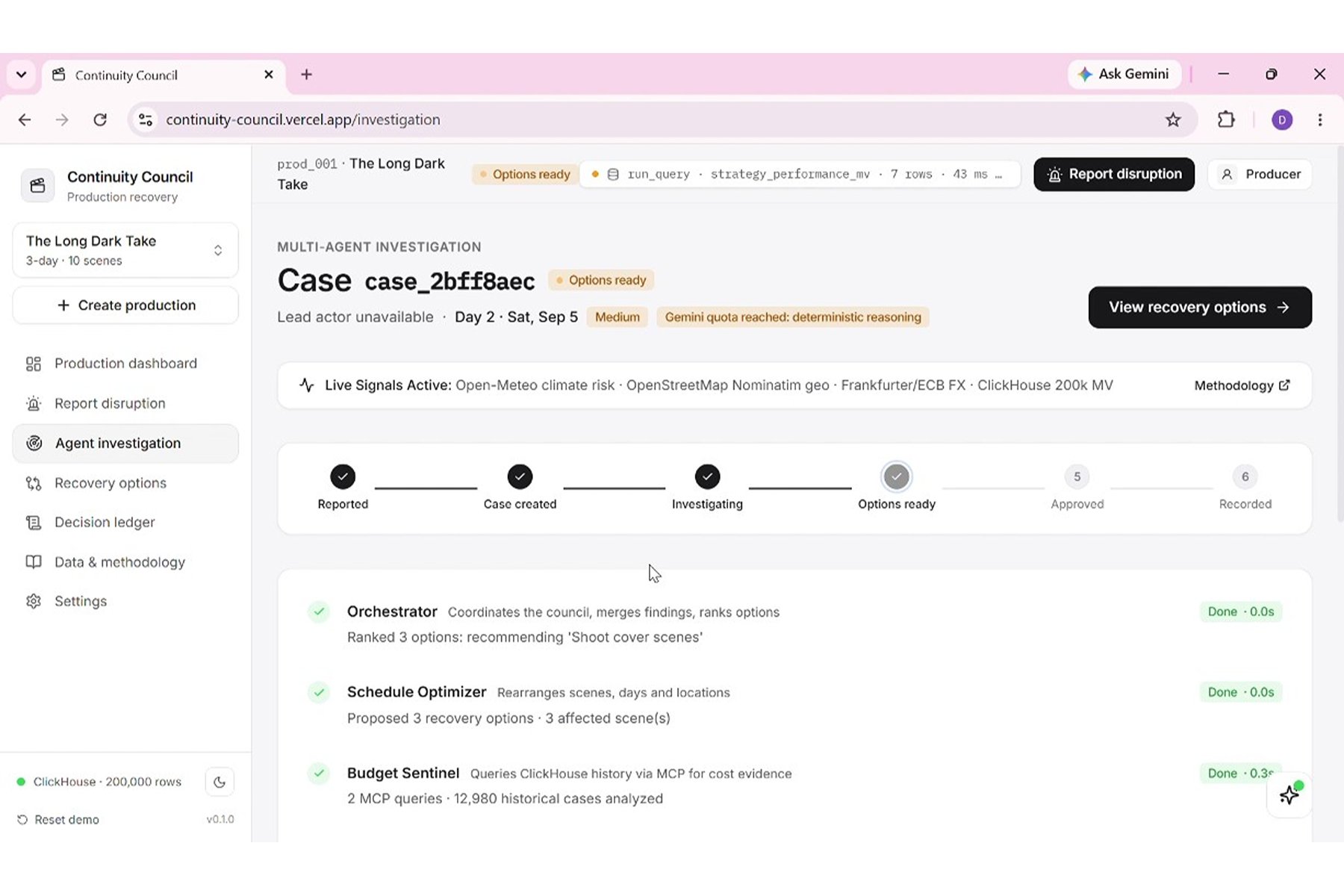
Multi-Agent Investigation: Six agents analyze schedules, costs, continuity, and compliance in parallel.
-
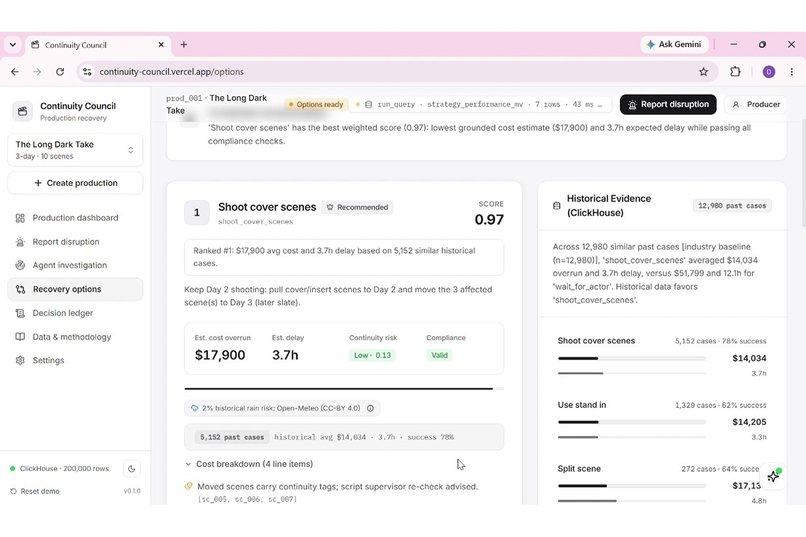
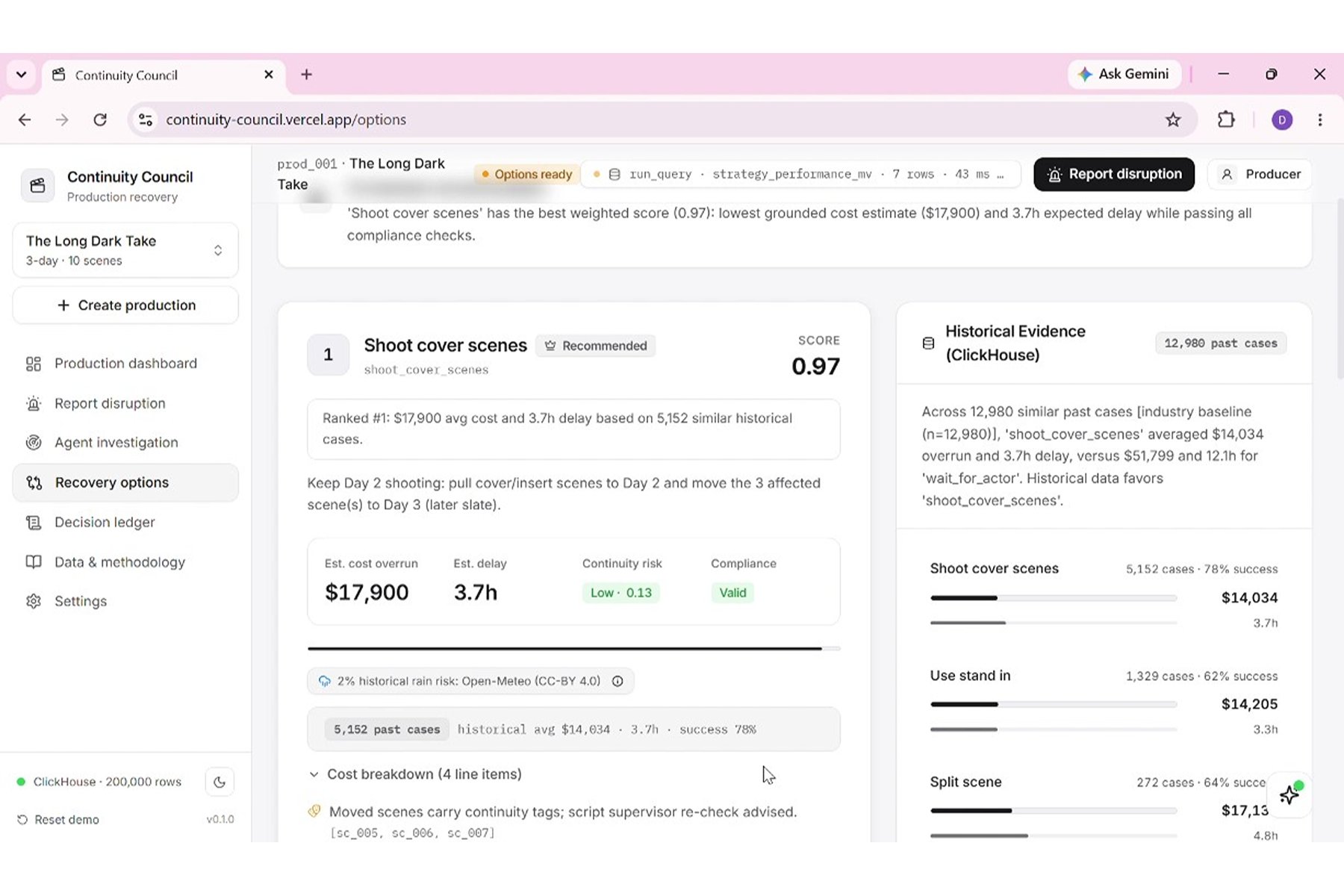
Ranked Recovery Options: Strategies are ranked by cost, delay, risk, and compliance.
-
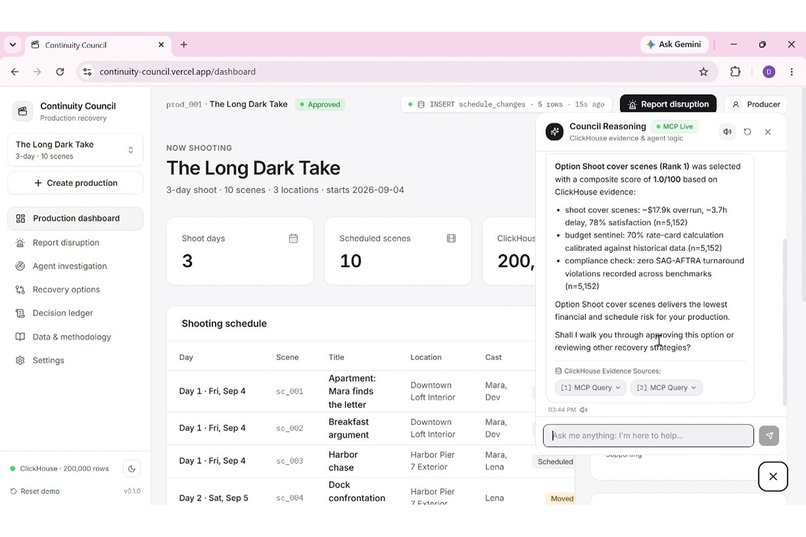
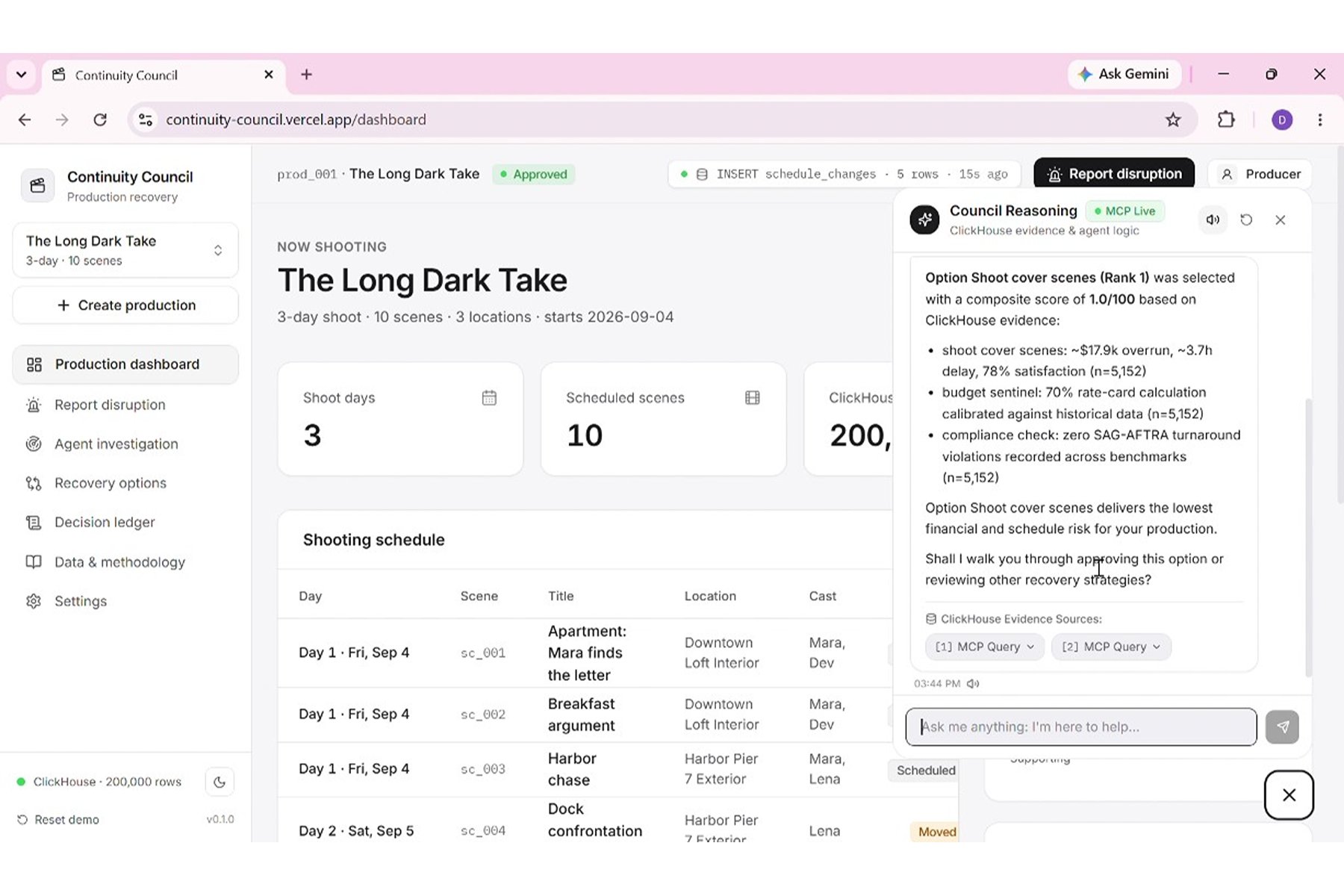
Production Chatbot: Ask questions and get answers grounded in production data.
-
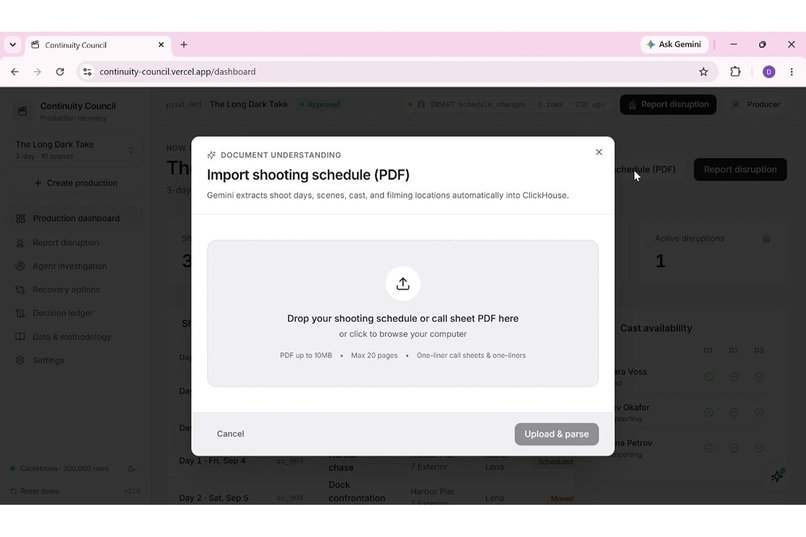
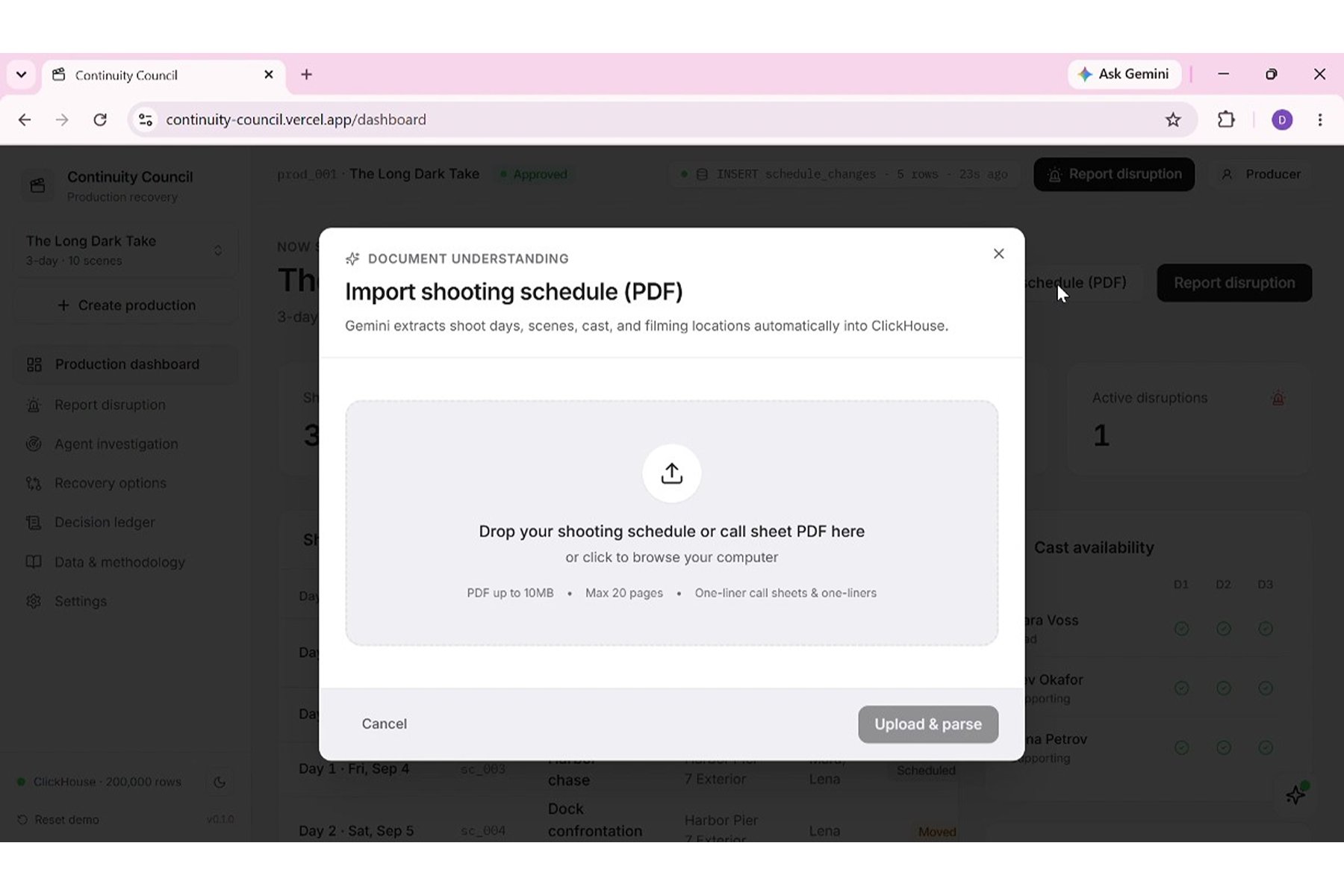
AI Schedule Import: Upload a call sheet and AI extracts scenes, cast, dates, and locations.
Inspiration
Film production runs on tight, interdependent schedules: cast, crew, locations, and budget all locked together. When something goes wrong mid-shoot like an actor becoming unavailable or a location falling through a production coordinator has to manually rebuild the schedule, re-check budget impact, and cross-reference compliance and union rules, usually under real-time pressure and without a clear view of what's actually worked before in similar situations. We wanted to see if an autonomous multi-agent system could take on that recovery process directly: not just suggest a fix, but investigate the disruption, evaluate multiple recovery strategies against real historical data, and hand back a fully evaluated, explainable decision.
What it does
Continuity Council is an autonomous multi-agent platform for film production disruption recovery. A producer reports a disruption in plain English, and the system parses it, identifies every scene and schedule element it affects, and dispatches a team of specialized agents to investigate in parallel: rescheduling, cost estimation, narrative continuity, and compliance/union rule checking, all coordinated by an orchestrator agent.
Every recovery option the system proposes is grounded in real historical data. The agents query a ClickHouse backed archive of past disruption cases live via MCP. Options are priced using a 70/30 calibration model (70% bottom-up union rate cards + 30% historical ClickHouse averages) and scaled globally using a Geo-Costing Engine that combines World Bank GDP PPP indices with OpenStreetMap city tiers.
Options that violate compliance rules (permit conflicts, cast availability, scene dependency order) are automatically flagged and blocked by the Compliance Sentinel rather than silently offered. Once a producer approves an option, an Auditor agent signs off and writes the decision to an immutable, cryptographically hashed ledger, giving the whole process a full audit trail for insurance and completion bonds.
How we built it
The backend is built on FastAPI, with the entire agent orchestration layer implemented using Google's Agent Development Kit (ADK). SequentialAgent, ParallelAgent, and Runner primitives coordinate the Schedule Optimizer, Budget Sentinel, Continuity Memory, Compliance, and Auditor agents. The frontend is a React application.
ClickHouse is the historical data backbone: a raw case-level table (disruption_history) and an aggregating materialized view (strategy_performance_mv) let agents query pre-aggregated cost, delay, and success-rate statistics per recovery strategy in milliseconds, live over MCP, rather than relying on the model to hallucinate outcomes. Gemini powers the natural-language disruption parsing, PDF call-sheet ingestion, and the reasoning/explainability layer.
To ensure global scalability and low latency, the frontend is deployed on Vercel's global edge network, while the backend is deployed on Google Cloud Run in asia-south1 (Mumbai), sitting directly adjacent to our ClickHouse Cloud cluster in ap-south-1. This regional alignment ensures that agent-to-database MCP queries execute in single-digit milliseconds.
Challenges we ran into
Getting the multi-agent orchestration onto Google's ADK required a full backend rewrite partway through the build, since the hackathon's technical requirements meant our original architecture needed to be re-implemented around ADK's agent primitives rather than a custom orchestration layer. We also prototyped a location moodboard feature using Vertex AI image generation. While we got live generation working reliably, we ultimately decided to cut it entirely rather than risk added complexity and failure surface so close to the deadline a deliberate scope decision in favor of a smaller, more dependable feature set.
Finally, hosting our ClickHouse instance and backend across different regions initially introduced severe latency during agent investigations. We solved this by actively mapping our infrastructure: we redeployed our Cloud Run backend to the Mumbai region (asia-south1) to match our ClickHouse cluster (ap-south-1), and implemented eager MCP session warming and investigation caching, bringing warm investigation latencies down to ~4ms.
Accomplishments that we're proud of
We are incredibly proud of our 200,000-row historical corpus. Rather than using uniform random synthetic data, we grounded it in real public archives: Open-Meteo historical weather (2019–2024), OpenStreetMap filming hubs, and SAG-AFTRA/IATSE union rate cards. If you query weather delays in Mumbai on our Methodology page, you will see a massive 8x spike from June to September the actual monsoon season. The data behaves like the real world, which means the agents' recommendations are grounded in reality.
We're also proud that every recovery decision is genuinely grounded in live ClickHouse queries rather than model generated estimates. You can watch the actual SQL execute in the MCP Live panel, see real row counts, and trace exactly which historical cases informed a given recommendation. The compliance layer actually blocking options that look attractive on cost but violate real constraints is a major point of pride.
What we learned
Building an agentic system where trust matters since a producer is making a real operational decision based on the system's output pushed us to prioritize explainability and deterministic guardrails over raw model output at every step. We learned a lot about designing ClickHouse materialized views for fast aggregate lookups suited to an agent's real time decision loop, and about scoping an ambitious feature set down to what we could make fully reliable in the time we had.
What's next for Continuity Council
We'd like to expand the range of disruption types the system handles, bring back a revised version of the visual moodboard feature now that we've proven the underlying generation pipeline works, and explore giving productions the ability to feed their own historical case data back into the system over time, so the historical baseline becomes tailored to their specific studio via our tenant-isolated cold-start blending model.


Log in or sign up for Devpost to join the conversation.