-
-
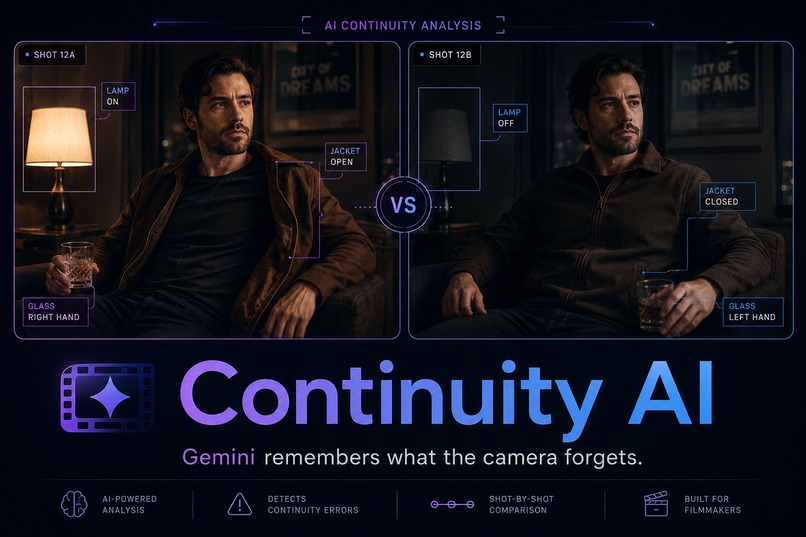
Continuity AI
Inspiration
Film continuity is still a highly manual process. Script supervisors must track hundreds of visual details across multiple takes, shooting days, and camera angles.
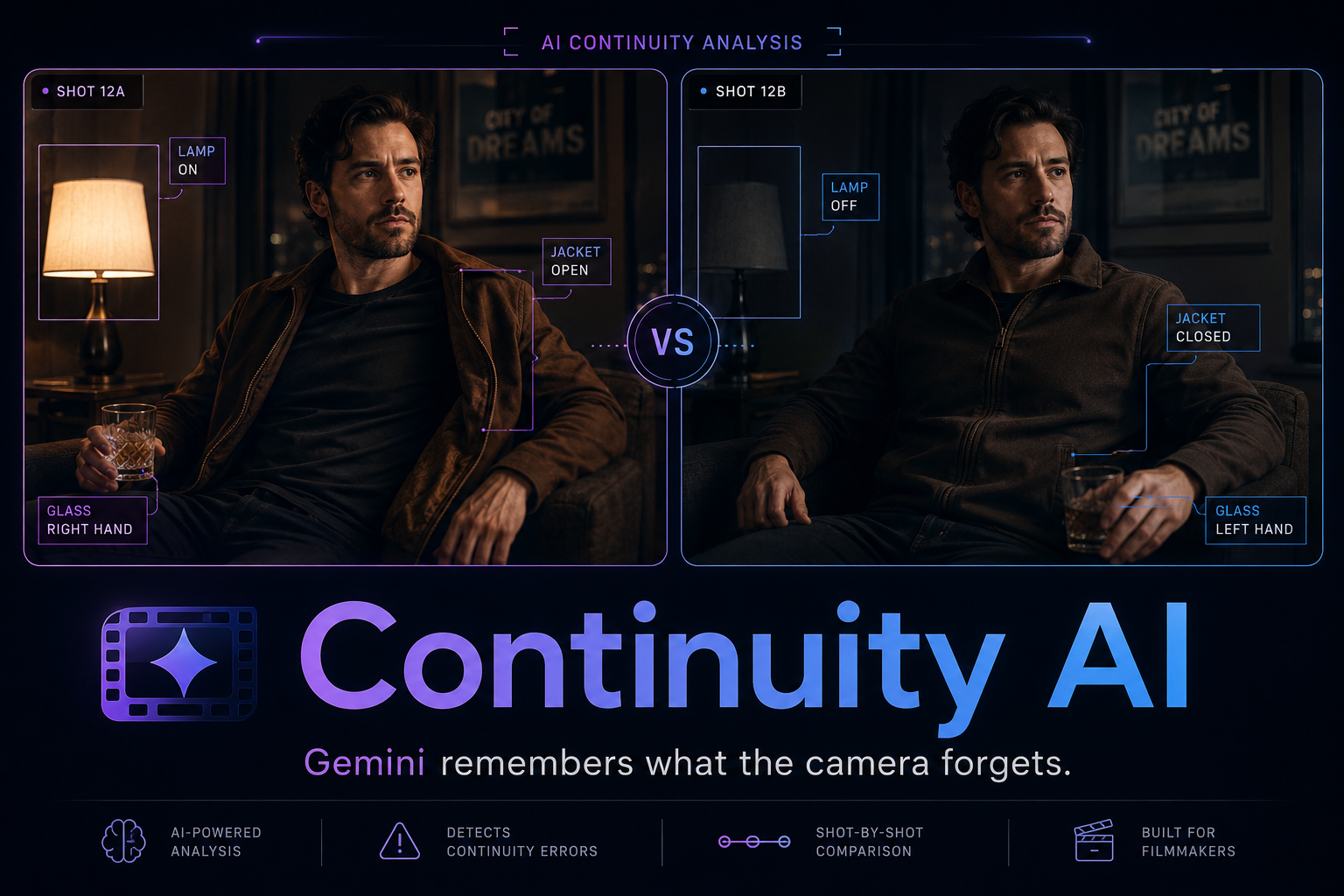
A small continuity mistake — a lamp switching off, a jacket changing state, or a prop moving between hands — can create editing problems, expensive reshoots, or additional VFX work.
Continuity AI was built to give film crews an intelligent visual memory.
What it does
Continuity AI is an AI-powered continuity supervisor for film production.
It analyzes different takes of the same scene and detects potential continuity inconsistencies involving:
- wardrobe
- props
- actor interactions
- object positions
- lighting and environment state
Instead of directly asking an AI model to compare two images, Continuity AI uses a two-stage pipeline.
First, Gemini analyzes each take independently and extracts a structured representation of the scene.
Then a Continuity Supervisor compares these structured scene states and checks them against the screenplay.
This makes the system script-aware.
For example, if the screenplay says that a character finishes their drink, a lower glass fill level in the next take should not automatically be flagged as an error.
How we built it
Continuity AI uses a multi-stage Gemini-powered architecture:
Visual Continuity Agent
Uses Gemini multimodal understanding to extract structured scene observations, bounding boxes, attributes and confidence scores.Script Agent
Converts screenplay actions into expected narrative transitions.Continuity Supervisor Agent
Compares takes, identifies potential inconsistencies and checks whether changes are expected by the screenplay.Human-in-the-loop review
A script supervisor can confirm an issue, mark it as intentional, ignore it, or leave it uncertain.Production analytics
Continuity events and observations are stored and analyzed with ClickHouse to provide production-wide continuity insights.
The application is built with Next.js and TypeScript and uses Gemini / Google Cloud for AI processing.
Challenges we ran into
One major challenge was avoiding false positives.
A simple image-difference system would report every visual change, even when the screenplay explicitly requires that change.
To solve this, we separated visual observation from continuity reasoning and added script-aware validation.
Another challenge was uncertainty. Gemini observations include confidence information, allowing Continuity AI to distinguish between strong observations and uncertain visual detections.
Accomplishments that we're proud of
- Structured multimodal scene extraction
- Script-aware continuity reasoning
- Human validation workflow
- Explainable 0–100 Continuity Score
- Interactive bounding-box comparison
- Production-wide ClickHouse analytics
- A complete script supervisor continuity report
- A live Gemini analysis workflow alongside a deterministic demo mode
What we learned
Continuity is not simply an image comparison problem.
Understanding whether something is actually wrong requires visual context, narrative context, and human judgment.
Combining Gemini's multimodal understanding with structured scene states makes the process much more explainable and useful to film professionals.
What's next for Continuity AI
Future versions could support:
- full video and automatic keyframe analysis
- costume continuity tracking
- makeup and hairstyle continuity
- persistent prop identification
- multi-camera shoots
- shooting-day continuity history
- mobile tools for script supervisors
- live on-set camera analysis
Continuity AI is designed to become a persistent visual memory for an entire production.
Gemini remembers what the camera forgets.
Built With
- antigravity
- clickhouse
- gemini
- google-cloud
- google-cloud-agent-builder
- next.js
- node.js
- react
- tailwind-css
- typescript

Log in or sign up for Devpost to join the conversation.