-
-
image
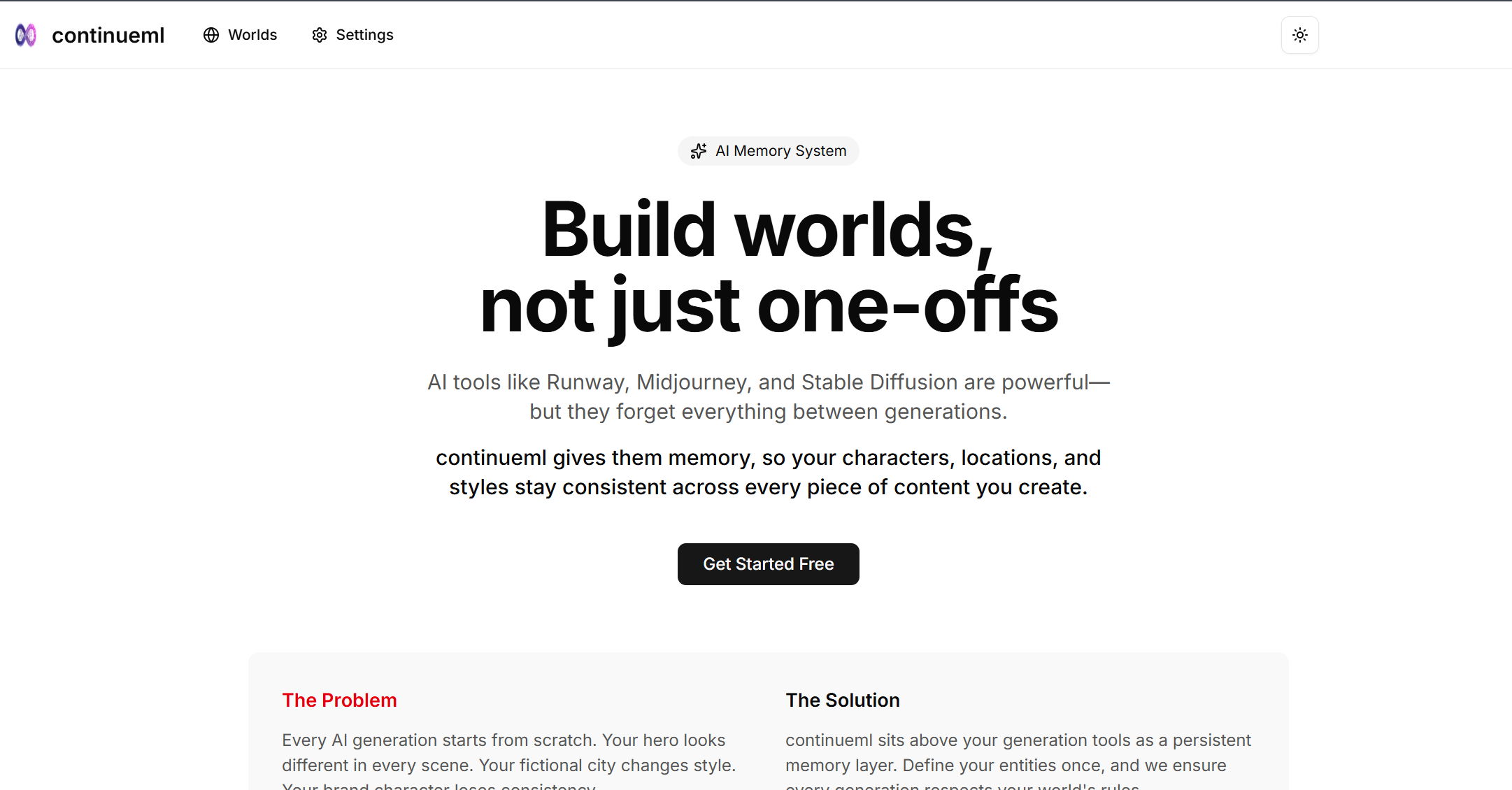
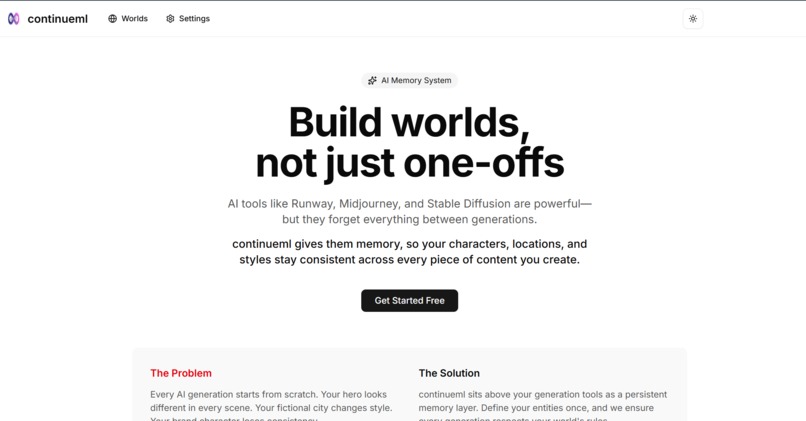
continueml was inspired by a major limitation in today’s AI creative tools:
AI can generate anything, but it doesn’t remember anything.
Creators building characters, storylines, or visual worlds constantly struggle with inconsistencies faces change, styles drift, details break across generations. I wanted to solve this missing layer by giving AI a form of persistent memory that feels natural, automatic, and reliable.
What Inspired Me
While experimenting with episodic AI content and multi-character storytelling, I noticed that creators were spending more time rewriting context than actually creating. Every new generation required repeating long descriptions.
That sparked the core idea:
- What if AI could store entity memories, recall them across generations, and enforce consistency automatically?
This became the guiding vision behind continueml.
What I Learned
Building continueml pushed me deep into the architecture of AI memory and semantic understanding. I learned how to combine:
- Visual embeddings (CLIP) for appearance tracking
- Semantic embeddings for personality, traits, and narrative context
- Vector search for retrieving relevant memories
- Prompt enhancement pipelines for context injection
- World + branch versioning for alternate timelines
- Consistency analysis for validating generated images against memory
It also taught me how creators think about continuity and how much value a memory layer adds.
How I Built It
I built continueml as a full-stack SaaS platform using:
- Frontend: Next.js 16
- Backend API: Node.js + tRPC
- Entity Metadata: PostgreSQL
- Vector Memory Storage: Pinecone
- Generation Queues: Redis + BullMQ
- Embeddings & Generation: OpenAI, CLIP, and Gen-3
- Deployment & CDN: Cloudflare/Vercel
The architecture is modular, with dedicated systems for the Memory Engine, Prompt Enhancer, Consistency Analyzer, and Versioned Worlds.
Challenges I Faced
Some key challenges included:
- Designing a reliable weighting system between visual and semantic embeddings.
- Ensuring consistent prompt enhancement without making prompts overly long.
- Handling branching worlds without duplicating too much vector data.
- Building a conflict detection system for merging branches.
- Ensuring the memory engine remained fast even with thousands of stored entities.
These challenges helped shape the final architecture and taught me a lot about building scalable AI infrastructure.

Log in or sign up for Devpost to join the conversation.