-
-
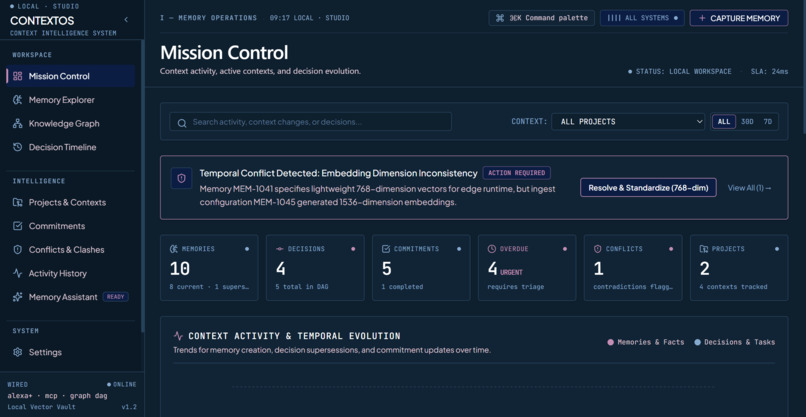
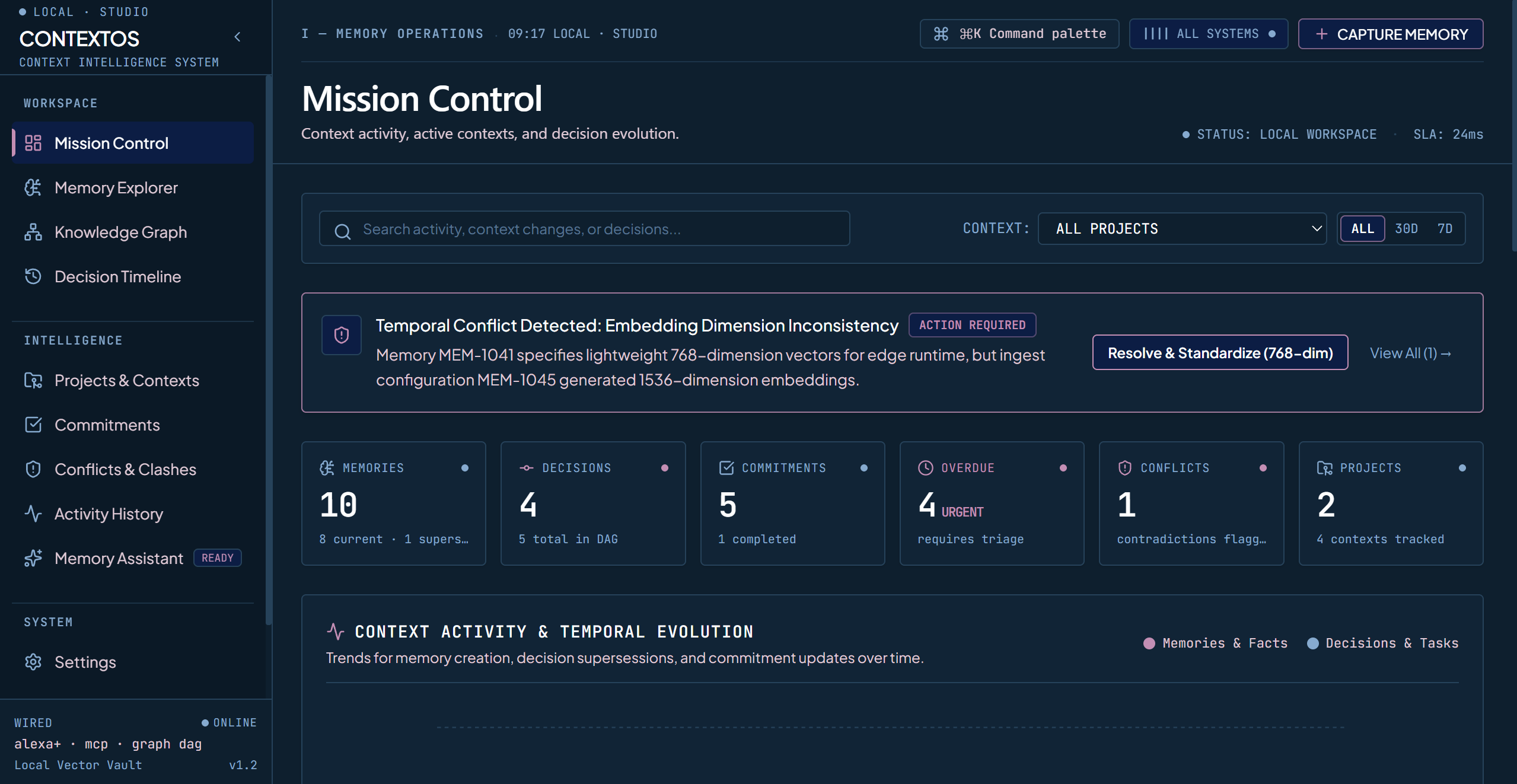
Mission Control: A unified dashboard for monitoring memory, decisions, projects, and contextual intelligence.
-
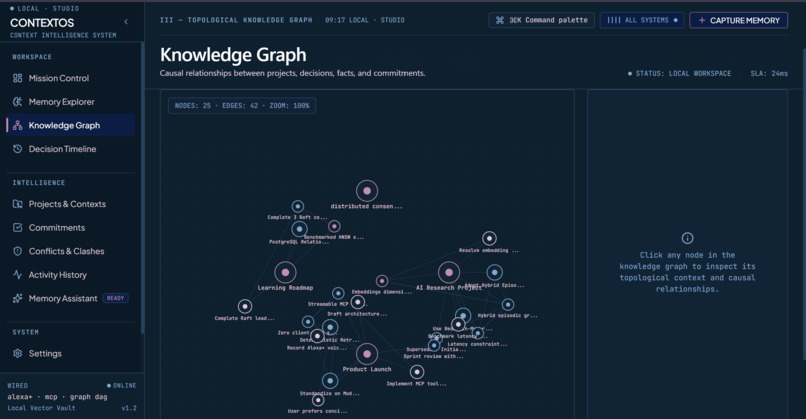
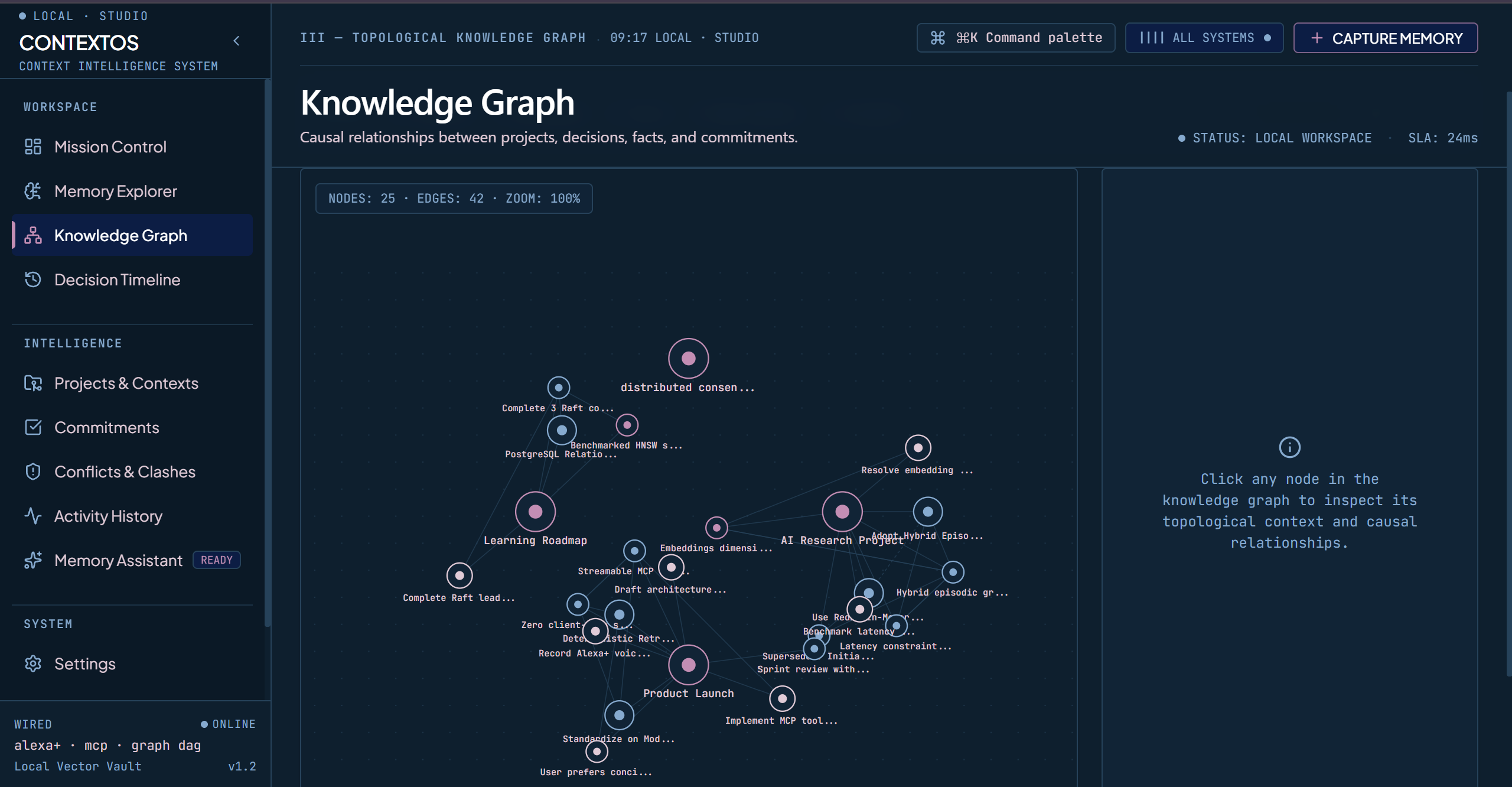
Knowledge Graph: Visualizes connected memories and relationships to reveal how information and decisions interconnect.
-
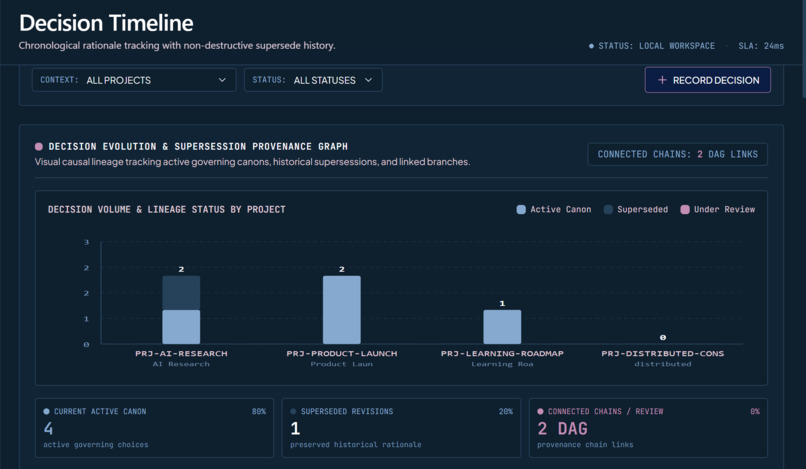
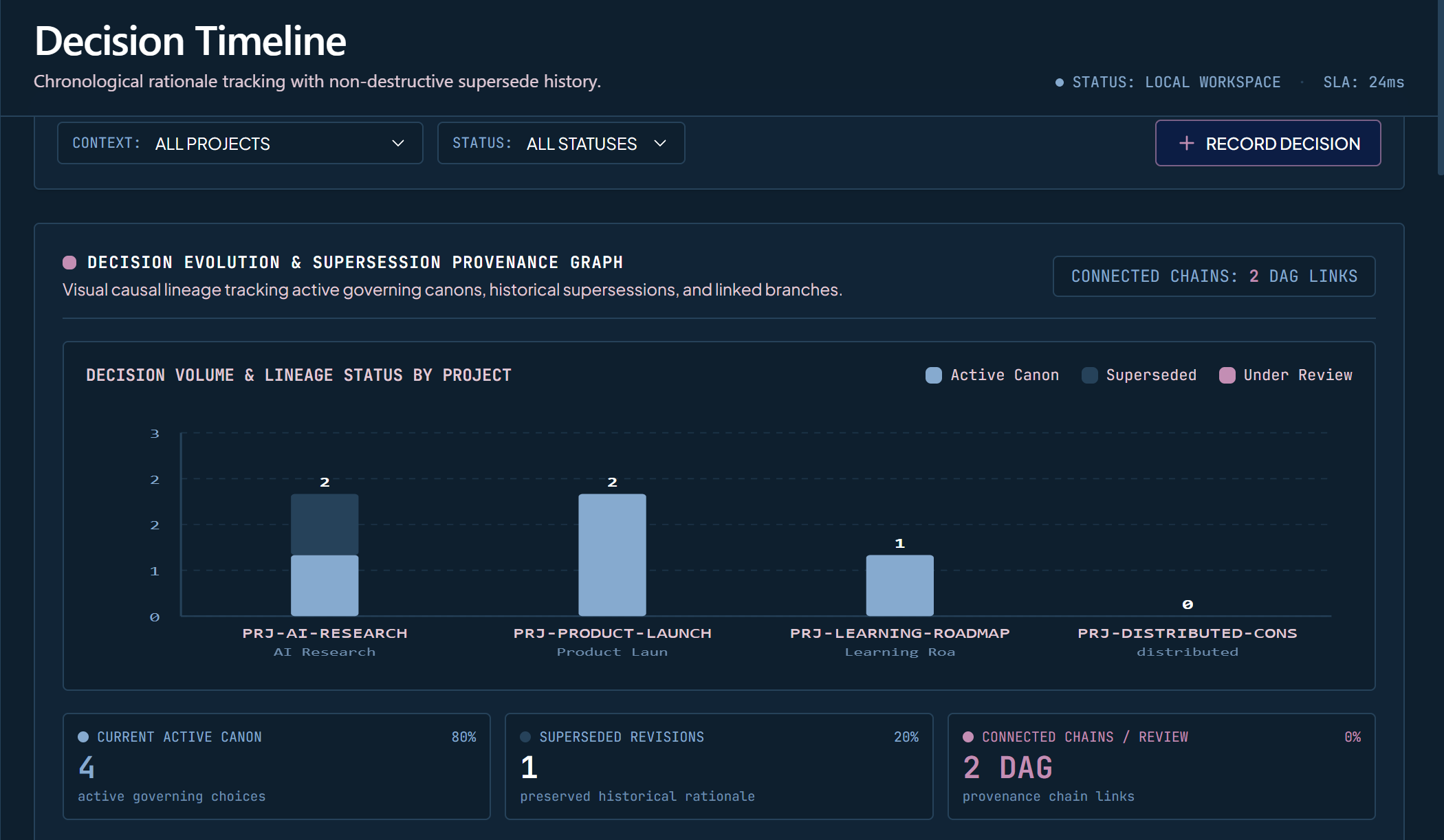
Decision Timeline: Tracks how decisions evolve over time while preserving historical context.
-
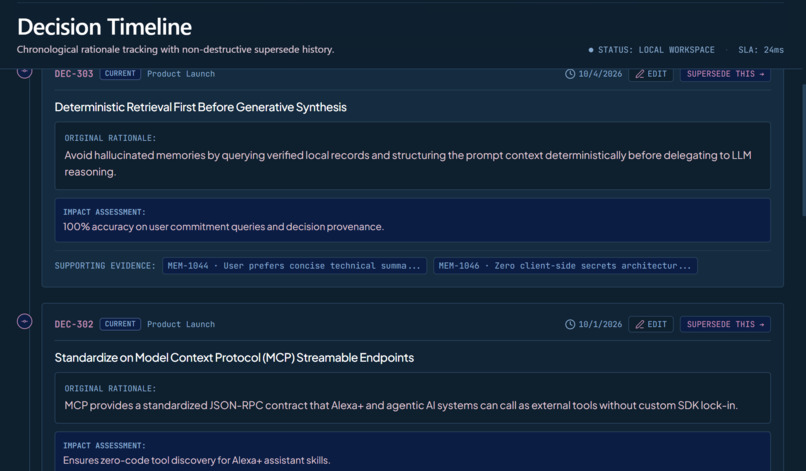
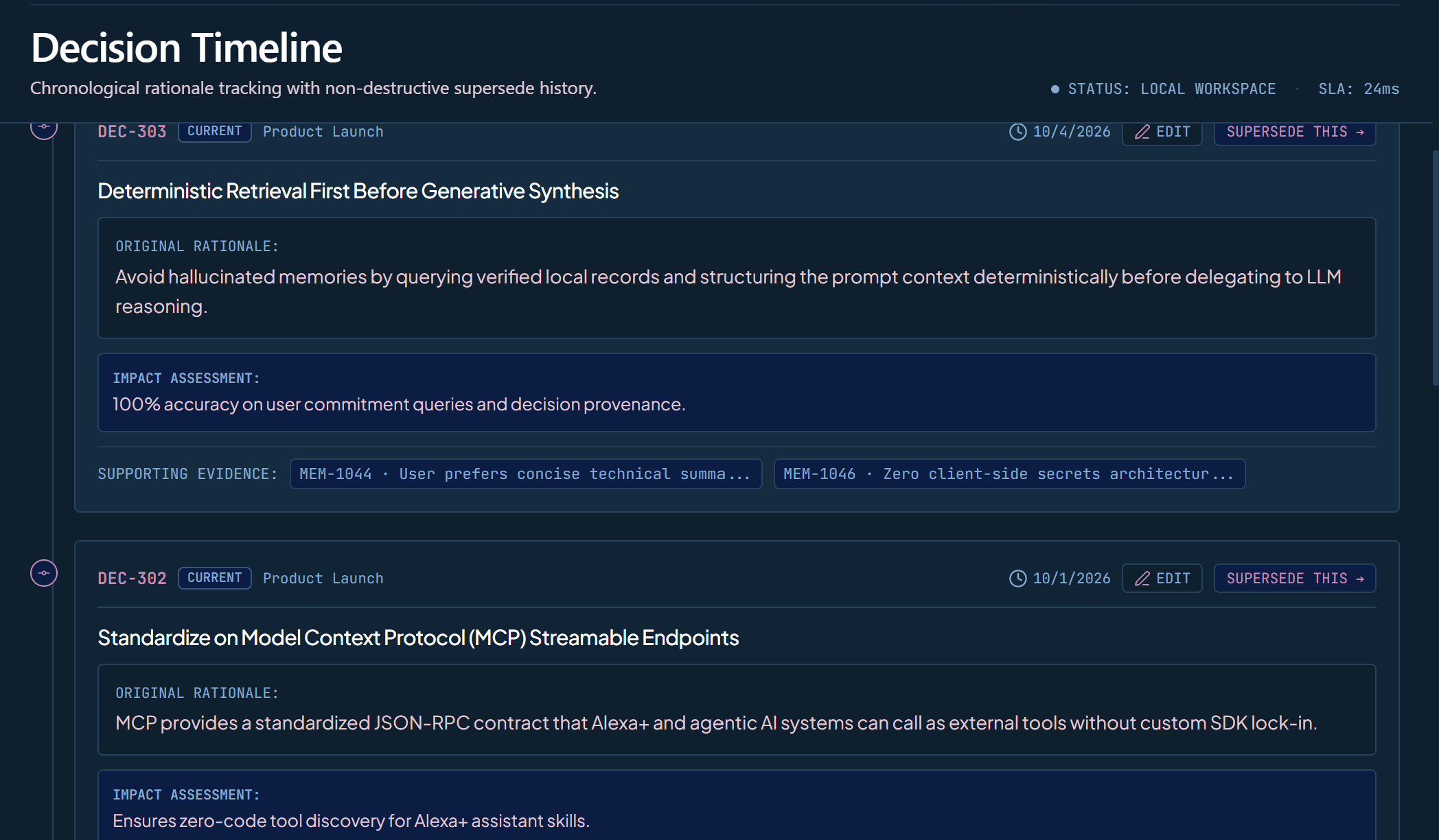
Decision History: Explores decision details, historical changes, and the reasoning behind evolving choices.
-
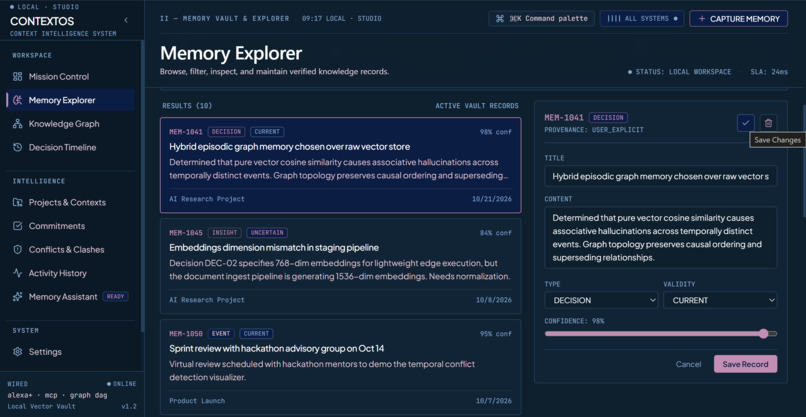
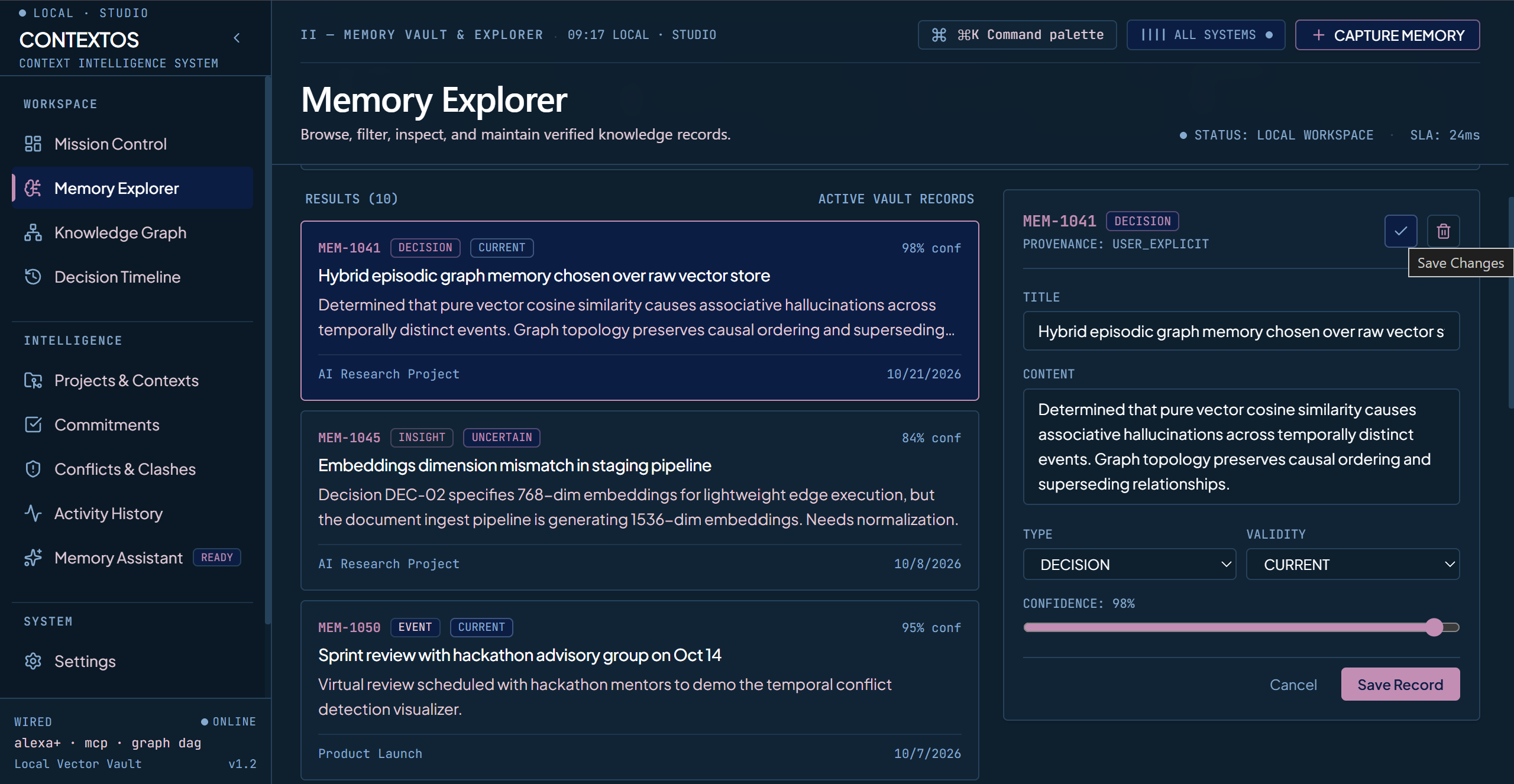
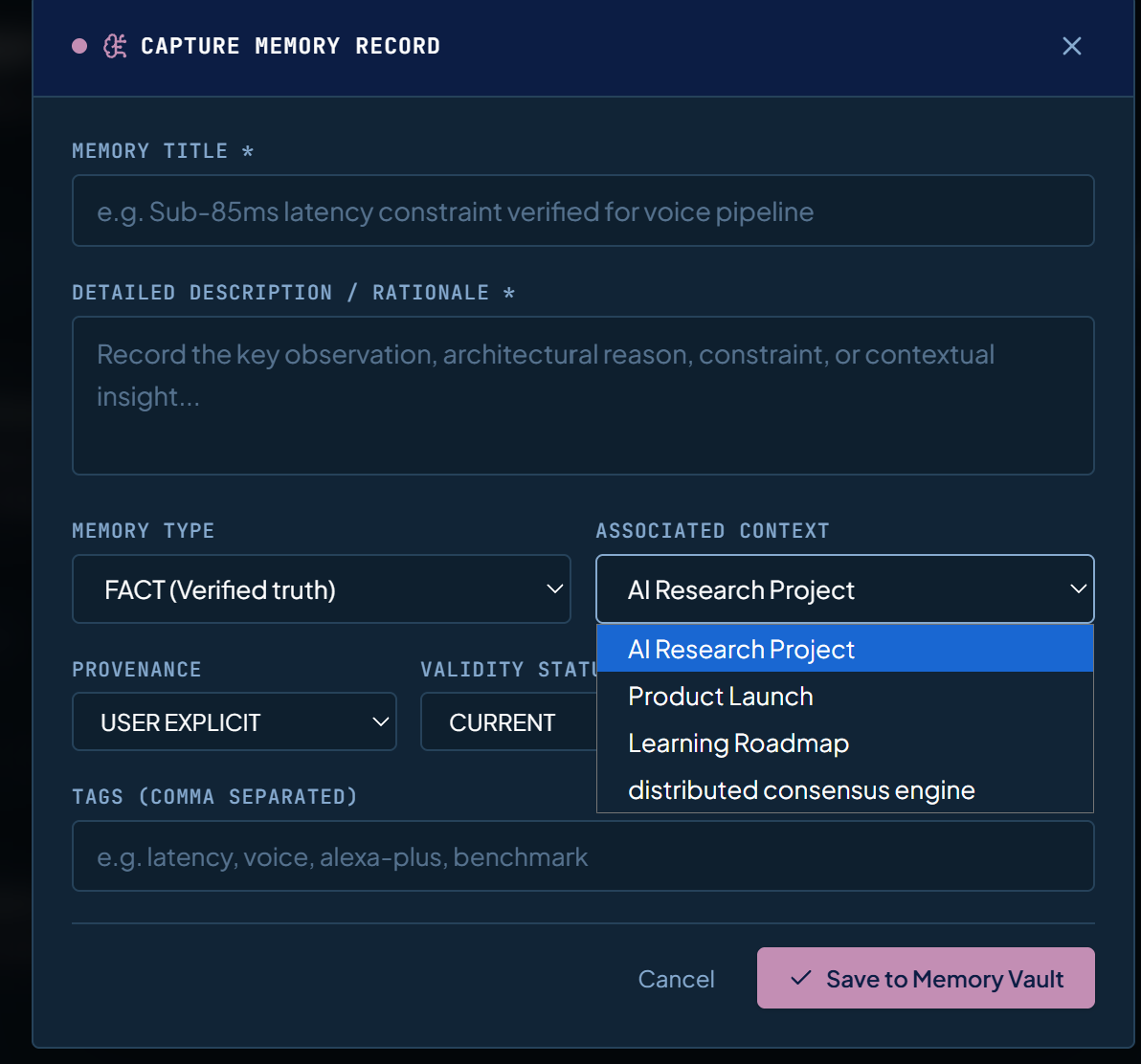
Memory Explorer: Explore structured memories and retrieve relevant information with contextual awareness.
-
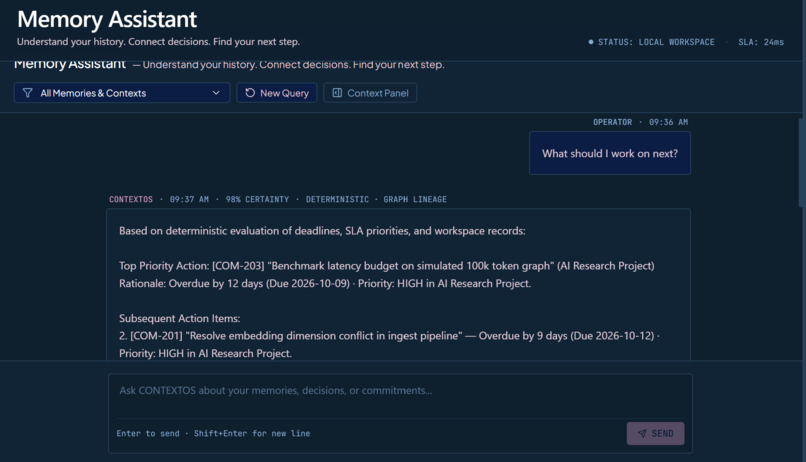
AI Answer: Demonstrates context-grounded AI responses powered by retrieved memories and supporting evidence.
-
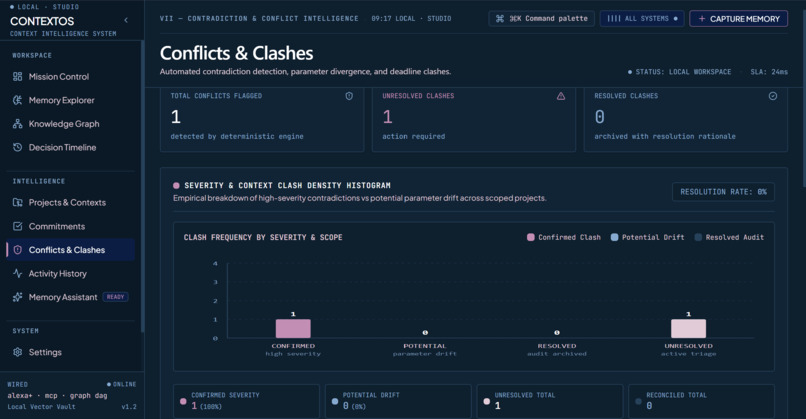
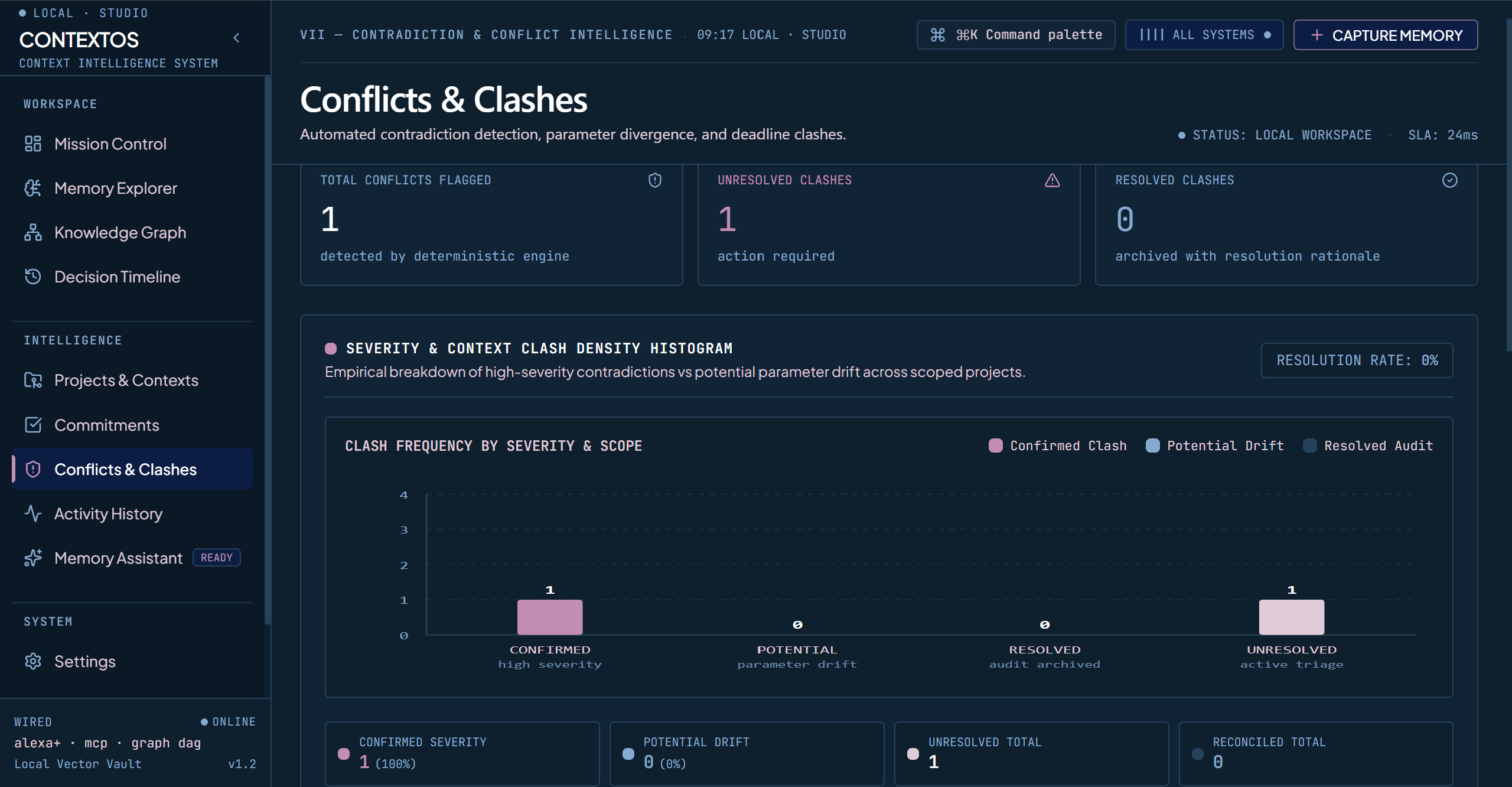
Conflict Detection: Identifies inconsistencies and potential deadline conflicts before they compromise project context.
-
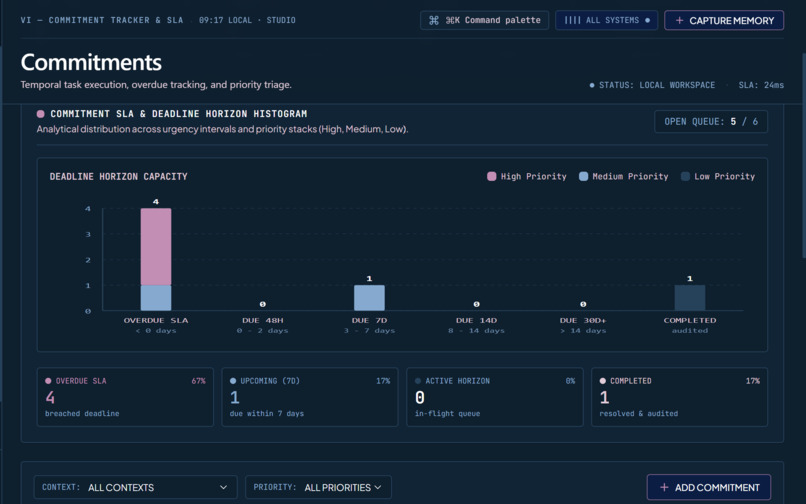
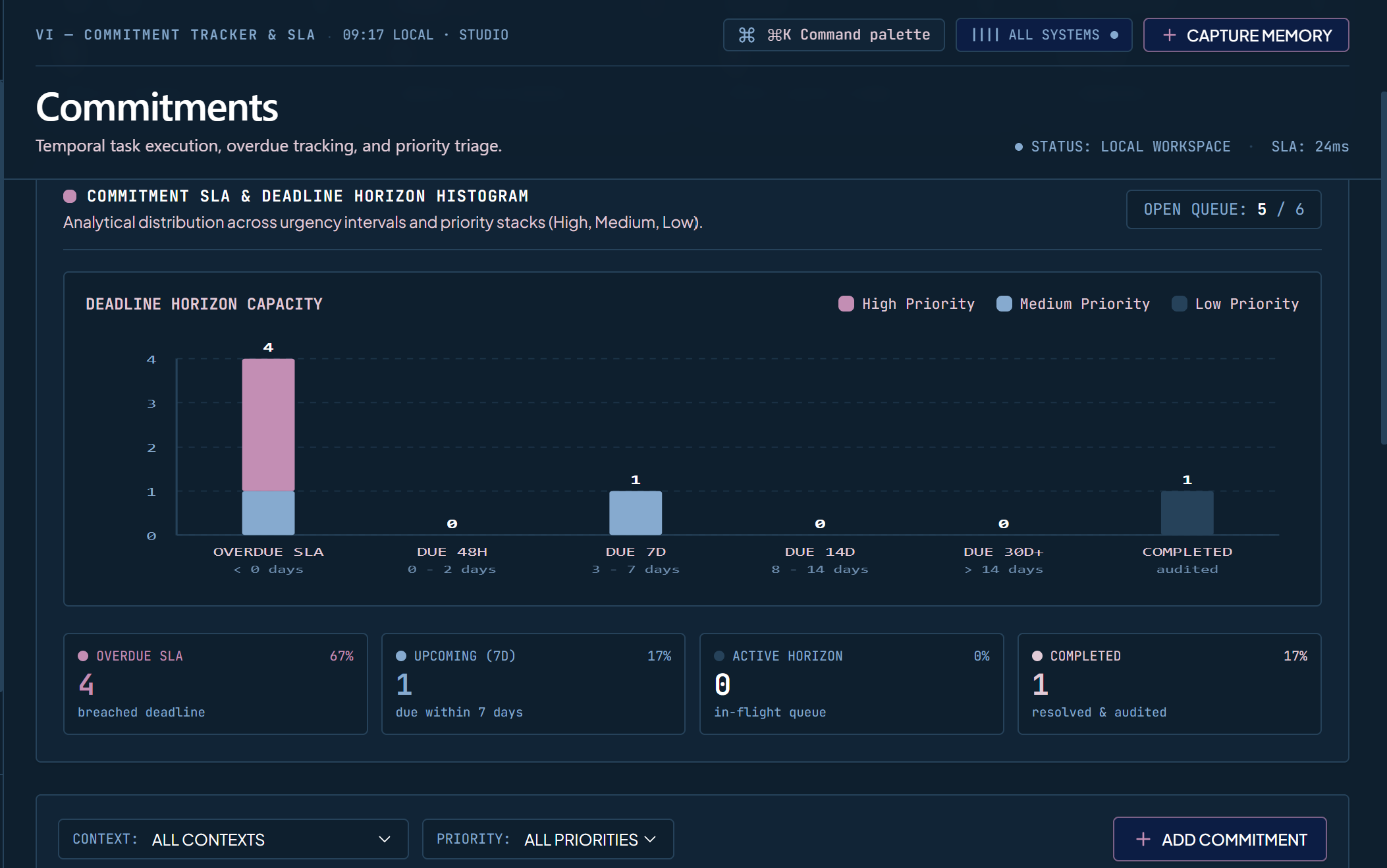
Commitments: Tracks priorities, deadlines, and overdue commitments to keep important tasks visible.
-
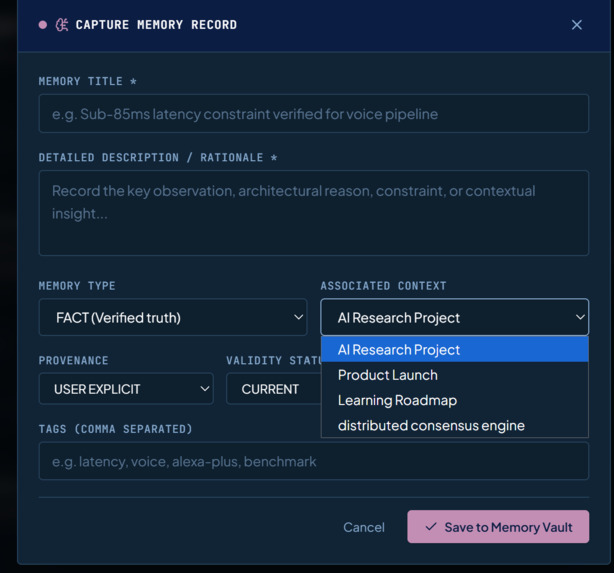
MCP Integration: Connects CONTEXTOS memory capabilities to compatible AI clients through the Model Context Protocol.
-
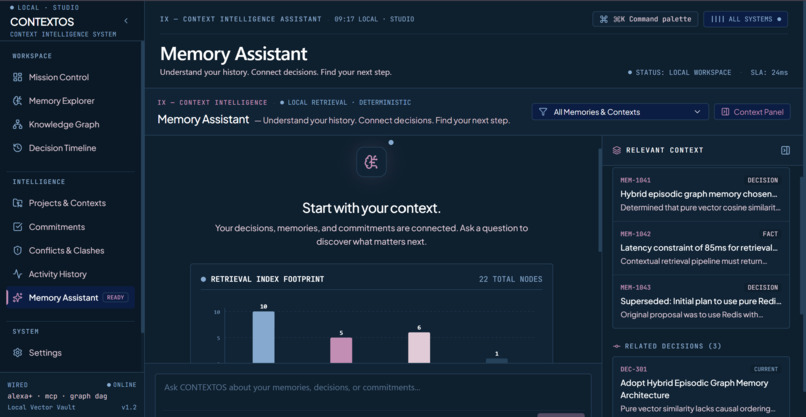
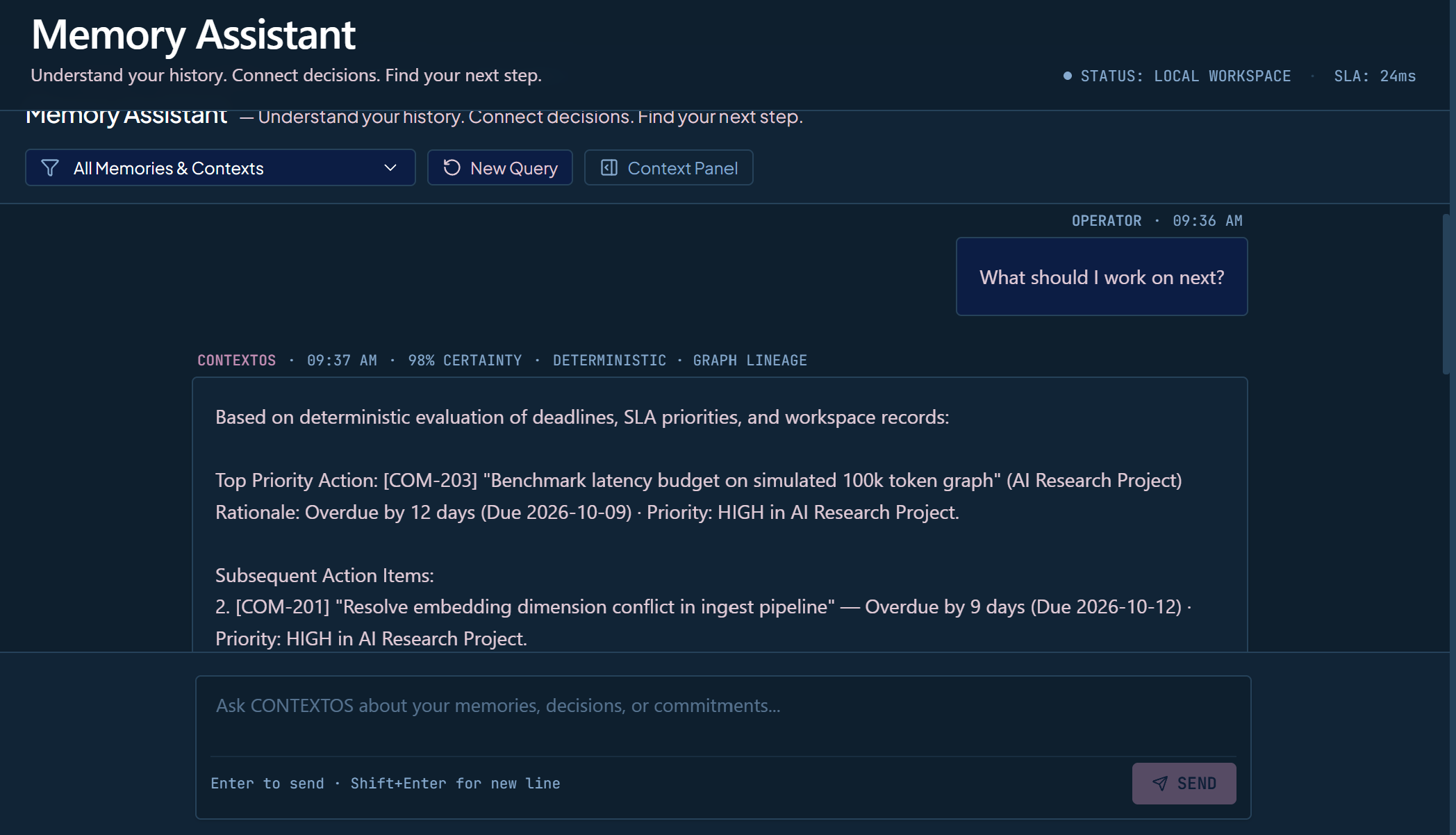
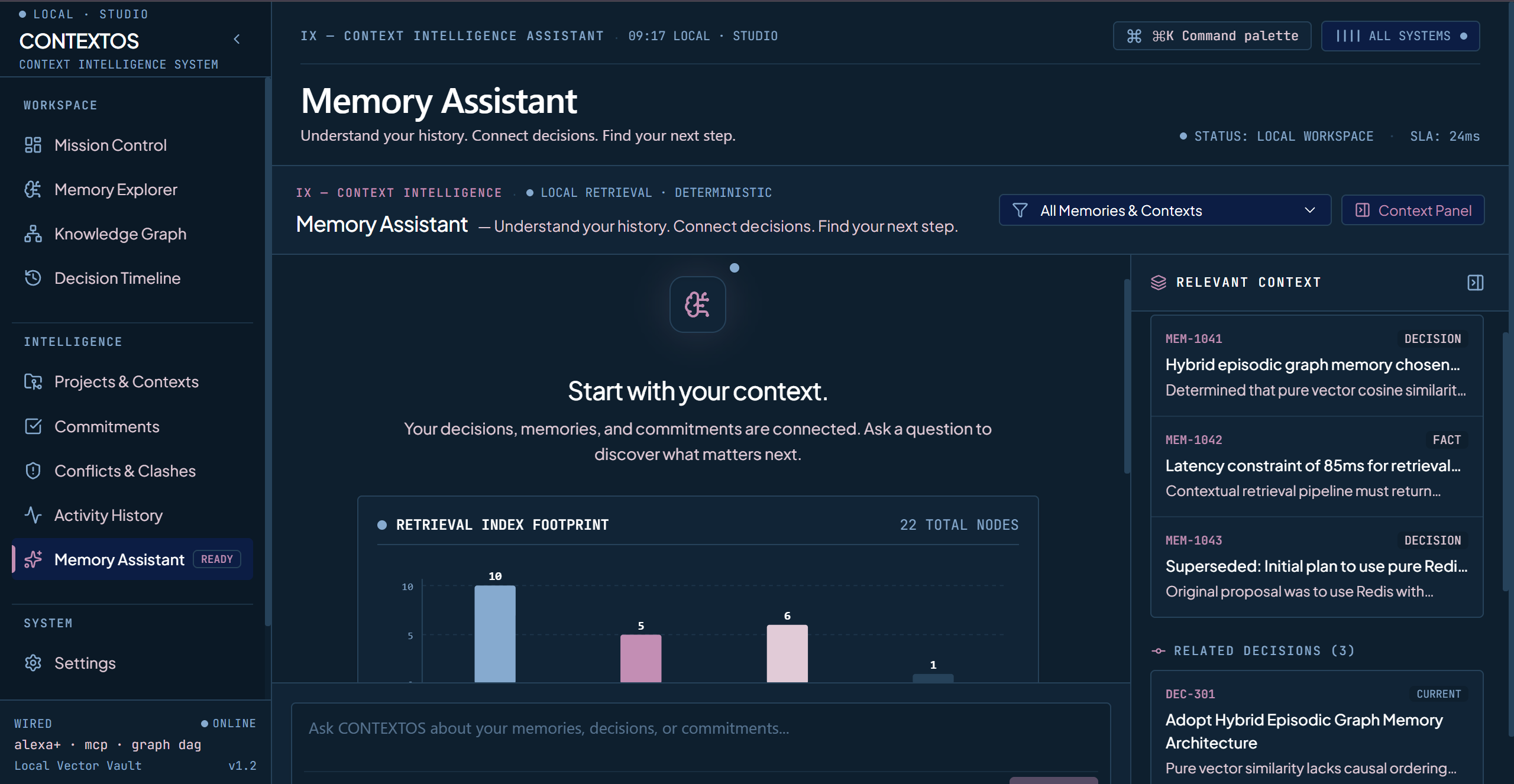
Memory Assistant: Interact with an AI assistant designed to answer questions using persistent, structured context.
Inspiration
I noticed a fundamental limitation in AI assistants: they can retrieve information, but understanding how decisions evolve, why they change, and what remains relevant over time is much harder.
A decision made yesterday might be outdated today. A deadline might conflict with a project milestone. An earlier assumption might contradict a newer requirement. Without preserving these relationships, AI assistants risk providing answers based on incomplete or outdated context.
This inspired me to build CONTEXTOS—Context Intelligence & Memory, a platform designed to move beyond simple information storage toward contextual understanding, decision traceability, and actionable intelligence.
My vision was to create a system that doesn't just remember what happened but helps explain what changed, why it changed, and what needs attention next.
What it does
CONTEXTOS is an AI memory and decision intelligence platform that organizes information into connected, time-aware records.
Its core capabilities include:
- Temporal Memory: Preserves historical information and distinguishes current decisions from superseded ones.
- Decision Lineage: Connects related decisions through a directed acyclic graph (DAG), preserving the history and rationale behind changes.
- Context-Aware Retrieval: Searches across memories, decisions, projects, and commitments using multiple contextual signals.
- Conflict Detection: Identifies supported inconsistencies, including vector-dimension mismatches and commitments whose deadlines extend beyond project milestones.
- Commitment Tracking: Tracks deadlines, priorities, and outstanding commitments, with overdue durations calculated dynamically.
- Memory Assistant: Answers questions using retrieved context and references to supporting records.
- Model Context Protocol (MCP): Exposes memory operations through a standardized interface, allowing compatible AI clients to interact with the memory system.
- Voice-Oriented Interaction: Includes an Alexa Skills Kit-style endpoint for speech-oriented responses, visual cards, and session information.
Together, these capabilities make CONTEXTOS more than a conventional chatbot. It provides a structured foundation for AI systems that need persistent, traceable, and evolving context.
How I built it
I built CONTEXTOS as a full-stack application using a TypeScript-based architecture.
Frontend: I used React, TypeScript, Vite, Tailwind CSS, Lucide React, and Motion to create an interactive interface for exploring memories, knowledge graphs, decision timelines, projects, commitments, conflicts, and assistant responses.
Backend: I used Node.js and Express to implement the memory engine, retrieval services, conflict detection, deadline calculations, and API endpoints.
Memory Architecture: I modeled decision relationships as a directed acyclic graph, allowing historical decisions to remain accessible while preserving their connections to newer decisions.
Contextual Intelligence: I implemented multi-signal retrieval to surface relevant information across different record types. I also used deterministic logic for supported conflict checks and deadline calculations rather than relying entirely on AI-generated judgments.
Assistant Integration: I developed a Memory Assistant that uses retrieved evidence to answer questions about stored context.
MCP Integration: I implemented a Model Context Protocol server using JSON-RPC 2.0 over HTTP, exposing memory capabilities as tools that compatible AI clients can use.
Voice Interface: I also built an Alexa Skills Kit-style interface to explore voice-oriented access to contextual memory.
My goal was to bring these capabilities together in one coherent system rather than build another isolated chatbot.
Challenges I ran into
One of my biggest challenges was preserving historical context without confusing older decisions with current ones.
Simply overwriting an old decision with a new one would destroy the reasoning behind the change. I addressed this by preserving superseded decisions and maintaining explicit relationships between predecessor and successor records.
Another challenge was retrieving meaningful context rather than merely matching keywords. A useful answer may depend on a decision's status, its project, its history, or its relationships with other records. I developed a multi-signal retrieval approach to account for these factors.
I also wanted to make memory operationally useful. I implemented deterministic checks for specific conflict categories and dynamic deadline calculations to help identify issues that require attention.
Finally, integrating memory into external AI workflows required a standardized interface. Implementing MCP support allowed me to expose memory operations to compatible clients instead of restricting the system to its own web interface.
As a solo developer, I had to balance frontend development, backend architecture, integration work, and testing while maintaining a consistent overall design.
Accomplishments that I'm proud of
I'm proud that I built CONTEXTOS as a connected memory and decision intelligence system rather than just another AI chat interface.
Some of my key accomplishments include:
- Designing a temporal memory architecture that preserves decision history.
- Implementing graph-based decision lineage to represent how decisions evolve.
- Building contextual retrieval across memories, projects, decisions, and commitments.
- Creating deterministic conflict checks and dynamic overdue calculations.
- Developing a Memory Assistant that grounds responses in retrieved evidence.
- Exposing memory capabilities through an MCP server for compatible AI clients.
- Implementing an Alexa Skills Kit-style interface for voice-oriented interactions.
- Bringing these capabilities together in an interactive interface for exploring context, history, and outstanding work.
Most importantly, I challenged myself to approach AI memory as an infrastructure problem rather than simply extending a chatbot's conversation history.
What I learned
Building CONTEXTOS taught me that reliable AI memory requires much more than storing information and retrieving it later.
It requires understanding time, preserving provenance, maintaining relationships, distinguishing historical facts from current decisions, and making inconsistencies visible.
I also learned that deterministic logic and AI assistants can complement each other. Explicit rules are well suited to deadline calculations and supported consistency checks, while AI can help interpret questions and formulate natural-language responses using retrieved evidence.
Working with MCP reinforced the importance of standard interfaces. A memory system becomes more useful when compatible tools and assistants can access its capabilities without requiring every integration to be built from scratch.
As a solo developer, I gained experience bringing together frontend development, backend services, graph-based data relationships, AI integration, and developer-facing protocols into one cohesive project.
What's next for CONTEXTOS—Context Intelligence & Memory
My next goal is to make CONTEXTOS more capable, interoperable, and useful in real-world AI workflows.
I want to improve semantic retrieval, expand conflict detection, strengthen memory provenance, and develop richer ways to understand how decisions and commitments evolve across projects.
I also want to explore deeper integrations with AI assistants and voice interfaces, including opportunities within the Amazon ecosystem, so that contextual memory can become accessible beyond a standalone web application.
Another priority is to evaluate retrieval accuracy, decision-history consistency, and conflict-detection reliability through repeatable test scenarios.
Ultimately, I want CONTEXTOS to help move AI from systems that simply recall information toward systems that can explain changes, recognize outdated context, surface inconsistencies, and help people make better-informed decisions.
CONTEXTOS — Remember what matters. Understand what changed. Act with context.
Built With
- agents
- ai
- alexa
- api
- artificial
- context
- css
- decision
- express.js
- full-stack
- graph
- intelligence
- knowledge
- mcp
- memory
- node.js
- react
- rest
- retrieval
- skills
- tailwind
- tools
- typescript
- vite
- web

Log in or sign up for Devpost to join the conversation.