Inspiration
AI assistants are useful, but they often lack reliable personal context, transparent tool usage, and meaningful user control over memory. I wanted to build an assistant that can help users with everyday tasks while giving them control over what information is remembered and what remains temporary.
This inspired me to create ContextOS, a personal AI assistant designed around contextual conversations, user-controlled memory, and tool-assisted workflows.
What it does
ContextOS brings several AI capabilities into one interface:
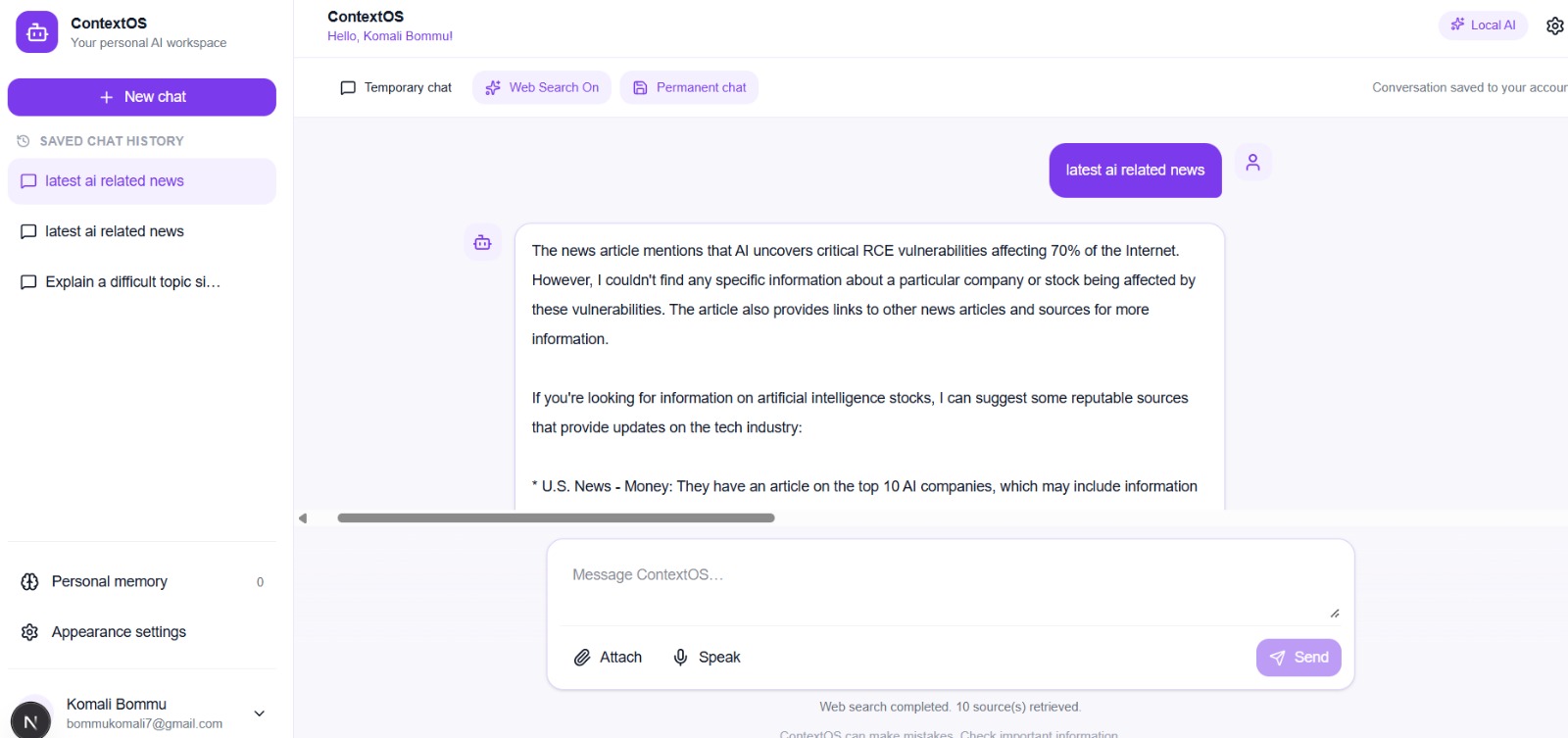
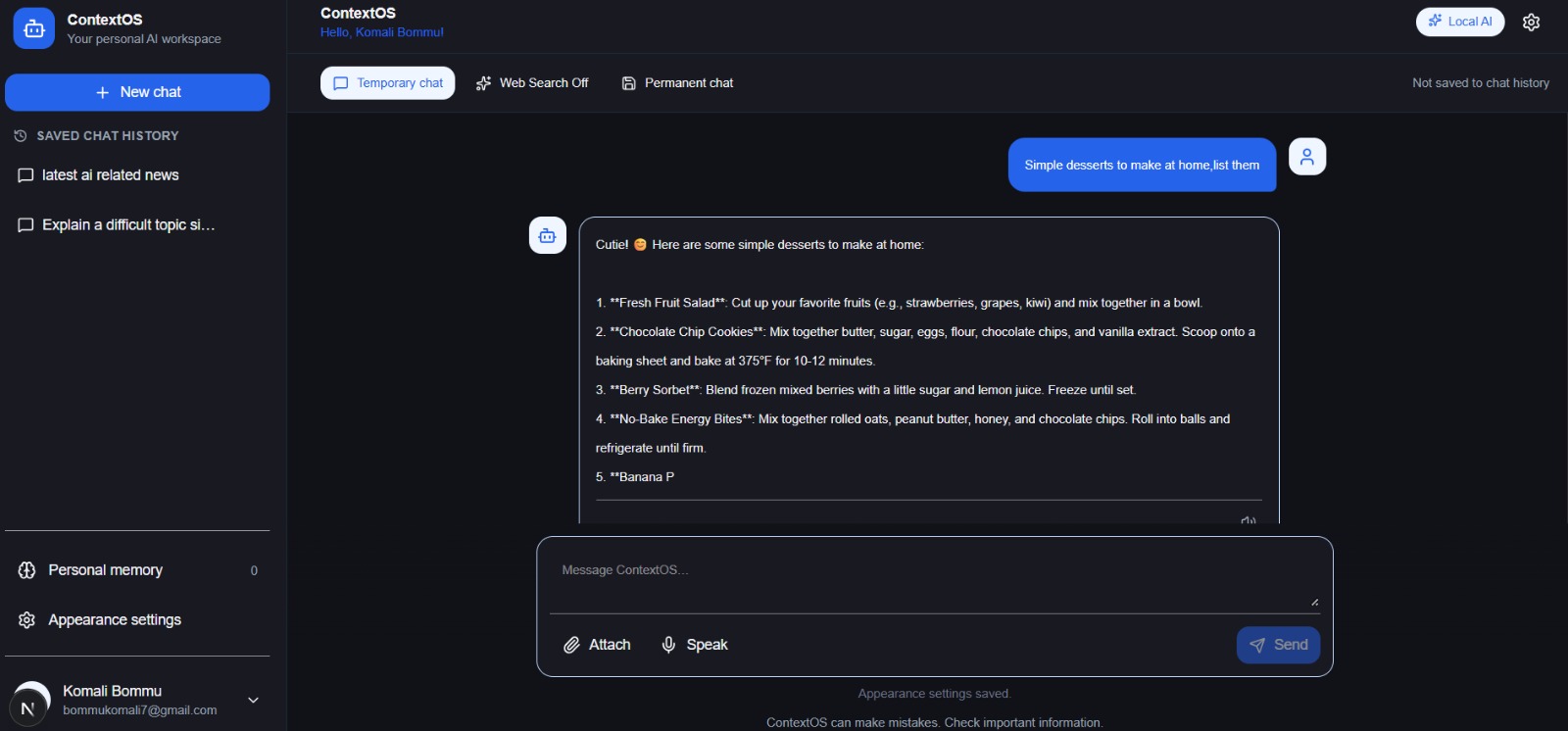
Regular Chat: Temporary conversations designed for questions without retaining personal chat history.
Context Chat: A mode for saving conversations and using relevant stored context to personalize future responses.
User-Controlled Memory: A foundation for explicitly approved memory saving rather than silently retaining every conversation.
Document Analysis: Upload supported documents and ask questions about their content.
Web Search: Retrieve online information to help answer questions that require current information.
Voice Interaction: Interact using voice input and spoken responses.
MCP Prototype: A separate Model Context Protocol server exposing tools for checking system status, searching context notes, and saving approved memories.
How I built it
I built ContextOS using Next.js, React, and TypeScript for the web interface and application logic. Supabase supports authentication and persistent application data. Ollama runs the Llama 3.2 1B model locally, enabling AI conversations without depending on a paid hosted language-model API.
I also developed an MCP server prototype to explore how an AI application can expose clearly defined tools for contextual information and memory operations.
Challenges we ran into
One of the biggest challenges was bringing multiple capabilities together while keeping the application functional: authentication, chat modes, database persistence, document processing, web search, voice interaction, and local model integration.
I learned more about full-stack development, API routes, database integration, local language models, and the Model Context Protocol. I also learned that building a trustworthy AI assistant involves more than generating responses—it requires thoughtful decisions about memory, permissions, privacy, and tool execution.
Accomplishments that we're proud of
What I learned
Building ContextOS taught me how to connect frontend development, backend APIs, authentication, persistent storage, and AI capabilities into one application.
I learned how to build with Next.js, React, and TypeScript; integrate Supabase authentication and database operations; connect a locally running language model through Ollama; and explore tool-based AI workflows using the Model Context Protocol (MCP).
What's next for ContextOS - A personal AI Agent You Can Trust
Future improvements include deeper MCP integration, more transparent tool-execution logs, stronger memory controls, and a deployment architecture that allows users to access the assistant beyond the local development environment.
Built With
- ai
- generativeai
- mcp
- naturallanguageprocessing
- next.js
- ollama
- python
- react
- restapi
- supabase
- typescript
- webdevelopment
