Inspiration
AI agents are increasingly writing dbt models and data pipelines by reading metadata from catalogs like DataHub — schemas, tags, owners, lineage. That metadata is a snapshot in time. Between "the agent generated this" and "this actually merges," stewards can add a PII tag, remove an owner, or deprecate a table. The generated code still looks fine in the diff, but the assumptions it was built on are gone. Nothing in a normal code review catches that, because the risk isn't in the code — it's in the catalog.
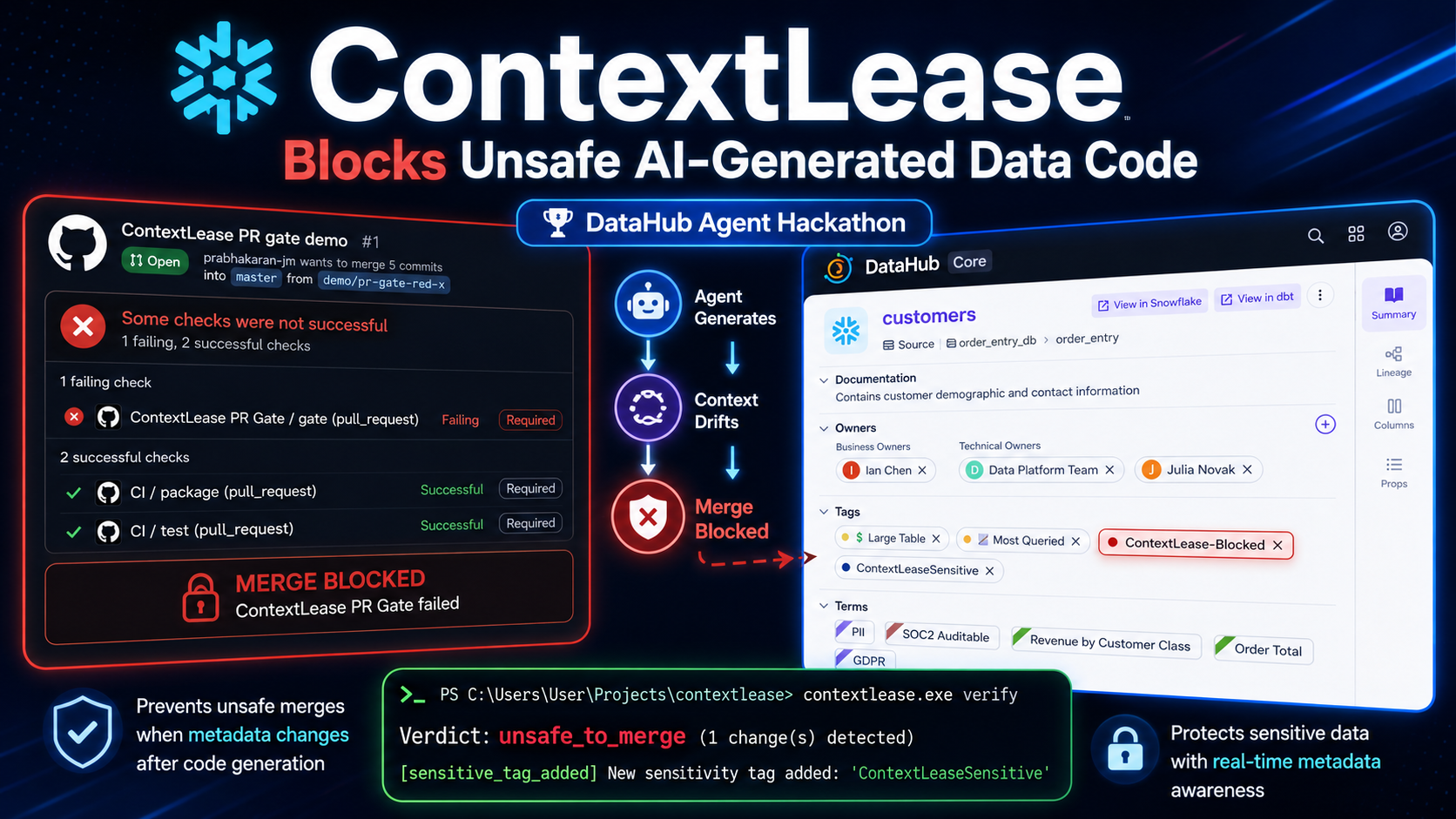
I built ContextLease to close that gap: lease the DataHub context an AI artifact depended on, then deterministically re-check it before merge.
What it does
ContextLease snapshots DataHub metadata into a lease (contextlease.json), then runs a pure, deterministic verifier before merge — no LLM in the safety decision.
End-to-end flow:
- An MCP-enabled agent generates a dbt model using the DataHub MCP Server (
mcp-server-datahub) - ContextLease captures the exact metadata context in a lease (via DataHub GraphQL)
- A steward changes metadata in DataHub after the lease exists
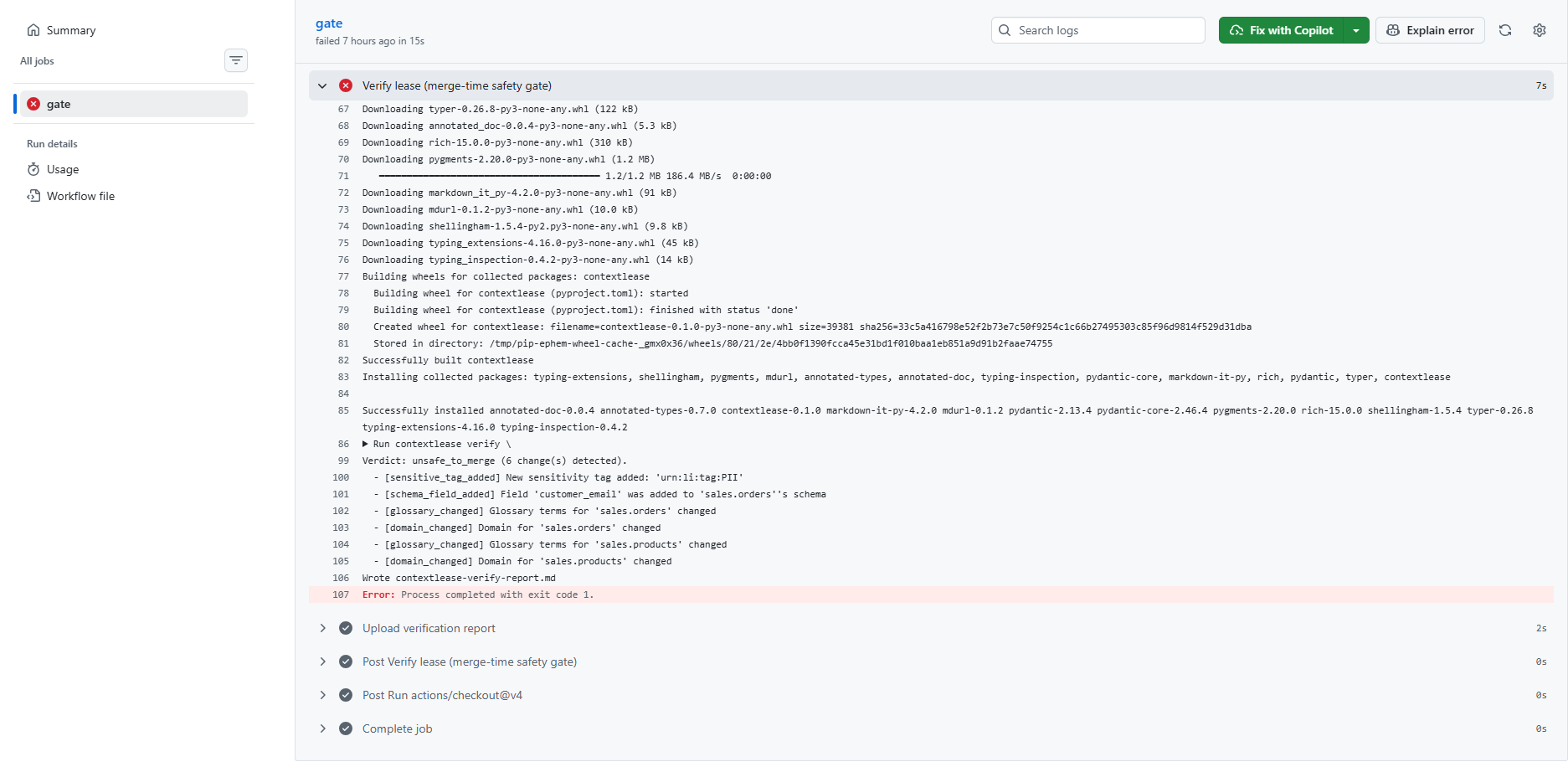
contextlease verifydiffs leased vs. current snapshots and returns a specific verdict (unsafe_to_merge,regenerate_required,needs_owner_approval, etc.)- Optional
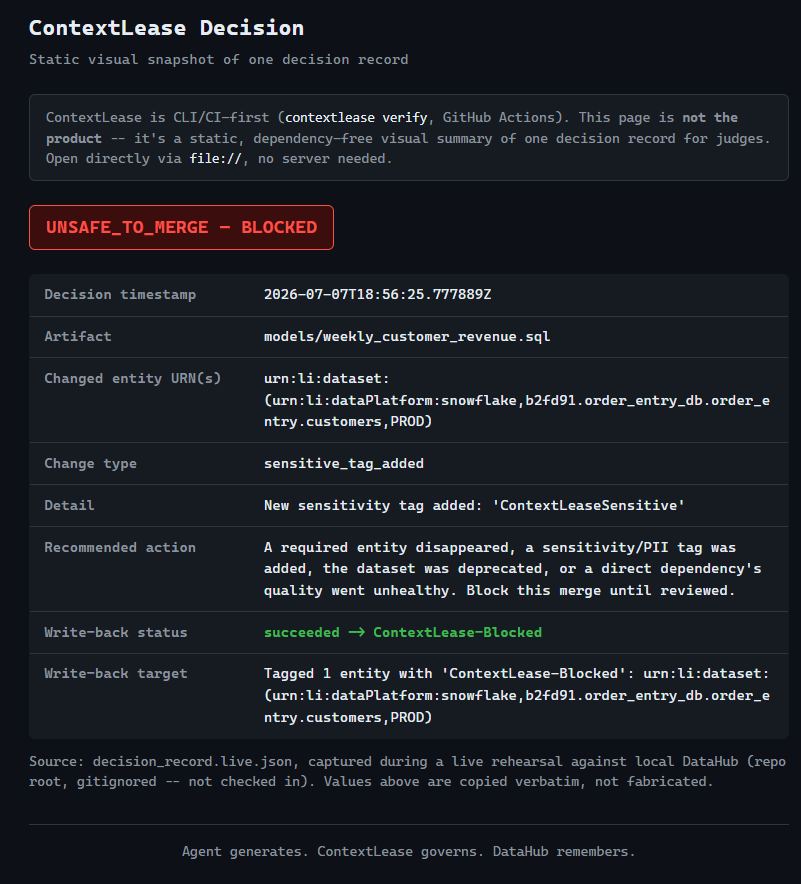
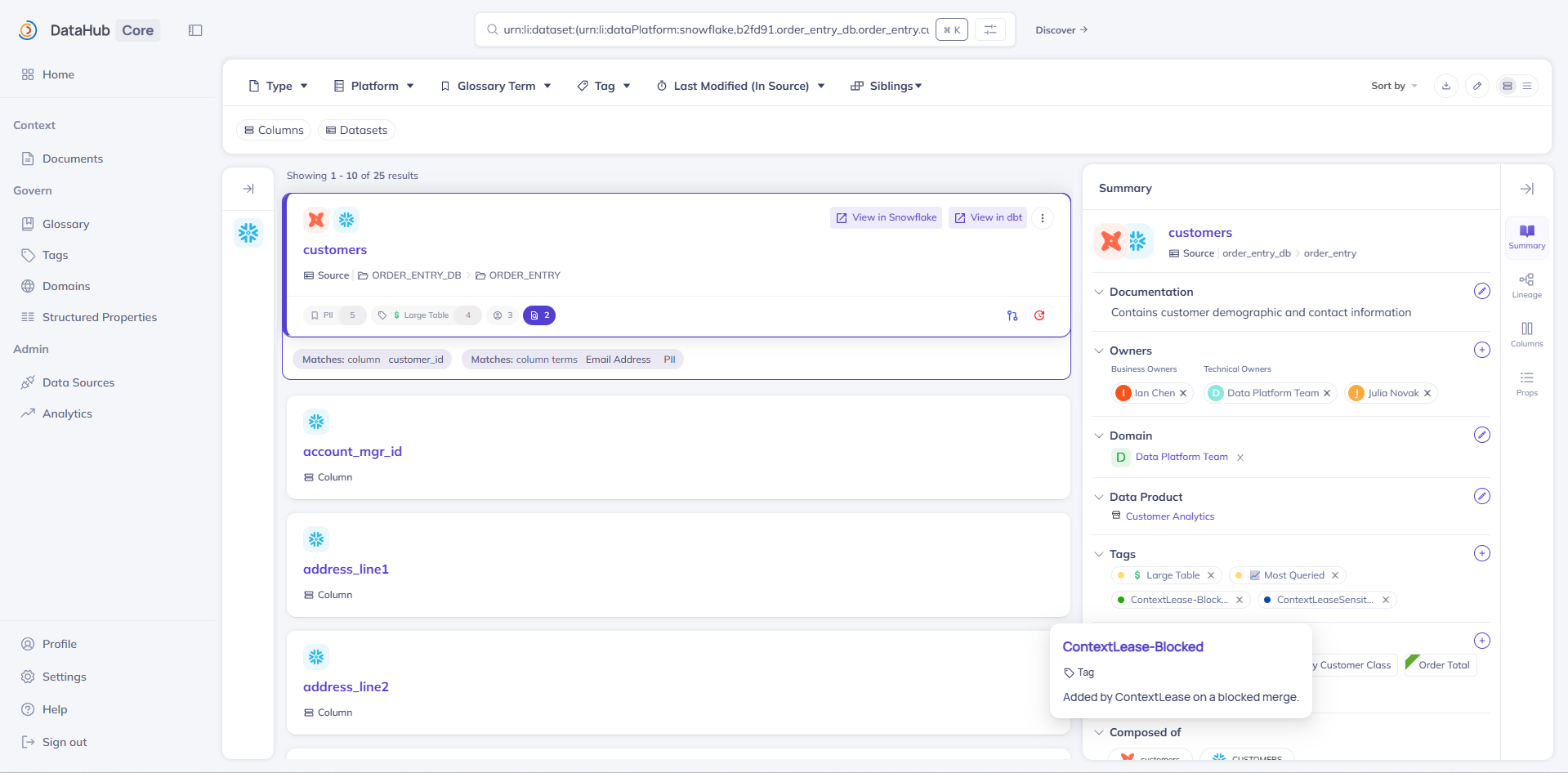
--write-back-datahubtags the datasetContextLease-Blockedso the block is visible in DataHub itself, not just CI logs
Three validated verdict scenarios in the repo:
- Sensitive tag added →
unsafe_to_merge(live demo + write-back) - Owner removed →
needs_owner_approval(examples 17–19) - Schema type change →
regenerate_required(examples 14–15)
Agent generates. ContextLease governs. DataHub remembers.
How I built it
- Python CLI (
Typer+Pydantic) with a clean split: pure verifier (contextlease/verifier.py), I/O adapters (snapshot.py,datahub_graphql.py), and orchestration (cli.py) - DataHub MCP at generation time:
contextlease agent-generatedrives Claude Code againstmcp-server-datahub; real tool calls are recorded in a generation trace with artifact SHA256 - DataHub GraphQL at verify time: deterministic, repeatable lease refresh and diff — no network in the verifier itself
- Sibling metadata merge: follows DataHub siblings so tags on either platform sibling are caught
- Decision records + Markdown reports for audit; optional GraphQL write-back to DataHub
- CI + branch protection:
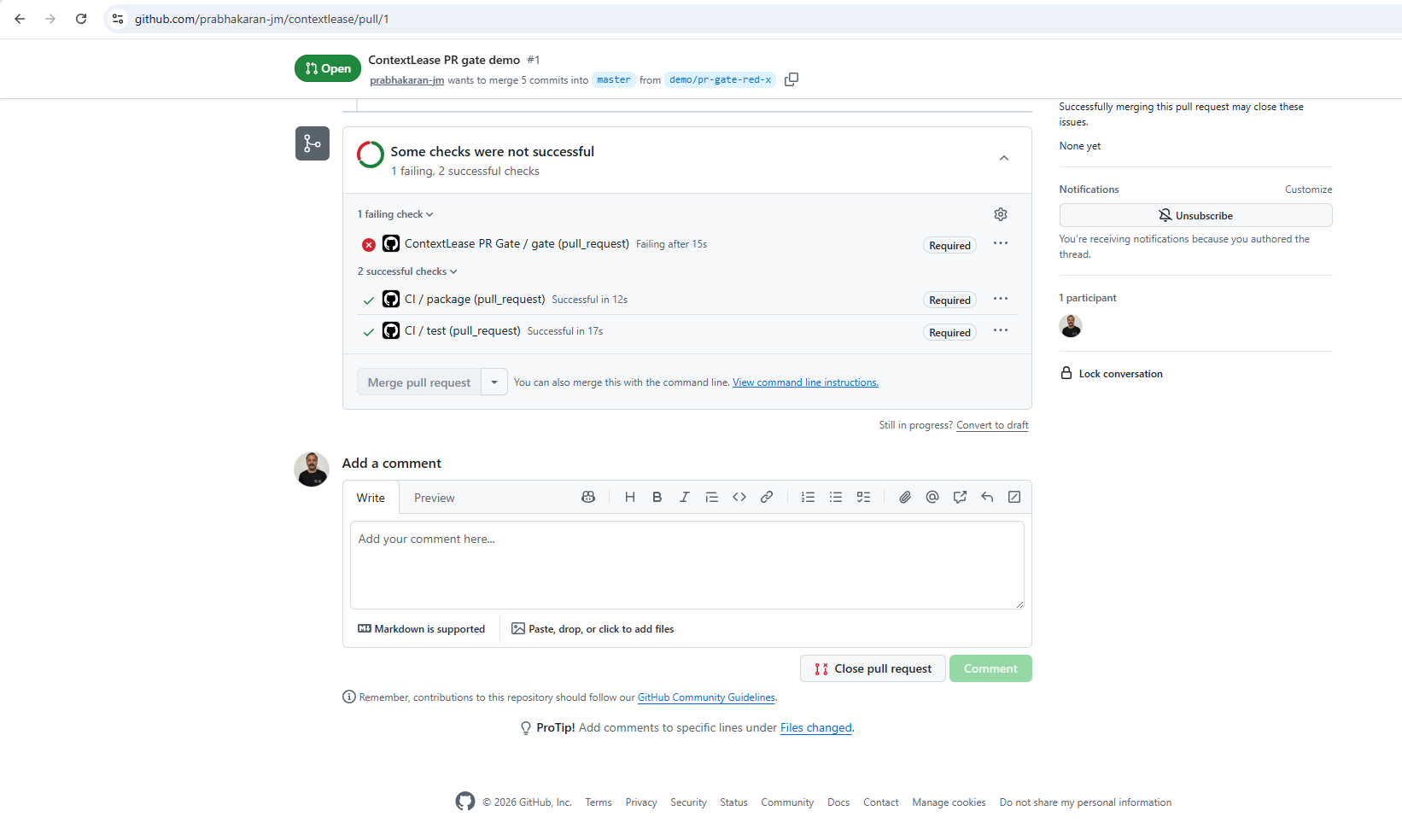
CI / test,CI / package, andContextLease PR Gate / gateas required checks — a drifted lease produces a real red X on a PR, not just a log line - Reusable composite GitHub Action (
.github/actions/contextlease-verify) — any repo can adduses: prabhakaran-jm/contextlease/.github/actions/[email protected]to a workflow today, not just this one - 91 tests, offline fixture path (
init-demo) for judges with no DataHub required — plus a.devcontainerso judges can open the repo in a GitHub Codespace and run the offline demo with zero local setup - Apache 2.0 licensed, per the hackathon's submission requirements
Challenges I ran into
- MCP vs GraphQL split: MCP gives the agent live context at generation; GraphQL gives ContextLease a deterministic, CI-grade re-check. Both are needed, for different reasons.
- Truthfulness in examples: Early docs described some fixture reports incorrectly; I fixed them and added tests so example leases match documented verdicts.
- Schema drift semantics: Had to extend the verifier beyond type changes to handle field add/remove and sensitive field tags without double-reporting.
- Field-level tags hide in a different place: a PII tag added to a column via the DataHub UI lands in
editableSchemaMetadata, not theschemaMetadatathe dataset-level tag diff already covered — missing this meant column-level sensitivity changes were silently invisible to the verifier until I found and fixed it. - GitHub PR gate + rulesets: Required status check names had to match exactly what Actions reports (
package,test,gatebound to GitHub Actions). Took several iterations to eliminate duplicate "Expected — Waiting for status to be reported" rows. - Live demo fragility:
agent-generateneeds Claude +uvx+ DataHub and takes minutes — the video uses real runs with honest cuts, not fabricated output.
Accomplishments that I'm proud of
- A novel, well-scoped problem with a clear "why not a linter" argument — the risk lives in metadata, not the diff
- Real DataHub integration depth: MCP generation, GraphQL lease/refresh, sibling merge, and write-back to the catalog
- Deterministic safety gate separated from I/O — same two snapshots always produce the same verdict
- Honest signal handling: never fabricates a signal DataHub doesn't actually expose — quality/freshness reports
unknownrather than guessing, and downstream lineage is documented as not-yet-captured rather than silently omitted - Rich demo artifacts: 20+ example files, live generation trace, red PR (drifted lease) and green PR (valid lease) for branch protection
- Production-shaped CI: test, package, and PR gate workflows with a reusable composite action
- Honest documentation: runbook, architecture docs, and a verifier hardened with schema add/remove rules validated by 91 tests
What I learned
- DataHub's value for agents isn't just "read metadata" — contributing back (write-back tags, visible blocks in the catalog) makes governance actionable for the next human or agent
- Determinism matters for merge-time safety: an LLM re-judging "is this safe?" would reintroduce the nondeterminism a lease is meant to eliminate
- Submission quality is as important as code: judges may watch the video and skim the repo without running Docker; clear verdict tables, offline quickstart, and stable CI check names matter
- GitHub rulesets bind to check-run names, not workflow display names —
integration_id: 15368(GitHub Actions) was the key to stable required checks
What's next for ContextLease
- Formal GitHub Marketplace listing for the existing
contextlease-verifycomposite action, so teams can discover and pin it without finding the repo first - Policy layer: org-specific severity overrides (e.g. column removed = hard block vs. warn)
- Broader artifact types: Spark SQL, Airflow DAGs, ingestion configs — same lease pattern
- Downstream lineage capture in leases (currently upstream only)
- DataHub OSS contribution: docs or a small skill for the merge-time lease pattern
- Optional hosted dashboard for decision records (static HTML prototype exists for judges)


Log in or sign up for Devpost to join the conversation.