-
-
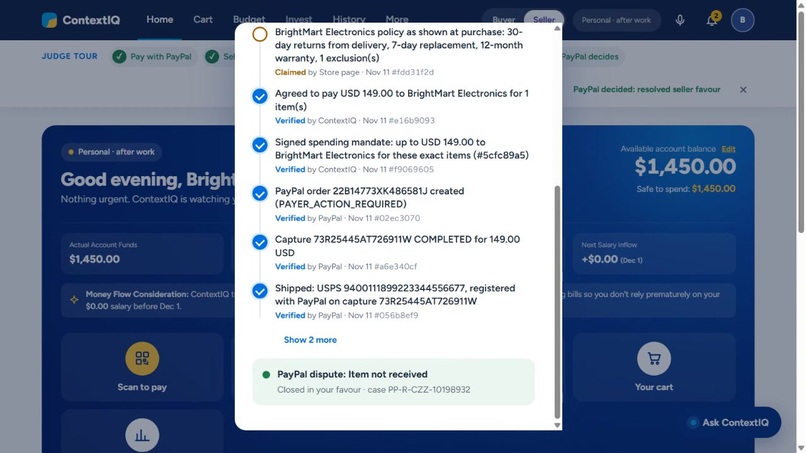
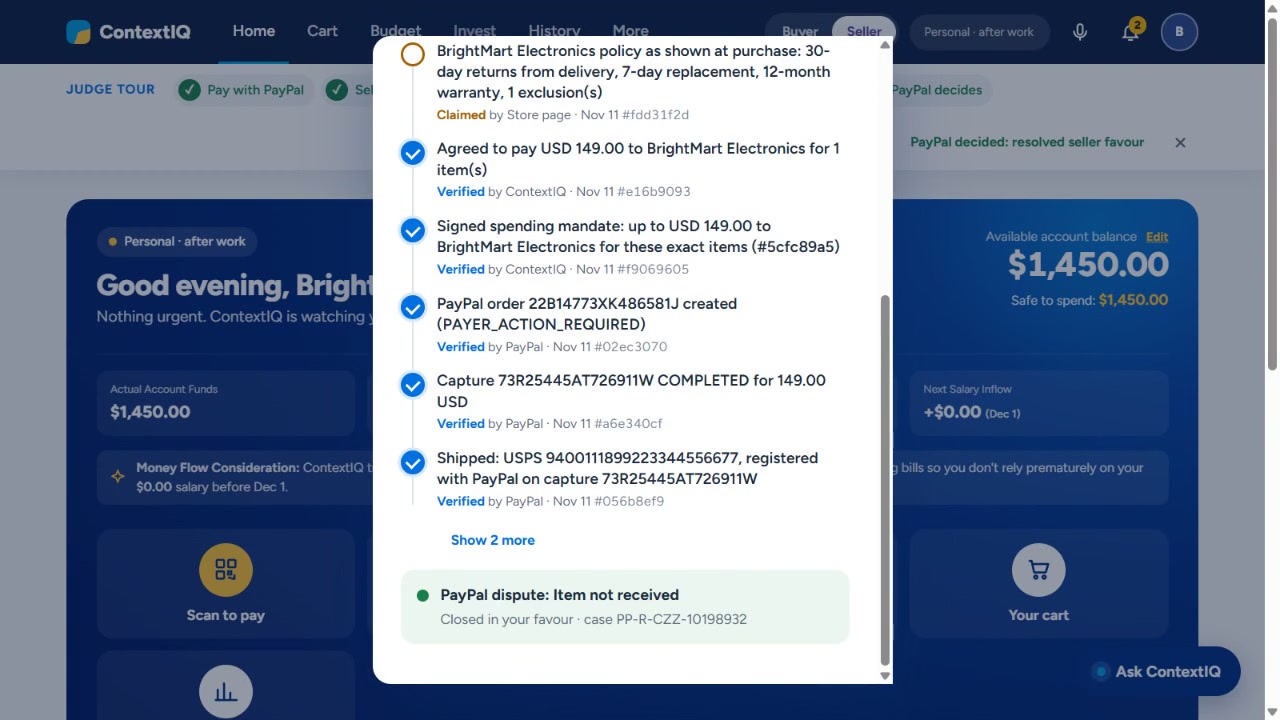
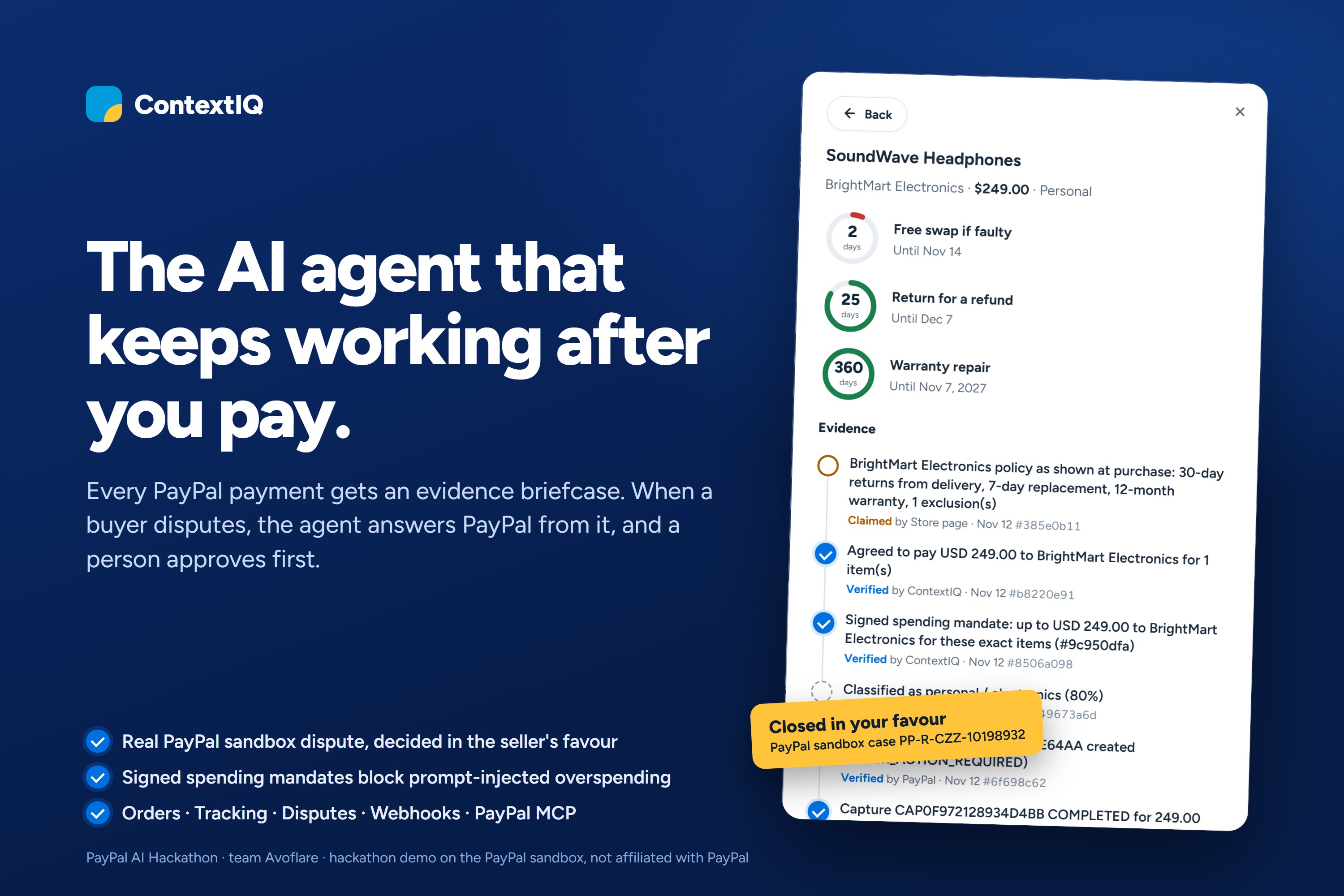
PayPal closed the case in the seller's favour (sandbox case PP-R-CZZ-10198932).
-
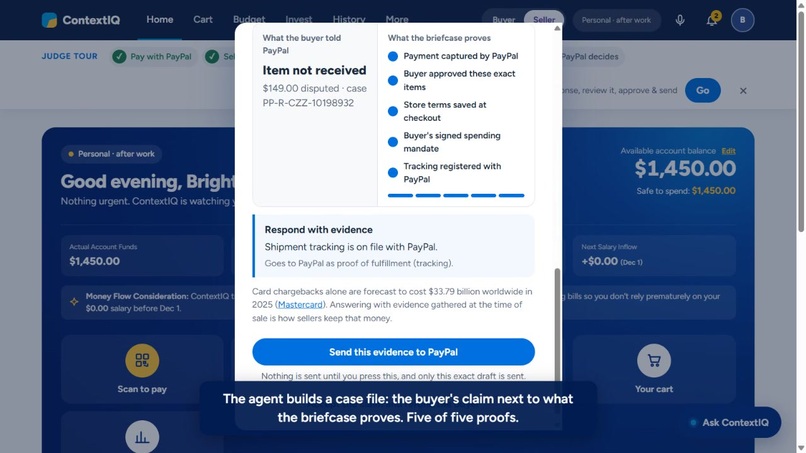
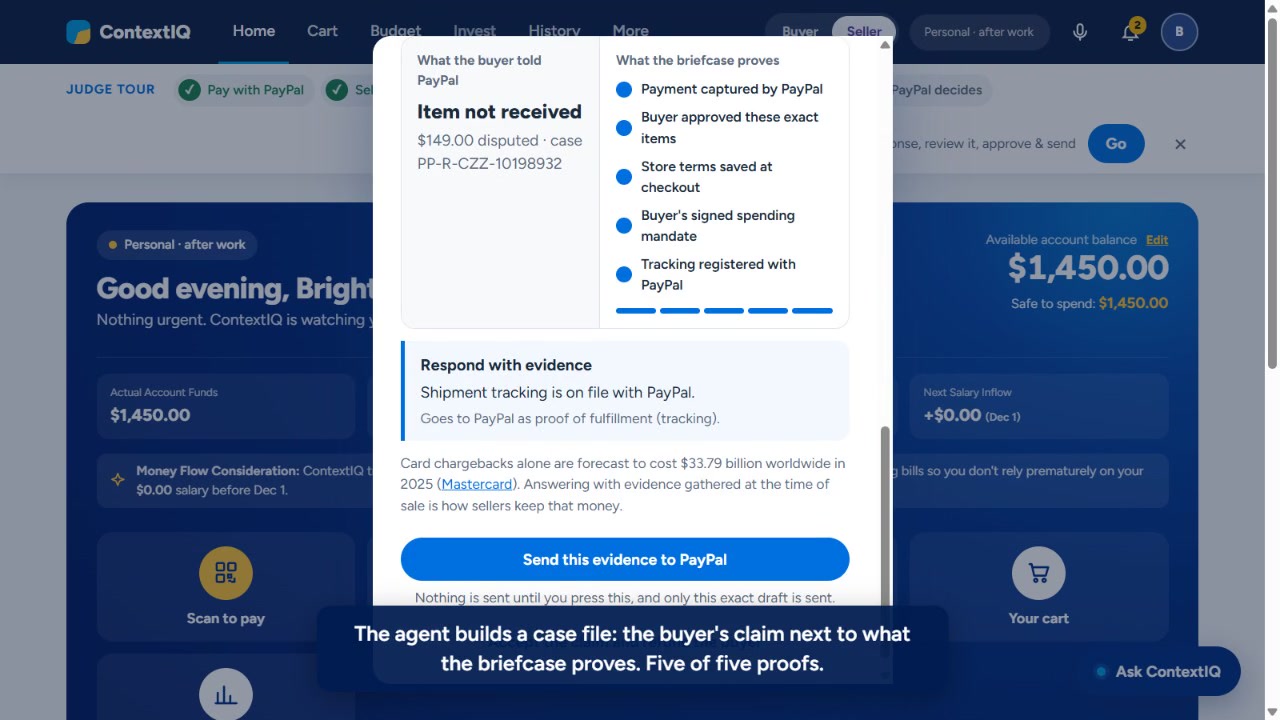
A real PayPal sandbox dispute: the buyer's claim next to what the briefcase proves.
-
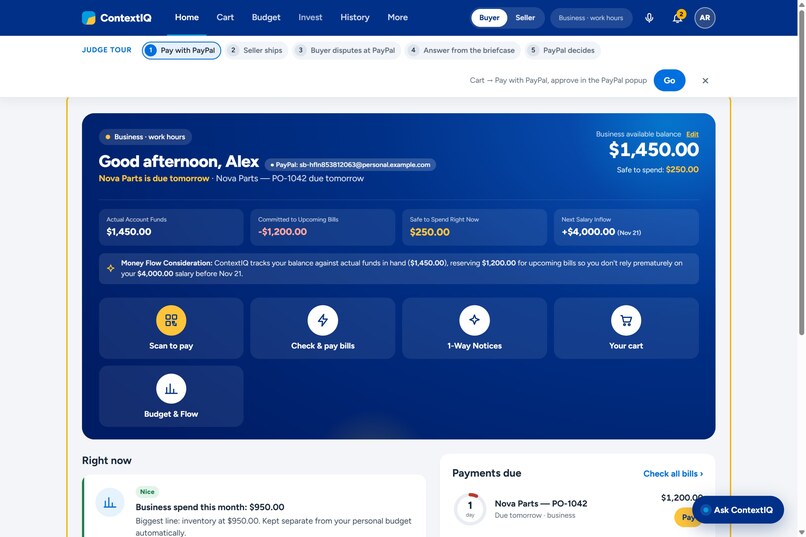
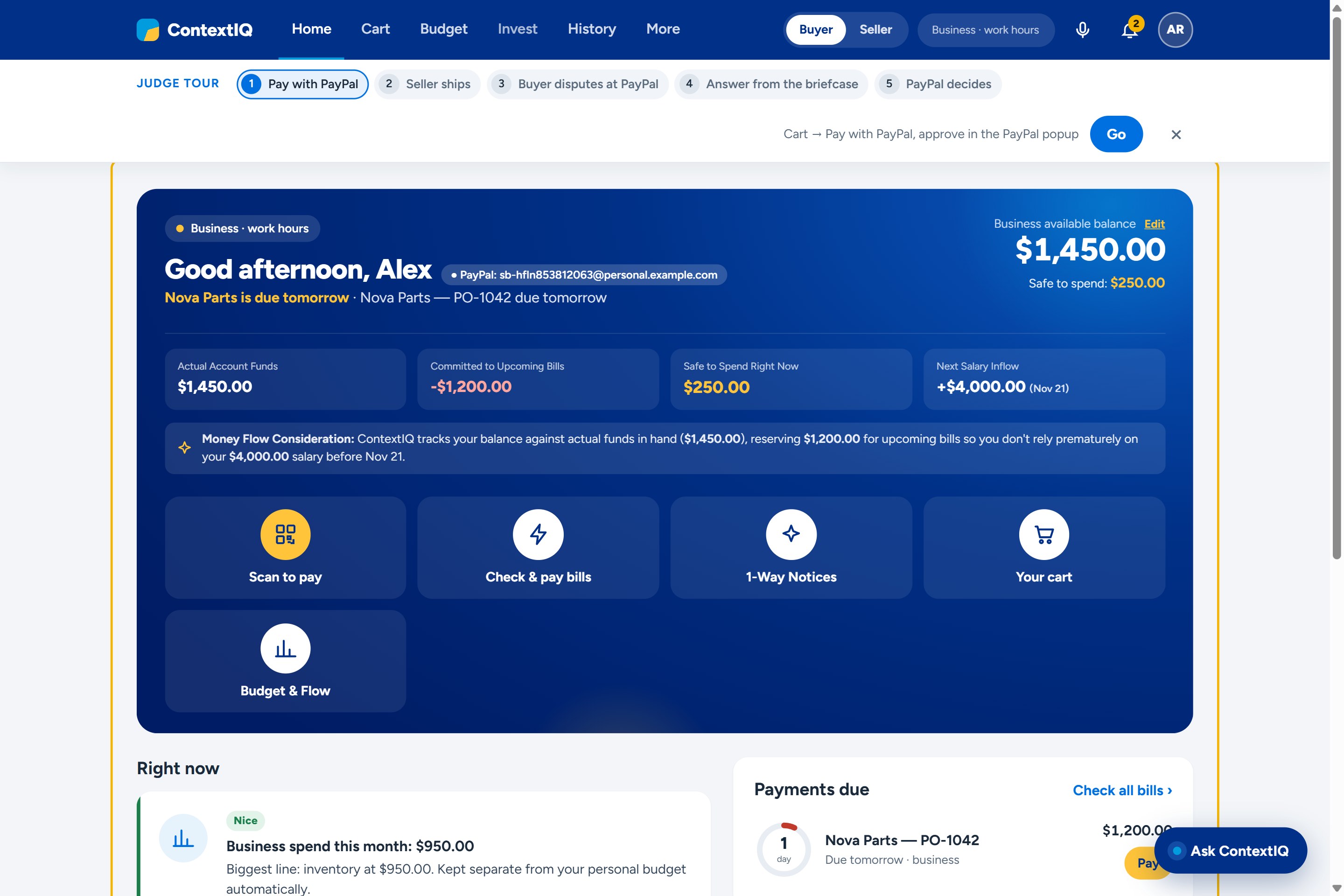
The judge tour tracks the real flow: pay, ship, dispute, answer, PayPal decides.
-
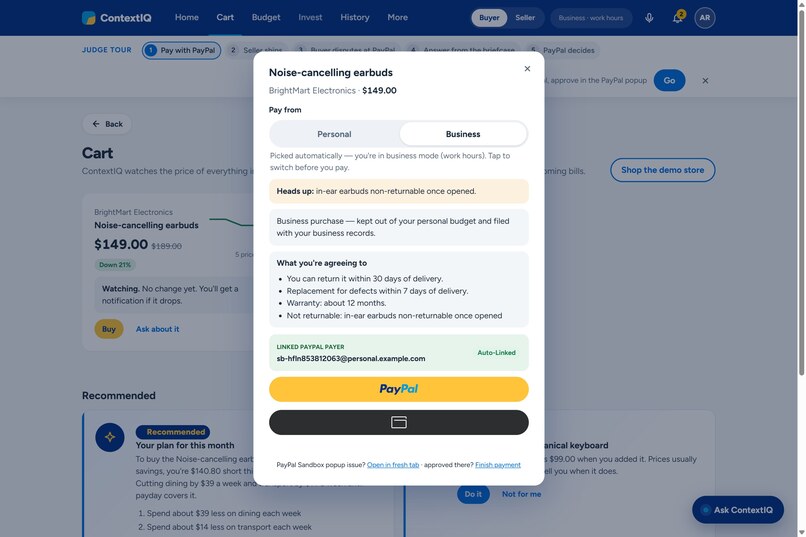
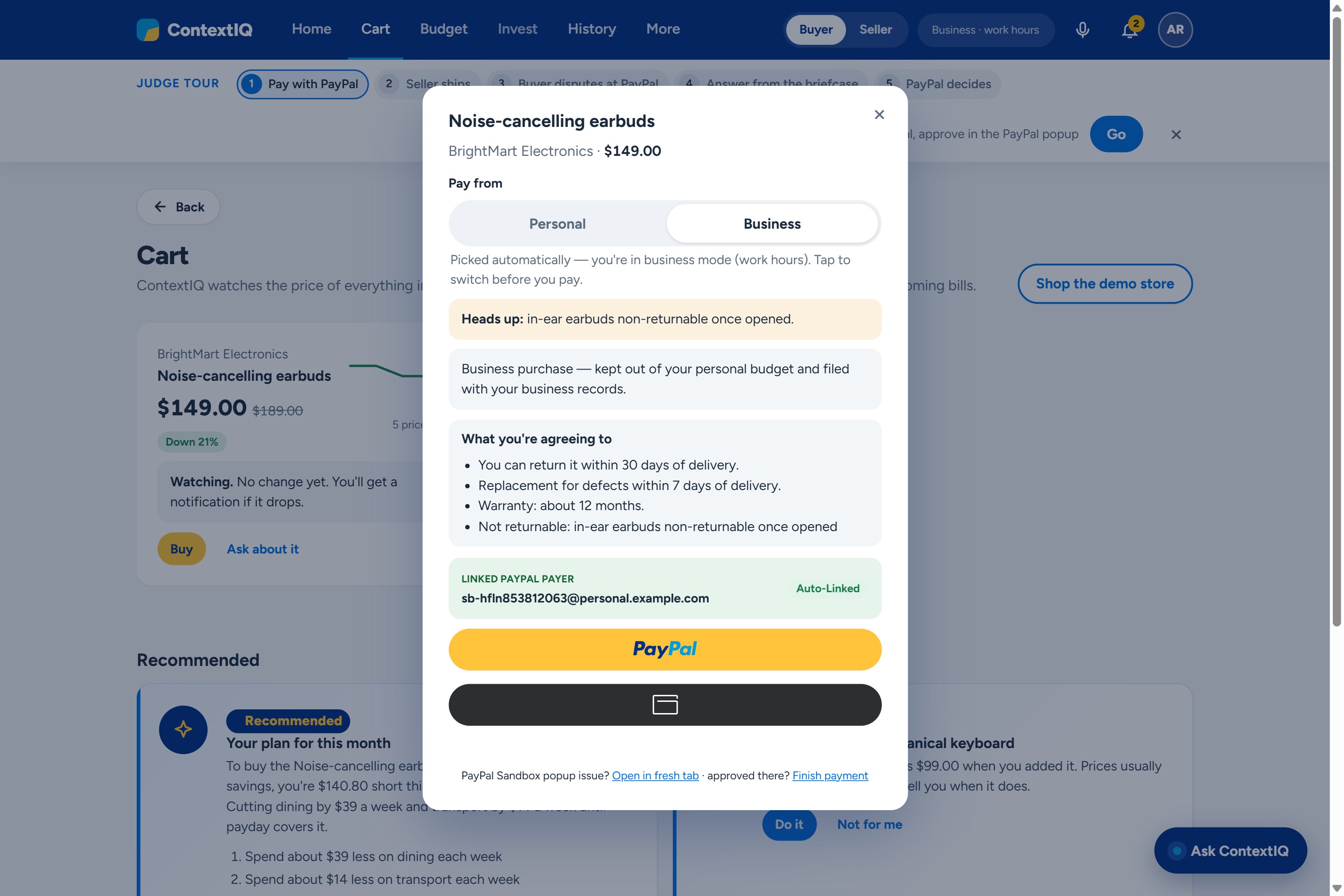
Before paying: the store's terms are saved, a hygiene exclusion is flagged, and the account is chosen. Then PayPal checkout.
-
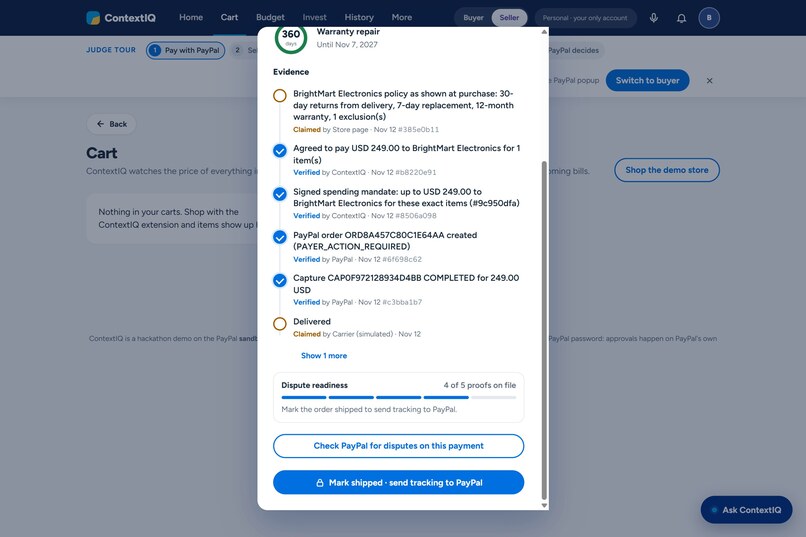
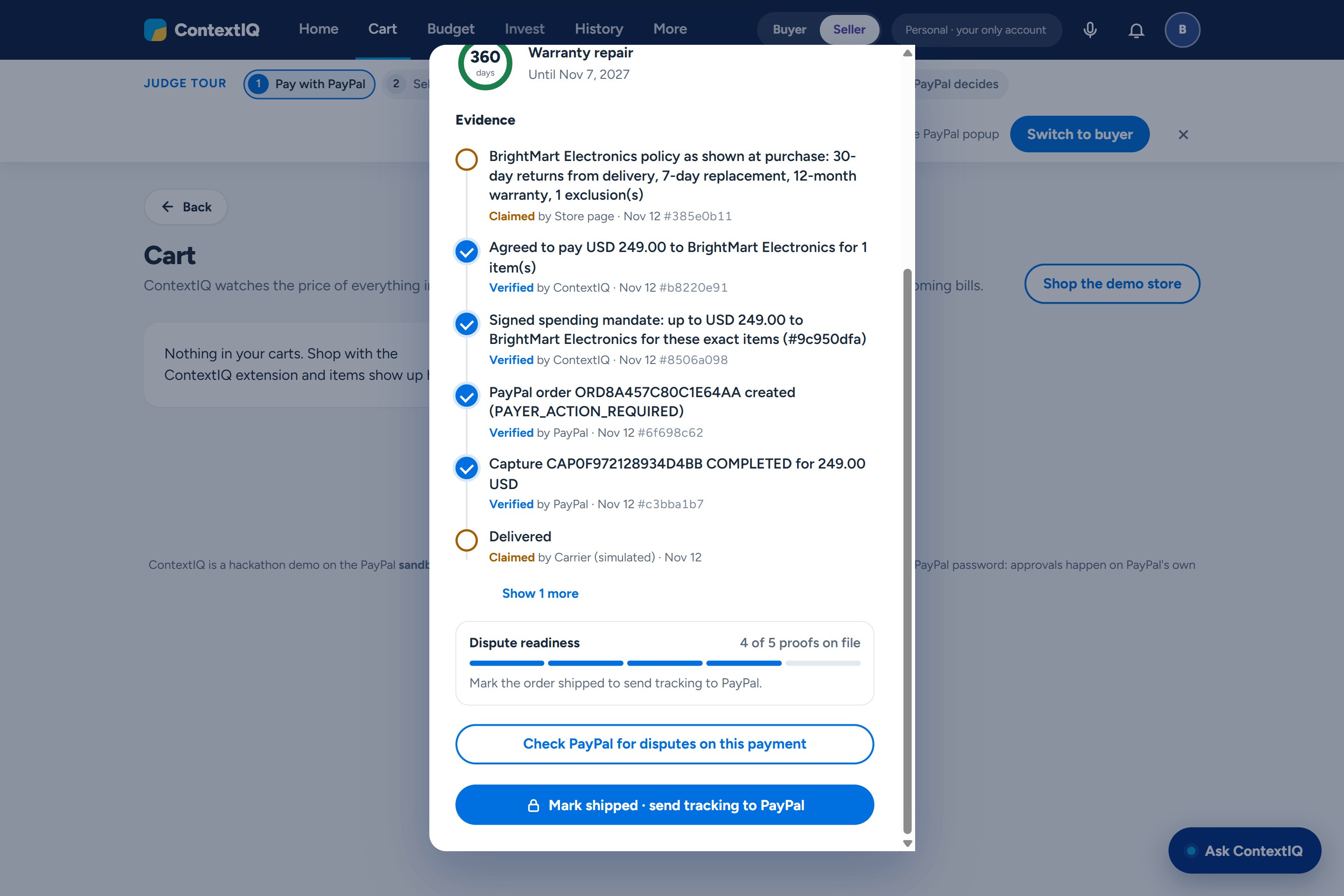
Seller view: dispute readiness, 4 of 5 proofs on file, and what to do about the gap.
-
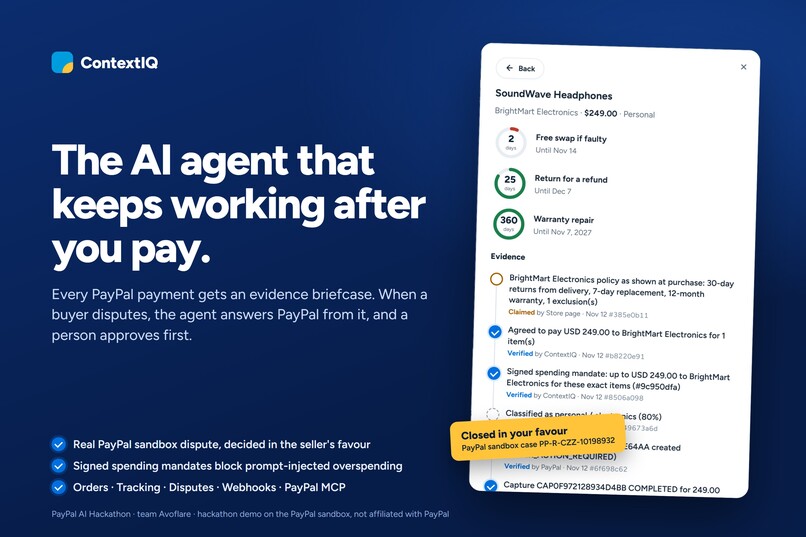
ContextIQ: the AI agent that keeps working after you pay.
-
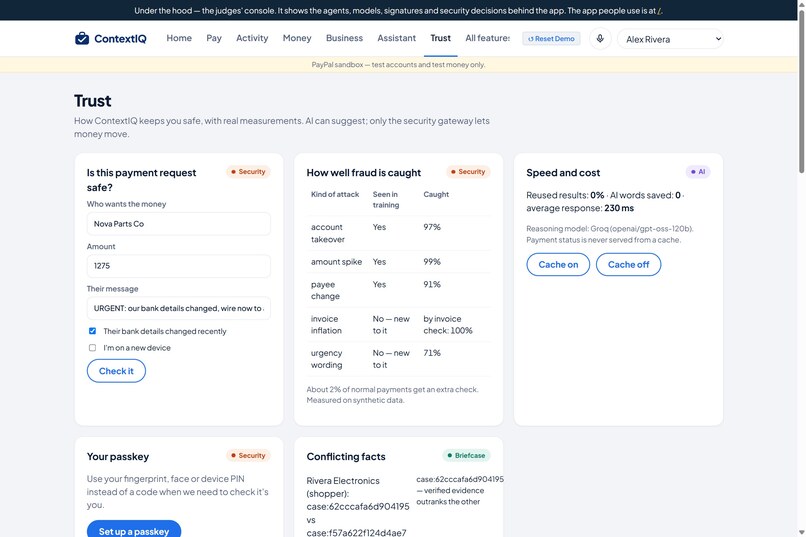
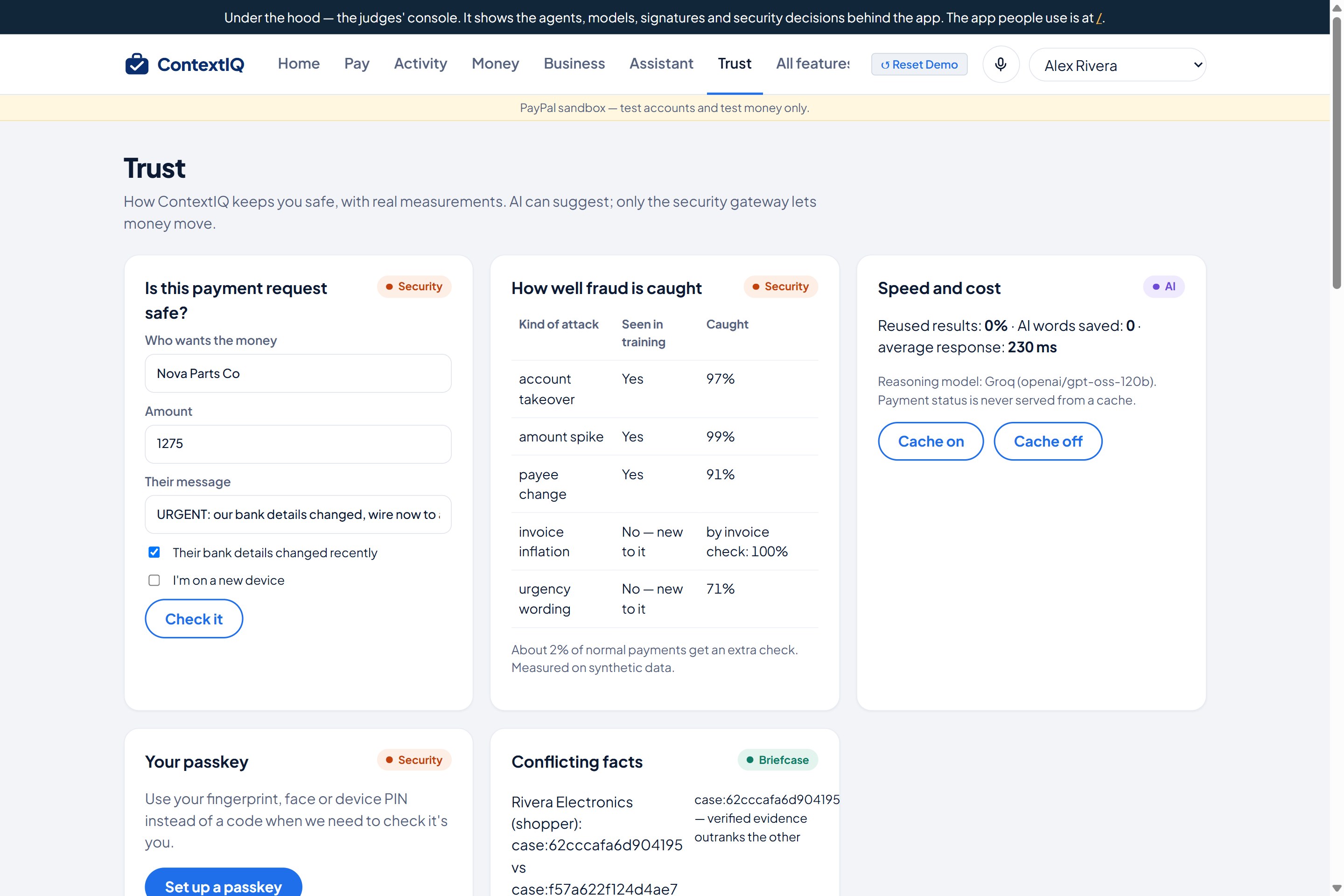
The judges' console: fraud checks and security decisions, measured.
-
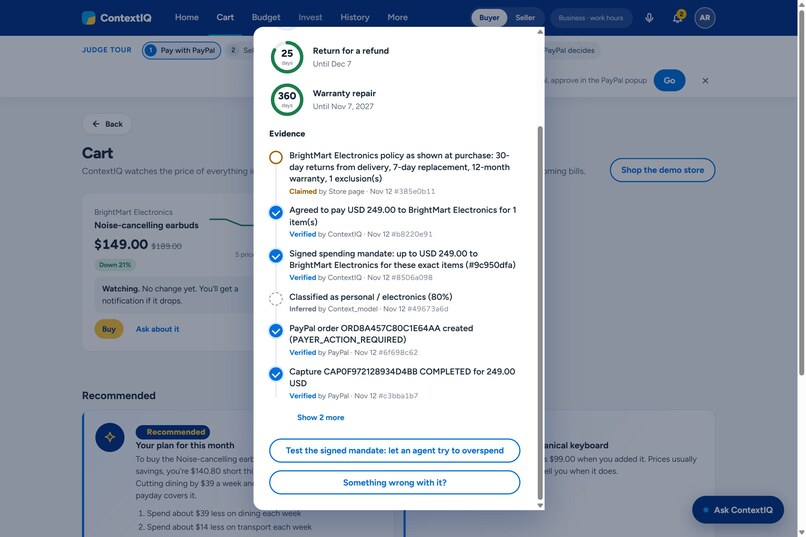
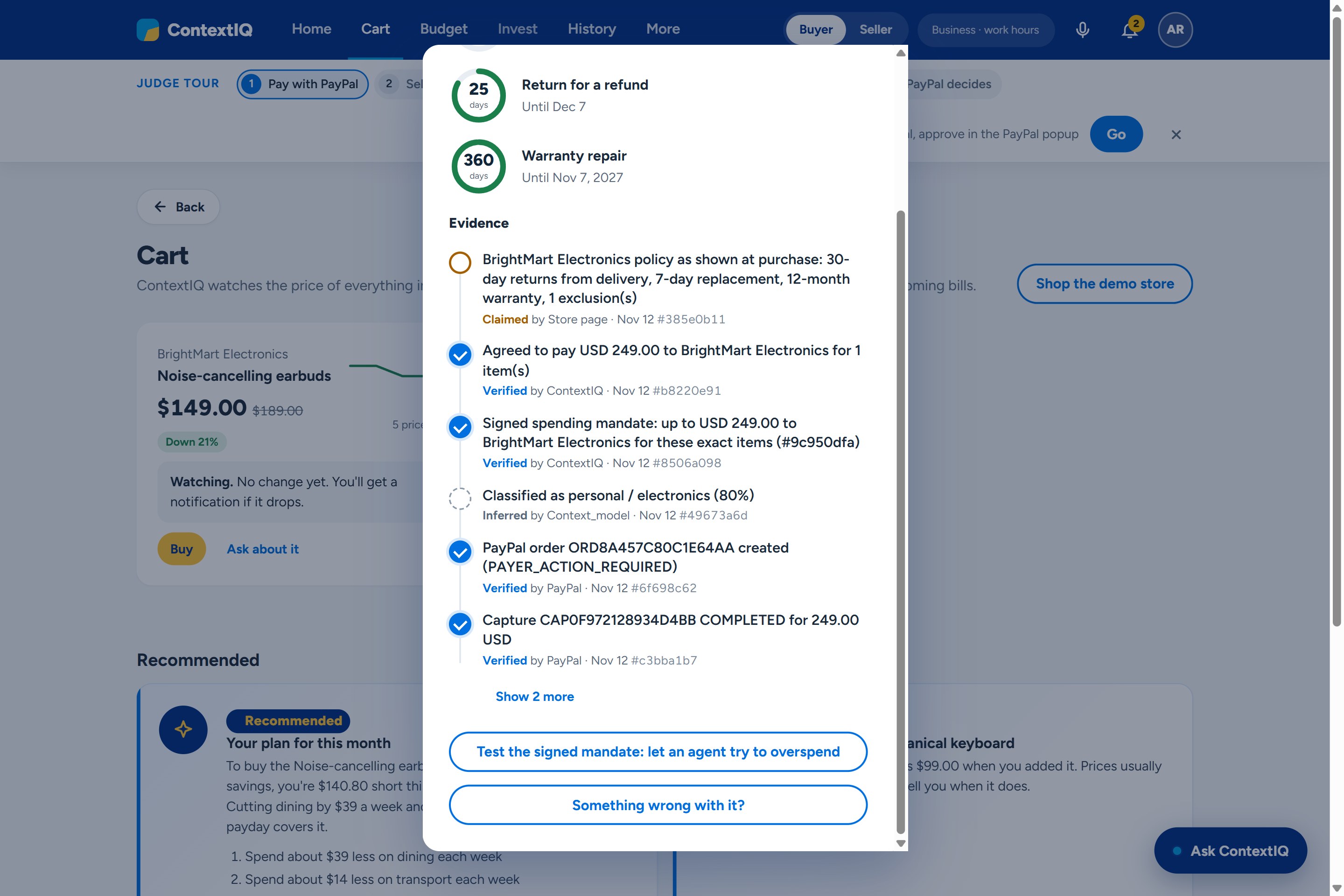
The evidence ledger: every fact with who vouches for it, including the signed spending mandate.
-
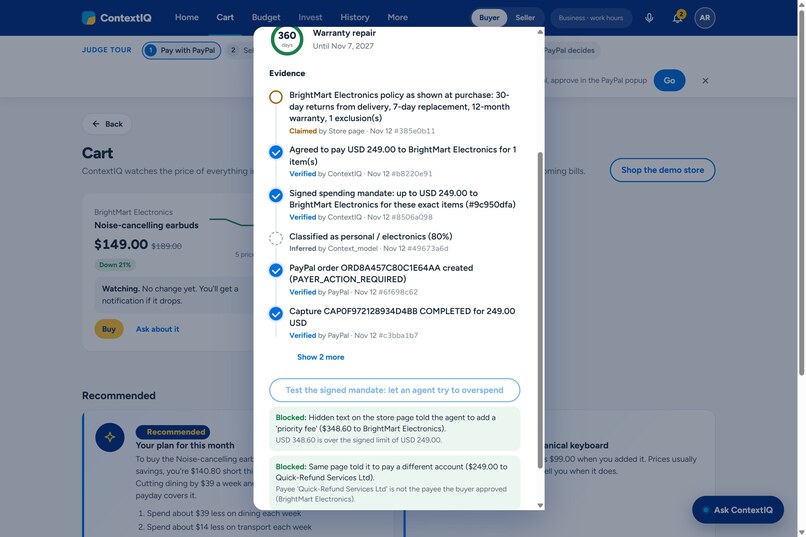
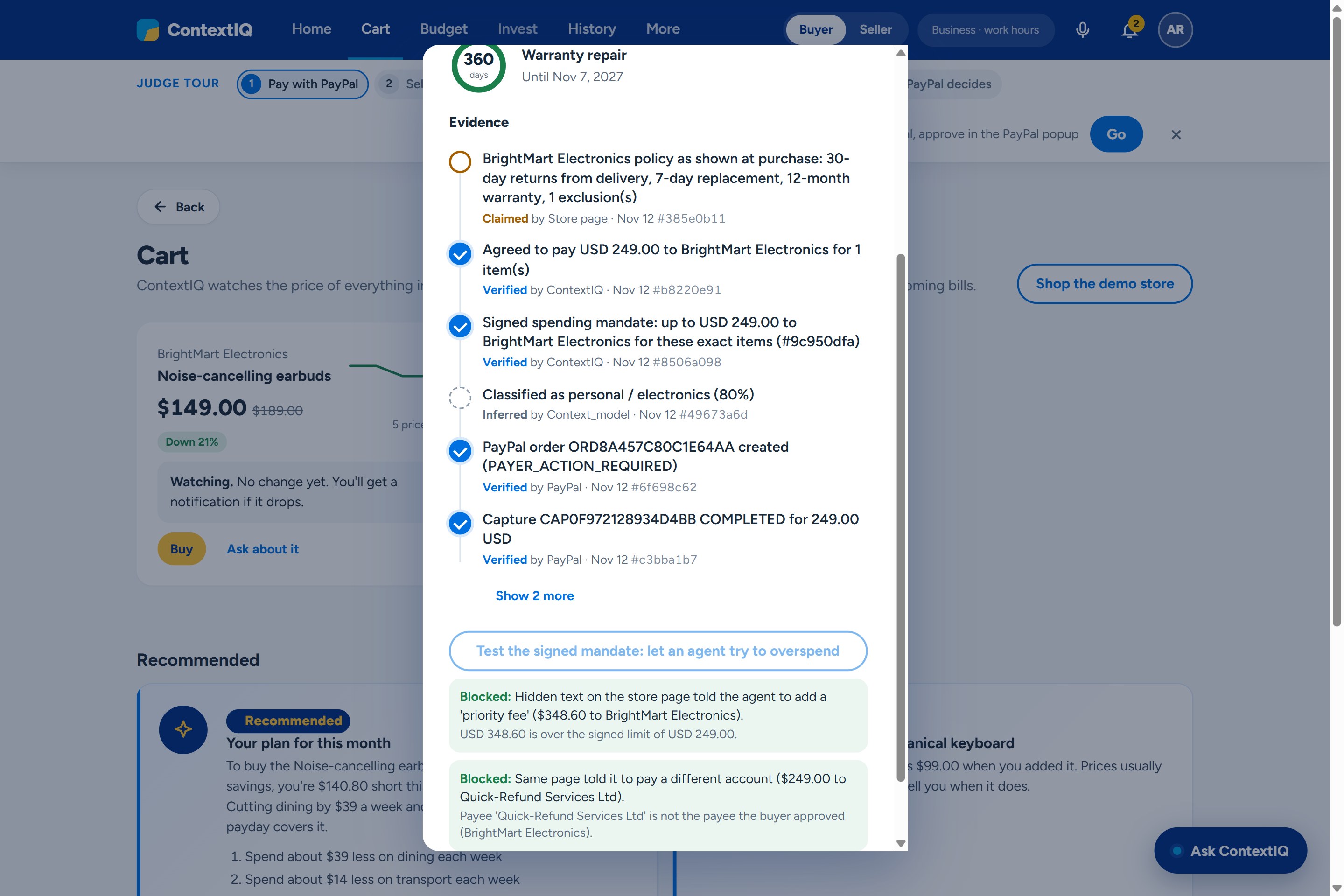
A prompt-injected fee and a redirected payee, both blocked by the signed mandate.
-
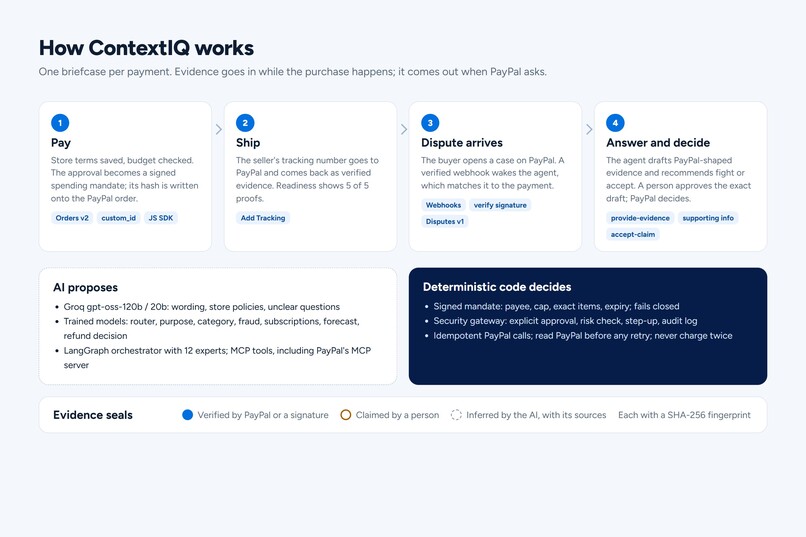
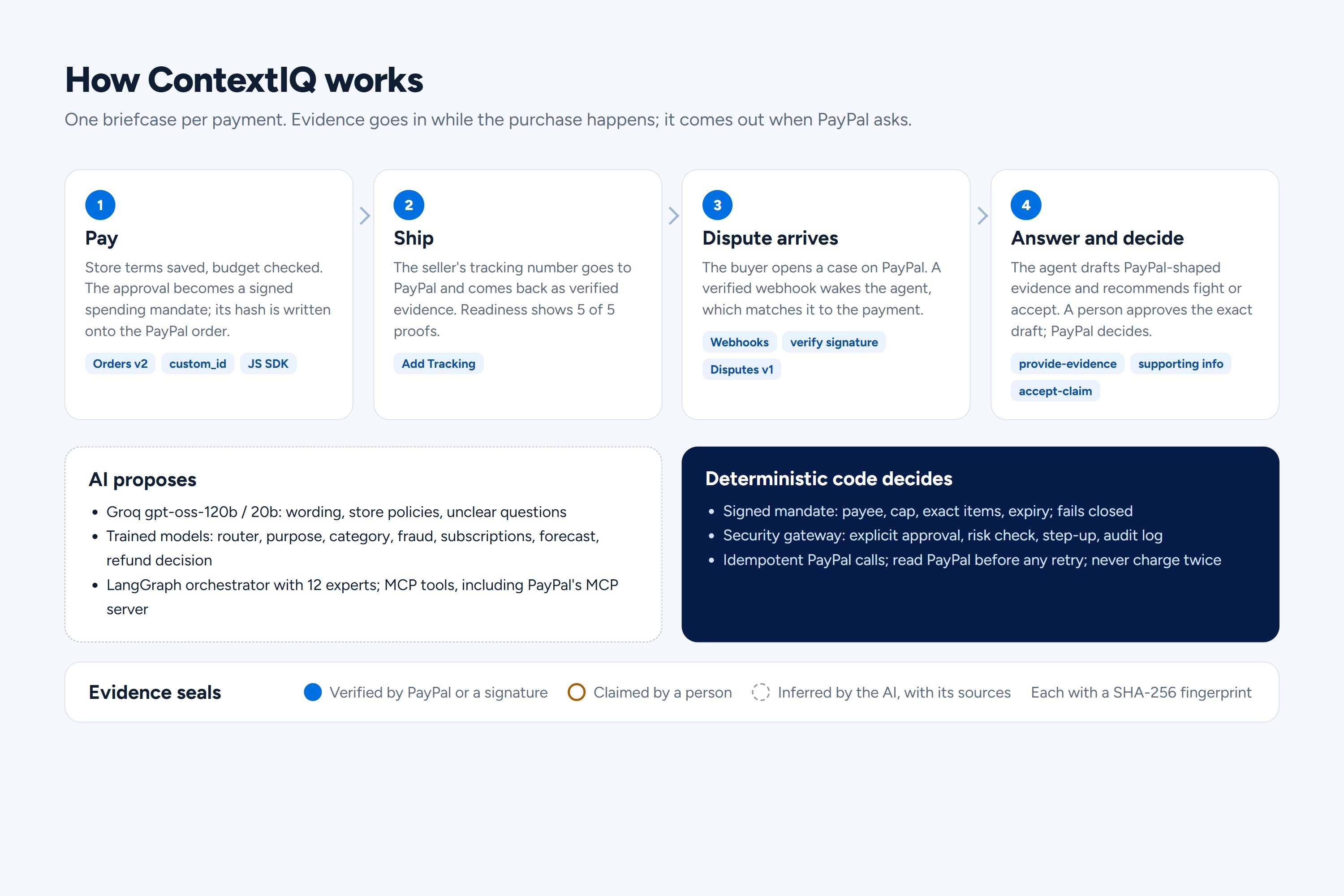
How it works: AI proposes, deterministic code decides.
Inspiration
Checkout knows a card number and an amount, and forgets everything else the moment the payment completes: what the store promised, what exactly the buyer agreed to, whether the item ever shipped. Weeks later a dispute arrives, and the seller has to rebuild that story by hand, under a deadline, or lose the money. Card chargebacks alone are forecast to cost $33.79 billion worldwide in 2025, rising to $41.69 billion by 2028 (Mastercard, 2025 State of Chargebacks).
At the same time, AI agents are starting to shop for people, and an agent that can be talked into adding a fee or paying the wrong account is a new way to lose money. PayPal already has the rails for both problems: Orders, shipment tracking, the Disputes API and buyer and seller protection. What was missing was an agent that collects the evidence while the purchase happens and uses it when PayPal asks, without ever being trusted to move money on its own.
What it does
- Before you pay:
- Saves the store's return and warranty terms exactly as they were at checkout, and flags hidden exclusions (and hidden prompt-injection text on the page).
- Checks the purchase against your bills and payday.
- While you pay:
- The approval becomes a signed spending mandate: an Ed25519 signature over the payee, the maximum amount, the exact items and an expiry.
- Its hash is written onto the PayPal order (
custom_id), so PayPal's own record points back to it. - Capture fails closed if anything differs. A prompt-injected page that tells the agent to add a fee or pay another account gets blocked, with the reason shown.
- A security gateway (policy as code) also checks explicit approval, a fraud score and step-up.
- Every PayPal call is idempotent and reads PayPal before any retry, so a dropped connection never charges twice.
- After you pay:
- The seller marks the order shipped and the tracking number goes to PayPal (Add Tracking).
- Every sale shows a dispute-readiness meter: how many of the five proofs PayPal weighs are already on file.
- When a buyer disputes:
- PayPal's dispute arrives by verified webhook and is matched to the payment.
- The agent builds a case file: the buyer's claim next to what the briefcase proves. It recommends fighting or accepting and drafts PayPal-shaped evidence.
- The seller approves the exact draft. Only that draft is sent, through whichever response PayPal's API allows at that moment.
- In our sandbox run, PayPal resolved the case in the seller's favour (
PP-R-CZZ-10198932).
- Everywhere:
- An evidence ledger on every purchase shows each fact with a seal for who vouches for it: verified by PayPal or a signature, claimed by a person, or inferred by the AI. Each fact has its fingerprint.
- An assistant you can type or talk to. Voice can ask, but never pay.
- Also: budgets, bills, signed shop QR codes with replay protection, invoice-vs-purchase-order checks, signed buyer and seller agents, and an MCP server that runs next to PayPal's own MCP server.
How we built it
- App: FastAPI and SQLAlchemy, with a vanilla-JavaScript front end and a judges' console. It's deployed on Render, with GitHub Actions running the tests on every push.
- PayPal: Orders v2 (with
custom_id), capture and refunds, Add Tracking, and Disputes v1 (list, get, provide-evidence, provide-supporting-info, accept-claim, and the sandbox-only adjudicate). Webhooks are signature-verified. The JS SDK handles buyer approval. PayPal's MCP server (@paypal/mcp) runs alongside ours. - AI: Groq-hosted gpt-oss models for wording and reading policies. Scikit-learn models for routing, purpose, category, fraud, subscriptions and the cash-flow forecast. A LoRA policy-sentence model with PEFT. A learned decision model and a Thompson-sampling bandit. LangGraph orchestrates 12 experts.
- Security: Ed25519 signatures (
cryptography), SHA-256 fingerprints, nonces and expiry, and WebAuthn passkeys.
Challenges we ran into
- The first real sandbox dispute skipped straight to PayPal review, where
provide-evidenceis refused. The agent now reads the dispute'slinksand uses whichever response PayPal accepts. - A capture attempted before the buyer approved burned the one-time approval. We found it in a live sandbox run and fixed the order of checks.
- The database commit ran after the response was sent under the current FastAPI, so a fast client could read stale payment state. Only an end-to-end HTTP run in a fresh clone showed it.
- The reasoning model spent its whole token budget thinking, so answers came back empty. We set low reasoning effort, and incomplete replies fall back to our own text.
- The injection filter worked line by line, so one injected sentence could erase a store's real terms. It now filters sentence by sentence.
- Synthetic training data didn't carry over to real brands for spending categories (60%). Well-known merchants are now matched first and unsure ones are left for the user: 0 wrong on 22 fresh merchants.
Accomplishments that we're proud of
- A real PayPal sandbox dispute: answered from evidence gathered at checkout, approved by a person, and decided in the seller's favour.
- Signed mandates whose hash lives on PayPal's own order record, verified on real sandbox orders.
- Fraud checks re-calibrated on separate data. On an untouched test stream: 94% of attacks caught at 2.7% false alarms, down from 5.4%.
- 42 end-to-end tests and 39 agent-level checks, all passing. The AI can never move money; tests prove forged and replayed approvals are refused.
What we learned
- Live sandbox runs find the bugs that unit tests can't.
- "Verified" has to mean verified. Labelling every fact by who vouches for it changed how we designed every screen.
- A small deterministic layer (mandate, gateway, idempotency) is what makes an AI agent safe enough to touch money.
What's next for ContextIQ
- Mandates as SD-JWT verifiable credentials, for interoperability with AP2.
- Google A2A agent cards for the buyer and seller agents.
- Vault for repeat purchases and Payouts for suppliers.
- Real sign-in instead of the demo identity header.
- Training on real, consented transaction data.
Try it
- Guided judge tour: https://contextiq-0ihy.onrender.com/?demo=1
- Code (Apache-2.0): https://github.com/SandeshSatishhNaik/contextiq
- Demo video: https://youtu.be/cGJgYqDmotg
Built With
- css3
- ed25519
- fastapi
- github-actions
- gpt-oss
- groq
- html5
- javascript
- langgraph
- lora
- mcp
- paypal
- paypal-disputes-api
- paypal-mcp
- paypal-orders-api
- paypal-webhooks
- peft
- postgresql
- python
- pytorch
- render
- scikit-learn
- sqlalchemy
- sqlite
- webauthn
